Services
Enterprise Solutions

Accelerate Enterprise Digital Transformation for Sustainable Change
Highlights
- Organisations have traditionally employed various implementation frameworks and methodologies for human resources (HR) transformations, but they are now being outpaced by artificial intelligence (AI).
- Integrating AI, generative AI (GenAI), and agentic AI into each phase of the framework accelerates the time to market, reduces risks, enhances quality, and boosts customer satisfaction by enabling smarter and more efficient outcomes.
- HR leaders should integrate AI into their transformation road maps with proper data governance to foster an AI-ready culture and nurture sustainable innovation.
In this article
OVERVIEW
The key to turning challenges into opportunities lies in leveraging a strong, adaptable existing implementation framework that artificial intelligence (AI) can accelerate and elevate.
As enterprises embrace agility and innovation in their human resources (HR) strategies to better navigate a shifting global environment, AI can enhance and accelerate each phase of their human capital management (HCM) implementation What enterprises need is a framework that can help them realise the tremendous benefits of an AI-enhanced HCM function with an intelligent, human-centric choice architecture.
CHALLENGES
HCM is undergoing an AI-led shift as organisations strive to build agile, intelligent, and people-centric HR capabilities.
These capabilities will address challenges like talent scarcity, high turnover, low productivity, and the demand for better employee experience. The deployment of these HR capabilities though large-scale cloud HCM implementations can at times be complex and lengthy.
Enterprises and their system integrators (SIs) are now striving to leverage AI, including generative AI (GenAI), and agentic AI to make HCM implementations efficient, simpler, faster, and cost-effective.
APPROACH
An AI-enabled transformation delivery approach during implementation can elevate HR transformation outcomes and reduce the time to market.
Such a framework can help enterprises infuse intelligence into every phase of HCM transformations to provide faster, smarter, and more cost-effective delivery. Figure 1 provides an overview of the AI layer integrating into HCM transformation to ensure on-time, on-budget delivery aligned with business goals.
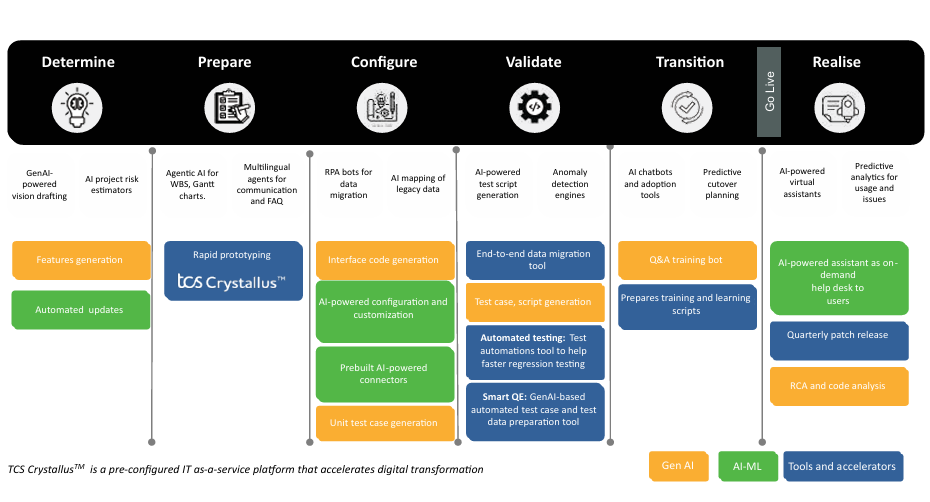
Figure 1: AI-accelerated HCM deployment
Figure one describes the six phases of HCM deployment cycle and their role in HCM transformation, to ensure on-time, on-budget delivery aligned with business goals.
Figure 1: AI-accelerated HCM deployment
Framework
Our suggested AI-embedded transformation framework is a six-phase approach to accelerate an intelligent, cost-effective, and innovative implementation.
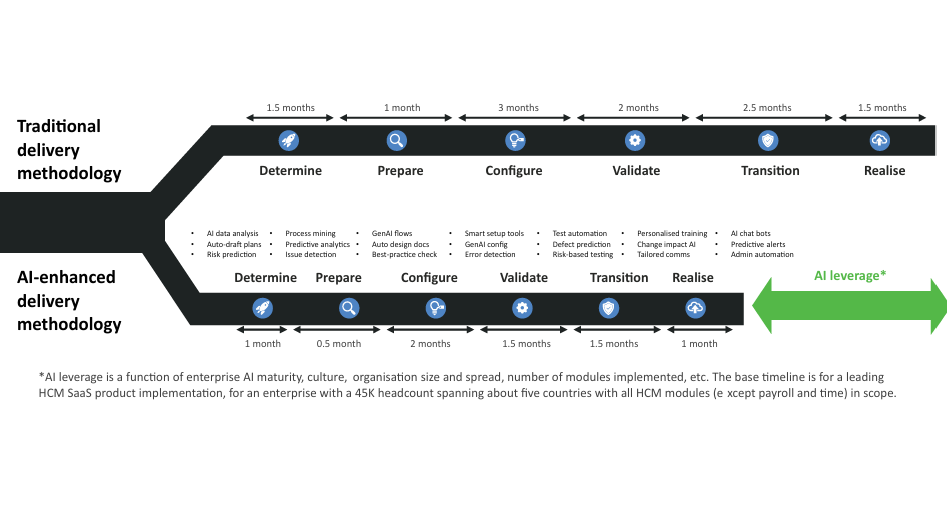
Figure 2: AI improves HCM lifecycle duration
Figure two graphically illustrates the difference between the timeline and lifecycle of a traditional framework and the same for an AI-enhanced framework.
Figure 2: AI improves HCM lifecycle duration
Phase 1: Determine
The ‘determine’ phase is where the transformation vision is defined and the foundation is laid for a successful implementation. Here, the identified stakeholders establish the project’s vision, scope, and business case, including value realisation and transformation road map.
AI can significantly strengthen the ‘determine’ phase by providing data-driven insights for decision-making.
- AI-powered analytics tools can correlate HR data (attrition rates, engagement scores, skills gaps) with external benchmarks to pinpoint areas of greater need or opportunity.
- AI-based project management assistants can analyse past projects to predict risk factors or optimal timelines, improving planning accuracy for road map creation.
- GenAI tools (like large language model (LLM) assistants) can help draft vision statements, stakeholder communications, and initial solution outlines by drawing on vast repositories of HR best practices.
By leveraging AI in this upfront phase, leaders can save about 70% of time on initial visioning and planning activities.
Phase 2: Prepare
In the ‘prepare’ phase, the team plans the project’s overall approach, controls, budget, tools, resources, and scheduling to support efficient project execution. Traditionally, these tasks are labour-intensive and require the creation of a programme charter, tools, project plan, risk management, and communication plan. AI simplifies these tasks.
- GenAI auto-generates draft charters, templates, and success metrics based on company size, industry, transformation goals, and insights derived from reports. Pre-built templates can include scope, guiding principles, success metrics, and timeline.
- Gen-AI can create workshop agenda, slide decks, success narratives, and talking points while simulating frequently asked questions (FAQs) and stakeholder resistance to facilitate preparation.
- Agentic AI can build work breakdown structures (WBS), timelines, and milestones. Gantt charts can be autogenerated and updated dynamically based on scope and dependencies. Agentic AI can also generate side-by-side comparison metrices and cost-benefit analyses.
- AI can estimate resource allocations, flag potential bottlenecks, and provide risk registers using past HCM project datasets and implementation patterns.
- Multilingual agents can tailor content for different regions and functions. Agents can also auto-generate communications, calendars, FAQs, and announcement drafts. Additionally, AI can build, distribute and analyse digital readiness surveys across business units.
Phase 3: Configure
After the familiarisation and prototype workshops are conducted, the team configures the instance, develops any necessary integrations or extensions, migrates data, and sets up workflows and security roles during the ‘configure’ phase. Traditionally, this phase demands significant manual effort and is often the longest.
AI and automation can significantly accelerate configuration and reduce errors with the following enhancements:
- Intelligent robotic process automation (RPA) bots can handle repetitive tasks like data migration—extracting, transforming, and loading employee records from legacy systems into the new HCM application with minimal human intervention.
- Machine learning can assist in mapping and reconciling data (eg, automatically matching old job codes to new job frameworks).
- AI-powered development assistants (such as code-generation tools) can help developers write integration scripts or extensions faster by suggesting code snippets and detecting potential issues.
- Many modern HCM platforms also embed AI to auto-configure certain elements; for example, an AI engine might recommend security roles based on analysis of job profiles.
- About 25% time can be saved in the configure phase with AI agents.
Phase 4: Validate
The purpose of the ‘validate’ phase is to conduct an end-to-end review of the final solution, including any adjusted configurations, integrations, extensions, and legacy data. Traditionally, validation is resource-intensive: test scripts are written manually, large volumes of test data must be prepared, and testers execute many repetitive test cases across the system integration and user acceptance testing instances.
During this phase, AI can provide the following enhancements:
- AI test automation frameworks can generate and maintain test scripts automatically. For example, machine learning algorithms might examine application usage patterns to prioritise critical test scenarios or auto-generate test cases based on requirements written in natural language.
- AI-driven test tools can perform self-healing of test scripts when minor changes occur, so that tests don’t break with each configuration tweak. This reduces manual efforts for test maintenance.
- Intelligent quality analysis (QA) through anomaly detection algorithms can skim through test results to spot patterns of failures or underlying system bugs faster than a human might.
In the testing phase of the implementation cycle, enterprises can embed AI in all the activities for potential time savings of about 45%.
Phase 5: Transition
The ‘transition’ phase is when the HCM solution goes live in production. Key activities in this phase include final data migration (cutover), switching over processes to the new system, training end-users, and ensuring business continuity during the transition. Traditionally, deployment and training involve extensive in-person support, helplines, and manual monitoring of issues during the go-live ‘hypercare’ period. Here’s how AI can help:
- AI de-risks deployment and boosts adoption through digital adoption platforms and chatbots. Intelligent in-app guides and virtual HR assistants answer user queries and offer walkthroughs, easing helpdesk loads.
- During cutover, AI-based scheduling tools can help plan the sequence of technical tasks for minimal downtime, and anomaly detection can monitor system health to catch issues early.
- AI can save 40-70% time on activities around cutover plan, including system downtime, data loading, and system activation.
Phase 6: Realise
After go-live, the ‘realise’ phase focusses on ongoing operations and enhancements to maximise value. In this phase, AI truly shines by enabling continuous learning and improvement with the following enhancements:
- AI-powered virtual assistants can serve as tireless support agents for employees and managers, handling routine inquiries (like policy questions or system navigation help) so that human HR staff focus on complex issues.
- AI assistants can resolve many tickets, deliver high return on investment (ROI) by streamlining service, and save staff time.
- AI tools constantly monitor system performance and user behaviour. Predictive analytics can alert HR IT to potential issues, for instance, spotting an unusual drop in system logins that might indicate a user adoption issue, or predicting when a new module might hit capacity threshold.
We see up to a 40% reduction in time for application management services (AMS) projects with innovation and opportunities for efficiencies through AI.
Below (see Figure 3) is the representation of key project activities by their impact on implementation quality/timeline (vertical axis) and the degree of AI leverage (horizontal axis). For eg. Activities in the top right quadrant (“Off the shelf accelerators”) combine high AI leverage with strong positive impact, such as AI chatbots and predictive cutover planning.
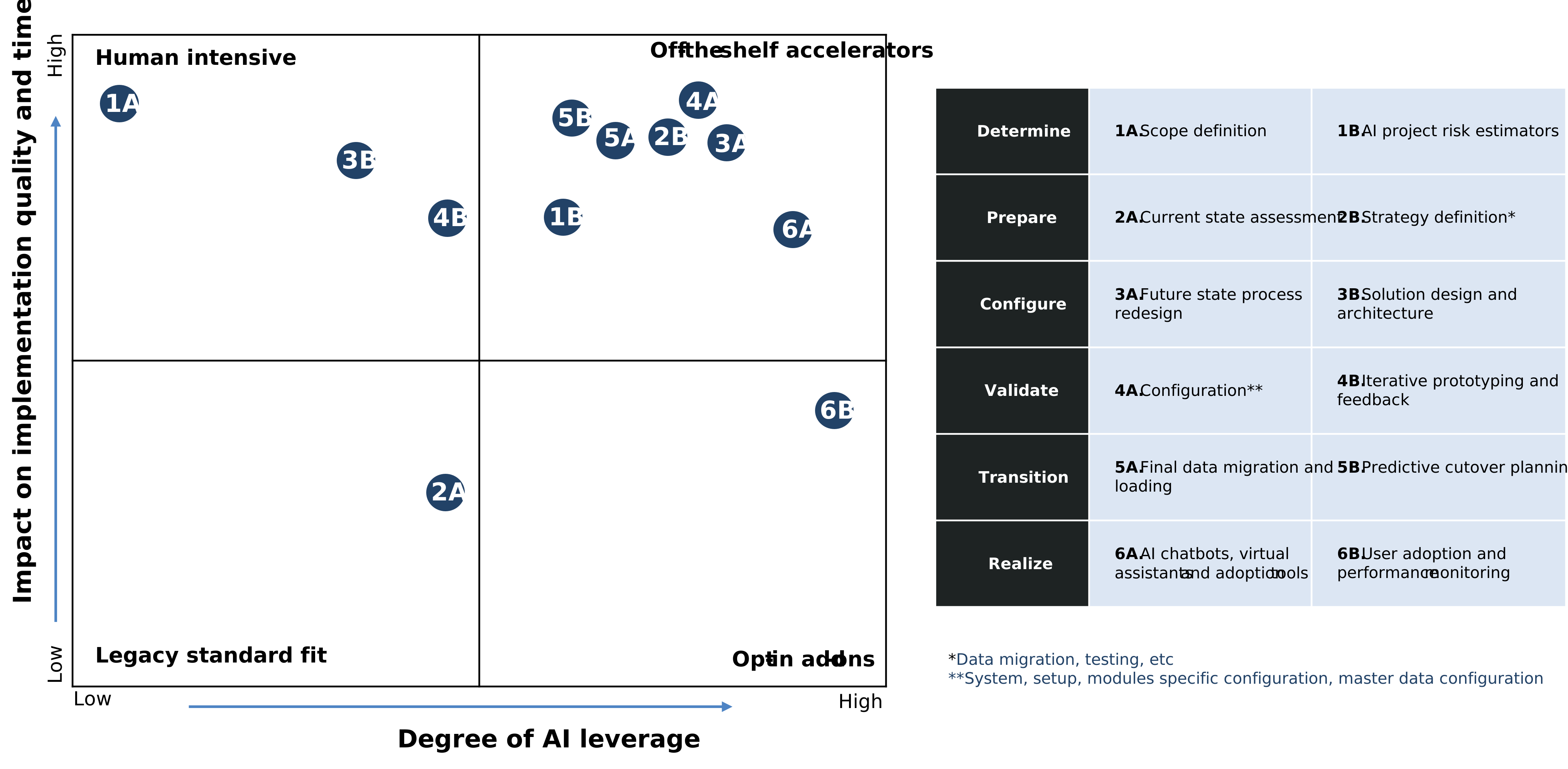
Figure 3: AI prioritisation grid
Figure three provides a grid to describe how the degree of AI leverage in transformation impacts the implementation quality and timeline.
Figure 3: AI prioritisation grid
Recommendations
Adopting AI-ready strategies and best practices from real-world transformations can help ensure a successful HCM implementation.
Our experience-based recommendations for HR and IT leaders embarking on HCM AI modernisation transformation are: .
1. Adopt an AI-augmented framework: Leverage proven transformation methodologies but enhance them with AI. Treat AI as an integral team member—a ‘co-pilot’ that can crunch data, automate tasks, and provide insights.
2. Invest in data and skills readiness: AI is only as good as the data and people behind it. Ensure HR data is clean, integrated, and accessible from the start. Simultaneously, upskill your HR team in data literacy and AI tools.
3. Prioritise high-impact scenarios: Identify pain points that are both critical to address and well-suited for AI. Focus on a few high-impact applications. Early wins will build momentum and stakeholder buy-in.
4. Ensure governance and ethics: Deploy AI in HR responsibly and ensure your solutions are human-centric. Establish guidelines for transparent and fair AI usage—avoid bias in algorithms (audit them regularly), safeguard employee data privacy, and clearly communicate how AI-driven decisions are made. Having HR, IT, legal, and employee representatives involved in AI governance will build trust and prevent ethical pitfalls.
5. Foster HR-IT collaboration: Encourage cross-functional teams for tight collaboration between HR and IT. HR brings process expertise and change management, and IT and data teams provide technology architecture and AI expertise.
THE WAY FORWARD
We are moving toward an AI-first operating model in HR, where AI manages the heavy lifting of analysis and routine administration, and human professionals focus on strategy, experience, and empathy.
Looking ahead, the role of AI in HCM will only expand. Those enterprises that embrace this symbiosis early under a strong governance framework will gain a competitive edge in talent attraction, development, and retention.
In conclusion, AI isn’t a magic wand on its own, but when harnessed through a disciplined transformation methodology, it becomes a powerful engine driving HCM transformation to new heights. Combining proven frameworks with AI enables HR to implement solutions more quickly, gain deeper insights, and drive lasting improvements, solidifying HR’s strategic value to the business.