Service
TCS Interactive

Humanizing Technology to Create Iconic Experiences
On this page
Heart before metrics
In a marketplace driven by experience, connection with brands must go beyond the mere transactions customers make for their desired products or services. There has to be something more, something that resonates with customers’ core values and ideas, something like purpose, an ethos shaped less by numbers and more by feelings.
Brands that lead with purpose are more likely to win over customers and earn their trust. That’s because customers favour brands that demonstrate genuine commitment to their purpose. And brands are realising that being purpose-led is more than just a good-to-have marketing mantra, it’s becoming a competitive differentiator that’s key to driving the next generation of customer trust and loyalty.
What does it mean to be purpose-led?
An organisation’s purpose, which is central to its operating and business models, should be the north star that guides every customer’s experience. It is a meaningful throughline organisations can use to foster relationships and lock in customer loyalty.
The same can be said about the role purpose has with employees working in an organisation. Because it grounds a company’s mission, purpose should also show up in its culture, how it hires, and how it supports employees.
So, purpose should be clearly and authentically defined both within and outside the organisation. Leaders must commit to making the purpose a cultural cornerstone. And marketing teams must infuse it into every customer engagement and experience they create, using all the marketing tactics they have at their disposal, from modern design and storytelling to innovative MarTech like AI-powered personalisation and data-driven decision making.
More than good intentions
Purpose can’t be used like clickbait just to capture customers’ attention. It takes a lot of forethought and follow-through. There needs to be consistent work to ensure customer experiences are aligned with the brand’s purpose. These five steps provide a roadmap for developing a clear purpose, and sustaining it over time:
- Define a clear and authentic purpose - Start by articulating a purpose that’s specific, meaningful, and true to your brand’s values. It should go beyond marketing and reflect what the brand stands for, internally and externally.
- Lead from the top - Purpose must be championed by leadership. When executives consistently model purpose-driven behaviour, it becomes embedded in the culture and decision-making across the organisation.
- Bring purpose to life in the customer experience - Translate your purpose into concrete actions that shape every customer experience. Purpose-led experiences create emotional resonance, deepen trust, and set your brand apart.
- Use AI and tech to personalise and scale purpose - Leverage AI and emerging technologies to personalise experiences, deliver on your brand’s promise at scale, and measure how well purpose is showing up across touchpoints.
- Empower employees as purpose ambassadors - Engage and equip employees to live and share your brand’s purpose. When teams believe in and embody the mission, it creates a consistent experience for customers.
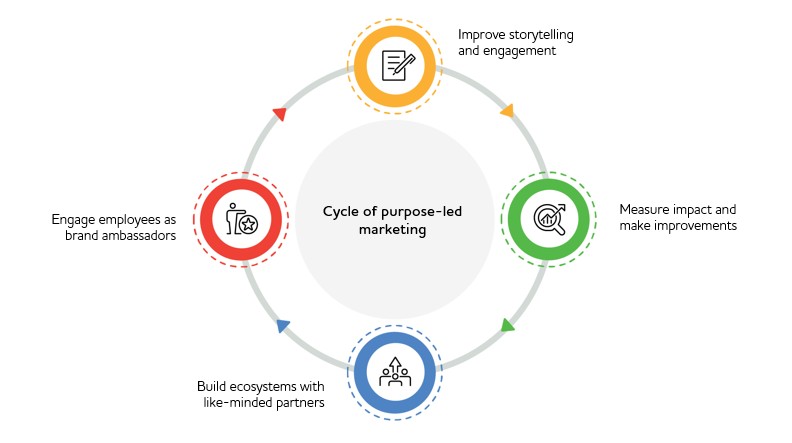
Cycle of purpose-led marketing
Cycle of purpose-led marketing
AI’s role
AI can enhance hyper-personalisation thereby enabling brands to really connect one-on-one with customers and drive purpose-led experiences that are meaningful. It’s imperative, however, to use AI responsibly. Here are a few examples of how AI can support purpose:
- AI’s ability to support decision making, problem solving, and predictive analytics can enhance customers’ trust and perception of the brand.
- AI-enabled monitoring (user feedback, social listening, etc.) helps brands track how well they’re delivering on their purpose and adjust when needed.
- AI can help generate innovative solutions that align with a brand’s purpose.
- AI-driven customer experiences can engage customers in the ideation and even co-creation of products and services.