INDUSTRY
Communications, Media and Information Services

Connect. Curate. Comprehend: Unlocking Value Beyond Boundaries
Highlights
- AI-driven chaos engineering automates resilience testing, overcoming the limitations of manual, reactive approaches in complex digital systems.
- Autonomous agents handle hypothesis generation, experiment execution, analysis, and remediation, with modular design and human oversight for critical scenarios.
- Continuous, automated chaos engineering reduces downtime, lowers costs, and improves compliance through proactive vulnerability detection and adaptive learning.
- Security, responsible AI, and risk mitigation are embedded, ensuring safe, ethical, and future-ready resilience for evolving digital ecosystems.
In this article
In this articleinpage
Resilience in the digital era
Why must resilience be engineered continuously, not occasionally?
Organizations today run on distributed systems, microservices, and cloud‑based platforms. These modern setups are fast and scalable, but they also add complexity and create more chances for things to fail. Even with strong monitoring, outages still happen because traditional testing reacts after issues appear. It also cannot predict how failures spread across connected systems.
Chaos engineering solves this by introducing controlled faults to see how systems behave under stress. It helps teams find weaknesses early. However, manual chaos testing is slow and hard to scale.
With AI and autonomous agents, chaos engineering can now be continuous and adaptive. AI can design experiments, run them safely, learn from results, and help teams strengthen systems automatically.
System failures can lead to revenue loss, customer impact, and regulatory risk. As digital services become central to business, resilience is essential. Organizations that can continuously test and improve their systems will stay more reliable and competitive.
Chaos needs automation.
Manual chaos engineering has limitations, making automated, AI-based solutions increasingly important for building resilient systems.
Historically, organizations have relied on manual testing and reactive monitoring to identify weaknesses. While these methods catch some issues, they often fail to uncover complex failure scenarios that only emerge under real-world conditions. Chaos engineering improves this by intentionally introducing faults to test system behavior. Doing it manually is slow, effort‑heavy, and inconsistent.
Manual approaches face several limitations:
- Limited coverage — humans can’t predict every failure.
- High effort — designing and running tests takes time and expertise.
- Slow response — issues may take long to identify and fix.
- Inconsistent results — learnings may not be repeatable across teams.
These challenges highlight the need for a more automated, intelligent solution.
AI agents drive resilience
Autonomous AI agents enable organizations to automate chaos experiments and strengthen their ability to recover from failures.
The conceptual framework relies on autonomous agents that leverage system data and historical events to automate chaos engineering tasks (see Figure 1).
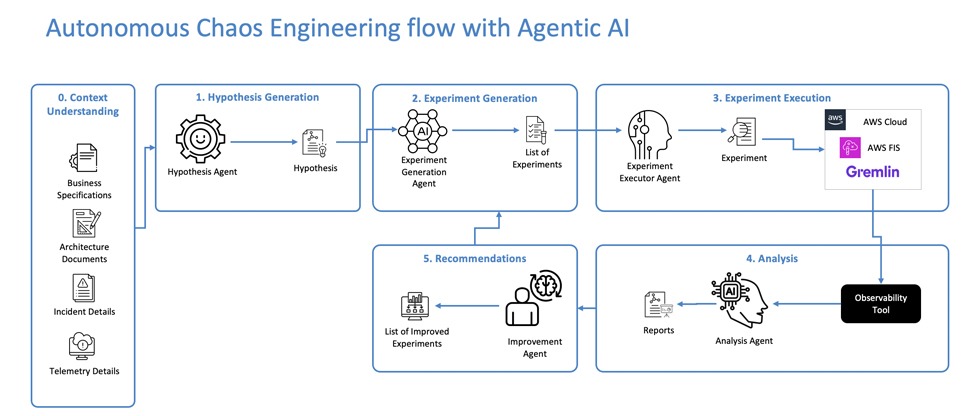
Autonomous Chaos Engineering flow with Agentic AI
Figure 1: The system model for autonomous chaos engineering, consisting of a series of interconnected agents.
Autonomous Chaos Engineering flow with Agentic AI
Instead of relying on manual processes, agentic AI–based chaos engineering uses a set of intelligent agents that can perform tasks independently, learn from results, and adapt over time.
How it works:
The framework includes several specialized agents, each with a clear role:
- Context agent – Gathers business goals, technical details, and system data.
- Prediction agent – Identifies likely failure scenarios using past incidents and current context.
- Design agent – Creates safe, controlled experiments to test resilience.
- Execution agent – Runs experiments and monitors system health.
- Analysis agent – Reviews results and highlights weaknesses.
- Remediation Agent – Suggests fixes and updates processes for future improvements.
These agents work in a continuous loop, learning from every experiment. Human experts stay involved for critical decisions, ensuring safety, oversight, and accountability.
Scaling resilience with AI
By automating chaos engineering, organizations can strengthen resilience, reduce costs, and better prepare for future growth.
Automating chaos engineering helps organizations strengthen resilience, lower costs, and support future growth. It transforms chaos testing from an occasional manual activity into a continuous, adaptive process. AI plays a key role by generating hypotheses, designing experiments using real‑time data, and adjusting test parameters based on system health. Integrating with observability and incident management tools further speeds up detection and recovery.
Key benefits of AI‑driven chaos engineering:
- Reduced downtime and faster recovery – Continuous testing exposes issues early, and automated responses limit disruption.
- Lower operational costs – Automation cuts manual effort and frees teams to focus on higher‑value work.
- Better compliance and transparency – Every action is logged, making audits and regulatory reporting easier.
- Scalability and flexibility – Modular design allows organizations to start small and expand as confidence grows.
- Continuous improvement – AI learns from every experiment, improving resilience over time.
How to adopt it:
- Start small by automating selected tasks while keeping humans involved for critical decisions.
- Expand coverage as systems mature and integrate with monitoring and incident tools.
- Move toward autonomy once the system can manage most resilience tasks independently, with human oversight for governance.
Challenges to plan for:
- Integrating AI agents with existing systems.
- Continuously validating results as environments evolve.
- Ensuring organizational buy‑in and effective change management.
By addressing these challenges and establishing strong governance, organizations can fully realize the value of agentic AI in building resilient, future‑ready systems.
Secure and responsible AI
Building resilient systems requires AI solutions that prioritize security, ethics, and risk management from the start.
Security and ethics are foundational to this approach. The agentic AI framework embeds these principles at every level:
- Strict access controls – Agents operate with only the permissions they need, reducing risk.
- Safe experimentation – Tests are run in controlled environments, with automatic shutdown if safety thresholds are exceeded.
- Data protection – Sensitive information is securely managed, with regular reviews and updates.
- Human oversight – Experts review high-risk scenarios and novel situations, ensuring responsible decision-making.
- Bias mitigation – AI models are regularly updated to prevent systemic bias and maintain fairness.
These safeguards ensure that automation enhances, rather than compromises, organizational trust and integrity.
Future-ready resilience
Using agent-based AI for chaos engineering helps organizations create stronger and more independent digital systems.
Agentic AI-based chaos engineering will continue to evolve:
- Multi-cloud and hybrid support – Agents will manage resilience across varied environments.
- Advanced integration – Deeper connections with observability and incident management platforms for real-time response.
- Standardization – Developing benchmarks and metrics to measure and compare resilience across organizations.
- Collaborative workflows – Combining human expertise with AI automation for even greater effectiveness.
As digital systems become more critical to business success, these innovations will be key to building organizations that are not just robust, but truly future-ready.
Agentic AI–Based autonomous chaos engineering offers a transformative approach to resilience. By automating and improving how systems are tested, organizations can reduce risk, lower costs, and stay ahead of evolving threats. With security, ethics, and continuous learning at its core, this approach enables businesses to become more adaptive and better prepared for tomorrow.