INDUSTRY
Consumer Packaged Goods and Distribution

Enabling Product Innovation and Omnichannel Experience in CPG
Highlights
- Climate volatility, resource constraints, and sustainability mandates are hampering crop predictability efforts, forcing CPG enterprises to rethink how upstream value chains are managed.
- By combining agronomy with internet of things (IoT), remote sensing, artificial intelligence (AI), and generative AI (GenAI), the industry is shifting towards proactive crop management powered by data-driven intelligence across the field lifecycle.
- By standardising routine tasks, scaling expert insights, and enabling precise, data-driven decisions, AI unifies on-field execution and agronomic intelligence into a more predictable, resilient, and high-performance agricultural system.
- Only this end-to-end, composite AI ecosystem that integrates GenAI with classical machine learning can address agriculture’s inherent variability and deliver reliable, predictive, and sustainable crop outcomes.
On this page
AI in crop management
The adoption of artificial intelligence (AI) for crop management is a transformative approach to make the Consumer Packaged Goods (CPG) upstream into a more sustainable, reliable, and predictable system
CPG’s upstream operations are increasingly strained by climate instability, tightening natural resource constraints, and rising global demand, making raw-material availability and quality less predictable. Manufacturers now face growing pressure to improve productivity, optimize input, manage supply and environmental risks, and deliver consistent, sustainable outputs. Simultaneously, consumer expectations on transparency, safety, traceability, and environmental responsibility are reshaping upstream value chains and pushing higher the performance standards for sourcing, formulation, and quality.
To improve CPG upstream performance, companies must focus on increasing agricultural yield, enhancing crop management practices, and adopting precision-farming technologies. Strengthening supplier collaboration and investing in resilient, climate-adaptive raw-material strategies will further stabilize input quality and availability. Together, these measures will build a more predictable, efficient, and sustainable upstream value chain, When powered by AI, this endeavour yields faster, more effective results.
AI is a transformative force capable of reshaping crop management end to end. By generating predictive insights on material variability, supply disruption risks, process behaviour, quality trends, and resource needs, AI boosts CPG upstream operations by enabling the shift from reactive decision making to proactive, sustainability aligned execution. It accelerates the shift from manual, resource-intensive processes to highly efficient, intelligence-driven operations—and from standardized, onesizefitsall approaches to precise, contextaware formulation and production decisions.
However, despite its clear potential, AI adoption in crop management remains uneven and slow (see Figure 1). Most growers, agribusinesses, and co-operatives are still early in their journey towards building predictive, AI enabled operating models because of several barriers to adoption.
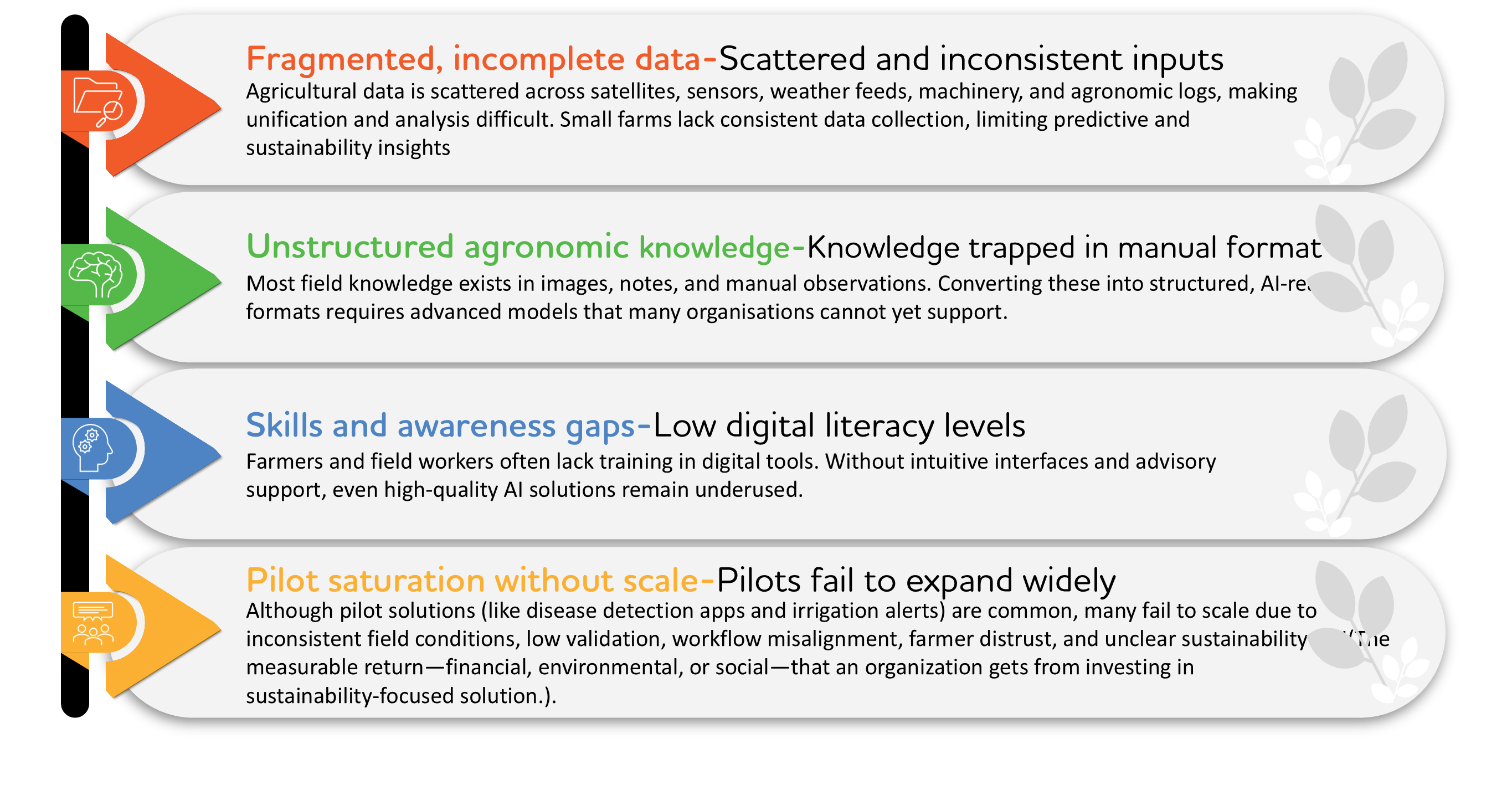
Figure 1
Key barriers to AI adoption
Figure 1
Strategy for success
AI is reshaping crop management by shifting it from observation based decisions to predictive, autonomous intelligence.
This gives farmers and agronomists real-time insights to react faster to environmental changes and optimise decisions across the crop lifecycle. As AI becomes embedded in daily workflows, intelligence becomes accessible to all, improving productivity, climate resilience, and sustainability. However, AI adoption is still maturing, requiring a balance between quick usecase gains and longterm operating model investment.
The table below explains how different types of knowledge in farming—operational, tacit, and intuitive decision-making—shape crop management today, and how AI enhances each of these layers. It illustrates how AI moves agriculture from inconsistent, experience dependent practices to scalable, data-driven, and predictable outcomes by automating routine tasks, formalising expert insights, and strengthening on-field decisions.
| Knowledge type | Description | Examples of tasks | How AI adds value |
| Operational knowledge | Practical, repetitive farm tasks performed differently by workers, causing variability in outcomes. |
|
|
| Tacit knowledge | Deep, experiencebased insights held by senior agronomists or expert farmers; difficult to document or transfer. |
|
|
| AIenhanced Decision | Practical ways AI elevates traditional intuition to measurable, data-driven decision framework |
|
|
Together, these three layers of knowledge—operational, tacit, and AIenhanced decision-making—illustrate how AI strengthens crop management end to end. By standardising routine tasks, scaling expert insights, and enabling precise, data-driven decisions, AI unifies on-field execution and agronomic intelligence into a more predictable, resilient, and high-performance agricultural system.
Unlocking AI’s full potential in agriculture requires a multidimensional strategy supported by a robust, domainaligned technology architecture. Cost efficiency, data quality, security, and ease of use must converge to create solutions that perform under real agricultural conditions.
A successful agricultural AI strategy must be industry-led, data-fuelled, and ecosystem-enabled (see Figure 2).
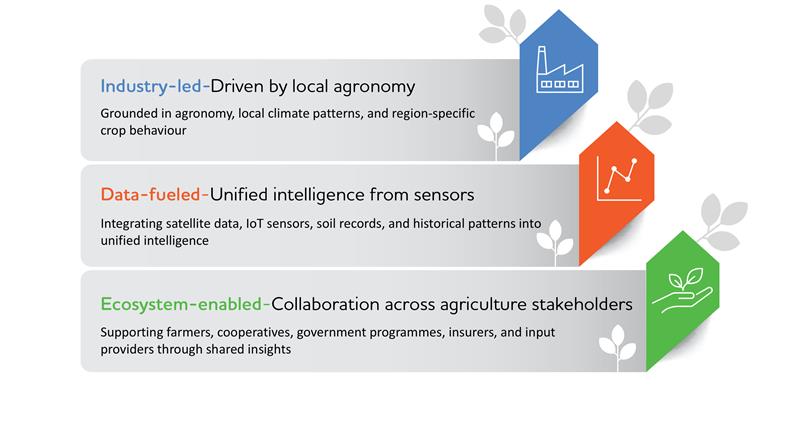
Figure 2
A strategy for AI success in agriculture
Figure 2
This foundation enables an enterprisewide agricultural AI model that is scalable, riskmitigated, and capable of sustaining longterm transformation.
The adoption of AI in the CPG upstream value chain follows a similar intelligence continuum observed across many AI-driven industries (see Figure 3). It encompasses three stages: assist, augment, and transform, with each stage unlocking progressively deeper operational and scientific capability.
The ‘assist–augment–transform’ framework shows how AI capabilities deepen as organisations mature. In the ‘assist’ stage, AI provides basic help—like alerts, automation, and guidance—to make work faster and reduce errors. In the ‘augment’ stage, AI supports smarter decisions by analysing data, spotting patterns, and offering predictive recommendations. At the ‘transform’ stage, AI drives major changes by enabling autonomous or semiautonomous systems that redesign entire processes, optimise resources, and unlock new, more efficient ways of operating.
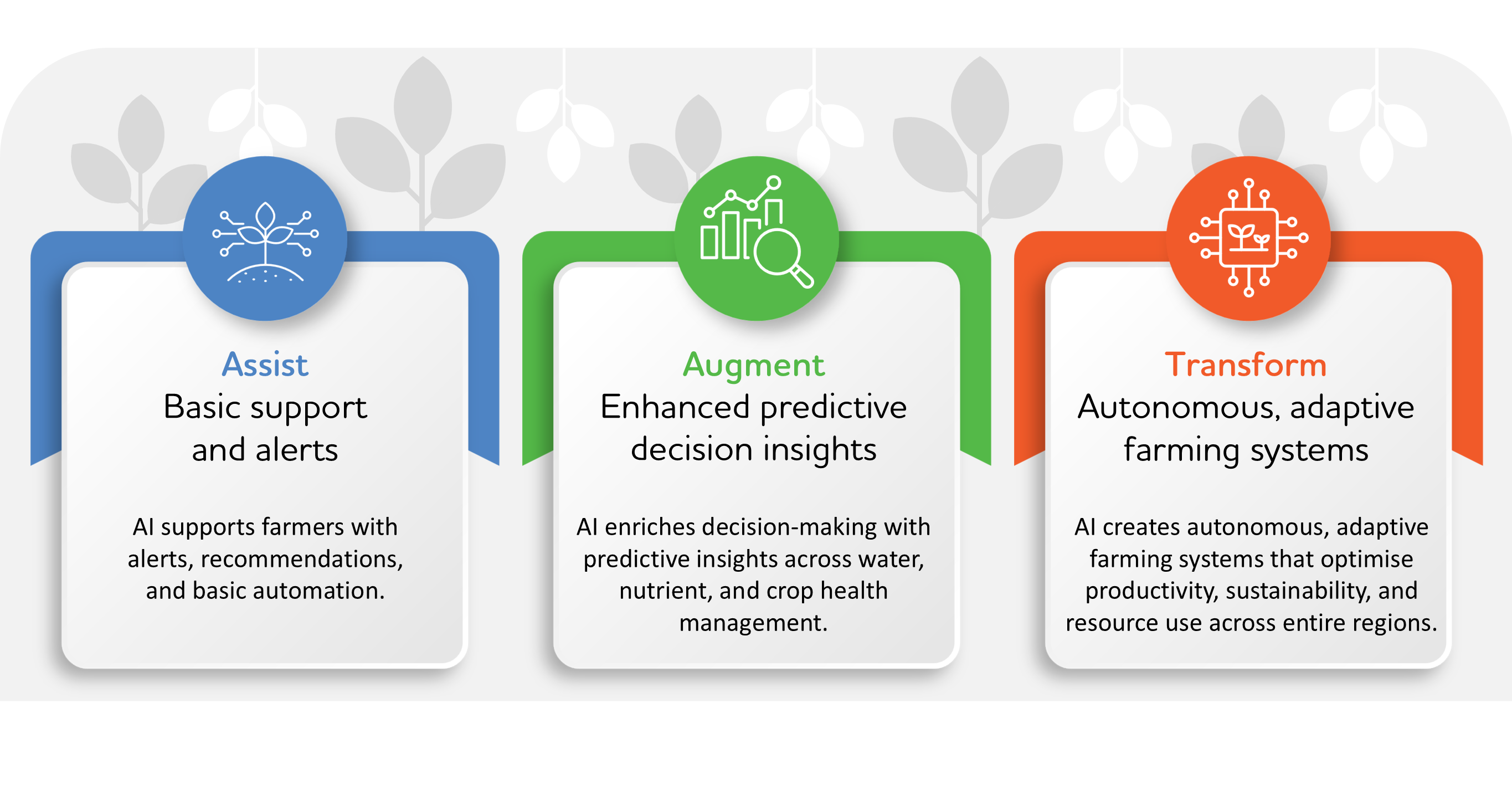
Figure 3
AI intelligence in crop management
Figure 3
Most agricultural organisations today remain in the ‘assist’ or ‘augment’ stages because their digital and data foundations are still maturing. Farms commonly use AI for basic alerts, weatherbased recommendations, or simple monitoring (‘assist’), and only some have progressed to predictive insights on crop health, water use, or nutrient needs (‘augment’). Reaching the ‘transform’ stage—where farming becomes autonomous and adaptive—requires consistent, highquality data, integrated sensing systems, and stronger digital capability, which are not yet widespread in agriculture.
With maturing models, easier data integration, and growing trust, the shift towards transformational AI-driven agriculture is accelerating. AI will reshape agriculture by enabling autonomous field operations, predictive crophealth management, optimised resource use, climatealigned farming, and scalable agronomic expertise. As models mature and data becomes easier to integrate, AI will move beyond supportive roles to fundamentally redesign how farms operate and how CPG enterprises ensure stable, sustainable upstream supply.
Many agricultural stakeholders begin with bottomup pilots—diseasescouting apps, irrigation alerts, soilhealth dashboards. But, without a broader framework, these efforts often stall, causing implementation fatigue and limiting the return on investment (ROI).
To achieve meaningful, scalable impact, AI must be contextualized within the entire agricultural value chain (see Figure 4).
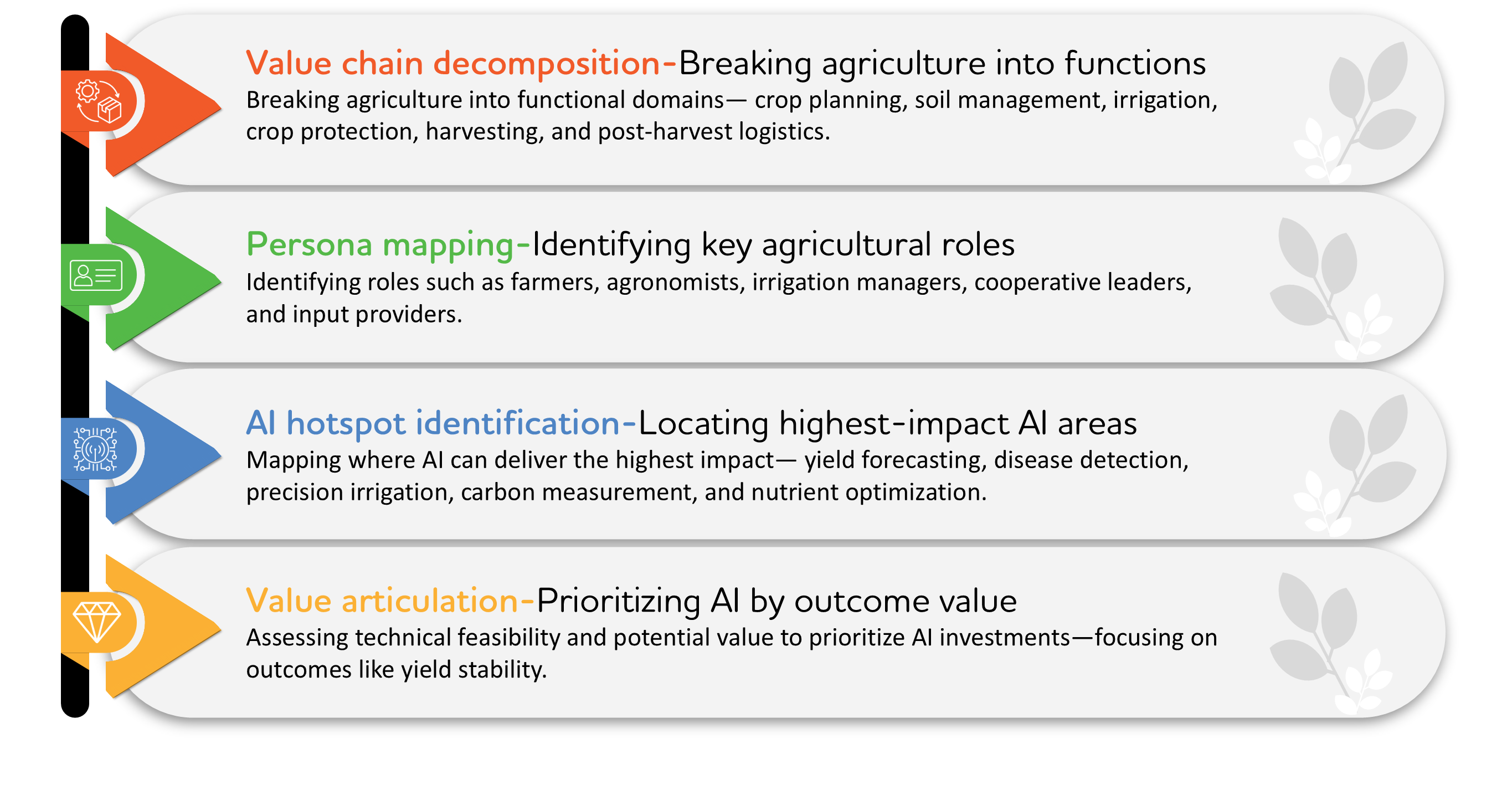
Figure 4
Valueexchange framework for agriculture
Figure 4
In agricultural ecosystems, AI can curate personalized insights for each role. Farmers receive targeted irrigation and nutrient guidance; agronomists gain predictive risk maps; co-operatives see aggregated sustainability indicators; and policymakers gain real-time visibility into regional agricultural health.
This democratization of operational intelligence elevates fieldlevel decision making, improves efficiency, and strengthens longterm sustainability—ultimately transforming agriculture into a resilient, predictive, and data-driven system.
GenAI journey
The emergence of GenAI marks a pivotal moment for agriculture.
It fundamentally transforms how growers, enterprises, and ecosystems manage crops, resources, and climate risks.
As we build nextgeneration, AI-powered agricultural systems, we should take cognizance of the learning from the GenAI journey so far.
Traditional agronomic and simulation models remain the backbone for groundtruth accuracy. However, GenAI and spatially aware large language modes (LLMs) unlock the ability to weave diverse agronomic data—soil, weather, satellite imagery, internet of things (IoT) signals—into intuitive narratives that simplify decisionmaking. These systems make complex analytics more accessible to growers and field teams, accelerating technology adoption across farming communities.
GenAI use cases in agriculture—from stress prediction to precision advisory—continue to multiply. Yet enterprises are discovering that building quantifiable business cases remains challenging. Misalignment between central technology teams, agronomy groups, and field operations often slows value realization. Additionally, standardized frameworks to measure sustainability impact, yield uplift, or cost efficiency are still evolving, making ROI assessment a persistent challenge.
GenAI pilots often demonstrate strong results in controlled test farms or specific geographies. But moving to scaled deployment introduces variability in climate, soil health, device availability, connectivity, and data quality. Challenges such as fragmented field-level datasets, inconsistent imagery cadence, and latency across digital layers can limit GenAI performance at scale.
The agricultural AI landscape—covering crop models, weather engines, remote sensing analytics, and generative intelligence—continues to evolve rapidly. With new models emerging across geographies, languages, and agronomic applications, it is difficult to predict future market leaders. This demands a portfolio-based GenAI strategy, ensuring resilience by blending multiple models across sensing, prediction, and advisory layers
As our work across global Agri value chains show, GenAI delivers the highest impact when integrated into a composite AI framework alongside classical machine learning (ML) models, IoT sensor networks, remote-sensing pipelines, and agronomic rule engines. This integrated approach enables end-to-end visibility, capturing microparameters, forecasting field stress, supporting traceability, and enabling regenerative agriculture at scale. The value lies not in replacing existing systems, but in augmenting and harmonizing them.
To drive enterprise-wide GenAI adoption in agriculture, organizations must strike a balance between rapid innovation and longterm strategic investments. This demands clear alignment between business, field operations, and technology groups; diversified AI model portfolios; cloudready architecture; transparent data frameworks; and welldefined measurement mechanisms focused on yield, resilience, and sustainability outcomes.
When these elements come together, enterprises build the foundation for an AIfirst agricultural architecture—one powered by ecosystem collaboration, cloud-scale platforms, robust data layers, and advanced AI engines. Such architectures unlock predictable yields, optimized resource use, and resilient, sustainable farming models for the future.
The path forward
AI is rapidly emerging as a cornerstone of nextgeneration agriculture, offering an unprecedented opportunity to transform farms into agile, insightdriven ecosystems.
As climate variability, resource constraints, and the demand for sustainable practices continue to intensify, AI enabled crop management stands out as a powerful catalyst for resilience, precision, and productivity across the agricultural value chain.
AI’s potential lies not just in automating tasks but in fundamentally enhancing farmers’ decision-making—delivering hyper-contextual insights, real-time advisory, and predictive intelligence that were previously unattainable.
To unlock this value, however, agricultural enterprises must strike a strategic balance between quick wins and long-term transformation. Piloting targeted AI use cases—such as stress prediction, disease diagnostics, or remote sensing—can deliver immediate impact. Yet building a robust, scalable, and datarich digital foundation is crucial for sustaining progress and enabling advanced, AI-driven agronomy models.
A tailored AIadoption strategy—shaped around regional crop patterns, farmlevel maturity, digital literacy, and available infrastructure—is essential for modernising agriculture. Multiple layers of AI enabled capabilities come together to achieve this, ranging from microparameter monitoring and IoTbased field visibility to predictive analytics, multilingual advisories, regenerativeagriculture compliance, and end-to-end farmtofork traceability. Together, these elements illustrate how AI can integrate seamlessly with sensors, satellite imagery, drones, and cloud platforms to build a fully connected and intelligence-driven agricultural ecosystem.
The benefits are transformative: improved crop health and yield, reduced input waste, early detection of stress and disease, optimized irrigation, carbonaligned farming practices, and transparency across the supply chain. AI amplifies human expertise, empowers growers with actionable intelligence, and supports enterprises in building sustainable, compliant, and future-ready agricultural operations.
Ultimately, the path forward is clear: AI is not just an enabler but a strategic imperative for modern crop management. Organisations that invest thoughtfully—adopting scalable architectures, leveraging microservices, integrating enterprise resource planning (ERP) systems, and combining AI-ML with IoT and remote sensing—will define the future of global agriculture. By embracing AI-driven digital agriculture today, enterprises can ensure long-term sustainability, enhanced productivity, and a resilient food ecosystem for tomorrow.