Industry
High Tech

High Tech Solutions to Drive Business Transformation through Technology
Highlights
- The shift from deterministic to agentic systems drastically reduces integration debt. It is no longer required to write the glue code to handle every edge case. Agentic AI’s reasoning agent handles the ambiguity.
- Layering of agentic mesh architecture allows for modular scalability. This modularity slashes time-to-market for new AI capabilities, which makes AI systems future-proof against the rapid release cycle of new GenAI technologies.
- This architecture’s human-in-the-loop approach ensures that high-stake actions are governed by real-time oversight.
On this page
The agentic inflection point
Agentic AI is not a feature—it’s a platform capability that rewires how product value is delivered, how operations scale, and how risk is governed.
Enterprises are moving beyond generative AI as an “answer engine” toward agentic AI as an outcome engine—systems that plan, take actions across tools and data, and iterate until a business objective is met. This shift compresses planning horizons and forces architecture decisions sooner than most transformation cycles allow. Choices are between incremental integration of agents into existing stacks versus structural modernisation to support agentic workflows, often landing on a domain-by-domain modernisation strategy. At the same time, agent deployments are proliferating across functions, creating a new risk: agent sprawl—siloed automations with inconsistent security, duplicated capabilities, and fragile orchestration. This is why the emerging enterprise pattern is a governed “fabric” (an agentic mesh), not isolated agent apps.
Autonomous System
What makes an AI system agentic?
Agentic AI systems are built around a language model (LLM, SLM) that do more than generate responses: they pursue objectives. An agentic system can perceive context, reason over goals, decompose work into steps, invoke tools/APIs, verify outcomes, and iterate—often across multiple systems—until it reaches a satisfactory and policy-compliant result.
Unlike chatbots that provide single-pass responses using LLMs, agentic AI operates through continuous feedback loops, maintaining a state of its environment, and utilising a control surface to act.
What distinguishes agentic systems from chat-style assistants is closed-loop execution, they:
- Maintain state (memory and contextual grounding)
- Have actuation surfaces (tool and action invocation with constraints)
- Run feedback loops (verification, retry, replanning, escalation)
This combination enables systems to complete work reliably rather than simply produce text.
Common foundational patterns that define agentic behaviour:
- Reason–Act Loops: The agent alternates between internal reasoning and external actions—think → act → observe → adjust—which reduces hallucination risk and improves performance on interactive, multi-step tasks. Ideal use cases include:
- Interactive troubleshooting (Incident triage): observe logs/metrics→adjust next steps.
- Web/UI Workflows: that require iterative steps and feedback
- Plan–Execute Separation: Planning is treated as a distinct step from execution (“decide what to do” vs. “do it”), improving predictability, auditability, and failure containment. Ideal use cases include:
- Regulated workflows (claims steps, onboarding/KYC) that require auditability.
- Complex migrations (app modernisation waves) where sequencing and dependencies matter more than improvisation.
- Tool/API invocation with structured contracts: Actions are executed via tools/APIs using typed, structured inputs/outputs, enabling determinism, validation, retries, idempotency handling, and safer automation. This pattern is indispensable for enterprise systems which interact with third-party systems such as CRMs, databases, analytics platforms etc.
- Reflective memory/self-improvement: The agent uses feedback from success/failure to write “lessons learned” into memory and apply them in subsequent attempts, improving performance over time without fine-tuning. It helps in recurring operational tasks such as recurring customer issues, incident categorisation and more.
- Multi‑agent Specialisation and coordination: Complex objectives are handled by multiple specialised agents (planner/executor/verifier/retriever, etc.) that communicate and coordinate either parallelly or sequentially—often improving breadth, robustness, and throughput compared to a single monolithic agent.
Where agentic AI applies
Agentic AI becomes most valuable when work has high coordination cost, multiple systems of record, policy constraints, and repeatable decision patterns.
High-impact application zones:
- Software engineering and platform operations.
Long-running tasks (code changes, review, test fixes) and operational remediation benefit from agentic planning and iteration, matching the direction of agent-optimised models. - Customer operations and service workflows.
Multi-agent flows (triage → retrieval → action → response) increase resolution and reduce escalations when orchestration is stateful and governed. - Enterprise modernisation and legacy transformation.
Agentic workflows increasingly support modernisation programs (analysis, migration steps, testing, documentation) and reduce time spent on coordination and translation work. - Regulated, policy-heavy domains (BFSI/insurance/health).
Work such as claims, underwriting assistance, and case management can be decomposed into supervised specialist agents under strict controls, enabling speed without sacrificing compliance. - Healthcare administrative support.
Agents automate patient scheduling, insurance claim processing, and pre-authorisation tasks, reducing the administrative burden on staff.
The friction points
Why agentic pilots stall.
Enterprises hit a consistent set of barriers when moving from demos to production-scale agent systems:
A) Uncontrolled autonomy and fragile orchestration.
Without explicit state and deterministic routing, agents can loop, lose context, or behave unpredictably, especially when coordinating multiple tools and sub-agents. Graph-based/stateful orchestration exists largely to solve this.
B) Security expansion: tool access becomes the blast radius. Agents connect to credentials, APIs, documents, and sometimes execution environments; this expands attack surfaces beyond prompts to indirect prompt injection embedded in third-party content. Large red-teaming corpora demonstrate the breadth and transferability of agent vulnerabilities.
C) Lack of enterprise governance primitives.
Organisations struggle with identity, authorisation, audit trails, and data boundary enforcement across many agents. The mesh narrative emerged specifically to address governance, interoperability, and visibility gaps.
D) Economics are opaque.
Per-call metrics do not reflect reality when a single objective triggers many tool calls, retries, and model invocations. Enterprises need budgets and telemetry aligned to outcomes, not tokens alone.
E) Operational readiness gaps (observability + incident response). Without end-to-end tracing across agent decisions, tool calls, and memory operations, production failures become hard to diagnose and govern. This is why platforms emphasise telemetry and evaluation pipelines.
The solution pattern: Agentic mesh + AgentOps + API-to-Skills
To scale agentic AI responsibly, enterprises need three coupled capabilities:
The agentic mesh (architecture solution).
An agentic mesh is a governed fabric that allows autonomous agents to discover each other, share context, coordinate decisions, and operate under policy-driven controls, which is distinct from a service mesh that routes network traffic. In agentic mesh specialised agents are decoupled, they discover each other through registry, gateway and communicate using standardised protocols (see Figure 1). This allows for:
Specialisation: A domain specific agentic can be fine-tuned on specific scenario without affecting agent from another domain.
Scalability: New capabilities can be plugged into mesh without re-writing the core-orchestrator.
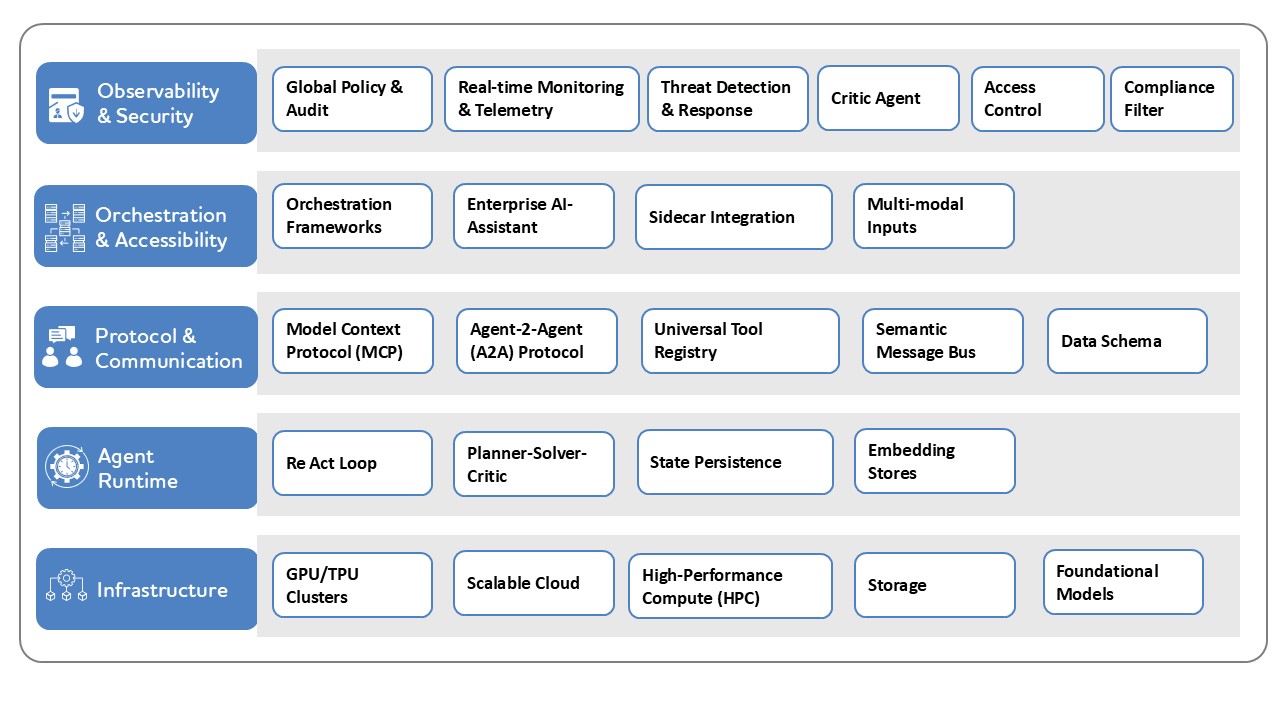
Figure 1
Layered architecture of agentic mesh
Figure 1
AgentOps (operating model solution)
Agent operations (AgentOps) is a set of practices focused on the lifecycle management of autonomous AI agents. It brings together principles from DevOps and MLOps, giving users more appropriate methods to manage and monitor agentic pipelines. It is not a one-time QA step, instead it combines synthetic suites, adversarial testing, and production telemetry.
Platforms are now packaging automated red teaming for agent pipelines for greater security.
API-based software becomes “skill-based” software (product solution)
Agentic systems reframe APIs as discoverable, typed skills rather than opaque endpoints:
- Model context protocol (MC)P standardises tool exposure and context sharing with clear contracts.
Agent-to-agent (A2A) enables cross-agent collaboration beyond a single framework/vendor.
Future outlook
How this solution positions the enterprise:
The next phase of enterprise software architecture is best understood as the shift from:
- Service orchestration → intelligence orchestration
- API integration → capability/skill marketplaces
- Microservice control planes → agent control planes
Key trends likely to intensify:
- Open interoperability will matter more than framework choice. A2A and MCP style standards reduce lock-in and allow heterogeneous agent ecosystems across vendors and frameworks.
- Security posture becomes a competitive differentiator.
As red-teaming benchmarks reveal persistent vulnerabilities, organisations that institutionalise AgentOps (evaluation + red-team + tracing) will move faster with fewer incidents. - Outcome economics will replace token economics.
Budgeting and pricing will shift toward unit economics per objective (per ticket resolved, per claim processed, per change request shipped), reinforcing the need for traces and governance tied to outcomes - Agent fleets will run like cloud-native systems.
Kubernetes-style patterns (sidecars, ephemeral RBAC, isolation, scaling) will become standard for fleets of agents and their tools.