INDUSTRY
High Tech

High Tech Solutions to Drive Business Transformation through Technology
Highlights
- Enterprises must fundamentally shift from traditional to AI-driven, adaptive systems to remain competitive against AI-native disruptors. AI infused software product engineering (SPE) is a core driver of revenue growth, innovation, and enterprise resilience.
- Embedding AI into products while simultaneously applying AI across the engineering lifecycle creates a compounding effect—accelerating innovation cycles, improving product quality, enhancing customer experience, and significantly reducing engineering and operational costs.
- By integrating AI across the end-to-end lifecycle with strong governance and ecosystem enablement, organisations can evolve toward self-learning, self-optimising platforms—establishing a scalable, trusted, and differentiated foundation for AI-enabled enterprises.
On this page
On this pageinpage
Introduction
Why reimagined software product engineering (SPE) is a CEO and C-suite priority.
The competitive landscape is increasingly shaped by AI-native disruptors that embed intelligence into the very fabric of their products. These organisations deliver solutions that are not only functional but adaptive—capable of anticipating user needs, responding to context, and improving continuously.
In contrast, traditional product engineering models are constrained by delayed feedback loops, rigid release cycles, and fragmented workflows. This limits an enterprise’s ability to innovate at speed and respond to market shifts.
AI enabled SPE has therefore evolved into a strategic growth lever. SPE directly influences revenue generation through differentiated digital offerings; operational efficiency through automation; and, organisational resilience through adaptive systems – while AI acts as a catalyst across all three dimensions.
TCS recognises this shift and has been investing in reimagining SPE by integrating AI into engineering frameworks, aligning product engineering with enterprise transformation agendas, and enabling clients to treat engineering not as a cost centre but as a driver of business value.
Value
Value creation through embedded AI and AI for products.
Value realisation in modern SPE emerges from two complementary dimensions. The first is embedding AI into products themselves, transforming them into intelligent, context-aware systems capable of continuous learning. Such products leverage agentic AI and evolve with user behaviour, enabling hyper-personalisation and sustained engagement.
Agentic marketplaces are not an evolutionary step. They mark a fundamental shift toward autonomous, intelligent economies where AI agents, rather than humans, become the primary drivers of value exchange. In this paradigm, platforms are no longer designed solely for user interaction, but for orchestrating networks of intelligent agents capable of discovering, negotiating, and executing outcomes in real time across partners.
The second is the application of AI to the engineering lifecycle. AI-enabled development accelerates code creation and improves consistency. Quality engineering becomes predictive, identifying issues before they surface. Platform engineering-led DevOps evolves into an intelligent, self-optimising function driven by insights and automation driven AIOps.
The convergence of these two dimensions significantly enhances business outcomes. Enterprises can reduce time to market, improve product quality, and lower engineering and operational costs simultaneously. More importantly, they enable continuous innovation rather than episodic releases.
AI-led
End-to-end AI-driven product lifecycle (all stages unified)
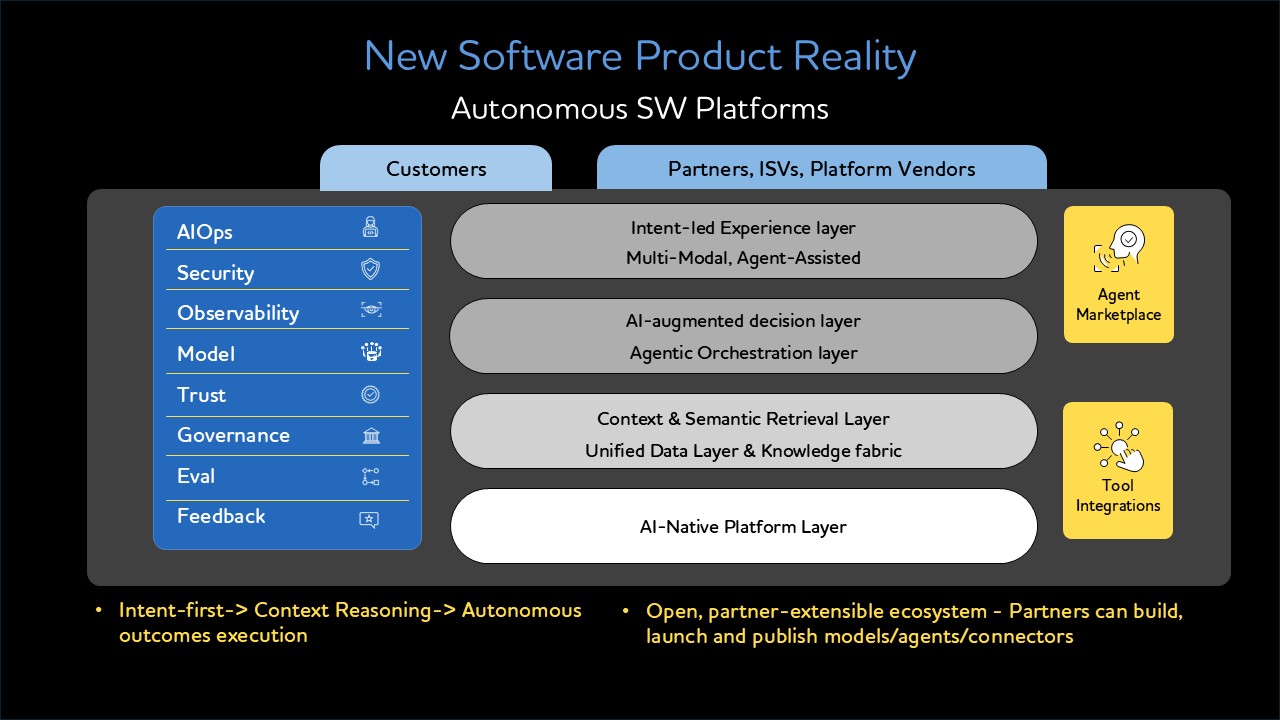
Figure 1:
Autonomous Software Platforms
Figure 1:
To unlock the full value of AI, organisations must move beyond isolated use cases and adopt an end-to-end AI-driven lifecycle.
The transformation begins at the ideation stage, where AI-driven insights enable demand sensing, customer understanding, and data-backed roadmap prioritisation. This ensures that product strategies are aligned with market reality.
Architecturally, enterprises must build AI-ready platforms for agentic orchestration, that are scalable, modular, and open. These platforms support interoperability across ecosystems and provide the foundation for sustained innovation.
During development and quality engineering, AI augments human capabilities through assisted coding, automated test generation, and intelligent defect detection. This leads to improved speed and higher assurance levels.
Operations are transformed through intelligent continuous integration and continuous delivery (CI/CD) pipelines and AIOps. Systems become capable of predicting performance issues, automating remediation, and optimising resource utilisation in real time.
A continuous learning loop connects every stage, ensuring that feedback from usage and operations informs ongoing product evolution. At the same time, engineering for non-functional requirements—performance, scalability, security, and reliability—is embedded by design rather than addressed reactively.
The result is a unified lifecycle that delivers speed, quality, and scale, ultimately enabling the creation of autonomous software platforms capable of self-optimisation.
Customer engineering enablement at scale
As enterprises scale AI-driven products, the need for robust customer engineering enablement becomes critical. Organisations must deliver solutions that integrate seamlessly into complex enterprise landscapes while maintaining speed and consistency.
Customer specific solution engineering services play a key role in enabling AI-native products tailored to specific business contexts. At the same time, rapid integration capabilities are essential to connect with core enterprise systems such as enterprise resource planning (ERP), supply chain management (SCM), and human capital management (HCM) etc.
To address this, TCS has co-created integration frameworks and connector ecosystems that accelerate interoperability. These “connector factory” approaches reduce integration effort, minimise technical debt, and enable faster ecosystem expansion.
Beyond integration, customer engineering increasingly involves co-creation—working closely with clients to develop solutions aligned with their strategic priorities. This approach allows enterprises to scale innovation while maintaining relevance and differentiation.
Trust, governance, and responsible AI
In Software Product Engineering, responsible AI must be engineered into the lifecycle rather than layered on top. This requires embedding governance directly within data flows, model usage, agentic AI and autonomous workflows, customer integration and delivery pipelines, and runtime systems to ensure all AI components remain traceable, auditable, and aligned to business intent.
Given that AI systems continuously evolve, governance becomes a real-time discipline—monitoring model accuracy, drift, bias, and relevance through integrated ModelOps practices. Equally critical is defining clear decision boundaries within product architectures, with appropriate human oversight and fail-safe mechanisms for high-impact scenarios.
Strong data governance underpins this foundation, ensuring data integrity, lineage, privacy, and controlled access across complex ecosystems. Together, these elements make trust an intrinsic capability of SPE, enabling AI-driven products to scale with consistency, transparency, and accountability.
Domain use case
AI-driven business workflow transformation.
AI-driven SPE extends beyond product innovation into the transformation of enterprise workflows. By embedding AI into core processes, organisations can achieve end-to-end optimisation and intelligent automation.
In ERP domain, AI enables financial automation, predictive forecasting, and real-time compliance monitoring. Supply chains become more resilient through advanced demand planning and logistics optimisation. In human capital management, AI-powered insights drive workforce productivity, talent optimisation, and improved decision-making.
Collaboration softwares are shifting from communication tools to intelligent coordination platforms that automate workflows, align teams, and drive outcomes using AI, enabling faster, more efficient execution with minimal manual effort.
CRM is evolving from a system of record into an AI-driven platform that proactively manages customer relationships, personalises engagement, and optimises lifecycle value through predictive insights and automation.
Security products are also evolving, with AI enabling proactive threat detection and automated response mechanisms that significantly reduce risk exposure.
These transformations deliver measurable business outcomes, including cost reduction, improved operational efficiency, increased agility, and revenue uplift. Enterprises transition from reactive process management to intelligent, predictive execution models.
Conclusion
From AI-enabled products to autonomous software platforms.
Software product engineering is transitioning toward a future defined by autonomy. Products are evolving into platforms that learn continuously, adapt dynamically, and optimise themselves without constant human intervention.
Reimagined SPE—anchored in embedded AI and AI-powered engineering—serves as the foundation for this transformation. It enables continuous innovation, faster time to value, and sustainable differentiation.
Organisations that combine scalable AI capabilities with strong governance and ecosystem alignment will gain a decisive competitive advantage. Autonomous software platforms, enriched with enterprise data and context, will become the cornerstone of AI-enabled enterprises.
TCS, with its comprehensive investments across AI ranging from infrastructure to intelligence, engineering platforms, talent, partnerships with AI industry leaders, is at the forefront of enabling this shift—helping clients move beyond digital transformation toward truly intelligent, autonomous enterprises.
Through solution accelerators, AI labs, rapid prototyping capabilities, and a 360-degree engagement model spanning product engineering and commercialisation, organisations can significantly accelerate the transition.