Industry
High Tech

High Tech Solutions to Drive Business Transformation through Technology
Highlights
- Traditional data acquisition methods cause massive delays in AI initiatives due to privacy risks and poor data quality.
- The synthetic data factory automates the generation of realistic, privacy-compliant data using generative AI models and automated QA loops.
- Implementing this architecture enabled a technology conglomerate to reduce test data preparation efforts and overall testing lead time significantly.
On this page
The data bottleneck in AI
AI is a cornerstone of modern enterprise transformation, yet many initiatives face a critical data bottleneck.
The promise of AI-driven transformation hinges on data, but enterprises face consistent challenges. Development and testing teams often wait 5 to 15 days for data updates from complex systems like ERPs. Furthermore, production data is frequently incomplete or lacks the variety needed to cover edge cases, leading to inaccurate models and extensive debugging. Using real customer data introduces significant privacy risks and regulatory burdens such as GDPR. Traditional manual masking methods are simply too inefficient, creating severe bottlenecks that stifle the pace of innovation.
Rise of the data factory
Enterprises must move beyond ad-hoc data provisioning and treat data generation as an industrialised process.
The synthetic data factory offers a centralised, governed platform integrated directly into enterprise systems. It begins by securely extracting metadata and schemas without violating privacy boundaries. An AI synthesis engine, utilising algorithms like the Synthetic Data Vault (SDV) and Generative Adversarial Networks (GANs), generates massive volumes of artificial data that mimics the statistical properties of the source. Crucially, it employs Large Language Models (LLMs) as an automated diagnostic layer to scrutinise data quality, continuously routing sub-optimal data back for refinement before delivery.
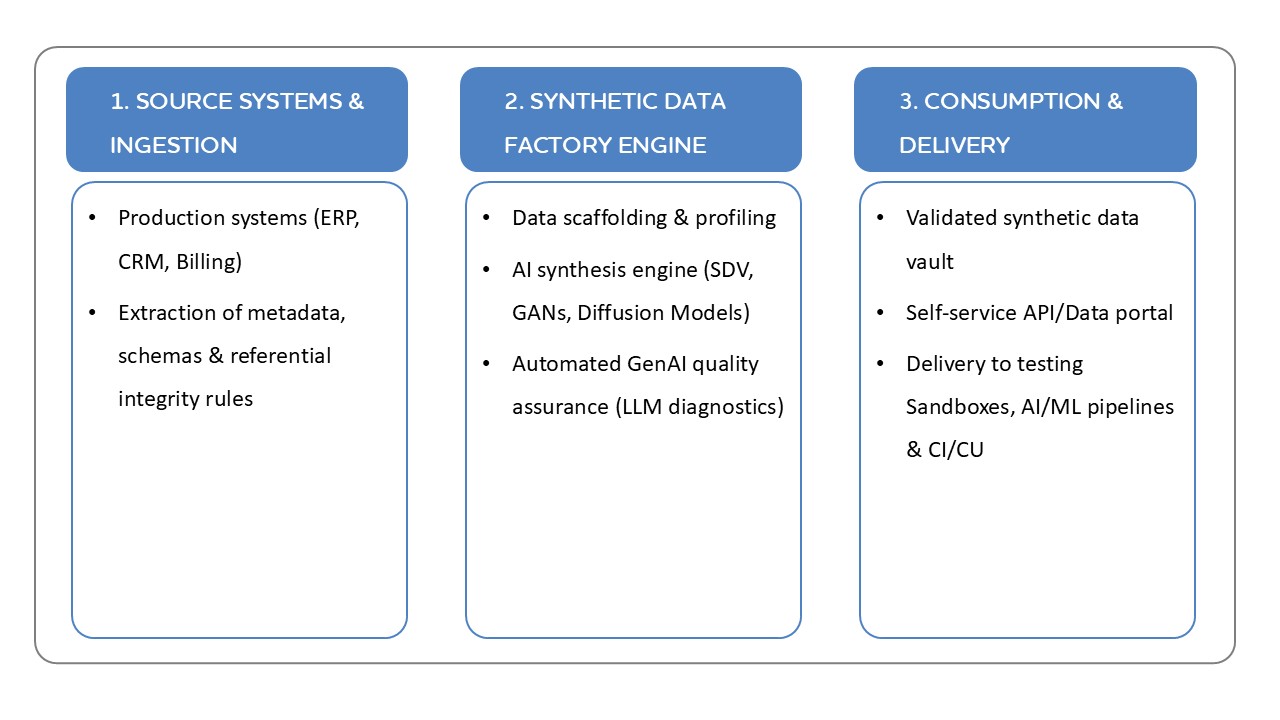
To realise the benefits of synthetic data at scale, enterprises must implement a robust, end-to-end "factory" architecture. Below is the reference blueprint for an industrialised data generation lifecycle:
Figure
Image-Synthetic architecture
Figure
Architectural Breakdown:
- Source Systems & Data Scaffolding: Connects to production environments to securely extract metadata and statistical distributions without violating privacy boundaries.
- The AI Synthesis Engine: Utilizes advanced algorithms (e.g., Synthetic Data Vault libraries) to generate massive volumes of artificial data mimicking the statistical properties of the source.
- Automated GenAI Quality Assurance: Employs Large Language Models (like Llama 2) as an automated diagnostic layer to scrutinize data quality, automatically routing "sub-optimal" data back into the synthesis engine.
- On-Demand Consumption & Delivery: Serves validated data to downstream environments on demand, eliminating the traditional 5-to-15-day wait times.
Enterprise Value Realisation
The true measure of a synthetic data factory is its measurable business impact in complex environments.
A technology conglomerate faced significant delays in test delivery cycles due to its complex business ecosystem. By implementing a synthetic data factory, the company scraped metadata and leveraged Python-based SDV AI models. GenAI was used to distinguish between qualified and sub-optimal data, seamlessly populating the qualified synthetic data back into their ERP. This resulted in a significant reduction in test data preparation efforts and total lead time for end-to-end testing, enabling robust testing without data exposure risks.
Strategic Blueprint for CDOs/CIOs
Adopting a synthetic data factory is a strategic imperative for any organisation looking to thrive as an AI-first enterprise.
Technology leadership should assess organisational readiness by evaluating current data provisioning bottlenecks and identifying high-value, high-friction areas like E2E testing or specific AI model training pipelines.
It is crucial to define utility and privacy guardrails early, collaborating with the CISO to establish the governance model, ensuring differential privacy and traceability metrics are in place. The next step involves executing a targeted pilot in a contained but complex ecosystem to implement the GenAI-driven factory reference architecture and prove immediate ROI, followed by scaling to an industrial model.