Industry
High Tech

High Tech Solutions to Drive Business Transformation through Technology
Highlights
- Empowering enterprises with agility and cost-efficiency, a hybrid multi-cloud approach is integrated with edge capabilities.
- TCS and Red Hat have co-created a strategic framework for hybrid multi-cloud transformation that ensures high performance in enterprises while mitigating security risks.
- The hybrid multi-cloud transformation canvas uses reference architecture, tools accelerators, and virtual delivery models that support multi-cloud environments to create customized solutions.
On this page
Assessing the current state of enterprises
A holistic evaluation of business, data, and technology dimensions is critical for informed decision-making.
Globally, enterprises are increasingly adopting cloud to support business innovation, ecosystem expansion, newer value propositions, growth, and agility. This move toward multiple cloud services leverages best-of-breed solutions and capabilities at an optimal cost. A hybrid multi-cloud environment that includes edge computing is the new standard.
Enterprises recognize the advantages of a multi-cloud setup, including redundancy, disaster recovery, cost optimization, and avoidance of vendor lock-in. With a hybrid multi-cloud strategy, organizations ensure business continuity, resilience against outages, and flexibility in selecting services from various providers based on specific needs and pricing.
For agile and cost-effective operations through hybrid multi-cloud and edge capabilities, enterprises must tackle technical, business, and operational challenges like:
Management: Cloud-based infrastructures can be complex to manage. Organizations must find the balance between working on a cloud-based platform while maintaining the enterprise ecosystem.
Vendor lock-in and portability: Proprietary and inflexible technologies from various cloud providers can be challenging while adopting a best-of-breed approach.
Integration: Varying APIs, and data interoperability challenges, especially across heterogeneous environments, can lead to integration and compatibility issues, hindering seamless cloud transitions. Open APIs allow better interoperability for companies deploying multi and hybrid clouds, particularly for container orchestration platforms and automation tools.
Security: Data residency requirements, encryption, and access control are vital in cloud environments. However, protecting sensitive data, managing access control across disparate platforms, and complying with regulations such as the General Data Protection Regulation (GDPR) or the California Consumer Privacy Act (CCPA) can be challenging.
Operational consistency: Maintaining operational consistency across a hybrid and multi-cloud environment is crucial because discrepancies or data loss can have serious repercussions.
Assessing cloud readiness solely from an IT perspective can lead to costly misjudgments, affecting long-term growth.
Unlocking cloud’s potential
TCS and Red Hat have co-developed a hybrid multi-cloud transformation canvas that enables clients to accelerate cloud transformation, while keeping risks at bay.
The hybrid multi-cloud transformation canvas helps companies visualize their transformation journey by conducting a discovery session to understand the current state of their IT environment such as collaboration platforms used for their workforce, whether the enterprise is cloud-enabled, how are the physical assets connected and whether they are data driven, and more.
A dynamic portfolio of business solutions can be seamlessly embedded and customized to suit the consumer context at any given time or place through any channel or device.
Helping companies visualize this journey, customized to their specific requirements, helps assess security measures, system and infrastructure accessibility, application environment resilience, and overall agility, holistically and well in time for course corrections, if at all.
In addition, the robust native capabilities of cloud help companies unlock new business opportunities using analytics, artificial intelligence, and machine learning. Organizations can develop new business structures, cater to new customer segments, and deliver highly personalized experiences throughout their diverse customer journeys. Cloud-native capabilities allow companies to spearhead new standards in customer engagement, differentiation strategies, and business modernization.
Today, businesses blend their internal capabilities with innovations, becoming value aggregators, consultation providers, and access facilitators. To be future-ready, enterprises need an ecosystem-first approach, leveraging customer data and advanced technologies creating agile processes, new business structures, and strategic partnerships.
Integrating next-generation technologies into their hybrid and multi-cloud environments is vital for enterprises. Transitioning to an integrated ecosystem on a hybrid and multi-cloud infrastructure can expedite value co-creation and improve revenue generation.
However, the migration, especially the strategy behind it, how it gets implemented, and whether or not it is successful, depends on a series of multidimensional assessments (see Figure 1).
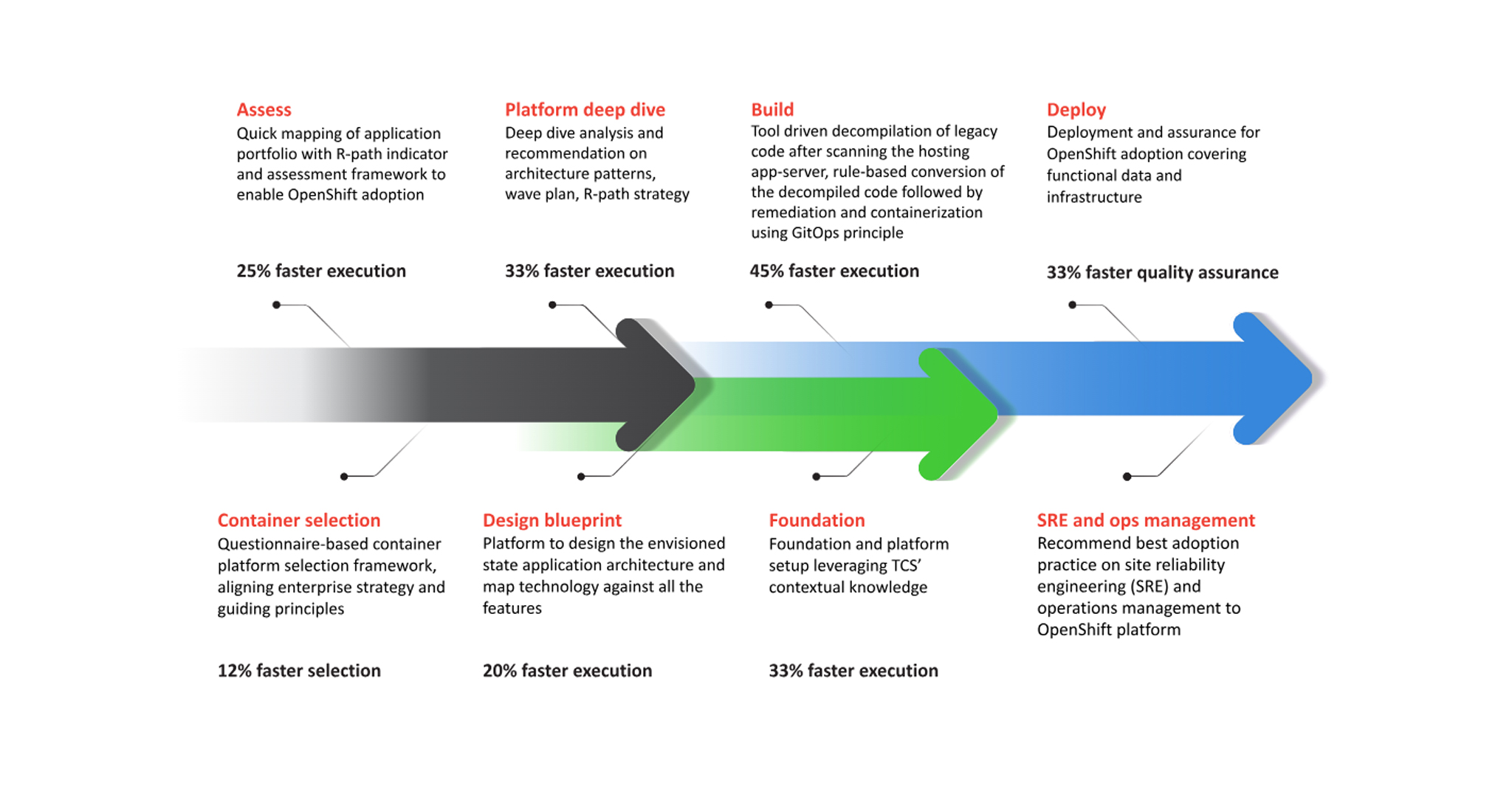
Figure 1
The stages of the ‘hybrid multi-cloud transformation canvas’ journey
Figure 1
Cloud migration assessment
The multi-cloud transformation journey commences with a comprehensive understanding of the enterprise's existing landscape and business impact. By creating business value-driven application portfolio buckets, followed by migration, experts can quickly get answers to predefined questions and parameters tailored for their specific industry. TCS and Red Hat bring value to the table, in the form of tools, assets, accelerators, frameworks, proof points, and proofs of concept.
The categorization of an application is graphically presented and dynamically updated by modifying input parameters. The process starts with assessing business value, followed by application complexity, and then mapping them to a high-level migration strategy. Factors like tech stacks, adaptability affinity, ecosystem touchpoints, and commercial-off-the-shelf (COTS) and software as service (SaaS) dimensions help determine application complexity levels.
Staying on the right path
The six Rs of business value driven portfolio rationalization are rehost, refactor, re-platform, retain, retire, and re-architect.
This framework considers business-value-driven outcomes to determine the right target platform affinity along with various application characteristics, which include:
Selective scaling needs
Business process categorization (different domains or systems, application technology stack, ecosystem touchpoints, and affinity towards open source and specific platform as a service (PaaS) or SaaS)
Replacement or retirement considerations
Latency concerns
Dynamic analysis provides a graphical representation of the framework, which is then used as a migration guide. It also allows iterative design and engineering to achieve the desired application capabilities.
The application estate is grouped into the following paths:
Microservices (re-architect, SaaS)
Modernize and migrate (lift and shift, rehost, refactor, re-platform)
Retain or replace
Retire
Once the path is determined, the suitable cloud and container PaaS, which fulfills the enterprise’s long-term objectives, is selected. This fitment assessment is imperative to align with the enterprise’s guiding principles.
Cloud and container assessments must keep business needs, application portfolio, and the cloud and container adoption strategy at their core. The next step entails an analysis of organizational readiness, operational considerations for clouds and networking, storage, computing, security, DevSecOps, tooling, ecosystem play, and license.
The stages of transformation
This transformation approach involves expediting the discovery and assessment of an organization’s as-is application landscape, followed by defining the to-be architecture on the target cloud platform. It includes identifying the migration pattern, planning the wave grouping, and blueprinting key pattern architecture to enable easy cloud and container migration.
We have co-created reference architectures, tools accelerators, virtual delivery models, and industry solutions supporting multi-cloud environments to elevate the process. For instance, during the execution phase, the accelerated application modernization framework helps fast-track the process by remediating and updating the application to the latest version. This can be utilized to ensure cloud and container nativity. The updated application can be seamlessly deployed to the target cloud and container setup through automated deployment.
The optimization of timelines and effort is paramount at this stage to enhance risk management and operational efficiency. This strategy is not merely a response to market demands but a proactive stance that can position enterprises to excel in an era where adaptability and innovation are pivotal to sustained success.
A LASTING BUSINESS IMPACT
Hybrid multi-cloud environments will reshape enterprise IT in the coming days.
To achieve operational excellence, cost efficiency, vendor neutrality, and security, enterprises need to enhance focus on informed decision-making and proactive problem-solving. To be future-ready, and to thrive in the evolving IT landscape, enterprises must have innovation-centric technological investments that will create a lasting business impact.