Industry
Manufacturing

Future-Ready Manufacturing: Partnering in your journey to a sustainable manufacturing enterprise
Highlights
- Manufacturing separations are uniquely complex because IT and OT are deeply interconnected. Success requires managing technology, plant safety, data and IP, and workforce dependencies, not just executing an IT carve-out.
- A 4-dimensional schema aligns strategic intent, technical execution, governance, and operational readiness to reduce risk, prevent value leakage, and enable repeatable separations.
- Targeted AI interventions accelerate and de-risk the lifecycle, improving portfolio/data/integration intelligence, strengthening TSA scope control and exit velocity, and enabling faster, evidence-backed decisions with fewer blind spots.
On this page
On this pageinpage
A manufacturing dilemma
Manufacturing enterprises are increasingly pursuing spin-offs, divestitures, joint ventures, and legal separations to unlock value, sharpen strategic focus, and respond to regulatory or market pressures. Yet, application and data separation remains one of the highest risk dimensions of such transformations—particularly in environments where IT, OT, data, and operational continuity are deeply intertwined.
Traditional separation approaches are often technology-centric and reactive, underestimating integration complexity, licensing dependencies, plant safety considerations, and the operational and financial impact of extended transitional service agreements (TSAs).
This whitepaper introduces a 4-dimensional separation schema tailored for manufacturing enterprises, enhanced by targeted AI interventions that improve decision-making, reduce risk, and accelerate outcomes across the end-to-end separation lifecycle.
The approach provides a repeatable and scalable blueprint that aligns business objectives, technical execution, governance, and financial outcomes while accelerating decisions and reducing risk.
The separation challenge
Why manufacturing separations are different (IT/OT, safety, and data interlocks)
Manufacturing separations fail not due to lack of effort, but due to fragmented decision making across strategy, technology, governance, and finance. Some of the major takeaways to make separation excellence is no longer optional – it is a competitive capability.
In manufacturing, separation decisions quickly propagate to the shop floor because business processes, plant controls, and enterprise systems are connected through real-time integrations. Even seemingly ‘back-office’ carve-outs (ERP, identity, network) can disrupt production scheduling, quality release, or traceability if interfaces and data ownership are not redesigned early. The result is that separation must be governed as an end-to-end operating model change, not only a technology split.
While applicable across manufacturing, separation risks differ by sector: discrete manufacturers often face manufacturing execution systems (MES), product lifecycle management (PLM) integration challenges, while process industries contend with stricter quality, traceability, and regulatory data requirements.
Manufacturing separations differ fundamentally from digital only enterprises due to:
- Tight coupling between IT systems and OT/plant operations.
- Shared ERP, PLM, MES quality, and supply chain platforms.
- Complex licensing, data sovereignty, and IP constraints.
- Safety critical systems where downtime is unacceptable.
- High dependency on tribal knowledge and key individuals.
Unlike services-led industries, manufacturing separations must safeguard plant uptime and safety because enterprise applications are tightly integrated with production execution and control environments. As a result, application separation must be treated as a business transformation challenge, and not just as an IT exercise.
A 4D AI-driven solution
The 4-dimensional separation is a proven approach for managing complex transformations across industries. However, manufacturing separations introduce unique challenges due to deep IT–OT coupling, safety dependencies, and regulatory constraints.
This paper adapts this proven approach specifically for manufacturing enterprises and enhances it with AI-driven intelligence to enable faster, safer, and more predictable separation outcomes. It structures separation decision-making across four interconnected dimensions, ensuring no critical perspective is overlooked.
Together, these dimensions transform separation from a series of technical activities into an integrated operating model that aligns strategic intent, execution, governance, and post-Day 1 sustainability. This reduces transition service agreement (TSA) dependency, avoids compliance and IP surprises, and protects operational continuity (see Figure 1).
- Increased divestitures and portfolio reshaping.
- Heightened regulatory and IP scrutiny.
- OT safety and uptime risks.
- Rising TSA costs.
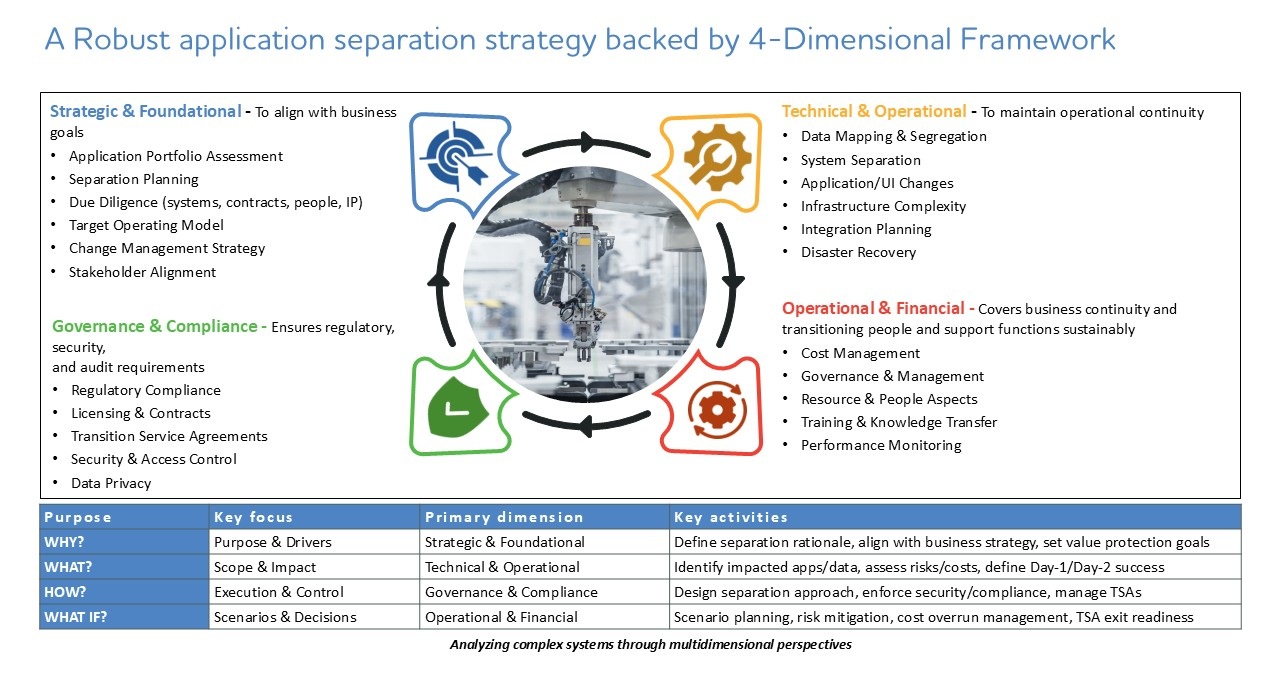
A robust application separation strategy
A robust application separation strategy
Dimension 1: Strategic and foundational (The why)
This dimension establishes intent, principles, and direction.
Key focus areas:
- Separation rationale and value protection objectives.
- Application portfolio assessment and treatment classification.
- Due diligence across systems, contracts, people, and IP
- Target operating model (Day 1 and Day 2).
- Stakeholder alignment and change strategy.
Outcome: Clear separation principles and defensible application treatment decisions.
Dimension 2: Technical and operational (The what)
This dimension ensures execution feasibility and operational continuity.
Key focus areas:
- Data discovery, classification, and segregation.
- Integration and interface disentanglement.
- System, infrastructure, and cloud separation.
- OT and plant safety validation.
- Disaster recovery and cutover readiness.
Outcome: Technically viable separation with minimised operational disruption.
Dimension 3: Governance and compliance (The how)
Key focus areas:
- Licensing and contractual compliance.
- IP protection and code ownership clarity.
- Security architecture and access separation.
- TSA definition, enforcement, and audit readiness.
- Data privacy and regulatory adherence.
Outcome: Separation that withstands audits, legal scrutiny, and regulatory review.
Dimension 4: Operational and financial (The what if)
This dimension prepares the enterprise for sustainable operations post separation.
Key focus areas:
- Cost baselining and allocation.
- Run model and sourcing design.
- People transition and knowledge transfer.
- Service continuity and stabilisation.
- Benefits realisation and TSA exit planning.
Outcome: Financially viable, operationally independent entities.
The key differentiator is not the framework itself, but how AI augments each dimension as an end-to-end intelligence layer, improving speed, accuracy, and decision confidence throughout the separation lifecycle.
End-to-end Separation lifecycle
A phased separation journey; not a linear checklist.
The schema is applied consistently across five lifecycle phases (see Figure 2):
- Discovery – Portfolio assessment, due diligence, application categorisation.
- Design – Target architecture, data and integration design, target operating model definition.
- Separate – System, data, infrastructure, and OT carve out execution.
- Knowledge transfer – Capability transition, stabilisation, and ownership handover.
- Business Change and decommission – Legacy shutdown, TSA exit, cost optimisation.
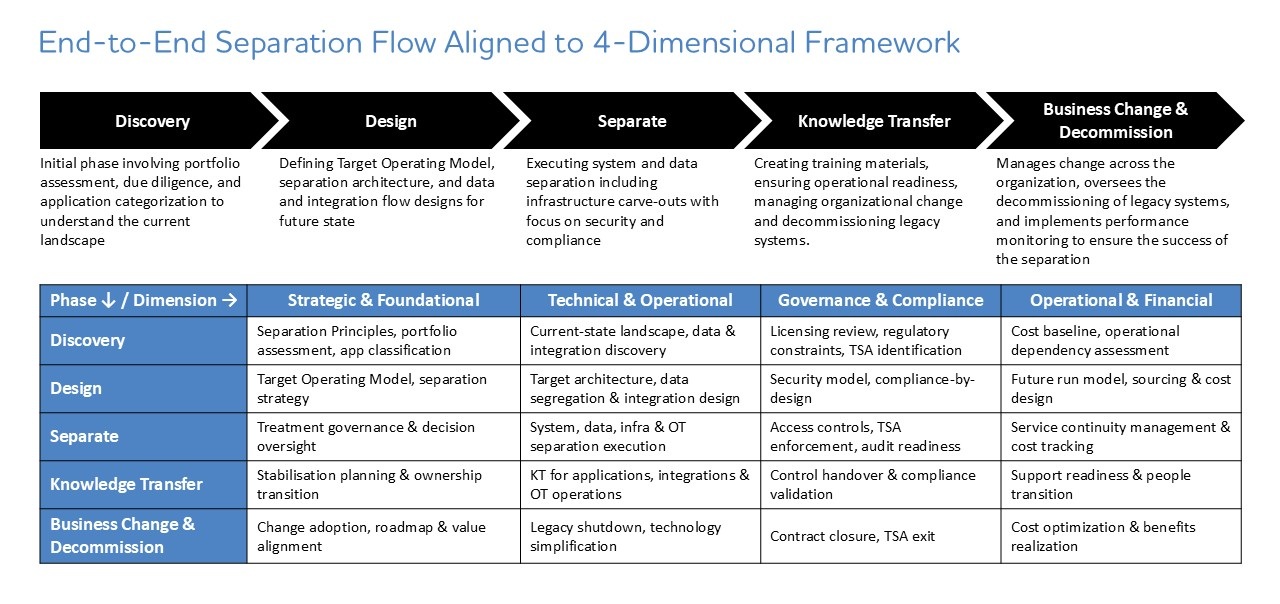
Separation Flow Aligned to 4D Framework
Separation Flow Aligned to 4D Framework
Each phase is executed through all four dimensions simultaneously, visualised as sequential rather than a linear checklist. Each phase must address all four dimensions in parallel to avoid late surprises.
Application categorisation: A practical separation lens
Manufacturing landscapes typically span five application categories, each requiring a distinct separation approach (See Figure 3):
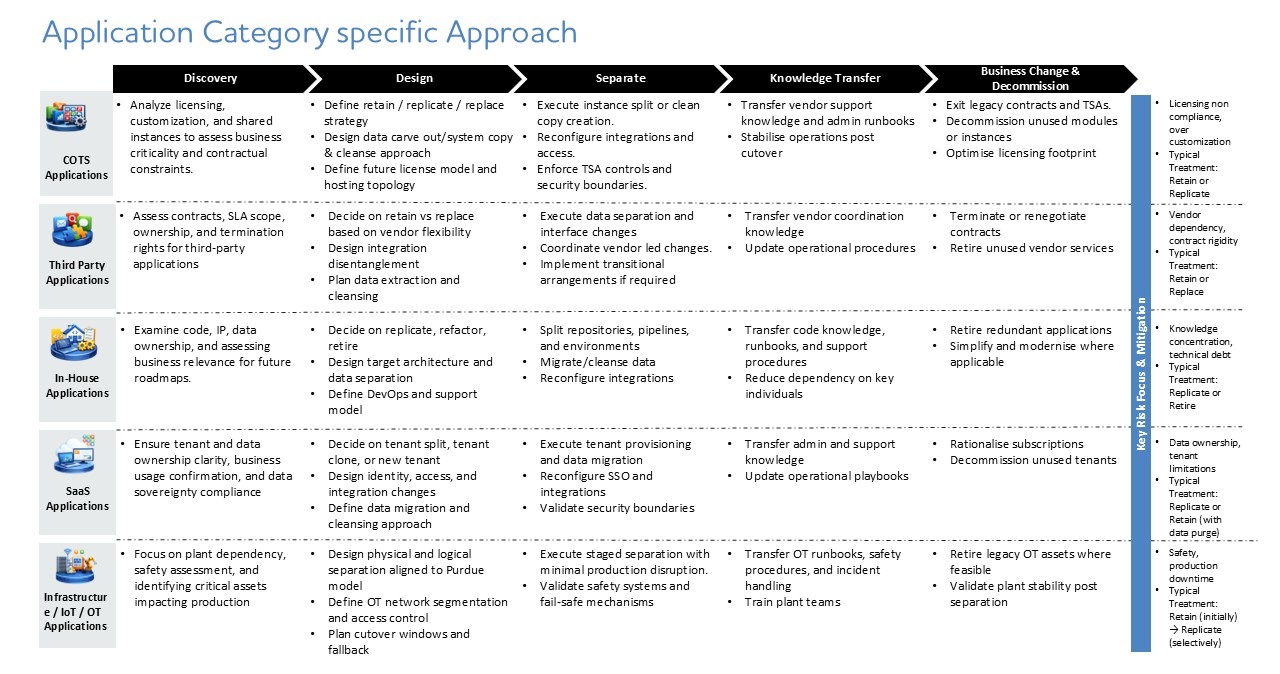
Application category specific approach
Application category specific approach
AI enables automated classification of ERP and commercial off-the-shelf (COTS) usage patterns and recommends optimal retain vs replicate decisions.
- COTS applications (ERP, PLM, MES, CRM)
- Licensing-driven decisions
- Typical treatments: Retain or replicate
- Third party applications
- Contract and vendor flexibility dependent.
- Typical treatments: Retain or replace.
- In house applications
- IP, skills, and technical debt driven.
- Typical treatments: Replicate, refactor, or retire.
- SaaS applications
- Tenant ownership and data sovereignty focused.
- Typical treatments: Replicate or retain with purge.
- Infrastructure/IoT/OT Systems
- Safety-critical, production linked.
- Typical treatments: Retain initially.
The approach combines consistent governance with category-specific execution to deliver clean separation, controlled risk and compliance, operational independence, and an optimised cost footprint, while ensuring business continuity and a risk-managed separation.
AI as a separation force multiplier
Where AI creates differentiation across phases and dimensions:
AI in discovery and portfolio rationalisation:
- Automated application discovery (including shadow IT detection).
- AI-based clustering of applications by business capability.
- Portfolio rationalisation recommendations (retain/retire/replicate).
- Contract intelligence extraction (licence and IP risks).
AI in data, integration and separation planning:
- Automated data lineage and entity classification.
- Integration dependency graph creation (critical for IT-OT separation).
- Separation sequencing recommendations (minimising downtime).
- Identification of data ownership and duplication risks.
AI in manufacturing operations intelligence:
- OT system dependency mapping (MES, SCADA, historians).
- Digital twin simulations to validate plant impact.
- Predictive risk analysis for production disruption.
- Safety scenario modelling before cutover.
AI in TSA optimisation and exit acceleration:
- TSA scope optimisation (avoiding over-dependency).
- Cost leakage detection across TSAs.
- Exit readiness prediction models.
- Continuous tracking of TSA exit velocity.
Other key differentiations:
- Portfolio intelligence: Automated app clustering and treatment recommendations.
- Data intelligence: Entity specific data discovery and lineage inference.
- Integration intelligence: Dependency graph analysis and decoupling sequencing.
- OT intelligence: Digital twin simulations and anomaly detection.
- Contract intelligence: Licence and IP risk extraction.
- Security intelligence: Identity and access management (IAM) cleanup and threat modelling.
- TSA intelligence: Scope recommendation and leakage monitoring.
- Cost intelligence: Scenario based cost and sourcing optimisation.
- People intelligence: Knowledge transfer copilots and adoption analytics.
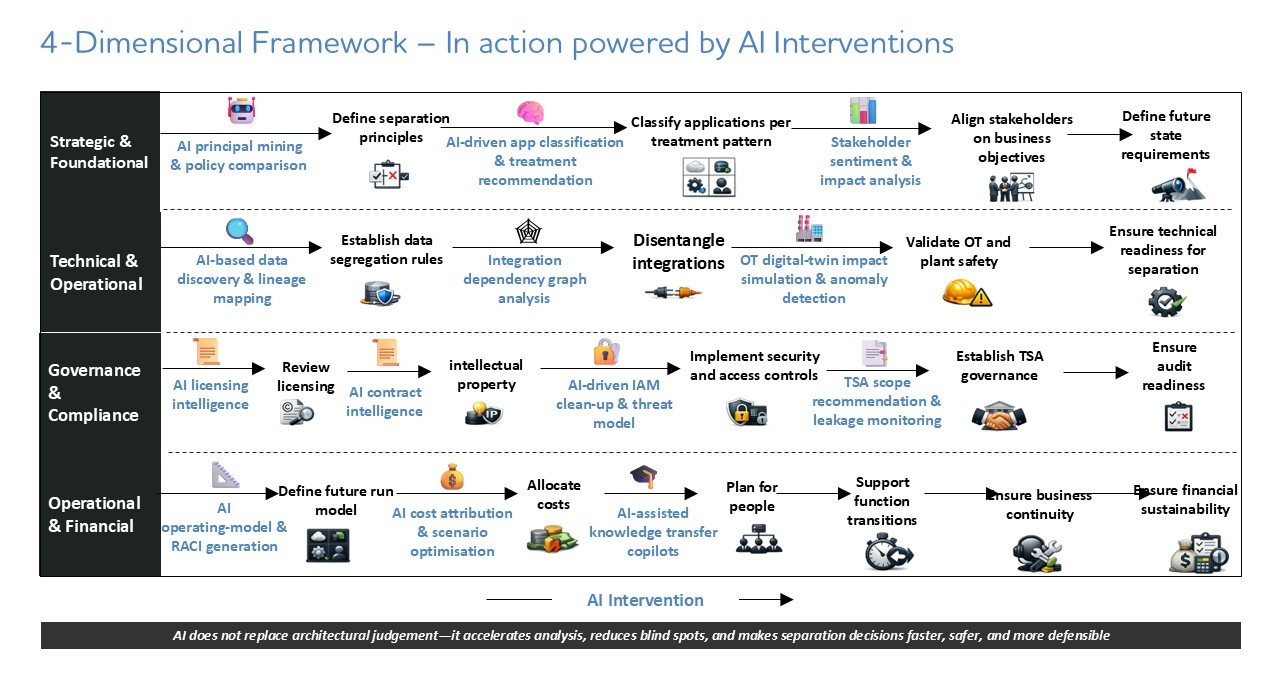
A 4-dimensional framework with AI interventions
A 4-dimensional framework with AI interventions
AI in separation is not a generic productivity tool—it acts as a decision intelligence layer that makes complex manufacturing carve-outs predictable, auditable, and significantly faster (see Figure 4 above).
Cost and risk overlay: Designing for reality
Every separation phase carries predictable cost and risk patterns:
- Highest technical and operational risk occurs during execution (separate phase).
- Governance and licensing risks peak early if not addressed in the discovery phase.
- Financial risks escalate if TSAs persist beyond intended timelines.
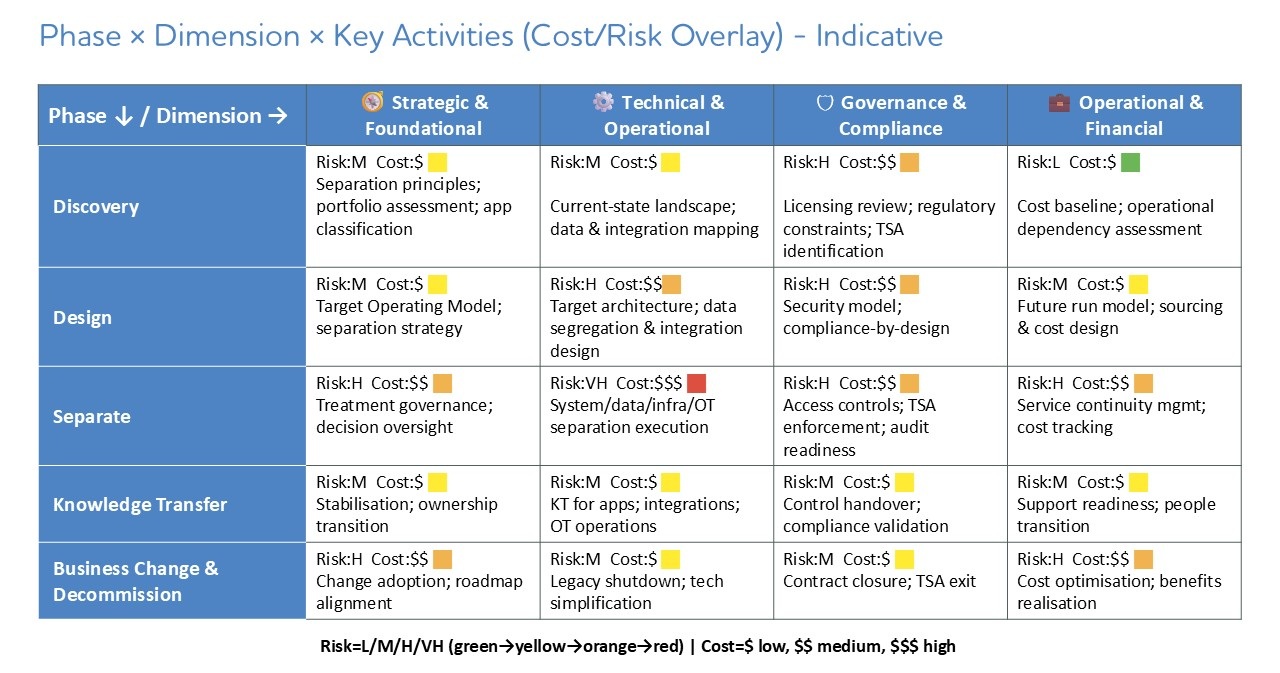
Phase × Dimension × Cost/Risk Overlay
Phase × Dimension × Cost/Risk Overlay
Overlaying risk (L/M/H/VH) and cost ($/$$/$$$) across phases and dimensions (see Figure 5 above) allows leaders to:
- Focus executive attention where it matters.
- Proactively deploy AI where risk concentration is highest.
- Avoid late stage surprises and TSA creep.
Strategic approach for spin-off
Separation readiness is not assessed for reporting—it is used to drive executive decisions on when to proceed, delay, or restructure a carve-out.
Below are the key parameters to measure efficiency for spin-off activities.
1. Separation readiness index (SRI) - Self assessment checklist for manufacturing separations
The SRI provides a quantitative, executive friendly view of how prepared an enterprise is to execute a spin off or separation without value leakage.
How it works
- 4 dimensions × 5 criteria each
- Score each criterion 1 (Not Ready) to 5 (Fully Ready)
- Dimension score = average
- Overall SRI = weighted average
Practical outputs that it can address:
- “Top 5 risks before Day 1”
- “Critical systems blocking separation”
- “TSA dependency hotspots”
- “Cost overrun indicators”
SRI interpretation
- 0–2.0: High risk – Separation not advisable
- 2.1–3.5: Medium risk – Significant mitigation required
- 3.6–5.0: Ready – Controlled execution feasible
How leaders/enterprises should use SRI
- Identify high-risk dimensions before investments
- Prioritise AI-led interventions in weak areas
- Decide TSA dependency strategy early
- Define go/no-go criteria for separation milestones
2. Day 1/Day 100/Day 365 Maturity Model
Horizon |
Focus |
Characteristics |
Day‑1 (Legal Separation) |
Stability & Compliance |
Systems operational, TSAs active, data segregation enforced, security controls live |
Day‑100 (Operational Independence) |
Optimisation |
Reduced TSAs, stabilised support, refined cost model, improved performance |
Day‑365 (Value Realisation) |
Differentiation |
TSA‑free, optimised application landscape, modernised platforms, measurable value realisation |
This maturity model should be actively tracked using an executive dashboard, not treated as a static milestone plan.
3. Manufacturing specific AI reference architecture
The reference architecture combines governance, AI intelligence, manufacturing applications, integration and OT fabrics, and security controls to support scalable and repeatable separation programmes.
4. Board-level separation dashboard (Indicative)
Executive dashboards should track readiness, TSA exit velocity, risk concentration, cost performance, and operational stability across Day1, Day100, and Day365 horizons.
Implementation Guidance:
Implementation progresses through discovery, design, and execution phases, combining portfolio assessment, AI-enabled analysis, governance controls, and operational stabilisation.
Measurable business outcomes enabled by AI:
- Accelerated timelines (~30 – 35%), faster discovery, and planning cycles.
- Reduced TSA costs through optimised scope.
- Lower risk of production disruption.
- Improved compliance and audit defensibility.
- Faster Day100/Day365 stabilisation.
What sets us apart
The 4-dimensional AI-enabled schema stands apart because it:
- Is manufacturing native, not IT generic.
- Treats OT and plant safety as first-class concerns.
- Integrates AI selectively, not opportunistically.
- Aligns architecture, governance, people, and finance.
- Is repeatable across manufacturers, not client specific.
A proven strategy
Manufacturing separations are becoming a repeatable strategic capability rather than isolated transformation events. Organisations that combine a proven separation approach with AI-driven intelligence can accelerate execution, reduce risk, and achieve sustainable value creation. The strategy presented here offers a practical blueprint for turning separation into a competitive advantage.