Industry
Retail

Omnichannel CX and Intelligent Innovation – The Future of Retail
HIGHLIGHTS
- Organisations operating on a global stage face pressures from volatile supply chains, talent shortages, and shifting geopolitical conditions, forcing enterprises to rethink their operating models and use global resources to maintain competitiveness.
- This has accelerated the setting up of global capability centres (GCC) and global business services (GBS) as companies seek to optimise costs, enhance agility, and access world-class talent.
- Artificial intelligence (AI) is reshaping the GCC, GBS models as organisations enable their innovation and digital hubs in various global locations to accelerate strategic enterprise AI initiatives.
- AI, however, increases the need for orchestrated global service models that can enforce data governance, enable AI-driven workflows, and create controlled environments through digital centres of excellence (COEs).
On this page
On this pageinpage
Introduction
Globalisation has become increasingly complex, with organisations facing pressure from volatile supply chains, talent shortages, and shifting geopolitical conditions to achieve success.
These dynamics compel enterprises to rethink their operating models and use global resources to maintain competitiveness. In recent years, the rise of global capability centres (GCC) and global business services (GBS) has accelerated as companies seek to optimise costs, enhance agility, and access world-class talent.
The GCC, GBS models are themselves being reshaped by artificial intelligence (AI) as organisations enable their innovation and digital hubs in various global locations to accelerate strategic enterprise AI initiatives. Rather than replacing GCC, GBS structures, AI increases the need for orchestrated global service models that can enforce data governance, enable AI-driven workflows, and create controlled environments through digital centres of excellence (COEs).
With this changed socioeconomic environment—and based on our experience designing and implementing large-scale GCC, GBS models—we have identified key factors that consistently lead to successful transformation with minimum disruption. This article explores three critical questions that determine success for business, technology, data and AI-enabled services:
- How deep is right: Determining the right level of leadership involvement, transition methodology, and organisational change management (OCM) based on organisational maturity
- When and what to transform: Designing the right sequence of moves that accelerate value realisation without overwhelming the organisation.
- Where to focus (micro-personalisation of the model): Identifying the most impactful factors for your organisation to achieve success.
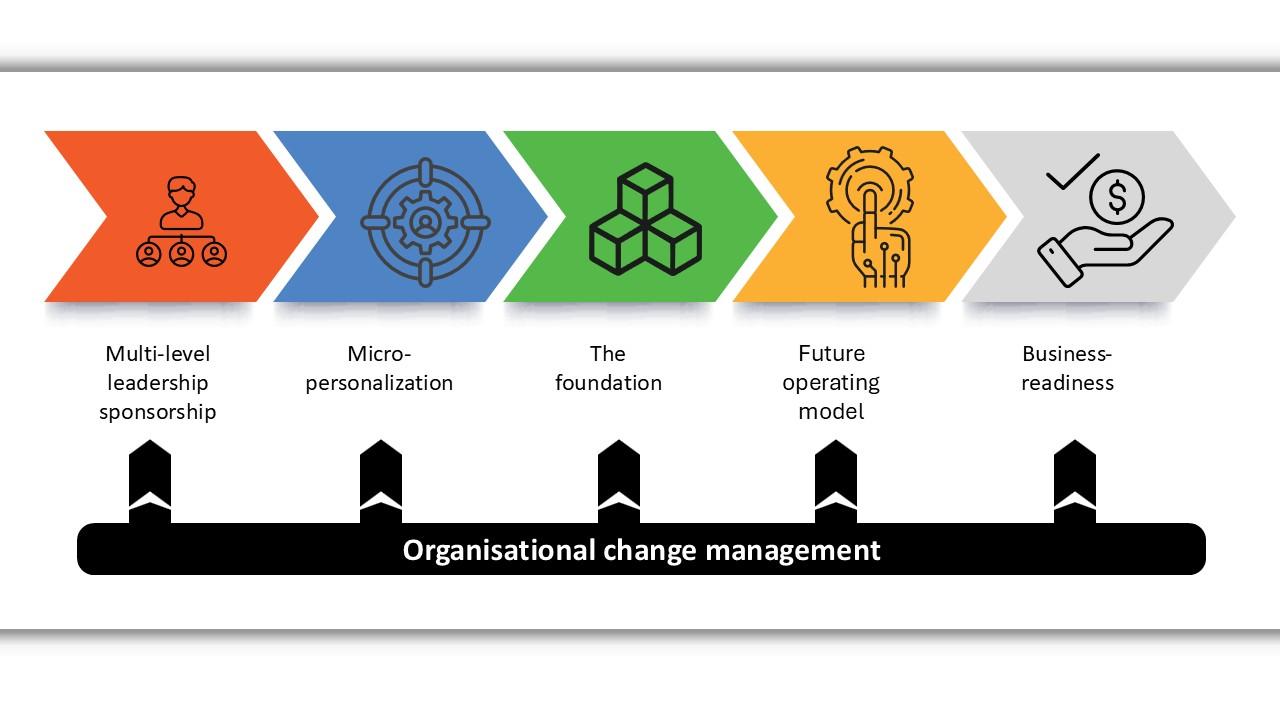
Figure 1
GBS Transformation Readiness Framework (GTRF)
Figure 1
These questions become pertinent in relation to five aspects that determing the transformation readiness framework for GBS (see Figure 1). They are: multi-level leadership sponsorship, micro-personalisation, laying a foundation with an AI and transformation office, future operating model design, and business readiness.
Multi-level sponsorship
Having leadership sponsorship even three to four levels below the chief executive officer (CEO) is essential for large-scale global transformation initiatives like GCC, GBS.
In many cases, organisations limit engagement to CEO-1, but experience shows greater return on investment (ROI) is achieved when sponsorship extends deeper to CEO-3 or -4 levels, especially for high-impact programmes where execution discipline and change adoption matter as much as design.
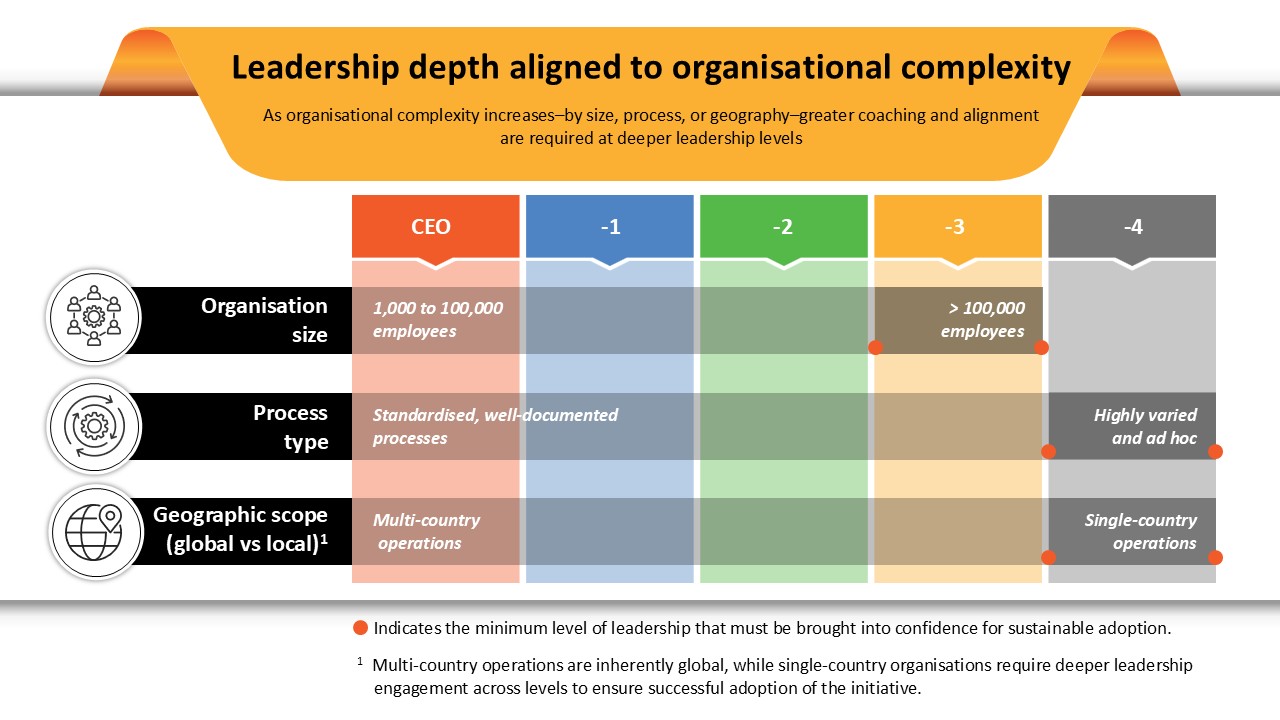
Figure 2
Leadership depth aligned to organizational complexity.
Figure 2
Multi-level leaders must clearly understand the strategic intent of the transformation, their decision rights, and the behaviours expected of them in the new model. Equipping them early with clear messaging, talking points, and engagement guidance enables consistent communication, faster issue resolution, and visible role modelling of new ways of working. As AI becomes embedded into GCC, GBS operating models, leaders at multiple tiers must also be aligned on responsible adoption, governance, and digital workflows. Otherwise, transformation stalls at the technology layer. When sponsorship is cascaded and aligned, it accelerates trust, speeds decision-making, and drives faster adoption of the new model.
Personalising the model
Today, micro-personalisation is no longer optional.
It is essential for both consumer-focused initiatives and business-to-business models like GCC, GBS. Success hinges on tailoring the execution model: selecting the right processes, customising transition methods, defining measurable success criteria, and planning for risks with a deep understanding of the organisation’s unique constraints, priorities, and culture.
No two GCC or GBS transformations are the same. Vendor partners often approach a new engagement as just another GCC, GBS implementation, leveraging repeatable approaches from multiple client experiences. Meanwhile, the client organisation sees its own context as highly distinct and expects a fully customised model. True success sits between these two perspectives: combining proven, time-tested practices with selective micro-personalisation aligned to the levers that matter the most.
Critical components, such as transition approach, operating model design, future scalability, and global versus local alignment, must be tailored based on the organisation’s maturity and process complexity. Early assessments help identify where standardisation will drive efficiency and where customisation is essential for success.
Devil is in the details
An interesting observation in large transformations is that organisations invest significant time in defining scope, selecting the right geographical location, and selecting the right delivery partners. But once the GCC, GBS build is approved, there is often a rush to ‘move fast and operationalise’. Of course, time is money and elongating such initiatives adds additional business risks.
But to transform effectively, the depth of analysis and handover rigour matter more than the speed of launch. This rigour becomes even more critical when embedding AI-enabled workflows, as poorly documented processes create high-risk automation and potential misalignment.
Allocate sufficient time and the right team mix to thoroughly address all details. Areas that typically require a deep-dive validation include:
- Process check: Conduct a Level 5 process analysis. This is particularly relevant for organisations over 50 years old, where informal workarounds exist and tribal knowledge replaces formal documentation. Pay attention to roles where employees have been in their positions for over eight years, as these often carry process shortcuts not documented.
- Infrastructure readiness: Perform comprehensive assessments of technology configurations, including bandwidth stability, dual monitor setups, landline telephones, and other technical requirements that enhance the productivity of the global workforce.
Thorough planning, realistic training environments, and staged knowledge transfer significantly reduce the post–go-live productivity dip and enable faster stabilisation.
Laying the foundation
One of the critical success factors is getting the foundation right early.
An effective foundation should have six elements (see Figure 3) that shape execution discipline, speed of decision-making, and adoption confidence in the enterprise.
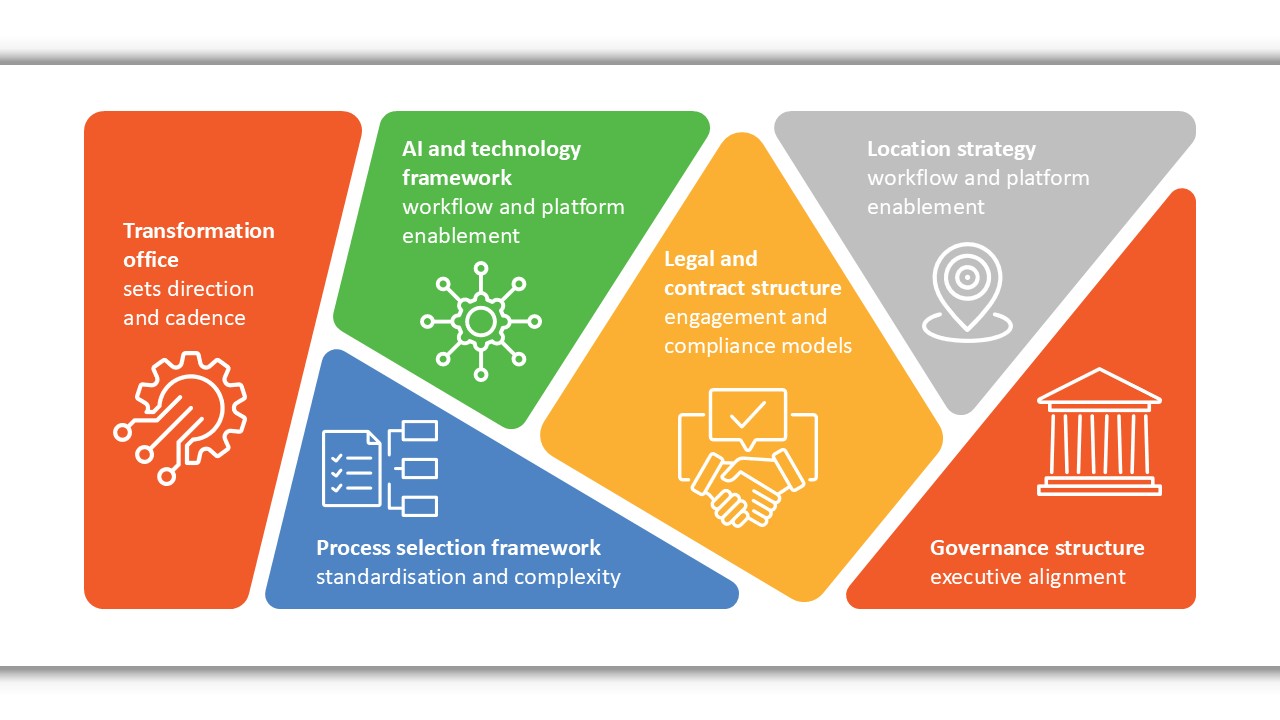
Figure 3
Six foundational elements of a successful transformation office.
Figure 3
The transformation office sets the direction, cadence, and accountability model for the programme. It defines decision rights, integrates cross-functional workstreams, and actively monitors dependencies in process migration, technology enablement, and workforce planning. From day one, program fundamentals must be established in parallel with people-readiness so that adoption momentum grows alongside design maturity.
The technology stack must enable automation, knowledge capture, collaboration, and performance monitoring. Having a dedicated AI forum to fast-track evaluation and implementation of AI use cases is critical for faster transformation and realisation of ROI. If priority for technology is not set from the beginning, organisations fall into traditional GBS, GCC framework, delaying transformation to later stages.
Choosing the right legal structure (eg, captive, hybrid, outsourced) shapes compliance obligations, intellectual property (IP) ownership, employment frameworks, and operational flexibility. Contracts must accommodate multiple engagement models (fixed price for steady-state operations, FTE-based for flexible capacity, and time-and-materials for innovation sprints) to capture opportunities without renegotiation delays during later stages when new processes are onboarded.
Location decisions are made evaluating talent availability, language capability, cost competitiveness, and geopolitical risk. Programme teams should validate shortlisted sites using external data while highlighting career and mobility opportunities. When employees clearly understand why a geography was selected (not just where), they are far more likely to support transitions and align with the organizational objectives.
Choosing which processes move first is critical to establishing credibility. The programme team should apply candidates across four dimensions:
- Standardisation
- Documentation quality
- Nature of work (transactional vs strategic)
- Complexity: Logic vs rule-based
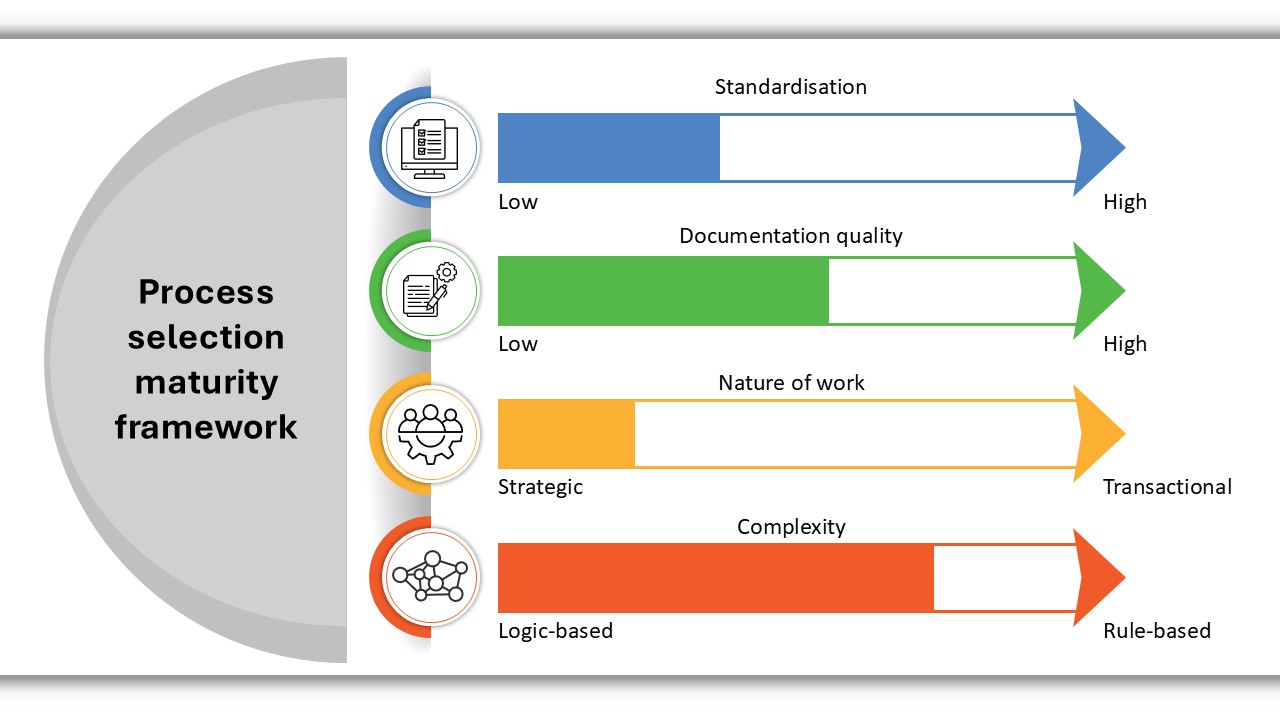
Figure 4
Process selection maturity framework.
Figure 4
Highly standardised, well-documented, transactional, rule-based processes lead early waves. More complex, judgment-driven work follows later.
An effective governance model aligns executive sponsorship with operational execution. Tiered forums (executive steering committees, programme control boards, and operational huddles) ensure decisions are made at the right level and at the right speed. This structure creates predictability in escalation and resolution, which becomes critical when scaling across functions and regions.
Setting up the operating model
Designing the operating model means putting the right work in the right place and defining how retained and global teams jointly create value.
The programme team allocates activities by comparative advantage: locations with deep process talent and modern technology skills take on high-volume transactions, analytics, and continuous-improvement sprints; the retained organisation focuses on cross-functional collaboration, partner interfaces, and decisions that rely on longstanding relationships and institutional memory.
When looking at it with a traditional lens, the instinct is often to shift ‘end-to-end process ownership’ to a single business unit or geography. However, in practice, the most effective models blend retained expertise with the new delivery capabilities. When forming the future operating model, evaluate each process end to end, then determine the activity split by asking:
- Which team brings differentiated skills?
- Where does each activity produce the highest business outcome when executed?
Client experience
In one of our recent global transformations, we:
- Transitioned rule-based transactions to a new geography first, while keeping review and approval with the original team
- Managed dual-team processing initially, which, at first, appeared inefficient but allowed both teams to use their unique strengths
- Protected critical business outcomes during the transition period
- Phased autonomy for the new team, granting more control as expertise grew and stability was achieved
- Delivered better long-term results, improving overall business performance compared to a traditional ‘end to end transfer’ approach
Business readiness
Readiness is more than a final ‘go, no-go’ check; it is a continuous discipline that runs in parallel with solution design and deployment to ensure the organisation can absorb and sustain a new GBS model.
System testing, data migration, and cutover planning are vital, but they only confirm that the platform works. True readiness means that people understand what is changing, leaders are equipped to guide teams through the transition, and the workforce can operate confidently on day one.
OCM anchors this discipline. Change impact analysis early in the programme identifies how each function and geography will be affected, eg, shifts in decision rights, process ownership, and technology use. Those insights shape communications, training, and engagement, so they are role-based and meaningful rather than generic.
Readiness dashboards integrate technical indicators (test completion, defect rates, data quality) with human ones (understanding, confidence, and proficiency by role). Leaders see the full picture: not just whether the system is deployable, but whether the organisation is prepared to adopt it.
During the initial phase of our recent GCC implementation, a critical decision point emerged: should OCM be embedded within the primary system integrator leading the transformation, or operate as an independent function? After a thorough evaluation of the advantages and challenges associated with both approaches, we elected to integrate OCM with the system integrator. This strategy delivered significant benefits:
SI-based OCM teams typically apply tested playbooks from multiple large programmes, giving predictable quality and reducing the risk of inexperienced or uneven change support that can occur with independent or internal teams.
Participating in functional design sessions makes it easier to identify process, stakeholder, and technology-related change impacts early, reducing surprises.
Immediate visibility to design choices, testing timelines, and cutover plans ensures OCM activities are coordinated with the technical build.
Embedded OCM teams already have established relationships with functional leaders, technical architects, and programme managers, allowing them to influence workstreams quickly and keep changing activities aligned across the enterprise.
Sitting inside the same delivery structure ensures OCM has a voice in decision-making forums, streamlines reporting, and provides leaders with a single integrated view of both technical- and people-readiness.
Readiness succeeds when OCM is fully woven into programme execution: shaping impact assessments, enabling, and aligning leaders with consistent messages and coaching, preparing employees with role-specific learning and hands-on practice, and sustaining adoption through post-go-live hyper-care. This comprehensive approach ensures a launch that is both technically sound and organisationally embraced.
Conclusion
Establishing the right foundation, selecting the optimal operating model, going deep into the details, and rigorously managing readiness create the right conditions for success. When OCM is integrated into each stage (sponsorship, design, execution, and sustainment), organisations achieve faster adoption, minimise risk, and realise measurable business outcomes positioning GCC as an enablement layer through which business, technology, data, AI, and innovation capabilities can scale responsibly and deliver real value.