Industry
Retail

Omnichannel CX and Intelligent Innovation – The Future of Retail
HIGHLIGHTS
- Traditional demand forecasting focuses on what customers will buy, however, resilient planning requires visibility into whether the supply network can actually deliver under changing risk conditions. Network-aware demand intelligence connects demand, supply structure, and external risk signals to close this gap.
- Anticipatory demand intelligence shifts forecasting from a reporting activity to a strategic decision capability, enabling faster response, stronger resilience, and sustained competitive advantage in volatile environments.
- By linking demand forecasts with supplier dependencies, country exposure, and climate and geopolitical risk indicators, organisations can identify disruption risks early and take proactive sourcing and inventory decisions before shortages occur.
On this page
On this pageinpage
Introduction
For decades, global supply chains have been optimised for efficiency, scale, and cost. They were not designed for sustained volatility.
In recent years, grocery retailers, manufacturers, and suppliers have faced repeated disruptions driven by climate shocks, geopolitical tensions, port congestion, energy shortages, labour constraints, and sudden regulatory changes. Droughts have reduced crop yields, floods have disrupted transport corridors, and trade restrictions have delayed or cancelled shipments. Yet many demand forecasting systems still operate on an implicit assumption: that supply will be available when customers place their orders.
This assumption creates a critical blind spot. Retailers may accurately forecast rising demand for essential products but lack visibility into whether upstream supply networks can fulfil that demand at the required time, cost, and quality. When disruptions finally appear in operational data, the response window is often narrow, forcing expensive mitigation actions or resulting in lost sales. At the same time, consumer expectations for uninterrupted product availability continue to rise. Regulators are also placing greater emphasis on resilience, traceability, and sustainability across supply chains. In this environment, failing to anticipate disruptions impacts not only revenue, but also brand trust, regulatory compliance, and long-term competitiveness.
The challenge facing leaders today is no longer limited to predicting what customers will buy. It is about understanding whether the global supply ecosystem will be able to deliver what customers will want, when they want it.
Anticipatory demand
Most organisations today use demand forecasting to plan production, inventory, and replenishment.
These forecasts are usually based on historical sales patterns, promotions, seasonality, and macroeconomic indicators. While these methods perform well in stable conditions, they become unreliable when climate events, political risks, supplier failures, or external shocks disrupt supply availability or logistics capacity.
This creates an opportunity to move beyond reactive forecasting toward anticipatory demand intelligence. Anticipatory demand intelligence expands the scope of forecasting by integrating three critical perspectives around the ways:
- customer demand is evolving across channels and regions
- supply networks are structured across suppliers, countries, and logistic routes
- climate, geopolitical, and economic risks are changing over time
When these perspectives are combined, organisations can see problems before they show up in shortages or price spikes. Instead of discovering shortages after they occur, leaders can identify exposure months in advance and act while options remain open.
Network-aware demand intelligence builds on existing forecasting approaches by connecting demand signals with supply networks and external risk factors. This shift enables organisations to move beyond volume prediction toward anticipating real-world outcomes. The framework is built around five core capabilities that work together to strengthen resilience and decision-making. Each capability addresses a specific business question rather than a purely technical requirement.
Core capabilities:
Provides a live view of how retail demand flows through suppliers, countries, ports, and raw material sources. It helps organisations answer a fundamental question -What parts of our supply network are exposed if demand changes?
Continuously assesses emerging risks from weather patterns, agricultural conditions, geopolitical developments, and trade policies. The focus is not on predicting events with certainty, but on estimating probabilities early enough to inform planning decisions.
Creates a digital map of suppliers, sub-suppliers, and sourcing regions, showing where each product truly originates from and improving transparency beyond tier-one suppliers.
Software agents that monitor risks, simulate options, and recommend actions. Monitors demand and risk signals, simulates alternative actions, and recommends practical responses. These insights support planners by narrowing choices, not replacing human judgement.
Enables exploration of complex trade-offs between cost, service, and risk as uncertainty increases, ensuring the framework can scale as decision complexity grows.
Together, these capabilities allow companies to move from “what will we sell?” to “can we safely deliver it?”
Use case
How risk-aware demand intelligence translates to real-world sourcing decisions.
Consider a grocery retailer that sources packaged food from supplier X. While the retailer views supplier X as a single entity, the supplier relies on raw materials sourced from multiple countries.
Using the network-aware demand intelligence framework, the retailer first builds a supply network map. This reveals that 60 percent of the raw materials come from country 2 and 40 percent from country 1. This insight alone highlights a concentration risk that was previously invisible.
The retailer’s existing forecasting system predicts demand of 8,000 tonnes for the product over the next five months. In parallel, climate and risk sensing models analyse rainfall trends, crop health indicators, political developments, and trade policy signals. These models identify an increasing likelihood of drought conditions and potential export restrictions in country 2.
The framework connects these insights to quantify exposure. Nearly half of the forecast demand depends on a region with elevated risk. Decision simulations then evaluate options such as maintaining the current plan, shifting partial sourcing to country 3, building inventory earlier, or renegotiating supplier contracts.
Rather than receiving a generic risk alert, the retailer receives a clear recommendation. For example, reallocate 30 percent of sourcing within three months to reduce disruption risk while maintaining cost stability.
The key outcome is not just awareness of risk, but timely, actionable guidance.
Decision flow
Demand signals feed into a connected intelligence flow that drives timely and coordinated decisions.
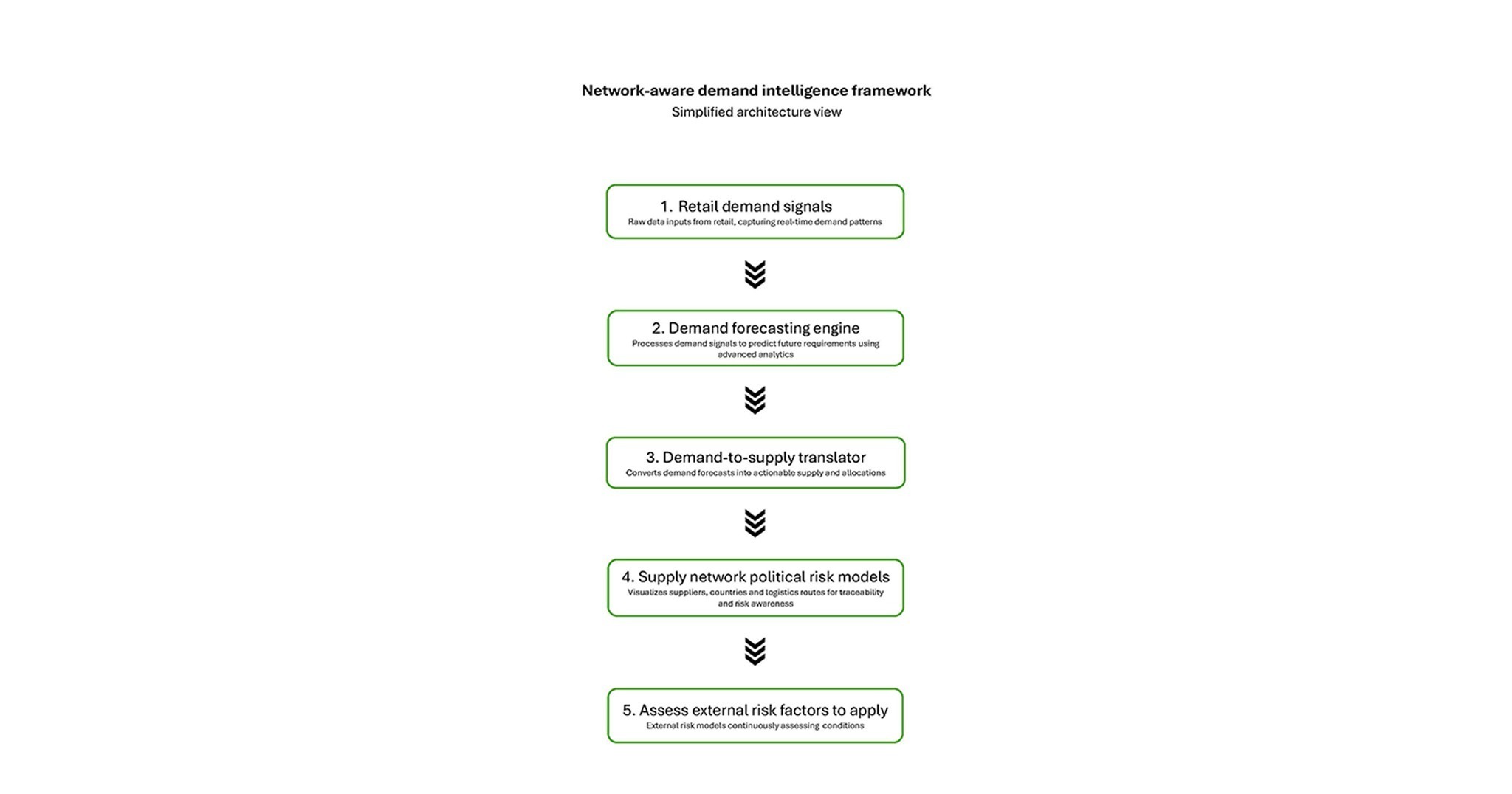
Figure 1
A graphic depicting a simplified view of the Network-aware demand intelligence framework illustrates how insight moves across the planning landscape in a connected and structured flow. The graphic sho
Figure 1
At a conceptual level, the framework operates as a connected flow of insights rather than a collection of isolated systems. Retail demand signals form the foundation, capturing near-real-time information of a customer’s purchasing behaviour. These signals feed into established demand forecasting engines, which continue to generate volume and timing projections. A demand-to-supply translation layer converts forecast demand into supplier, country, and logistics requirements. This step identifies the parts of the supply network required to fulfil future demand. Supply network mapping and external risk models provide the structural and environmental context, continuously assessing climate, geopolitical, and regulatory signals. Decision automation components sit on top of this insight layer, enabling scenario analysis and response recommendations.
The architecture is intentionally modular, allowing organisations to adopt capabilities incrementally without disrupting existing planning processes.
Intelligent spine
Traditional planning approaches rely heavily on historical data, which limits their ability to anticipate unprecedented or accelerating disruptions.
Machine learning models complement these approaches by identifying forward-looking patterns across large and diverse data sources.
Climate-aware machine learning models analyse large volumes of data such as satellite imagery, weather forecasts, soil moisture data, crop yields, and historical disruption records. Over time, they learn how environmental and political factors translate into reduced yields, transport delays, or supply constraints.
That means, rather than waiting for a drought or policy change to impact shipments, these models estimate the probability and potential severity of disruption months in advance. When linked to supply network structures, these probabilities become directly actionable for demand planners.
For example, if crop health indicators in a producing region begin to decline, the model can estimate the likely impact on output. This information is then translated into expected shortages or delays for specific products, enabling proactive sourcing or inventory adjustments.
As supply chains become more interconnected, decision complexity increases rapidly. Organisations must balance cost, service levels, sustainability goals, and risk exposure across multiple suppliers, regions, and inventory options. Relying on a single forecast is no longer sufficient in such an environment.
Future-ready optimisation builds on demand and risk insights by evaluating how sourcing and inventory strategies perform across multiple disruption scenarios. Instead of seeking one “perfect” plan, it helps identify strategies that remain robust under uncertainty. While advanced computing approaches such as quantum optimisation are still emerging, designing the framework to be future-ready ensures these capabilities can be adopted as they mature and begin to deliver practical business value.
Impact and adoption
The network-aware demand intelligence framework delivers value across revenue protection, cost management, customer trust, compliance, and sustainability.
By identifying potential shortages before they occur, organisations can reduce lost sales and avoid costly last-minute sourcing. Improved visibility into supplier dependencies strengthens traceability and supports regulatory reporting. It also supports sustainability goals by allowing companies to choose more stable and responsible sources. Most importantly, consistent product availability during disruption builds long-term customer confidence. Additionally, it transforms forecasting from a reporting function into a strategic capability.
Adoption, however, requires change. Many organisations struggle with fragmented data, limited supplier transparency, and siloed planning teams. There may also be cultural resistance to relying on new models instead of familiar spreadsheets.
These challenges can be best addressed by first focusing on use cases, building trust in the data and confidence through measurable outcomes, and expanding capabilities incrementally.
The future of demand forecasting lies not just in smarter predictions, but in enabling smarter decisions.
Organisations that invest in network-aware demand intelligence will move from reacting to disruptions toward shaping their own outcomes. They will see risks earlier, act faster, and compete more confidently. In an uncertain world, anticipatory insight becomes a lasting source of competitive advantage.
The companies that successfully make this shift will not only survive volatility but also learn to operate better because of it.