Industry
Retail

Omnichannel CX and Intelligent Innovation – The Future of Retail
HIGHLIGHTS
- Of the over 3 billion globally generated feedback entries through multiple touch points, less than 5% are analysed by most retail organisations, thus missing critical insights for enhancing consumer experience.
- There’s a defined need for an augmented large language model (LLM) approach to extract actionable, measurable insights from feedback to boost customer satisfaction and loyalty.
- By leveraging a closed-loop enterprise solution model, reactive processes can be transformed into proactive systems, ensuring that insights lead to measurable actions.
On this page
On this pageinpage
A big source for insights
Multiple touch points across the globe are estimated to generate over three billion feedback entries every day.
These touchpoints include social media, email, websites, apps, and physical stores. However, most retail organisations analyse less than 5% of this feedback, missing critical insights that could enhance consumer experience. This gap has major financial consequences for retailers. Additionally, negative experiences can lead to purchase abandonment or brand switching, contributing to an estimated $3.7 trillion in lost revenues.
While generative artificial intelligence (GenAI) can help with sentiment analysis and intent detection, concerns about hallucinated insights and inconsistent taxonomies hinder adoption. Our novel approach uses a chorus of large language models (LLMs) trained on retailer-specific labelled data in enterprise cloud, ensuring consistent, accurate topic classification. Additionally, early evaluations have shown a 90% reduction in manual effort, 10 basis points improvement in customer satisfaction (CSAT) score, and a 30% increase in labelling accuracy. This can help retailers resolve tactical issues and prioritise strategic actions in almost real-time, enhancing consumer satisfaction and loyalty. While the approach is intended for the retail industry, it is relevant for all industries.
This paper explores the significance of consumer feedback data, the limitations of traditional GenAI models, and how an augmented LLM solution at scale empowers retailers to make data-driven decisions.
The feedback loop
Consumer feedback offers critical insights into products and services, helping brands align with audience needs.
Successful brands actively listen and adapt based on the voice of the consumer. Per some assessments, about 64% of billion-dollar companies now analyse feedback to enhance customer experience. While AI and machine learning (ML) tools help unify and analyse feedback, delivering secure, reliable, and actionable real-time insights remains a challenge.
With this article, we are making a case for analysing consumer feedback across different touchpoints as well as listing the limitations with classic GenAI solutions (see Figure 1). Additionally, we lay out a precise GenAI solution framework for organisations that can create accurate topics for feedback for reliably quantifying the discovered themes.
Through our research into this technology landscape, we have identified six limitations with the capabilities of GenAI-based classic LLMs to offer analysis and insights.
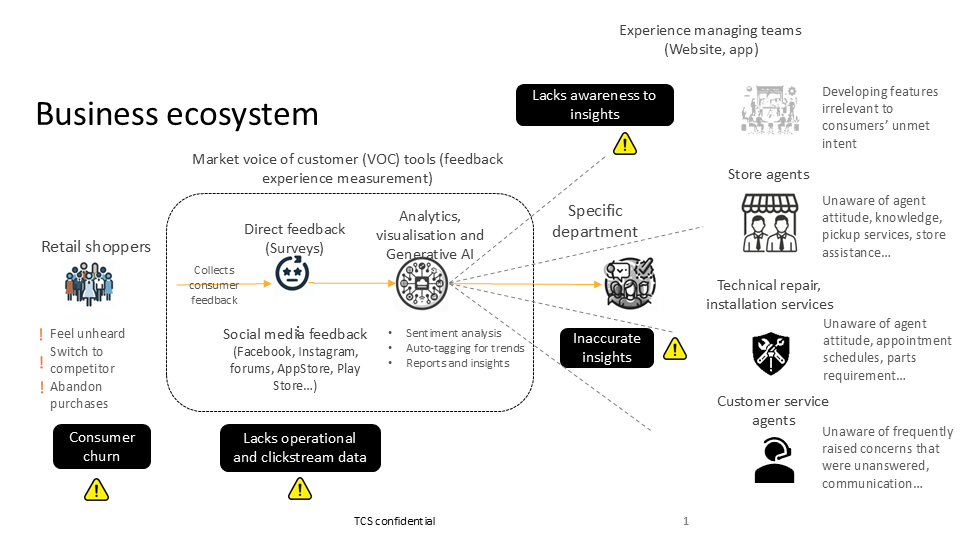
Figure 1
Business ecosystem
Figure 1
The key drawbacks of the existing voice of the consumer ecosystem include:
- Fragmented insights: Survey tools miss key inferred data (eg, clickstream), making feedback analysis incomplete and root causes hard to identify.
- Reactive insights: Analysis is based on post-event consumer feedback—feedback after consumer experience. This causes the organisation to fall behind consumer expectations.
- Call for help: Per some estimates, 40% of consumers leave feedback when they need help. Essentially, when in desperate need of help, they can leave personally identifiable information (PII) information at risk with third-party solution providers.
- Insights not democratised: Insights from market tools aren’t democratised to reach every department in an organisation due to tool licence limitations and internal team hierarchies, making the customer experience (CX) strategy ineffective.
- Suboptimal LLMs: Platforms rely on fixed, suboptimal LLMs, ignoring better-performing alternatives, leading to poor analytics.
- Inconsistent labels: Manual tagging is impractical due to high feedback volume. While AI can auto-tag, it often assigns inconsistent labels to identical feedback, making the process unreliable.
These six drawbacks call for the development of a new AI solution in the enterprise cloud platform. Augmented training for the LLM will solve this problem and generate accurate and consistent labels for measuring the impact of discovered themes.
Closing the loop
By leveraging a closed-loop enterprise solution model, we aim to transform reactive processes into proactive systems, ensuring that insights lead to measurable actions.
This approach emphasises not only on the detection of issues and patterns in real-time but also on a cohesive process that integrates insights into a system evolving with business needs (see Figure 2).

Figure 2
Enterprise cloud data platform
Figure 2
A high-level approach for processing consumer feedback using augmented LLMs. uses three integrated platform groups (see Figure 2):
- Enterprise cloud for unified data collection
- Machine learning for model selection
- Auto-tagging, and visualisation for tracking theme trends and enabling action
The three platform groups help gather the necessary data for LLM and integrate with enterprise operational, transactional, and behavioural data. This builds the ability to discover the right model for processing feedback and auto-tag to display accurate theme trends (see Figure 3).
- Enterprise cloud platform for multi-channel insights: This platform enables organisations to break down data silos with third-party survey market tools and bring consumer feedback into the unified data ecosystem as first-party data. The feedback data sources are also integrated with enterprise operational, transactional, and behavioural data. This preserves sensitive consumer information and overcomes the partial insights generated using LLM.
- Machine learning platform for game-changing AI capabilities: GenAI-based LLMs are poised to revolutionise the voice of the consumer. They can help analyse big data and provide actionable insights at a scale that is beyond the capacity of human analysts. Here’s a quick look at the classic versus augmented LLM models and what they offer.
| Classic LLM | Augmented LLM |
| Pre-trained LLMs auto-tag feedback with contextually relevant but often inconsistent or abstract labels. For instance, campaign-related input might be tagged as 'sales', 'marketing', or 'promotion', or even have hallucinated labels, across different runs, reducing reliability. These inconsistencies require tedious manual review to detect. | To ensure consistent and accurate labelling, the LLM is custom-trained with domain-specific samples. Using retrieval-augmented generation (RAG), the model accesses training data from secure cloud storage, enabling it to learn organisational context and generate precise, actionable labels. |
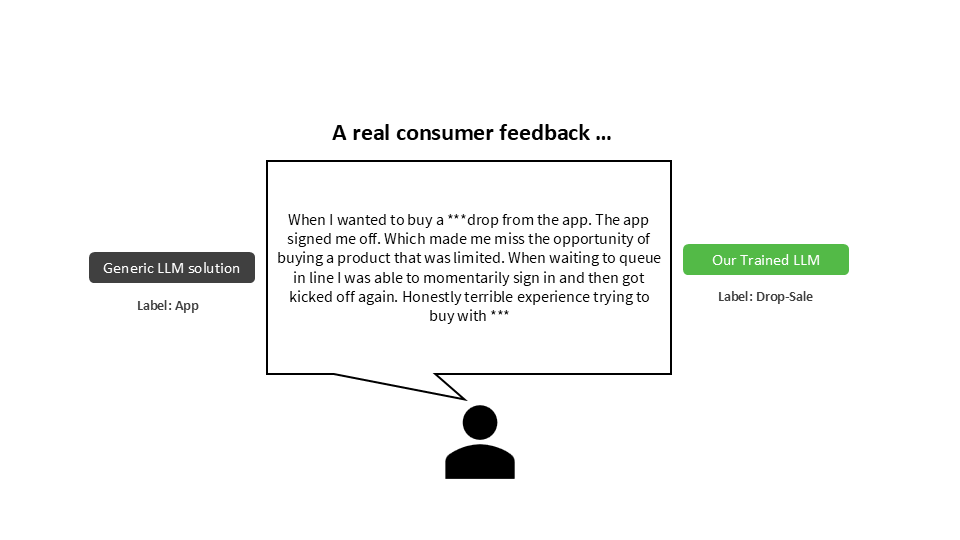
Figure 3
Sample feedback labelling
Figure 3
How it’s done using CI-CD workflow
To deploy augmented LLMs reliably at scale, we use a CI-CD pipeline with cloud-native tools. Kubernetes Cronjobs and Cloud Scheduler manage parallel batch and streaming jobs. Insights are shared in near real-time via event-driven triggers to platforms like Teams, Slack, or Google Chat. Docker and Kubernetes ensure scalable, fault-tolerant LLM services. Centralised logging and dashboards track key metrics—latency, token usage, model drift, and errors—supporting auto-scaling and retraining. This setup ensures insights remain accessible, timely, and actionable. With the deployment pipeline in place, the final step is to ensure insights are accessible and actionable through effective visualisation.
3. Visualisation platform for intelligent analytics: It is essential to build analytics and visuals within the enterprise cloud platform in case insights are unavailable on the common platform. Additionally, it is important to capture the benefits from the democratized insights across every enterprise department. Such a system can write the LLM output to the unified data platform, enabling visual analytics from accurately labelled feedback. This can then help provide a reliable, real-time visual according to the trends as well as subsequent quantified impact over a period of time (see Figure 4).

Figure 4
AI analytics for accurate, quantifiable impact
Figure 4
Return on investment
By converting vast volumes of consumer feedback into precise, actionable insights, the solution empowers brands to respond swiftly to consumer needs, optimise investments, and enhance satisfaction.
This approach strengthens loyalty and positions retailers to scale their success across industries.
For example, we deployed this solution model for a US-based electronics retailer with an annual feedback volume of more than 1 million records. The solution helped them realise the following key benefits using our augmented LLM solution:
- Listening to feedback raised CSAT score by 10 basis points, enhancing loyalty and competitive edge
- Identified growth opportunities, reduced misaligned investments, and improved returns
- Timely support reduced consumer churn, increasing lifetime value
- Enhanced feedback loop efficiency through automated LLM workflows prioritising critical issues, saving time, and surfacing trends.
- Insights democratised across departments via a common portal, reducing reliance on technical skills.
- Easily integrated with other platforms and data types, scalable to other industries like telemetry and healthcare.
- Built on a secure cloud platform with encrypted, private LLM instances protecting consumer-sensitive information.
- Organisation-specific samples showed improved tagging accuracy and adaption to new data.
- Easily updated models and parameters without code changes, ensuring optimal LLM performance.
Results
The retailer recently implemented the augmented LLM solution, and their customers were highly satisfied (see Table 1).
| Metrics | Description | Value |
| CSAT score | Consumers rate their satisfaction with the brand and offerings, typically on a 1-5 scale | +10 bps |
| Manual effort reduction | This indicates the operational efficiency achieved | 90% |
| Feedback labelling, tagging accuracy | This indicates the ground truth benchmark for measuring the accuracy of augmented LLM tagging against manual labelling | 96% |
AI and personalisation
There’s a defined need for an augmented LLM approach to extract actionable, measurable insights from feedback to boost customer satisfaction and loyalty.
A solution that can train pre-existing LLMs with internally categorised data stored in the cloud can ensure accurate tagging and enable precise, data-driven decisions. Additionally, features like optimal model selection, secure data handling, and customisable frequency for publishing insights make this approach uniquely effective.
Going forward, retailers need to align the voice of consumer practices with sustainability and personalised experiences based on relevant feedback and by adapting strategies to be in tune with emerging trends. This will be key to advancing customer experience initiatives for growth and differentiation. Finally, the goal is to link feedback with consumer journey analytics, visualise operational data, and map behaviour for root cause analysis with human-assisted resolution. GenAI in the enterprise cloud can help accelerate model experimentation and deployment of the best-performing algorithms. In the long run, this scalable approach can enable faster insight discovery across diverse data sources and industries, enhancing organisational performance through advanced AI.