Industry
Retail

Omnichannel CX and Intelligent Innovation – The Future of Retail
HIGHLIGHTS
- Digital retail ecosystems have become increasingly complex and data driven. That means conventional quality engineering (QE) models, dependent on manual testing, siloed teams, static coverage, and fragmented shift-left initiatives, are no longer sufficient to ensure perceptiveness for the evolving retail landscape focused on delivering superior customer experiences.
- An agentic QE marketplace—a unified ecosystem of specialised autonomous agents that work round the clock to protect and enhance retail operations by seamlessly orchestrating test strategy planning, synthetic data generation, fault injection, and risk assessment—can help overcome this challenge.
- QE will be a strategic and self-governing approach, adapting dynamically to changing systems and business needs. This will enable retailers to roll out features faster, contain cart abandonment, improve omnichannel performance, and deepen customer loyalty through flawless digital experiences.
On this page
On this pageinpage
Abstract
Poor quality of digital experience in retail comes with a staggering price tag.
Per some studies, the global average shopping cart abandonment rate stands at an alarming 70.19%, with mobile shoppers abandoning carts at rates exceeding 80%. More troubling is the fact that 48% customers abandon carts due to unexpected costs and security concerns, a 42.8% increase in blocked security threats on big events like Black Friday, and critical infrastructure failures during peak shopping moments. In a nutshell, modern retail e-commerce is plagued with multiple challenges that have been exacerbated by the rapid pace of industry evolution.
Ensuring top-notch e-commerce services requires perceptiveness for implementing and utilising new technology without functional glitches, managing real-time content changes, handling customer interactions efficiently, and maintaining continuous monitoring—all the while meeting demanding release schedules where developers must resolve issues in hours rather months. Yet current approaches—manual testing, siloed teams, reactive incident response—cannot keep pace. A single checkout bug during peak season can cost millions in abandoned transactions. Additionally, inventory-sync failure can erode customer trust, while payment gateway failures damage brand reputation, and customer loyalty.
Per our TCS Global Retail Outlook while retail executives overwhelmingly view AI as cornerstone to future success the actual deployment remains largely superficial. The study poll for retailers indicates that most of them have implemented chatbots (51%) and basic AI tools, but only 24% use AI for autonomous decision-making, and 85% haven't even begun implementing multi-agent systems. This gap between recognition and implementation represents both the industry's greatest challenge and its most significant opportunity.
As digital retail ecosystems become increasingly complex and data-driven, traditional quality engineering (QE) approaches have struggled to keep pace. Fragmented tools and disconnected processes slow retail release cycles and limit visibility across customer-facing retail applications and services. This whitepaper introduces the agentic QE marketplace—an intelligent, collaborative architecture where specialised agents augment existing retail development and QE ecosystems aiding perceptiveness for retailers. These agents work together to enhance test creation, execution, coverage, observability, and continuous feedback. A unified instrumentation strategy underpins the framework, ensuring retail-specific cohesion, optimisation, and significant reductions in resource usage and QE cycle time. By integrating core infrastructure agents, operational excellence agents, and domain-specific agents, the framework redefines QE as a proactive, self-optimising retail quality fabric—one that continuously learns, adapts, and drives customer experience and business outcomes for the retail sector.
Seeking superior CX
To deliver superior customer experiences, modern retail enterprises need to use data to become perceptive of the forthcoming evolutions.
Retailers rely on intricate microservices, distributed data pipelines, third-party integrations, and rapid release cycles to ensure good customer experience. However, conventional QE models, dependent on manual testing, siloed teams, static coverage, and fragmented shift-left initiatives, are no longer sufficient for the current evolving retail landscape.
An agentic QE marketplace will introduce a unified ecosystem of autonomous agents, each augmented with mathematical optimisers and specialised QE functions. Capabilities such as test strategy planning, synthetic data generation, fault injection, and risk assessment are seamlessly orchestrated within a composable, discoverable, and version-controlled marketplace. This paradigm elevates QE from a reactive function to a strategic, self-governing discipline capable of adapting dynamically to changing systems and business needs in retail. For retailers, this results in faster feature rollouts, reduced cart abandonment, improved omnichannel performance, and deep customer loyalty through flawless digital experiences.
Intelligent quality
Technology teams for a mid-sized retailer generally prepare for a 10x surge in digital traffic over a typical holiday season such as Thanksgiving.
This is also when marketing departments launch flash sales, introduce new payment options, and coordinate with fulfillment partners to ensure best customer experiences. Meanwhile, the behind-the-scene technology-development teams work to deploy about seven new features to help personalised recommendations, dynamic pricing, loyalty integrations, and mobile checkout enhancements. In the midst of such hectic activity, traditional QE teams face a difficult choice—they can either rush incomplete testing and risk customer-facing failures, or delay launches and miss revenue opportunities.
The agentic QE marketplace fundamentally shifts this dynamic. Instead of humans manually designing thousands of tests, autonomous agents collaborate intelligently to anticipate failures, generate targeted test scenarios, validate resilience under extreme load, and continuously learn from production behaviour. Our research validates this approach. We see that machine learning in testing increases productivity and process speed by 48%, improves test coverage by 60%, reduces testing costs by 46%, and helps boost confidence for companies while making mission-critical quality decisions by 65% . Additionally, AI-powered systems excel at predictive defect analysis, enabling organisations to proactively identify high-risk code areas and reduce post-release defects before they impact customers. This helps retailers to confidently deploy digital experiences for their customers, turning quality into a competitive moat from being a cost burden as customers enjoy seamless interactions.
Boosting quality
The marketplace model reimagines QE as a living ecosystem of specialised agents that work round the clock to protect and enhance retail operations.
Each agent is purpose-built for a distinct retail challenge (see Figure 1).
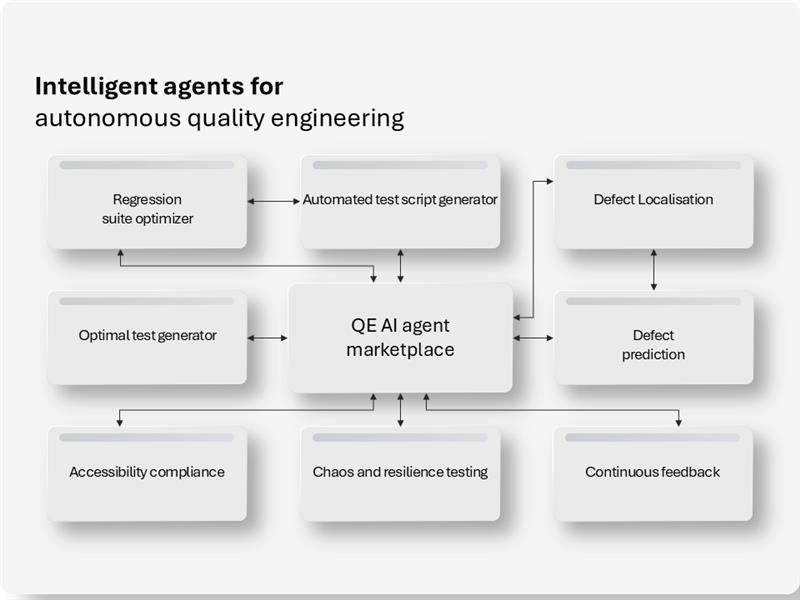
Figure 1
Reimagining quality engineering
Figure 1
These include:
The ecosystem continuously analyses historical defects, customer behaviour patterns, and system vulnerabilities to predict likely failures. Agents automatically generate test scenarios that stress payment logic, inventory deductions, discount calculations, and fulfillment workflows ahead of new promotion launches. In addition, during peak traffic events, agents dynamically scale testing while ensuring no checkout scenarios go untested.
Production is the ultimate teacher. Issues like slow checkout, failed payments, and inventory mismatch are captured in real time by the marketplace. The agents then analyse the root causes and immediately enhance test coverage to prevent recurrence. Machine learning (ML)-driven systems excel at this through autonomous adaptation. They detect anomalies in test results, identify subtle performance drifts, and implement self-healing capabilities that automatically adapt to system changes without manual intervention, minimising downtime and enhancing reliability.
Unlike generic testing tools, agents understand retail business logic. For instance, the promotions agent knows discount rules, loyalty mechanics, and margin impacts, while the cart-and-checkout agent focuses obsessively on cart abandonment and transaction completion rates. Additionally, the fulfillment agent ensures order accuracy and that delivery promises are honoured. This business perceptiveness ensures testing remains outcome-driven—protecting revenue, building customer loyalty, and safeguarding brand reputation.
Retail peaks are predictable yet chaotic. Events like Black Friday, Cyber Monday, and holiday campaigns demand flawless execution under extreme load. The marketplace pre-stages test scenarios that simulate these conditions, validating that payment gateways, inventory systems, recommendation engines, and fulfillment pipelines remain reliable when traffic spikes 10x, 20x, or even 100x. In an outage, agents rapidly isolate root causes and validate fixes before re-release.
Modern retail spans in-store, web, mobile, and partner channels. Customers expect consistency–omnichannel price match, accumulating loyalty points across channels, and inventory reflecting real-time availability everywhere. The marketplace agents validate end-to-end omnichannel workflows ensuring seamless experiences regardless of how customers interact with the brand.
Friction to delight
Adopting the technology will help retail businesses secure transparent, auditable operations that reduce compliance risk and demonstrate end-to-end customer trust, sandboxed high-risk flows (eg, card payments or data privacy) that preserve brand reputation, and stringent resource management, security, and role-based controls to safeguard sensitive retail operations.
The framework ensures that each agent is managed as a secure, auditable microservice. Additionally, the marketplace bus controls message routing, prioritisation, and schema consistency.
Here’s a quick look at the possible retail transformations using our framework:
| Key transformations and outcomes | Benefits | Business impact |
|
Faster innovation |
|
|
Peak-season readiness |
|
|
Reduced operational costs |
|
|
Customer delight |
|
|
Revenue protection and growth |
|
Strategic benefits of the framework:
The marketplace enables perceptiveness for retailers with accelerated QE by delegating repetitive and analytical tasks to intelligent agents, enabling faster feature releases and A/B tests (essential for rapid retail innovation cycles).
It also ensures deeper coverage during sales surges, new launches, or digital migrations, predictive risk identification and proactive test expansions, and human testers to focus on experience enhancements and customer-centric features.
For retailers, these can lead to faster revenue recognition, lower operational costs, peak season readiness, and higher net promoter score (NPS) for customer satisfaction. Additionally, the system continuously aligns with retail strategy, which means domain agents automatically adapt to new stock keeping units (SKUs), loyalty programmes, and payment channels without expensive manual regression.
Future evolution
The agentic QE marketplace is an effective tool to aid perceptiveness for retailers and can be a transformative step for retail.
By embedding intelligent, collaborative agents that reason, generate, validate, and optimise tests across complex retail ecosystems, QE becomes a proactive, self-optimising discipline. Supported by unified instrumentation and agentic orchestration, the framework ensures cohesion, faster rollout, reduced cycle time, and superior system resilience. Retail exemplifies its immediate impact as the marketplace model reduces friction, enhances customer experience, and scales quality as a lasting competitive advantage in digital commerce.
Going forward, as retail platforms become more complex, agents will gain cross-domain reasoning, leveraging real-world production telemetry for learning, optimise performance collaboratively across store, web, and mobile touchpoints, benchmark agent variants via A/B runs to minimise defect leakage on critical promotional days, and enable an open exchange for retail and technology partners to share best-practice blueprints. That means, QE will enable true adaptive intelligence for retail—driving the business from mere assurance to value creation and competitive differentiation.
Enterprises adopting this approach will be able to build a perceptive, continuously learning QE fabric that adapts to change, scales intelligently, delights customers, protects reputation, boosts revenue, and sustains quality as a core business driver in retail’s future.