Industries
Travel and Logistics
Data and AI in Travel Industry for a Memorable Passenger Experience
HIGHLIGHTS
- Increasing congestion in urban rail traffic due to high demand in modern cities calls for effective passenger flow control strategies to mitigate congestion on platforms and crowding in trains.
- Effective management of passenger flow in urban public transport systems is also essential for enhancing safety, comfort, and operational stability amid increasing congestion challenges.
- Leveraging technology and data analytics can optimise service supply, inform passengers, and improve station experiences. This will help rail organisations maximise the number of passengers while ensuring a comfortable and safe experience for them.
Overview
Public transport is considered the backbone of sustainable and inclusive mobility.
As urban areas continue to grow, public transport networks are increasingly leveraging technology and innovation to enhance passenger flow and crowd management. The goal of passenger flow management in public transport systems is to maximise capacity while ensuring that passengers enjoy a safe and comfortable journey, particularly in complex urban environments such as railways, metros, buses, and trams.
Congestion is especially pressing in urban rail networks across the globe, given the high traffic in modern cities, risking safety and comfort. Therefore, it is necessary to adopt reasonable and effective strategies to reduce and manage congestion on platforms and crowding in trains to improve operational stability.
Public transport in general and urban rail systems in particular can adopt solutions used in sectors such as retail to monitor platform congestion, predict peak time passenger flows, and dynamically change service frequency to adjust to the flow.
The solutions help measure passenger flow with sensors at stations, network, and vehicles, thus enabling effective demand management. Such technologies have been fully deployed in retail and advertising sectors; public transport could also benefit from them.
Advanced video analytics for real-time crowd monitoring, sensor-based occupancy tracking, and AI-powered predictive models for passenger flow can aid effective passenger flow management. Retail, for instance, uses footfall analytics to optimise store layouts, while advertising leverages location-based data for targeted campaigns.
Measure occupancy rates—the proportion of available space or capacity that is currently being used by passengers within a public transport environment—affect passengers’ travel time, social distancing, and comfort. These rates can be directly measured using sensors or video analytics, whether on-board vehicles, at platforms, or at intermodal transport hubs.
Challenge
Any urban rail traffic (URT) system operating without passenger flow control could result in a large number of passengers being stranded on platforms or crowding in trains during peak hours.
Observations indicate that train occupancy in certain urban metro systems often exceeds 120% during peak hours, highlighting the high demand for public transportation in densely populated areas.
In practice, the oversaturated situations of URT lead to serious troubles for both passengers and train operations:
- A large number of passengers impacts capacity, leading to passengers queuing on platforms. When passenger density on platforms exceeds load capacity of trains, it results in congestion and overcrowded platforms, making stampedes a big risk.
- Congestion increases the time passengers take to board or alight. In some severe cases, due to the high interaction between trains, primary delays could extend and propagate as secondary delays to other trains on the URT network. This results in direct increase in trains’ dwell time in oversaturated situations.
Connecting smart stations
When travelling by URT (train or transit), a station is the first and last touchpoint of a passenger.
Every passenger must access the station before boarding the train and must exit the station upon arrival. While at the station, a passenger often uses escalators or stairs, purchases a ticket, and goes through fare collection gates before and after a train ride. Therefore, for transit agencies, it is important to include all these encounters in the evaluation of total passenger travel times when developing service improvements using passenger flow analysis (see Figure 1).
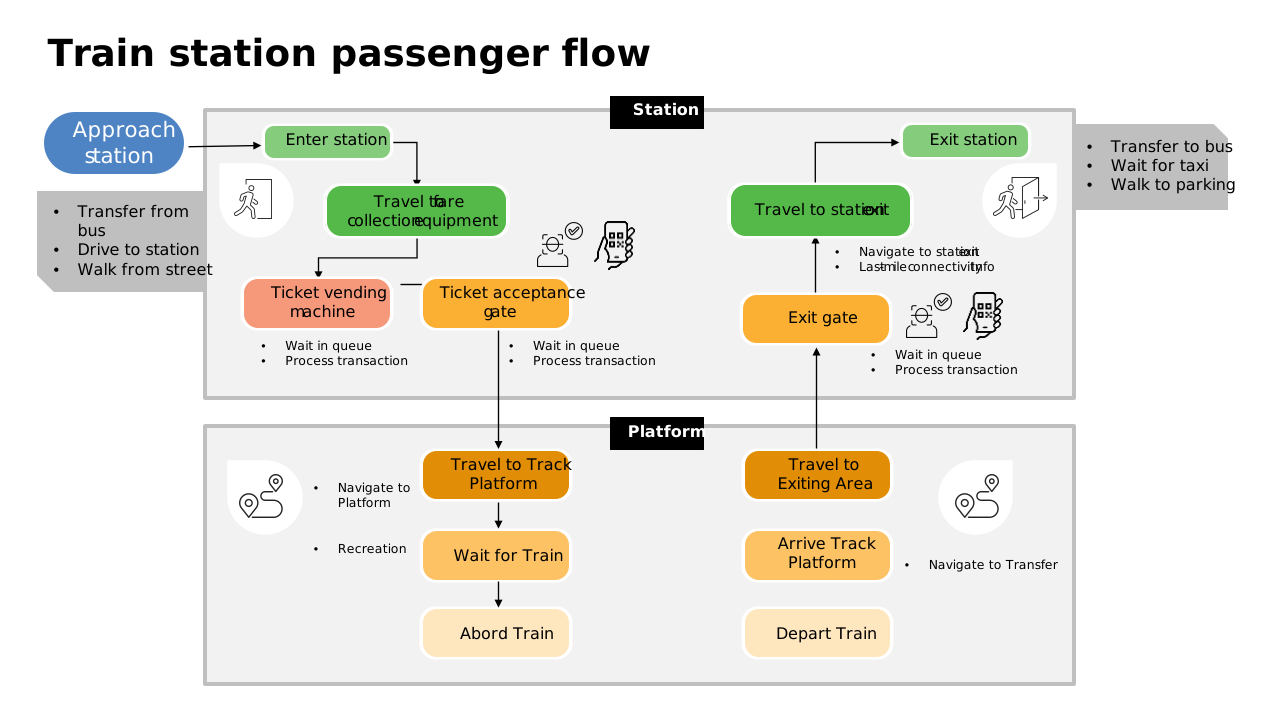
Figure 1
Passenger flow analysis
Figure 1
To overcome the challenges of URT, public transport organisations should build certain capabilities in a prioritised, phased approach. For example, a planning capability that ensures operational and crowd control management, and transport services are able to adapt to actual demand is critical. This capability should enable an organisation to adjust train frequency, manage entry and exit gates, and implement crowd control measures, to align service supply with real-time passenger demand. It is pivotal to have the capability to monitor the overall system—passenger flow on the one hand, and service capacity on the other.
Here are some approaches that can help to manage passenger flow better:
Biometric identification will facilitate the whole passenger process by speeding up the digitalisation of public transport through passenger verification. It will reduce physical interaction of passengers and will improve their comfort levels and experience, without requiring them to present any travel document. Passengers’ biometric features would be used during security checks, ticket validation, and payments.
Systems must be able to accurately calculate the expected carload to provide meaningful information to passengers by collecting real-time occupancy data from the vehicle and use historical data to predict the expected carload at the next station.
For eg, passenger load and distribution inside the vehicle is calculated by the onboard unit (OBU), which immediately sends the data to the central monitoring unit. In a subsequent step, the system deducts the number of passengers likely to leave the train at next station. To do so, the system uses historical data of passengers boarding at the next station and deducts this percentage from the current carload.
Developing advanced analytics will help operators and authorities make data-based decisions in transport planning with the core objective to leverage technology and data analytics for effective crowd management and improved passenger experience .. Simulation techniques have been used to control the occupancy rate of trains and set a limit by regulating the number of entrance turnstiles available and through understanding passenger flow. As part of a longer-term vision, AI and machine learning can offer precise predictions to the operator, triggering the ‘fail-to-board’ indicator. This allows for the activation of specific operational actions such as dynamic pricing models based on passenger demand, personalised travel recommendations and targeted retail offers within stations, resulting in optimised passenger flow.
For indoor locations such as metro stations, wifi technology, mainly wifi 5, 6 and 6E, is highly efficient. Passengers usually have their wifi enabled on their smart phones. The use of wifi real-time locating systems improves indoor localisation of people, and it can capture the number of people present in certain areas, the direction in which they are moving and their precise location. Using this technology, the terminal (passenger’s mobile device) can be identified even if passengers are not connected to the internet, once again assuming each passenger has one mobile device. With the assistance of this technology, it is also possible to calculate customer arrival rates and residence, dwelling times. In addition, by acquiring new insights into how passengers behave, it becomes possible to create new business models. For example, data on passenger preferences can lead to customised offers and dynamic adaptation of marketing strategies based on passenger classification.
Here are some real-world examples showcasing the solutions public transport operators have taken to improve passenger flow and manage crowd:
- A metro operator in South Korea has adopted an advanced analytical approach to enhance operational efficiency and passenger experience. By leveraging functional data analysis (FDA), the metro authority clusters stations based on their geographical characteristics, enabling a more nuanced understanding of spatial dynamics across the network
- A leading European national rail operator developed a web application in house that provides statistical and real-time information for passengers. Using this web-based service, passengers use statistical information to determine when it is best to travel and check the position of vehicles and their occupancy in real time.
- Metro operators in Europe use big data technology and self-learning models to predict vehicle occupancy based on trip planner requests and other data sources. The occupancy forecast is based on a combination of connection requests from trip planners as well as mobile ticket purchases.
- A leading train operator in Japan has launched the ‘route search with in-train congestion monitoring’ pilot, adding a function that allows users to see in-train congestion on some of the routes displayed in search results. This service displays in-train congestion information obtained over the last 30 weekdays, Saturdays and Sundays. The data is calculated using congestion data for weekends and holidays and is updated daily.
- A leading metro operator in Latin America is implementing solutions for sharing information with passengers (at the platform and on apps) to guide them into less-crowded timings (peak flattening). The solutions leverage machine learning by processing existing data flows (ticketing and trains) without installing new sensors. The technology provider used the heterogenous data already produced by many systems, including ticketing, vehicle sensors (weight), wifi, Bluetooth, 4G, and closed-circuit television (CCTV).
These approaches improve passenger flow and help with crowd management with technologies and innovation that cover various aspects—from real-time counting and predictive models to leveraging insights from historical data. The objective is to shift from individual to collective use of public transport mobility.
The road ahead
The passenger flow control strategies help reduce or avoid traffic congestion inside stations.
Passenger flow control strategies are designed to minimise congestion and waiting times, both inside and outside stations. By coordinating passenger movement and service schedules, these strategies aim to optimise the overall travel experience. The proposed optimisation framework (see Figure2) uses analytics and simulation models to predict passenger demand, inform operational adjustments, and guide passengers through digital channels, ultimately reducing bottlenecks and improving service quality.
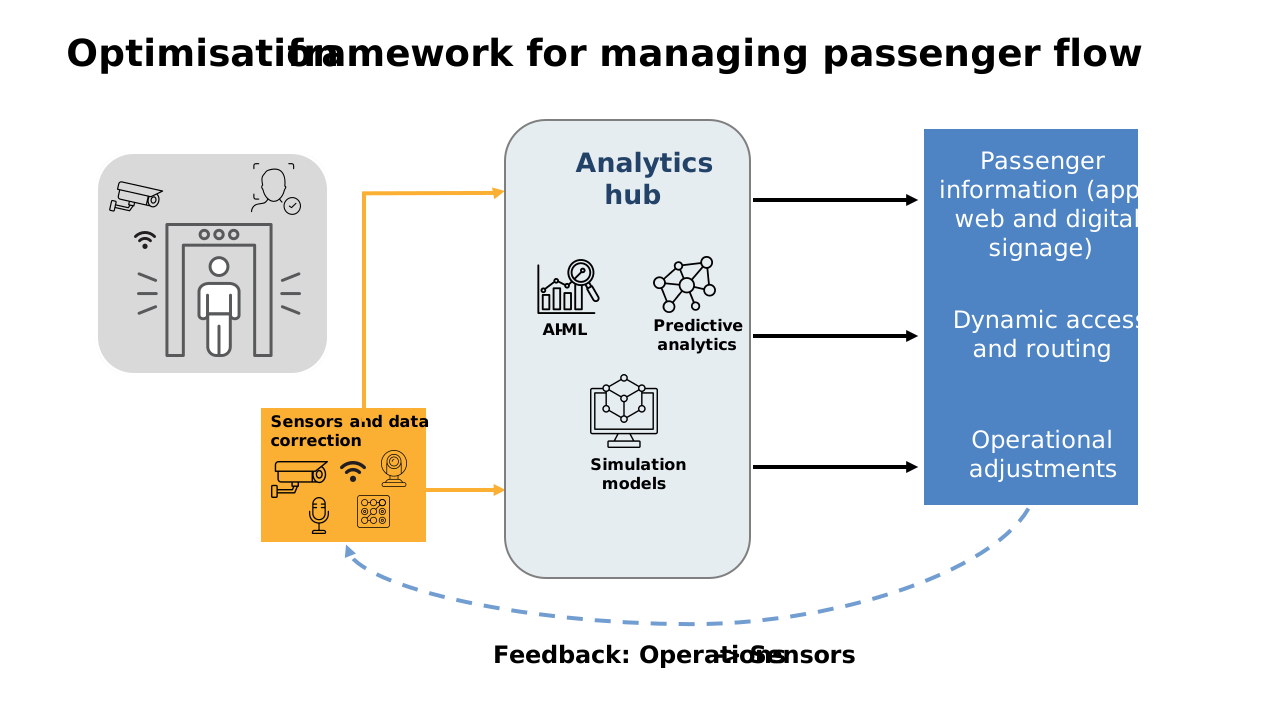
Figure 2
Passenger flow analytics
Figure 2
Urban rail, transit stations are a point of interactions between passengers and transportation authorities all over the world. It is necessary to increase the volume of investments in smart stations to decrease congestion and overcrowding.
Hence, passenger flow and crowd management are an opportunity towards improving the safety and quality of passenger services at stations and improving revenue streams by maximising the value of passenger dwelling time.