Service
Artificial Intelligence

Building a Smarter, Connected Tomorrow with AI-first and Agentic AI
Highlights
- Fine‑tuning enables organisations to turn general‑purpose language models into domain‑specific, instruction‑reliable systems that deliver outputs aligned with real operational needs.
- This tailored adaptation strengthens model performance by applying the right training techniques, structured data preparation, and parameter‑efficient methods that refine behaviour with greater precision and efficiency.
- Such targeted refinement results in models that provide higher accuracy, safer and more consistent responses, and improved effectiveness across enterprise workflows and decision‑making contexts.
On this page
On this pageinpage
Why fine‑tune LLMs
Fine-tuning is the process of adapting a pre-trained large language model (LLM) using curated, task-specific data, so it performs better for your organisation’s needs. This approach improves accuracy and efficiency by teaching the model your domain-specific terminology, workflows, and compliance requirements. A fine-tuned model consistently follows instructions, delivers outputs in your preferred formats, and reflects your brand tone.
Fine‑tuning helps organisations improve model performance while making artificial intelligence (AI) systems more efficient, faster, and safer for enterprise use. By customising language models for specific domains and tasks, fine‑tuning enables better accuracy, optimised resource usage, and reduced operational risks, ensuring models perform reliably in real‑world scenarios.
The benefits of fine-tuning:
- Enhanced performance and accuracy through domain‑specific customisation and task‑specific optimisation, allowing models to deliver more relevant and precise responses
- Reduced cost and improved efficiency through reduced token consumption and more efficient utilisation of compute resources
- Lower latency by using smaller and faster models, resulting in quicker response times and improved user experience.
- Risk mitigation by helping reduce hallucinations and harmful or undesired behaviours within the target domain, and by supporting fairness goals when paired with representative data, evaluation, and runtime safeguards
Together, these benefits make fine‑tuning a practical approach for enterprises that want to deploy AI solutions with improved accuracy, speed, and reliability. By focusing on performance, efficiency, and risk reduction, fine‑tuning supports the development of AI systems that are better suited for operational workloads and business‑critical applications.
Practical enterprise use cases
Fine‑tuning is used when a general‑purpose language model does not meet specific application needs and training a model from scratch is not practical. It allows organisations to adapt an existing model to deliver better accuracy, relevance, and control for targeted business scenarios.
Key use cases:
- Domain specialization: where models are adapted for fields such as medicine, finance, or law, enabling them to understand domain‑specific terminology, technical language, and context more accurately
- Task performance optimization: which improves results for focussed tasks like sentiment analysis, code generation, translation, or summarisation, often allowing smaller models to outperform larger general‑purpose models
- Style and tone alignment: helping models match formal business communication, technical writing, or a brand‑specific voice
- Instruction following: improving adherence to formatting rules, multi‑step instructions, and structured outputs, including correct routing in multi‑agent frameworks.
- Compliance and safety: through models that are trained to follow organisational policies, regulatory requirements, and application‑specific guidelines.
- Language or cultural adaptation: tailoring models for specific languages, dialects, or cultural contexts that are not well represented in the original training data.
When not to fine tune:
- When knowledge changes frequently, using retrieval augmented generation (RAG) helps keep responses current without needing retraining.
- Factual accuracy or citation-based outputs are better supported through retrieval with sources, as finetuning alone cannot guarantee grounded responses
- When only tone or format needs adjustment, system prompts or templates offer a quicker and more economical solution. Business rules, routing logic, or structured decision flows are more effectively managed in the application layer instead of altering the model’s parameters.
The fine‑tuning process
The fine-tuning process follows a structured approach from planning to deployment, combining model configuration with continuous evaluation to ensure both performance and alignment with the intended use case.
The process begins by defining the vision and scope, selecting an appropriate base model, and preparing the training dataset. Teams then choose the fine-tuning technique, configure task-specific layers, set relevant hyperparameters, and proceed with training. Throughout training, regular benchmarking and iterative evaluation help track performance, monitor accuracy, and guard against overfitting.
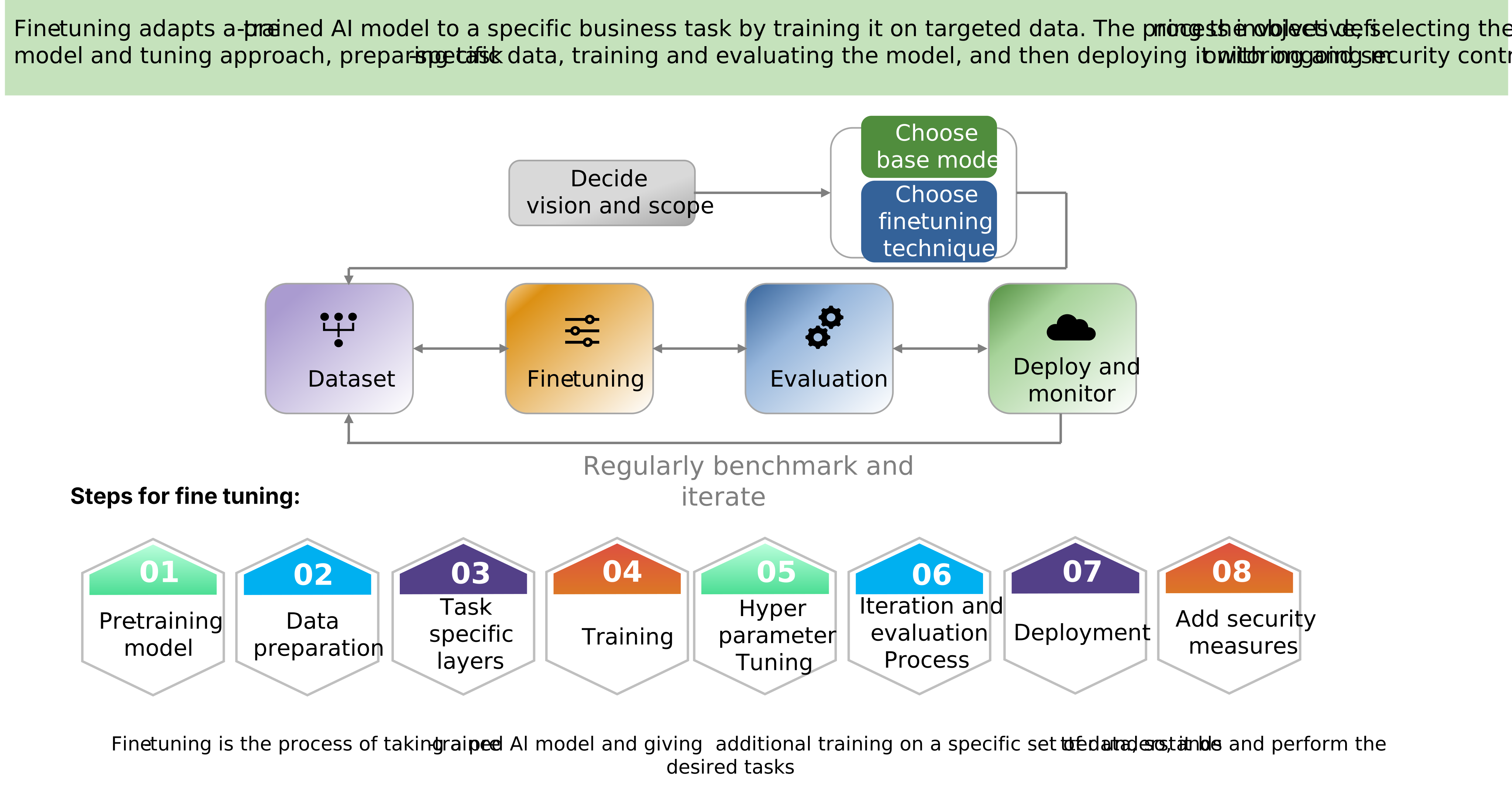
Figure 1: Fine-tuning LLM
Figure 1: Fine-tuning LLM
To provide full context, the underlying LLM training stages should also be highlighted, covering pretraining, supervised finetuning, instruction tuning, and alignment training using approaches such as direct preference optimisation or reinforcement finetuning.
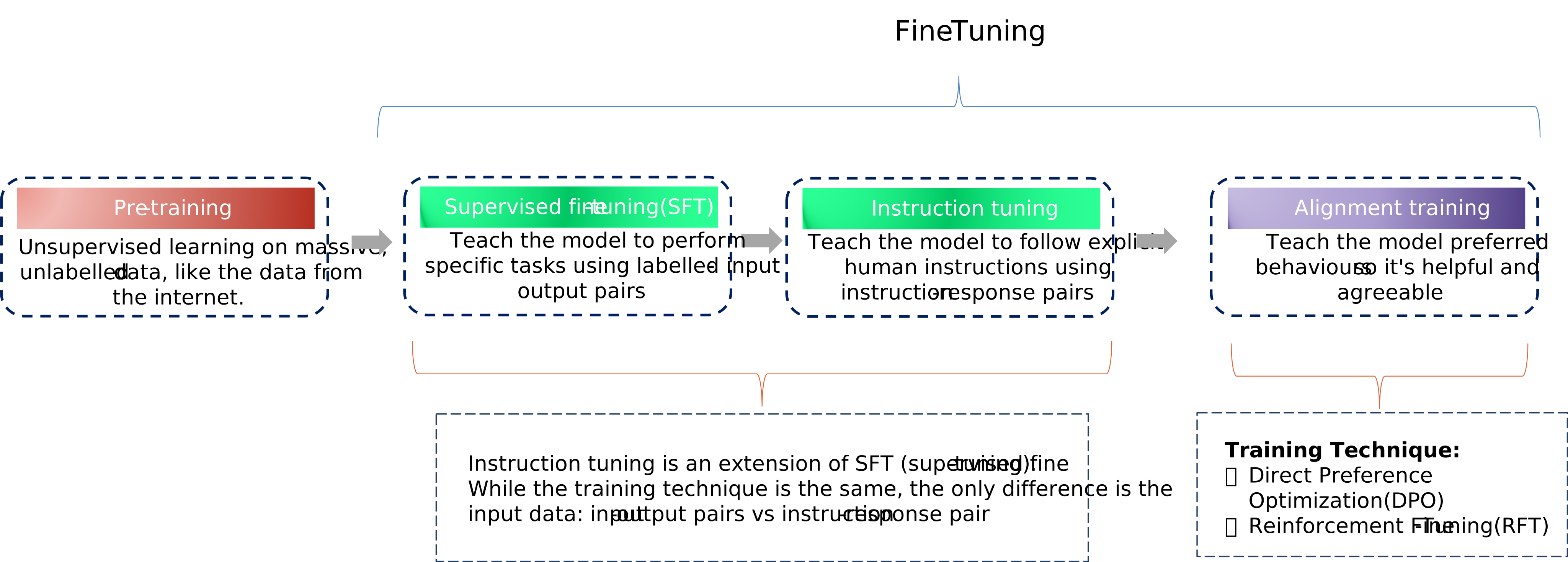
Figure 2: LLM training stages
Figure 2: LLM training stages
Fine‑tuning is guided by a small set of hyperparameters that control how the model learns during training and influence overall performance.
- Number of epochs: One complete pass through the training dataset, allowing the model to learn from every example once.
- Learning‑rate multiplier: Adjusts the original pre‑training learning rate during fine‑tuning, with larger values working better for larger batch sizes.
- Batch size: Number of training examples processed per iteration. For example, 1,000 samples with a batch size of 100 require 10 iterations to complete one epoch.
The real impact of fine‑tuning
Fine‑tuning impacts a language model in two keyways— knowledge gain and behaviour change, which together make the model more accurate, relevant, and dependable for enterprise use.
- Knowledge gain: The model learns domain‑specific information not covered in initial training, becoming more informed about industries, products, regulations, and workflows. Example: A base GPT model that knows general finance concepts can, after fine‑tuning on banking payments data, learn specialised terms, regulatory requirements, and transaction workflows.
- Behaviour change: The model adapts how it responds with tone, structure, and style to match business or client expectations. Example: A telecom support chatbot learns to reply politely, concisely, and in the company’s communication style.
Fine‑tuning merges knowledge gain with behavioural adaptation, so the model understands the domain deeply and responds accurately, contextually, and professionally, leading to higher accuracy, efficiency, and trustworthiness in real‑world use cases.
Key techniques and when to use them
Large language models can be fine‑tuned using different techniques based on task requirements, domain clarity, and training feedback. These approaches guide responses, improve alignment with human expectations, and enable controlled, reliable behaviour across enterprise use cases.
- Supervised fine‑tuning (SFT) is the foundational technique, training models with labelled input-output or instruction-response pairs. It supports domain specialisation, task optimisation, style and tone alignment, instruction following, and language adaptation, and is recommended as the starting point for most projects due to clear data and dependable results.
- Direct preference optimisation (DPO) trains models to prefer certain responses over others using comparative feedback, without a separate reward model. It improves response quality, safety, and alignment with human preferences when preferred and non‑preferred outputs can be identified.
- Reinforcement fine‑tuning (RFT) optimises models with reward signals and fits objective domains such as mathematics, chemistry, or physics, where answers are clearly right or wrong and evaluated by experts.
Full vs parameter‑efficient fine‑tuning approaches
Language models can be fine‑tuned using two main parameter training approaches: Full fine‑tuning and parameter‑efficient fine‑tuning (PEFT) (see Figure 3). The choice depends on compute cost, speed, and the level of change required. PEFT methods are designed to retain the strengths of the pre‑trained model while enabling efficient task‑specific adaptation.
- Full fine‑tuning retrains all model parameters. While this allows complete model adaptation, it is computationally expensive, requires large storage and high compute, and carries the risk of catastrophic forgetting. This approach results in slower training and inference due to the large number of updated parameters.
- PEFT freezes the base model and augments it with a small number of trainable parameters. This significantly reduces compute, storage, and training time while largely retaining the base model’s general capabilities, with tradeoffs depending on task and data.
- LoRA and QLoRA, common PEFT methods, add small adapter layers to the pre‑trained model. These adapters are lightweight and task‑specific, enabling faster training, easier rollback, and the ability to maintain separate adapters for different use cases without duplicating the full model.
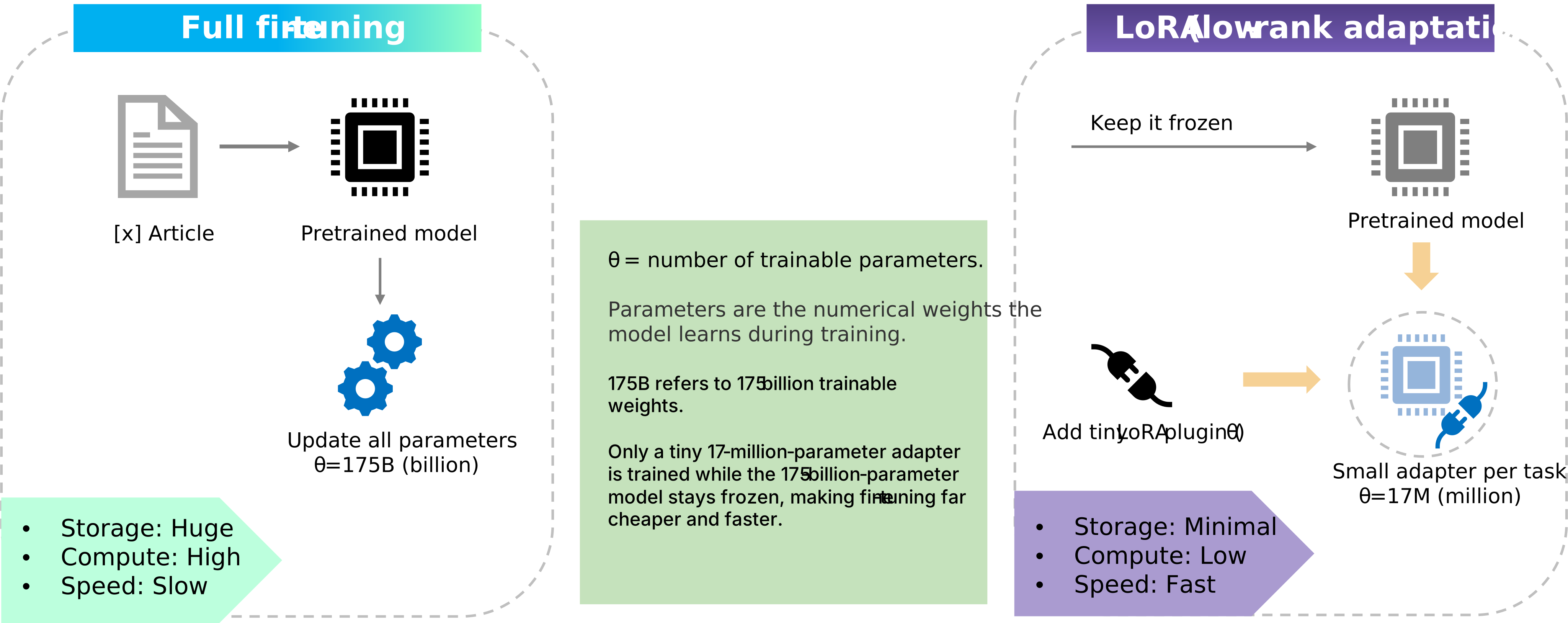
Figure 3: Fine tuning approaches
Figure 3: Fine tuning approaches
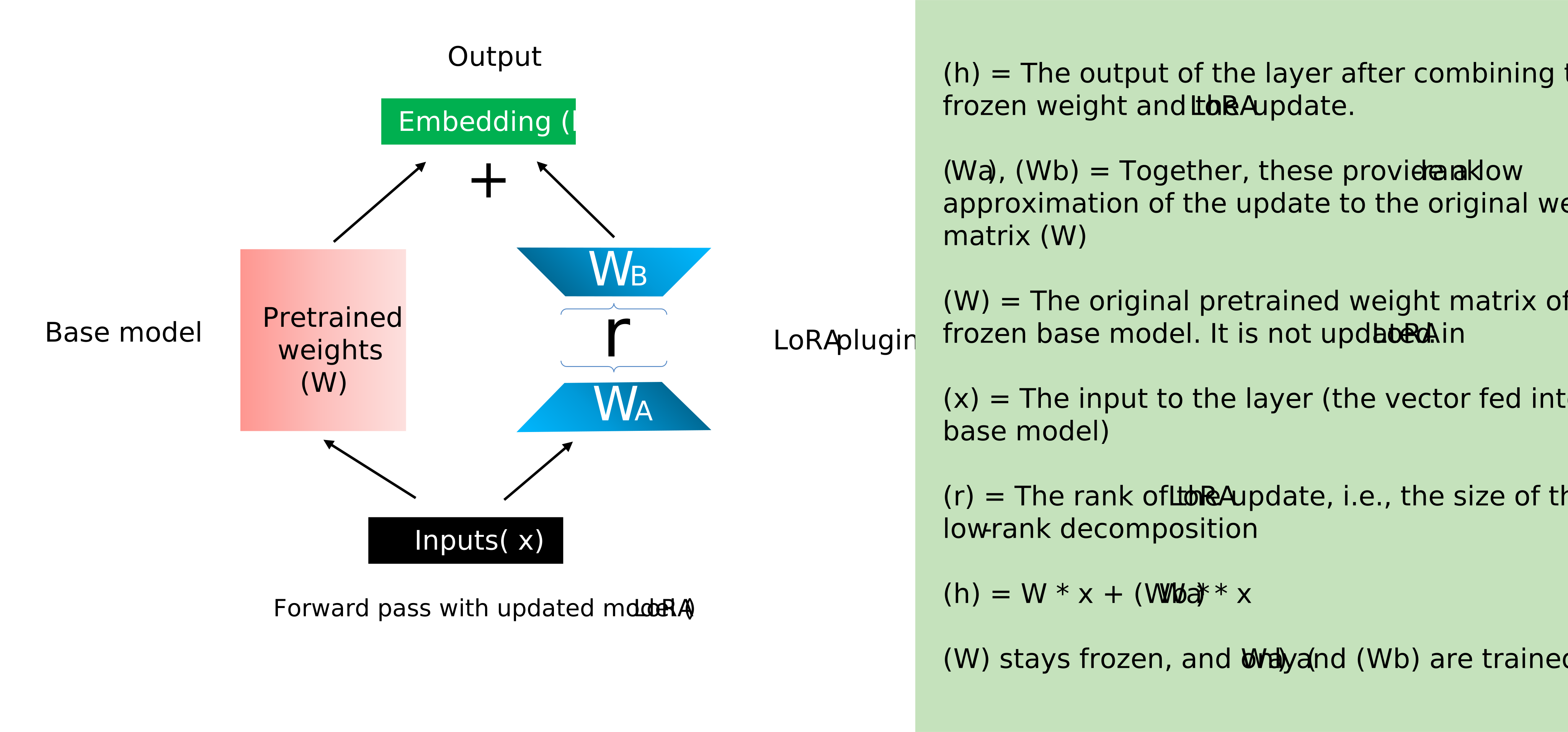
Figure 4: Forward pass with updated model (LoRA)
Figure 4: Forward pass with updated model (LoRA)
Azure for fine-tuning
Azure provides an end‑to‑end environment for fine‑tuning LLMs, bringing together models, tools, infrastructure, and production readiness in one platform (see Figure 5).
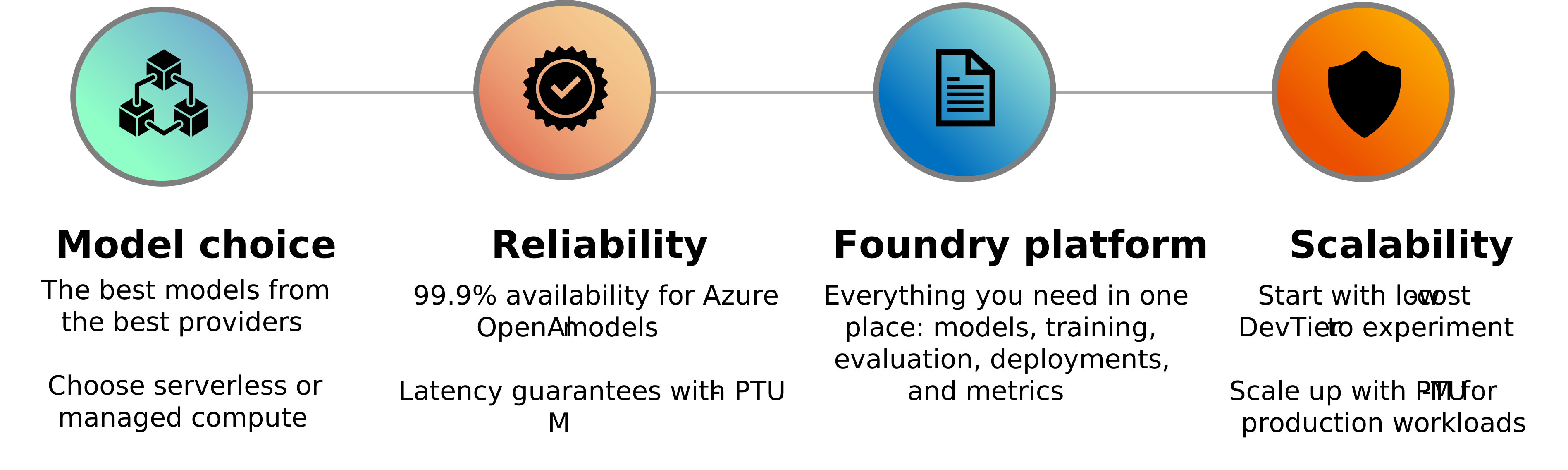
Figure 5: Azure fine-tuning advantages
Figure 5: Azure fine-tuning advantages
Azure AI Foundry and Azure ML Studio enable organisations to train, evaluate, deploy, and monitor fine‑tuned models with reliability, scalability, and operational control across environments.
- Unified platform support providing fine‑tuning, evaluation, deployments, and metrics in one place
- Flexible fine‑tuning options, including LoRA and QLoRA, while retaining base model capabilities
- Checkpointing and incremental fine‑tuning to evaluate progress at each epoch and address overfitting
- Developer‑friendly onboarding starting with a low cost developer tier; hosting and usage charges vary by model, region, and deployment option
- Enterprise‑ready scaling with provisioned throughput unit - managed (PTUM) support, service level agreement (SLA)-backed availability options and predictable throughput, latency characteristics (where applicable), global deployments, and higher tokens per minute (TPM) quotas.
- Extended model availability aimed at longer production support windows for fine-tuned models, subject to model lifecycle and retirement policies
Together, these capabilities provide a clear and reliable path from experimentation to enterprise‑scale deployment on Azure.
Understanding fine‑tuning costs and optimisation strategies
Fine‑tuning costs vary based on several factors, including the base model selected, the volume of training tokens, the fine‑tuning approach adopted, hosting requirements, and depending on the technique, model grading tokens. Serverless training follows a consumption‑based pricing model with limited hyperparameter control, while managed compute uses allocated graphical processing unit (GPU) quotas and supports deeper customisation and tuning flexibility.
After training is complete, hosting costs continue while the fine‑tuned model remains deployed and available for inference. Actively monitoring usage and deleting unused deployments is essential to avoid unnecessary charges and maintain cost efficiency.
Key cost‑optimisation practices include:
- Selecting an appropriate model size based on task complexity
- Optimising training datasets by removing redundant or irrelevant examples
- Using checkpoints to evaluate each training epoch and prevent overfitting early
Azure further improves cost predictability by offering higher quotas for fine‑tuned models, Provisioned throughput units - managed (PTUM) availability across regions, and extended model lifespans for production use. Together, these practices help teams balance performance, reliability, and cost control as fine‑tuned models scale into enterprise‑grade services.