Highlights
- The zero-trust architecture transitions from traditional perimeter-based security to a "never trust, always verify" philosophy that continuously validates every access request.
- Organisations achieve resilience by securing five core pillars, identity, endpoints, network, data, and cloud/apps, supported by visibility, automation, and governance.
- The implementation journey is a multi-phased triathlon involving initial discovery, architectural design, and continuous optimisation to ensure long-term security maturity.
On this page
On this pageinpage
The security mandate
As organisations continue to embrace digital transformation, the limitations of perimeter-based security models have become increasingly apparent. The shift towards remote working, cloud services, and interconnected devices has created a fluid environment where traditional boundaries are no longer effective. This has necessitated a move to a zero-trust approach, which moves away from “trust but verify” to “never trust, always verify” and helps organisations manage threats that may originate both inside and outside the network, and therefore continuously verifies every access request.
Zero-trust architecture (ZTA) is designed to address these challenges by enforcing strict identity verification, continuous monitoring, and adaptive access controls. By treating all entities as potentially untrusted and requiring validation at every step, ZTA helps organisations reduce vulnerabilities, contain threats, and safeguard critical assets in an ever-evolving cyber landscape.
The rapidly evolving threat landscape has made this a top priority for senior leadership. To mitigate mounting cyber risks, organisations can leverage the zero trust operation model (ZTOM™©) framework, which integrates leading industry standards and global best practices such as the National Institute of Standards and Technology (NIST), MITRE, and the Cybersecurity and Infrastructure Security Agency (CISA). This framework, when implemented alongside the Purdue Enterprise Reference Architecture, The Open Group Architecture Framework (TOGAF), and Sherwood Applied Business Security Architecture (SABSA), ensures effective zero trust status and a secure Information Technology (IT) and Operational Technology (OT) estate. Organisations can improve their cybersecurity and risk posture by holistically assessing themselves and enhancing their overall maturity and resilience. We have built a strong zero-trust architecture foundation, and this leads us to a critical next aspect.
Architectural design
The house of ZTA provides organisations with a structured and strategic approach to implement zero trust core fundamentals across the enterprise. It helps define how the core security principles (foundation), key technology domains (pillars) and strategic business outcomes come together to life and form an overarching resilient, yet adaptive, zero-trust architecture.
From the ground up, each layer of the house of ZTA supports the layer above it allowing organisations to deliver consistent protection and control over their users, devices, network, data, infrastructure, and systems.
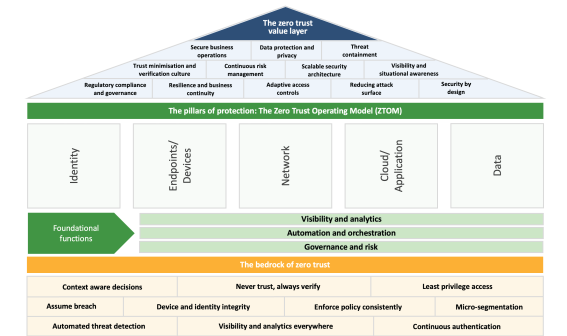
Figure 1
The house of zero trust
Figure 1
2.1 Roof: The zero trust value layer
The roof represents the key business values, strategic goals, and tactical outputs of zero trust. It reflects the outcomes organisations care the most about including data protection, risk reduction, risk posture, risk tolerance, adherence to regulation, threat containment, vulnerabilities, improved resilience posture and security by design.
2.2 Pillars of protection
The pillars of protection provide core building blocks that help establish controls matrix, operational resilience, and implement zero trust to achieve the required outcomes.
Identity: Deploy identity and access management (IAM) solutions to manage user identities and access rights based on least privilege, access policies, and authentication.
Endpoint/devices: Ensure devices meet security standards and compliance requirements before granting access such as having updated antivirus software, active firewalls, and proper encryption. Monitor user behaviour to detect anomalies.
Network: Implement granular network partitioning to ensure that a security incident in one area remains contained and cannot easily spread into the other sector. Use technologies like virtual local area network (VLAN) and software-defined networking (SDN) to micro segment your network. Use firewalls, VPNs, and zero trust network access (ZTNA) solutions to secure network inbound and outgoing traffic and enforce segmentation.
Cloud/applications: Integrate best security practices into each stage of development and conduct regular application testing. Use virtual machines of sandboxes to segment workloads. Enforce compliance with industry standards and regulations such as Payment Card Industry (PCI) and General Data Protection Regulation (GDPR).
Data: Enforce end-to-end encryption to safeguard sensitive datasets from unauthorised access. Categorise data and implement data loss prevention (DLP) solutions to prevent unauthorised data exfiltration.
Visibility and analytics: Maximise visibility by integrating data from cloud, logs, and network traffic into a unified view. Use advanced techniques and tools to turn this data into context needed to detect and stop emerging threats.
Automation and orchestration: Keep all systems and applications up to date with the latest security patches to mitigate vulnerabilities. Continuously scan for and remediate vulnerabilities. Generating alerts for suspicious activities and blocking IP addresses in real time. Orchestrating threat detection systems with incident response platforms and integrating tools like security information and event management (SIEM), endpoint detection and response (EDR) with the broader cybersecurity operation aligned with security strategy objectives.
Governance and risk: Develop policies and clear rules aligned with regulatory requirements like health insurance portability and accountability act (HIPPA) and GDPR. Supported by regular ZTA focused audits. Risks are mitigated by continuous verification. Incorporate real time monitoring and swift response mechanism.
2.3 Foundation: The bedrock of zero trust
The foundation is the security philosophy that underpins zero-trust architecture. Principles such as “Assume Breach”, “Never Trust, Always Verify”, “Continuous Authentication” are the guiding ethos that senior management / executive can use to prioritise strategic investments, drive decision-making, manage risks, apply controls and ensure a proactive approach to risk and threat management.
The ZTA journey
Implementing a zero-trust architecture is a transformative and evolving journey rather than a single project or programme. It has wider implications for an enterprise strategy. To help visualise this, we have framed the journey into a triathlon which symbolises the unique yet inter-connected phases that an organisation must go through before they can reach the desired state of zero trust.
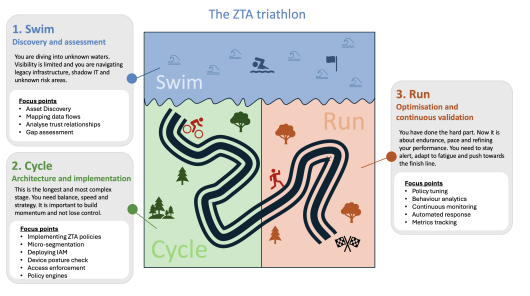
Figure 2
The ZTA triathlon journey
Figure 2
Operational barriers
Pitfalls |
Success factors |
Absence of a well-defined security strategy |
|
|
|
|
|
|
|
Measurable outcomes
The successful ZTA implementation delivers measurable business advantages. To gauge the impact of the ZTA implementation programme, organisations can utilise the following attributes to evaluate the overall effectiveness of the implementation.
Business benefits of ZTA |
Metrics used to measure benefits |
Enterprise risk reduction
|
|
Cyber incident response time
|
|
Organisation wide reduction in breaches |
|
Authentication success rates, access control violations |
|
Adaptability to hybrid cloud/ environments |
|
Reduction in supply chain attacks |
|
Return on investment (ROI) |
|
The path forward
A successful transition is executed through six strategic phases designed to align security with enterprise risk goals:
Strategic design: Aligning ZTA with the organization's unique risk profile.
Asset discovery: Comprehensive cataloging of data flows and infrastructure vulnerabilities.
Maturity analysis: Establishing a baseline "as-is" state to prioritize investments.
Targeted implementation: Developing a roadmap with defined scopes for each security initiative.
Cultural alignment: Fostering a "security-first" culture through workforce training and awareness.
Sustained optimisation: Conducting regular audits to address emerging gaps and ensure perpetual adaptability.