Services
Enterprise Solutions

Accelerate Enterprise Digital Transformation for Sustainable Change
Highlights
- In the wake of mergers and acquisitions, and corporate restructuring, organisations face the complex task of integrating diverse application portfolios while ensuring the continuity of financial records.
- This paper presents a unified and intelligent archival approach to decommission Oracle SaaS and migrate purchase-to-pay data—including purchase orders, invoices, and payments—to an on-premises environment for compliance, reporting, and audit.
- The solution focuses on extracting raw data from Oracle Fusion’s internal tables, and related attachments through secure API calls, generating a cross-reference that maintains data relationships and enables seamless, audit-ready reporting.
In this article
In this articleinpage
OVERVIEW
Seamless migration for purchase-to-pay data from Oracle Fusion Cloud ensures compliance, long-term data accessibility and cost-effective reporting.
In today’s dynamic business landscape, mergers and acquisitions, divestitures, and digital transformation initiatives often lead to complex application portfolios that demand careful consolidation and data preservation.
Every organisation needs to find a pragmatic balance for their complex portfolios between regulatory assurance and fiscal prudence—and create its own archival solution to safeguard corporate financial memory irrespective of SaaS maintenance.
CHALLENGES
Navigating the complexities of data and document extraction in Oracle Fusion Archival transformations is challenging.
In Oracle Fusion applications, structured data such as invoices, purchase orders, and payments, resides within relational tables that can be extracted through standard interfaces. However, the supporting documentation—invoice images, approval memos, receipts, and supplier correspondence—is stored as unstructured content across multiple modules and repositories. Extracting this information while preserving the precise linkage to its originating transaction proves to be the most intricate aspect of this initiative.
A key complexity involves limitations on APIs (Application Programming Interfaces) and operations. The extraction of the attachments is performed using SOAP UI, which revealed other operational challenges. Variation in invoice attachment formats, database encoding issues with non-English characters, and inconsistencies in attachments caused by user input errors created challenges. Maintaining synchronisation between structured transactional data and unstructured documents was critical to maintaining the end-to-end data lineage. Additionally, the SOAP UI caching behaviour occasionally returned outdated file content, necessitating a controlled workaround mechanism to ensure that each extracted attachment reflected the most accurate and current version.
APPROACH
Integrating structured and unstructured data—procurement and payables—for a holistic archival and reporting framework requires strategic planning and an intelligent framework.
Our recommended solution involves extracting structured data related to active purchase orders, invoices, and payments from Oracle Fusion using BIP and metadata information using SQL queries.
The solution architecture is represented in the following diagram:
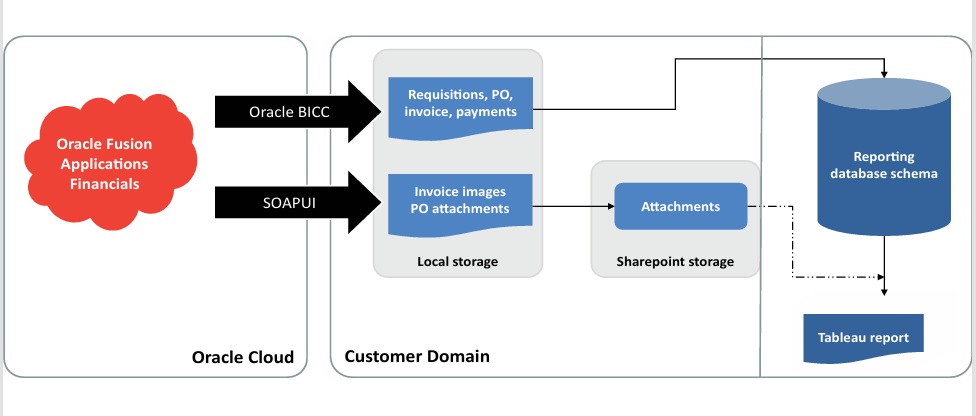
Figure 1
Extracting structured financial data from Oracle Fusion
Figure 1
As a best practice, the structured data should be loaded into the reporting database schema on Oracle using Python scripts. SOAP UI groovy scripts should be used to extract attachment files, which are then stored on a SharePoint server. A cross-reference of file attachments to corresponding records should be generated and loaded into the reporting database schema. Tableau reports can be built to show the lineage of records along with associated attachments.
Proof of concept
Bridging Oracle Fusion Cloud and on-premises infrastructure to preserve data lineage for a multinational pharmaceutical company.
A multinational pharmaceutical company, headquartered in Asia, exemplifies this challenge. Following the acquisition of a new firm operating on Oracle SaaS cloud, the organisation needed to transition to a unified cloud environment while reducing costs and operational complexities. To achieve this, it elected to decommission the acquired company's Oracle SaaS environment, yet preserve critical purchase-to-pay data, including invoices, payments, purchase orders, and requisitions for statutory compliance and reporting.
The business imperative was clear: migrate and archive accounts payables transaction history from the Oracle Fusion Cloud to an on-premises reporting database. This transition ensures long-term accessibility of historical financial data, maintaining data lineage and traceability for audit purposes, while enabling cost-effective reporting.
The integration following the acquisition extended beyond technology—it was about preserving compliance and operational continuity while rationalising systems.
Migrating purchase order and accounts payable data from Oracle Fusion Cloud to this on-premises platform was essential for regulatory compliance, but the process involved three layers of complexity.
Cloud to on-premises: Moving data from a SaaS-based source to an on-premises target required reconciling two fundamentally different data governance and security models, while ensuring integrity.
Structured data and unstructured data: Beyond transactional data, the migration necessitated the capture of vital attachments and supporting documents—invoices, receipts, and payment proofs for archival and reporting needs.
Unified access and lineage: Users needed a single source of access to both structured and unstructured data, with preserved lineage across diverse financial documents for traceable audit-ready insights.
The solution architecture was, therefore, designed to comply with both SaaS application and on-premises standards, enabling the organisation to decommission the cloud environment while retaining the complete functional visibility and data lineage within the archival system.
TCS successfully extracted purchase orders, accounts payables invoices and payments data, along with their associated attachments, while maintaining complete data lineage and traceability. This ensured seamless reporting of all P2P transactions and supporting documents within the on-premises reporting platform.
Business benefits
Driving compliance, efficiency, and financial insights through intelligent archival enables long-term financial resilience.
Our An intelligent, well-structured migration for purchase-to-pay data from Oracle Fusion Cloud provides measurable business value such as:
Regulatory compliance and audit assurance: Full transactional and document history can be retained to meet statutory and audit requirements, ensuring readiness for any financial review.
Enhanced decision-making: Historical visibility across procurement and payables data can be preserved, empowering chief financial officers (CFOs) and finance leaders with insights for compliance-driven and strategic reporting.
Reduced total cost of ownership (TCO): Recurring SaaS licence and maintenance costs can be lowered by decommissioning the acquired Oracle Cloud environment.
Operational transparency: Corporate finance teams can track any open purchase orders, invoices, and payments, facilitating a proactive approach on collections and supplier adjustments.
Unified reporting experience: End-users are provided with single, integrated reporting environment, eliminating multiple logins and streamlining data access across entities.
Together, these benefits reinforce an organisation’s commitment to fiscal integrity, compliance excellence, and operation efficiency, turning a complex migration into a catalyst for long-term financial resilience.
THE WAY FORWARD
Upgrading an archival framework to a strategic data and analytics platform can create future paths to successful growth.
Looking Companies that manage a successful migration have several opportunities to extend the value of the transformation beyond compliance and reporting to broader enterprise intelligence and system integration initiatives.
Advanced analytics and data lakes: The archival data and relevant attachments have the potential to be integrated into a data lake environment to enable seamless analytics across invoice, payment, and PO data, providing deeper visibility into spend patterns, supplier performance, and financial trends.
Enterprise data warehouse integration: The solution can be adapted to support the end-to-end migration of P2P data and attachments from Oracle Fusion to Oracle E-Business Suite (EBS) and enterprise data warehouses, ensuring scalable archival and business continuity.
Legacy system modernisation: This approach can also be extended to migrate P2P data and associated documents from legacy systems (Oracle EBS Suite) to Oracle Fusion applications (Upload), ensuring the historical information remains intact during modernisation.
Proof of concept for re-upload: A POC can be executed to explore re-uploading archived documents into Oracle Fusion.