Industry
Life Sciences

Patient-centered Care Models Taking Center Stage in Life Sciences
Highlights
- Clinical trials collect rich data from imaging, genomics, wearables, biomarkers, and clinical systems, but this data often remains fragmented and difficult to integrate.
- The paper explains how a patient-centric, metadata-driven data foundation can connect multimodal trial data with better governance, lineage, and reuse.
- This approach creates AI-ready clinical data that supports faster insights, stronger traceability, improved compliance confidence, and better clinical decision-making.
On this page
On this pageinpage
Why Multimodal Clinical Data Integration Matters
Clinical trials generate vast amounts of biological and physiological data, creating a rich source of evidence for understanding disease mechanisms, treatment effects, and patient outcomes. From patient-reported outcomes and case report forms to biological samples and connected devices, clinical trials rely on a diverse range of data sources to capture evidence across the patient journey. Data capture is increasingly becoming efficient process, but generating actionable insights remains challenging because data often resides in fragmented systems and organisational silos. Naturally, no clear picture emerges of the overall disease and the patient’s journey. The disparate evidence has potential only when a patient-centric foundation can link these disparate data sources. Only when this is achieved can clinical, data science, and safety teams move past manual data preparation and cleaning and focus on the main drivers of drug development – the patient sub-groups responding to therapy, the reasons they do so, as well as how safer drugs can be designed with improved quality in the subsequent phases.
From Data Abundance to Insight Scarcity
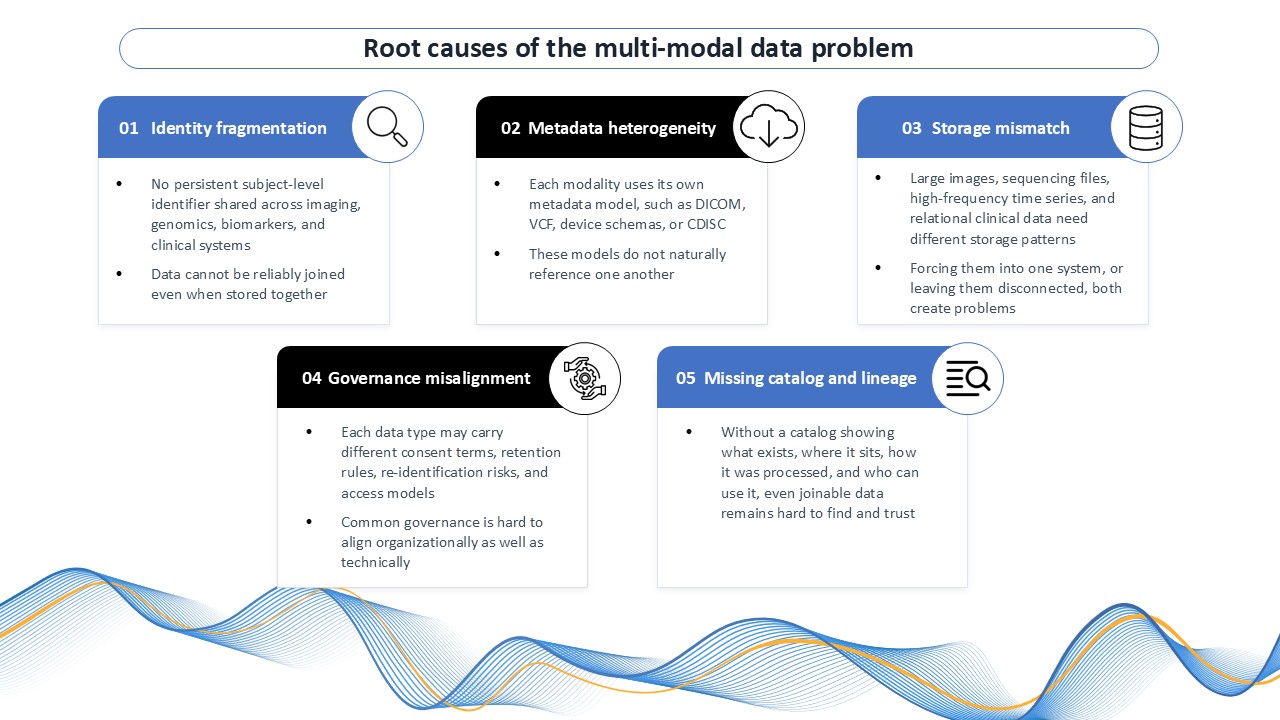
The problem is not the massive amounts of data collected. The root causes can be attributed to five operational friction points that divide the patient’s journey into isolated compliance and storage pockets. This is illustrated in the figure below (Figure 1).
Root causes of the multi-modal data problem
Root causes of the multi-modal data problem
- Identify fragmentation: Accession numbers, sample barcodes, and EDC IDs generated across different sites and vendors are found to be disconnected. The absence of a persistent subject-level identifier shifts the onus to fragile, manual lookup tables that link these clinical, imaging, and genomic datasets.
- Metadata heterogeneity: Domain-specific standards such as Digital Imaging and Communications in Medicine (DICOM) headers, Variant Call Format (VCF) genomic variants, and Clinical Data Interchange Standards Consortium (CDISC) Study Data Tabulation Model (SDTM) formats dictate modalities and cannot be cross-referenced. This makes multi-modal querying impossible without custom translation pipelines.
- Storage mismatches: Binary images, large genomic Reference-oriented Alignment Map (CRAM) files, streaming telemetry, and structured Electronic Data Capture (EDC) tables need to be stored differently. Storing together in a single relational database downgrades the performance, while storing in isolation prevents multi-modal analytics.
- Governance misalignment: There is a lack of uniformity while managing consent, retention, and privacy regulations (General Data Protection Regulation (GDPR), Health Insurance Portability and Accountability Act (HIPAA), and Title 21 Code of Federal Regulations (21 CFR) Part 11). Hence compliance becomes a challenge with permissions and patient-withdrawal tracking across clinical, wearable, and genomic data remaining unaligned.
- Missing catalogue and lineage: The absence of a unified view of data assets forces scientists to spend valuable time searching for files and tracing data lineage, slowing the pace of research and insight generation. Without clear lineage and harmonisation, research teams often find it difficult to trust the insights generated from merged datasets.
A Patient-Centric Multi-modal Data Foundation
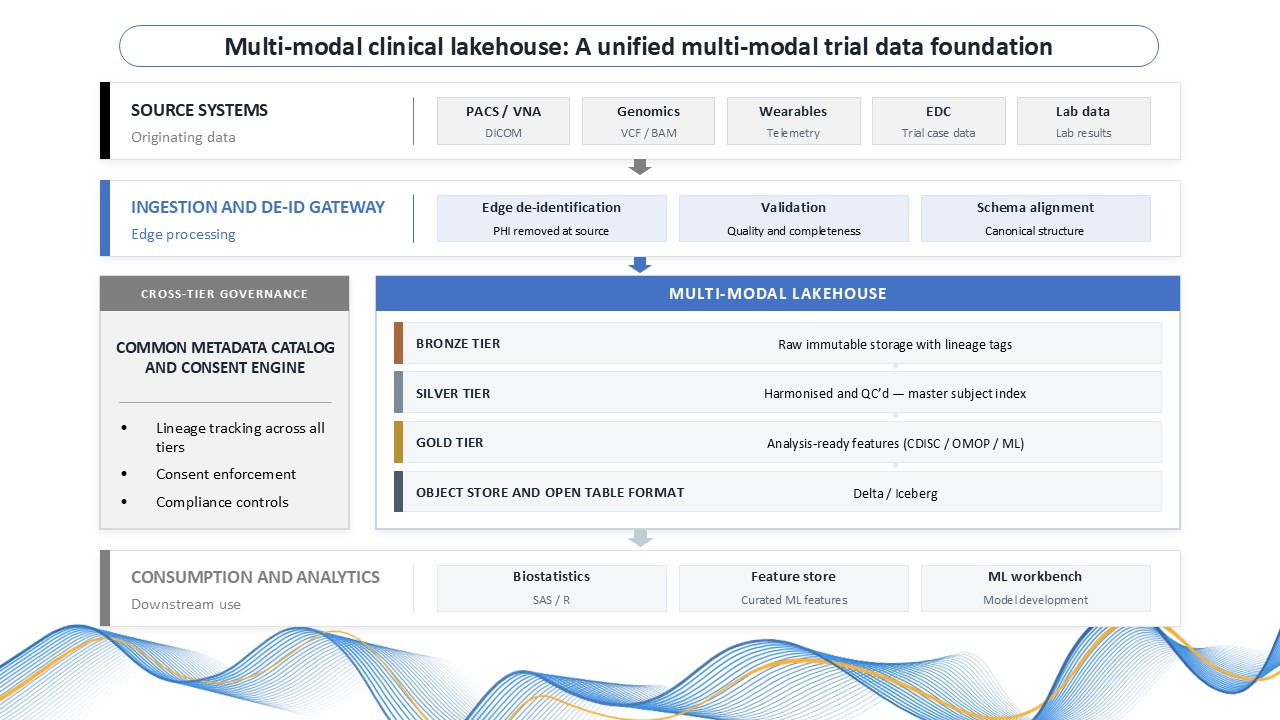
Multi-model complexity can be resolved without needing to overhaul existing tools via a unified patient-focused architecture (Figure 2).
Unified Multi-Modal Clinical Trial Data Foundation
Unified Multi-Modal Clinical Trial Data Foundation
that uses metadata to stitch trial data together. The subject universal Id and visit Id enable the aligning of heterogeneous data streams across both identity and time wherein imaging, genomics, clinical, operational, and digital biomarker data are interpreted as part of one coherent participant record. This allows source formats to be preserved where necessary with imaging aligning with DICOM and genomics retaining Global Alliance for Genomics and Health (GA4GH) or VCF structures. Also, clinical data can remain aligned with CDISC or Observational Medical Outcomes Partnership (OMOP) patterns while device data retaining its time-series character. From isolated downstream steps, this architecture frames metadata cataloguing, governance, and compliance within cross-cutting wrappers.
The different layers are explained below:
Source systems: The architecture connects directly to the key systems that support a clinical trial, bringing together imaging data from Picture Archiving and Communication System (PACS)/Vendor Neutral Archive (VNA) platforms, genomic data from VCF, Binary Allignment Map (BAM), and CRAM pipelines, high-frequency streams from wearable and electronic Clinical Outcome Assessment (eCOA) platforms, and core clinical data from systems such as EDC, Clinical Trials Management System (CTMS), Clinical Data Management System (CDMS), and Lab Informatics Management System (LIMS).
Ingestion and edge de-identification: Before data enters the platform, modality-specific gateways verify formats, apply privacy safeguards, and enforce quality checks. Whether processing DICOM images, genomic files, or continuous data from wearables, these controls help ensure that the data is secure, compliant, and ready for downstream analysis.
Common metadata and catalogue layer: This layer establishes a trusted view of data across the platform. A Master Subject Index links local identifiers to a common subject_uid, while the catalogue captures schemas, lineage, and mappings to standards such as MedDRA and LOINC, making data easier to find, trace, and reuse.
Storage layer (multi-modal lakehouse): Data progresses through three layers in the lakehouse. Raw source files are retained in Bronze, validated and standardised data is managed in Silver, and analysis-ready datasets and reusable ML features are curated in Gold. This structured approach improves traceability, reduces preparation effort, and makes high-quality data readily available for research and analysis.
Governance, security and compliance: Consent-aware access control and automatic masking when patients withdraw consent, immutable 21 CFR Part 11 audit logging, PII disclosure risk monitoring, and dataset version control strengthen governance, security and compliance credentials through an active compliance wrapper.
Consumption and analytics layer: Standardised presentation layer exposing APIs, ML workbench feature stores, automated radiomic extraction engines, and optimised JDBC/ODBC connections for traditional biostatistics platforms (SAS, R, etc).
Downstream Impact: Reusable Evidence, Faster Insight, Trusted AI
A unified multi-modal foundation can accelerate clinical insight generation by reducing the time teams spend reconciling disconnected files and preparing data for analysis. By linking governed, reusable datasets and features through consistent subject_uid and visit_id identifiers, researchers gain a unified view of patient data across modalities and studies. Clinical scientists can create more complete patient cohorts, biostatisticians can work with traceable, analysis-ready data, and data scientists can reuse validated feature pipelines, replacing the extraction-logic pipelines for every study. The result is a more efficient and trusted analytical environment that enables faster, more reproducible research.
These benefits extend systematically across the trial lifecycle:
- Stratification and response prediction: Bringing together imaging, genomics, and clinical signals can provide a more comprehensive understanding of disease mechanism, patient heterogeneity, and therapeutic response. For example, teams can correlate baseline whole-exome sequencing (WES) variants directly with RECIST imaging endpoints to model the response of specific patient subgroups to therapy.
- Continuous safety monitoring: Bringing together wearable ECG data, patient-reported outcomes, and routine laboratory results provides a more continuous view of patient safety. This holistic perspective can help identify emerging risks earlier and support more timely intervention when concerns arise.
- Objective digital endpoints: Processing continuous wearable accelerometry data into hourly activity or sleep metrics provides an objective, real-world window into patient health, bypassing highly subjective in-clinic questionnaires.
- Site optimisation and compliance: Sponsors can optimise future protocols by linking operational logs to patient-level evidence. Significantly, the platform provides defensible transparency — this means data lineage, versioning, and AI/ML model drift controls are fully auditable for regulatory review.
Implementation Considerations: Pragmatic Modernisation Without Disruption
Modernising clinical infrastructure does not mean huge expenditure. The overhauling can be done in tandem with legacy systems and without disrupting active trials.
Early value and minimised operational friction can be ensured with a staged rollout in place:
- Begin with a multi-modal pilot: A single Phase II or III study combining varied data streams—such as EDC, central laboratory feeds, and wearable sensors—provides a manageable environment in which to validate the integration workflow.
- Overlay existing systems first: A data catalogue and Master Subject Index can be layered over existing PACS, EDC, and genomics environments, making data searchable and connected without requiring changes to underlying source databases.
- Establish automated traceability from the outset: Standardised audit trails can link every derived analytical endpoint to its source data, reducing the manual effort required during regulatory submissions.
What is also equally important is when data managers, clinical scientists, and regulatory leads work together early on. There is a greater likelihood of solutions co-designed with study teams aligning with operational realities, which in turn enables sustained adoption.
From Integrated Data to Learning Trials
Organisations that can learn continuously across trials, molecules, and therapeutic areas will emerge successful in drug development. A unified, patient-centric multi-modal data foundation encourages sponsors to adopt an industrialised evidence-generation engine over a reactive, study-by-study data assembly. As machine learning, real-world evidence (RWE), and precision medicine become foundational to pipeline strategies, this integrated approach moves from an operational advantage to a regulatory and clinical necessity. Hence, a multi-modal data foundation is the answer towards securing the agility, auditability, and scientific precision needed to bring life-changing therapies to patients faster.
We acknowledge and thank Sanjeev Sachdeva, Global Head – Advisory and Business Process Services, Life Sciences, Tata Consultancy Services, for his visionary guidance, leadership, and invaluable contributions in shaping and authoring this white paper.