Industry
Manufacturing

Future-Ready Manufacturing: Partnering in your journey to a sustainable manufacturing enterprise
Highlights
- Manufacturers can move beyond isolated AI pilots by combining data vault for enterprise history, lineage, and auditability with data mesh for domain-owned data products, self-service delivery, and federated governance.
- To make each AI use case faster and safer, enterprises can adopt a lightweight “AI-for-AI” framework that automates metadata, quality checks, and reusable features from governed data products.
- The same hybrid approach can scale across manufacturing domains and ERP value streams such as P2P, R2R, and plan-to-produce, enabling reuse without locking the enterprise into a single vendor stack.
On this page
On this pageinpage
Challenges
Manufacturers are under pressure to move from AI pilots to AI in production—across plants, products, and enterprise functions—while data remains fragmented across OT/IT, plant applications, multiple ERPs, and post-merger landscapes. The result is predictable: slow onboarding of new sources, inconsistent KPIs, and AI initiatives that stall in data preparation.
Why do manufacturing AI programmes stall?
- Data is not AI-ready by default: OT/IT and ERP data needs consistent semantics, quality, and point-in-time correctness—otherwise models drift and copilots generate weak narratives.
- Delivery doesn’t scale: When all integration and KPI work sits with a central team, time-to-data becomes time-to-value lost for both plants and corporate functions.
- Decentralisation without guardrails breaks trust: Definitions diverge (e.g., “OTIF”, “inventory available”, “cost-to-serve”), making enterprise reporting and model monitoring harder.
- The hybrid resolves the trade-off: The vault preserves enterprise history and auditability, while mesh enables domain teams to publish certified data products (e.g., “Supplier Performance” used for COO OTIF programmes and CIO-controlled P2P risk analytics) under federated governance.
Data Mesh: the operating model shift
Data Mesh is an operating model in which manufacturing domains, such as Engineering/PLM, Plant Operations/MES, Quality, Supply Chain, Service, and Finance, own and publish their data as end-to-end data products, complete with contracts, documentation, and defined quality targets. A shared platform team provides self-serve capabilities (ingestion, processing, catalog, security, observability). A small, federated governance group sets the enterprise standards that travel with data products.
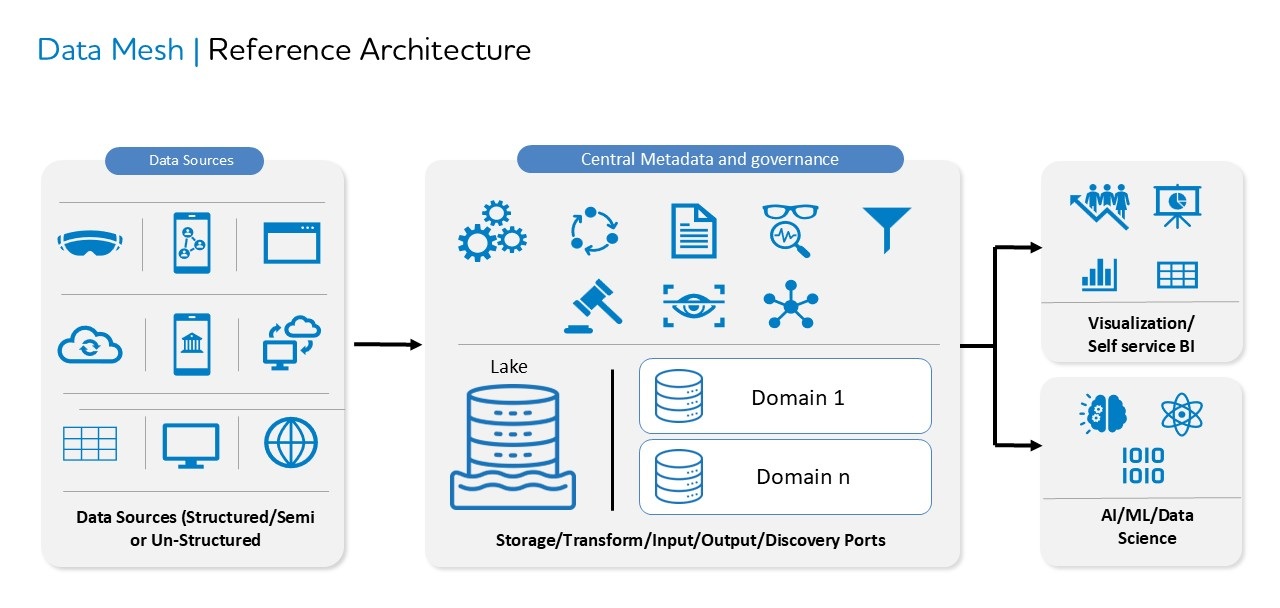
Data Mesh reference architecture
Data Mesh reference architecture
In manufacturing terms: plant and functional teams can iterate faster (new sensors, new suppliers, new product variants) while the enterprise retains interoperability through data contracts and federated computational governance. The payoff is quicker reuse of trusted data for analytics, AI, and ERP process optimisation.
From a domain perspective, P2P or Record-to-Report (R2R) becomes a data product owned by the respective function—published with clear contracts, quality service level objectives, and access patterns for both analytics and AI use cases.
Data vault: The integration spine that preserves trust
Data vault is built for change: it separates business keys (Hubs), relationships (Links), and descriptive history (Satellites) so new sources and attributes can be added without reworking downstream consumption. For manufacturers integrating multiple ERPs, MES/SCADA, warranty, supplier, and CRM systems, the vault provides a consistent audit trail and point-in-time reconstruction—critical for financial controls and explainable AI.
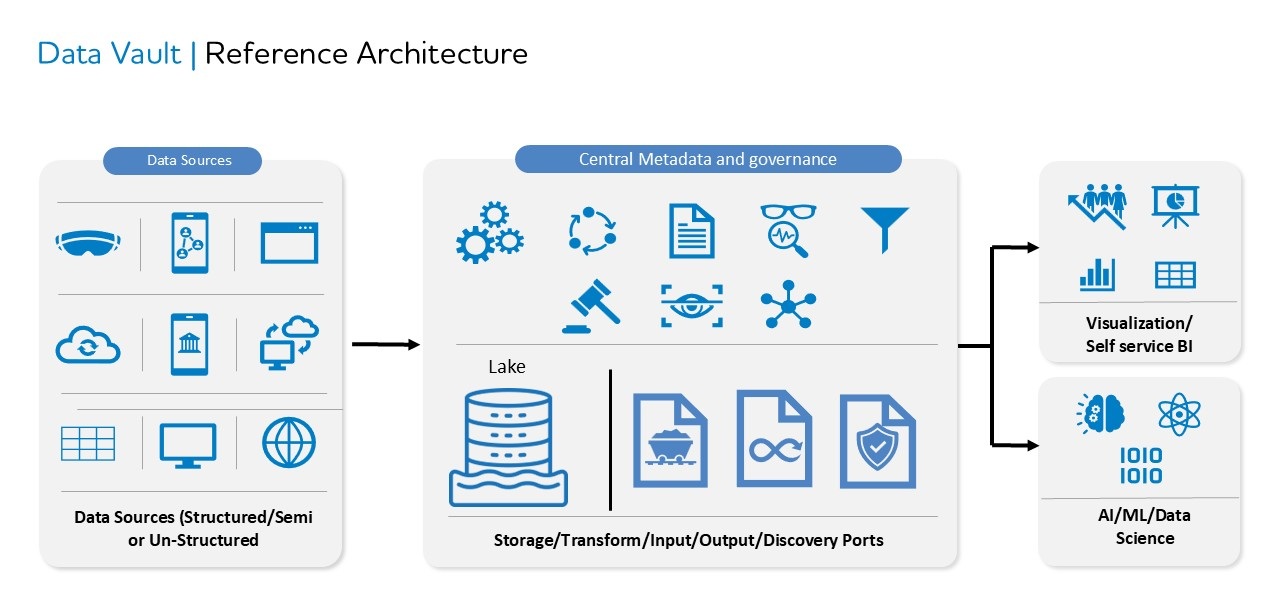
Data Vault Layered Reference Architecture
Data Vault Layered Reference Architecture
Example: In Procure-to-Pay (P2P), supplier master, purchase orders, goods receipts, and invoice events from multiple ERPs are integrated into the data vault. This creates a consistent, historied backbone for supplier performance, invoice matching, and risk analytics.
Why this matters for AI: Point-in-time correctness and lineage make features defensible (and easier to monitor). From the vault/semantic layer, teams can publish reusable features (offline/online) via a feature store to reduce training-serving skew.
The hybrid blueprint (Vault + Mesh)
Across automotive, chemicals, industrial equipment, and utility manufacturing, the pattern repeats: multiple plants, multiple product lines, and multiple generations of ERP/MES/PLM. The hybrid blueprint treats Data Vault as the integration spine (enterprise history + control plane for lineage) and Data Mesh as the operating model (domain data products + platform self-service). That combination prevents “data swamps” on one side and “mesh sprawl” on the other—so AI programmes scale without losing controls.
For example, a “Supplier Performance” data product combines Data Vault integration (multi-ERP supplier and PO history) with Data Mesh ownership (procurement domain), enabling reuse across OTIF programmes (COO) and supplier risk analytics (CIO/CDO).
Governance that scales without slowing teams
Governance becomes critical once data products are operationalised across business functions. For example, in P2P and R2R, the same data products used for operational decisions must also meet financial controls, compliance requirements, and auditability standards. In this context, governance refers to enterprise data governance—covering data quality, lineage, access control, and policy enforcement—augmented with observability to monitor data health and usage in real time.
For CIOs/CDOs, the differentiator is the control plane: a small set of standards and automated checks that make domain delivery safe at scale. Aim for “governance by default” (policy-as-code) rather than governance by exception. For instance, when a COO launches an OTIF programme, the same governed “Supplier Performance” product must also satisfy finance controls for accruals and supplier risk analytics—without creating parallel pipelines.
- Data product lifecycle + contracts: Define purpose, grain, freshness, allowed usage, and deprecation/versioning rules (treat data like an API).
- Quality SLOs + observability: Automated checks (completeness, duplicates, drift), scorecards, drift detection, and real-time monitoring of data health and usage - so plant and finance stakeholders trust the same numbers.
- Security, privacy, and access policy: Consistent identity, Role-Based Access Control or Attribute-Based Access Control(RBAC/ABAC), masking, and policy tags that travel with data products (especially for supplier, employee, and financial data).
- Lineage and auditability: End-to-end lineage from source to KPI/feature to model—supporting SOX-style controls and responsible AI evidence. In R2R, financial postings used for AI-driven variance analysis must be traceable back to source transactions to meet audit and compliance requirements.
- Operating model (RACI): Domain product owners and stewards own definitions; platform team owns tooling; a small council arbitrates cross-domain semantics and interoperability.
- How to measure it: The effectiveness of this governance model should be measured through both technology and business outcomes. From a CIO/CDO perspective, key indicators include time-to-onboard new data sources, percentage reuse of certified data products and features, policy compliance rates, and reductions in manual governance effort. From a COO perspective, success is reflected in faster decision-making and measurable improvements in business programs such as OTIF, production yield, working capital optimization, and supply chain responsiveness. Together, these metrics demonstrate whether governance is enabling trusted, reusable data products that accelerate AI adoption at scale.
This governance layer is critical for the “AI-for-AI” model. Without consistent data definitions, lineage, and observability, reusable features and models cannot be trusted or scaled. Governance ensures that every feature, KPI, and AI output is explainable, consistent, and compliant—enabling safe reuse across use cases.
An “AI-for-AI” approach: Make every new use case cheaper than the last
To scale AI, make every use case start from reusable building blocks: certified data products, automated metadata/quality, and reusable features. This reduces one-off feature engineering and accelerates both classic ML and GenAI grounding on enterprise data.
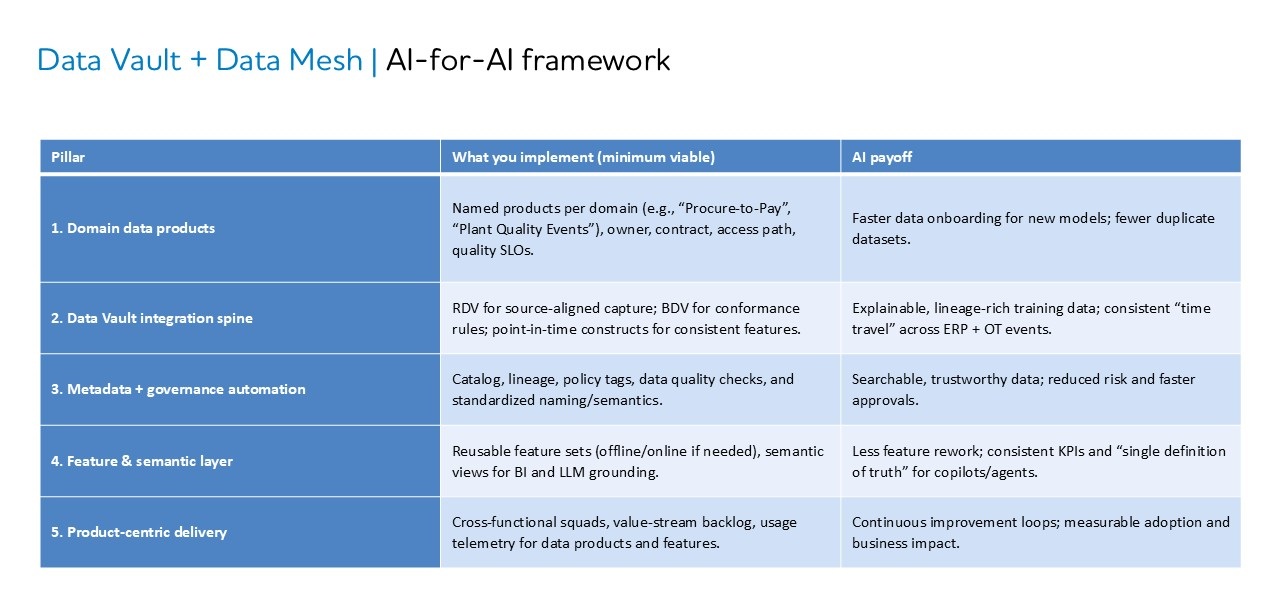
Data Vault Plus Mesh AI Framework
Data Vault Plus Mesh AI Framework
For instance, in P2P, reusable features such as supplier lead-time variability, invoice mismatch rates, and delivery reliability are built once from governed data products and reused across multiple AI use cases (risk scoring, anomaly detection, OTIF optimisation).
ERP-led use cases to start with:
- Procure-to-Pay (P2P): Supplier risk scoring, PO exception handling, invoice anomaly detection.
- Record-to-Report (R2R): Close acceleration copilots, intercompany reconciliation, cash forecasting.
- Plan-to-Produce: Forecast improvement, schedule optimisation, constraint-aware recommendations. Data products: demand signals, BOM/routings, capacity calendars, shop-floor actuals.
- Quality & traceability: Process drift detection, batch genealogy, deviation analytics (high value in chemicals).
- Asset and maintenance: Predictive maintenance, spares optimisation, maintenance work-order copilots. Data products: equipment hierarchy, sensor signals, work orders, parts consumption.
- Aftermarket and warranty: Claim triage, failure-mode analytics, parts demand forecasting, service copilots. Data products: claims, service history, parts orders (and telematics where applicable).
A pragmatic rollout path
- Start with two to three anchor data products tied to one outcome. Example: “Supplier Performance” + “Inventory Position” for OTIF and working capital. Define contracts and SLOs upfront.
- Stand up platform + spine. Land sources, model the integration core in Raw/Business Vault, and automate catalogue/lineage/security controls.
- Industrialise reuse. Publish certified views/features, measure adoption, and scale domain-by-domain (new plants, new ERPs, acquisitions) using the same patterns.
- Organizations do not need to transform their entire data landscape at once. A phased approach—starting with a small set of high-value data products and expanding through repeatable patterns—can deliver measurable business outcomes while establishing a scalable foundation for AI. The combination of Data Vault, Data Mesh, and governance-by-design provides a pragmatic blueprint that can be adapted across manufacturing domains, ERP landscapes, and modernization programs, helping enterprises move from isolated AI initiatives to sustainable AI at scale. Drawing on its experience in large-scale manufacturing transformations, data modernization programs, and ERP-led business change initiatives, TCS helps enterprises operationalize these patterns to accelerate trusted AI adoption while maintaining governance, auditability, and business alignment.