Industry
Manufacturing

Future-Ready Manufacturing: Partnering in your journey to a sustainable manufacturing enterprise
Highlights
- Battery Energy Storage Systems (BESS) are critical to grid stability and renewable integration, with rapid growth increasing system scale and complexity. As deployment expands, safety becomes essential to performance and public confidence.
- Despite stronger standards, incidents persist due to risks that accumulate unnoticed over time. This paper highlights how AI-enabled safety strategies enable early risk detection and proactive intervention in BESS deployments.
- The objective is to equip stakeholders with a comprehensive understanding of common safety risks, the limitations of conventional controls, and how AI-driven tools can support scalable and compliant safety outcomes across diverse BESS portfolios.
On this page
On this pageinpage
BESS safety challenges
BESS installations operate at the intersection of electrical, thermal, and environmental dynamics.
Unlike conventional systems, they undergo frequent cycling, varying load profiles, and exposure to external conditions that fluctuate over time. These factors create a multidimensional safety landscape.
Key challenges include:
- Thermal management: Small temperature non-uniformities can accelerate degradation and lead to hotspots.
- Electrical imbalances: Differences in cell aging introduce performance inconsistencies.
- Operational stress: Aggressive cycling under grid dispatch signals can push systems beyond initial design envelopes.
- Environmental exposure: Ambient conditions such as high temperatures or humidity stress system components.
Today’s deployments are also geographically dispersed and grid-integrated, increasing the potential scope of impact if failures occur. This makes integrated safety monitoring and proactive risk management essential.
According to industry safety tracking efforts, while safety events have not risen proportionally with deployments, risks still attract regulatory focus and community concern, emphasising the need for more proactive strategies.
Common failure patterns
Failures in BESS environments rarely manifest as abrupt, isolated breakdowns.
Instead, they unfold through subtle, interlinked patterns that, when correlated across subsystems and time, indicate elevated risk.
Typical failure patterns include:
- Thermal anomalies: Local hotspots due to ineffective heat dissipation.
- Cell imbalance: Uneven degradation affecting voltage and capacity profiles.
- Control inconsistencies: Software thresholds failing to capture interacting parameter drift.
- System stress cycles: Repeated exposure to high power demand or rapid cycling.
These failure precursors often remain within permitted operational limits when viewed individually, but when aggregated, they form a trajectory toward unsafe conditions. The challenge is magnified by data fragmentation; operational insights are scattered across multiple platforms and lack centralised correlation, making it difficult to see emerging risk vectors holistically.
By recognising failure as a progressive process rather than a discrete event, organisations can begin to identify, triage, and mitigate risk earlier, avoiding escalation. Figure 1 illustrates the typical evolution of safety risk in battery energy storage systems, showing how early deviations such as thermal drift and cell imbalance can accumulate over weeks or months into detectable risk conditions and, if unmanaged, lead to safety incidents.
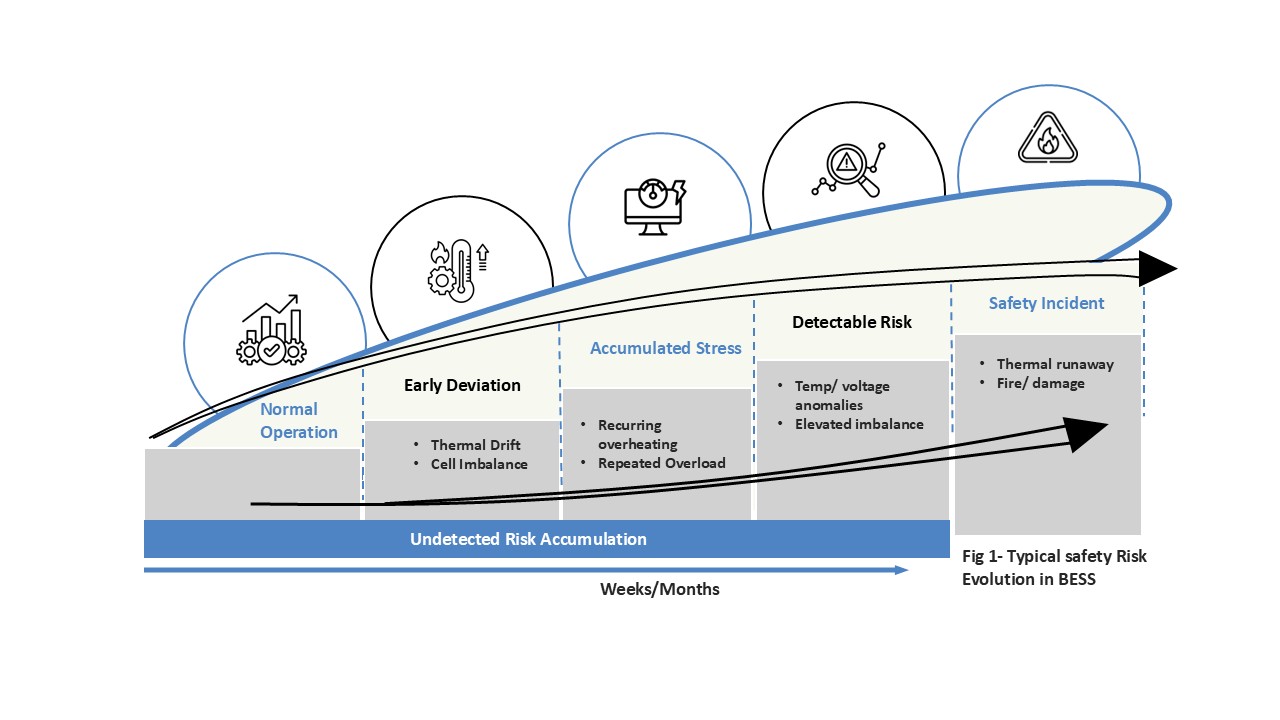
Typical Safety Risk Evolution in BESS
Typical Safety Risk Evolution in BESS
Shortcomings of legacy controls
Traditional safety control strategies largely depend on static thresholds, alarms, and shutdown logic.
These mechanisms are designed to protect against defined fault conditions but are inherently reactive. They trigger actions only after predefined limits are breached, often when risk has already materialised.
Limitations of legacy controls include:
- Rigid thresholds: Do not adapt to aging, changing load profiles, or site-specific variables.
- Lack of context: Fail to link historical stress events with real-time conditions.
- Isolated parameter evaluation: Treat data points individually rather than correlating cross-system behavior.
- Uniform safety margins: Apply one-size-fits-all limits regardless of actual risk context.
These limitations produce two undesirable outcomes. First, alerts may trigger too late to prevent risk escalation. Second, overly conservative operation can lead to unnecessary derating or downtime, reducing availability and value. Both raise operational costs and weaken confidence in safety frameworks.
Legacy models struggle to scale across fleets with diverse operating conditions. The industry needs frameworks capable of dynamic, context-aware safety assessment that evolve with system behavior.
AI-enabled risk intelligence
Artificial intelligence enhances BESS safety by adding a layer of risk intelligence that moves beyond simple threshold tracking.
AI models analyse large volumes of data from multiple sources, including battery management systems (BMS), power conversion systems (PCS), HVAC sensors, and grid telemetry to detect meaningful patterns and anomalies. Figure 2 illustrates the intelligent safety framework for BESS, highlighting how operational data and environmental context are transformed through AI-enabled risk intelligence into predictive safety actions supported by governance mechanisms.
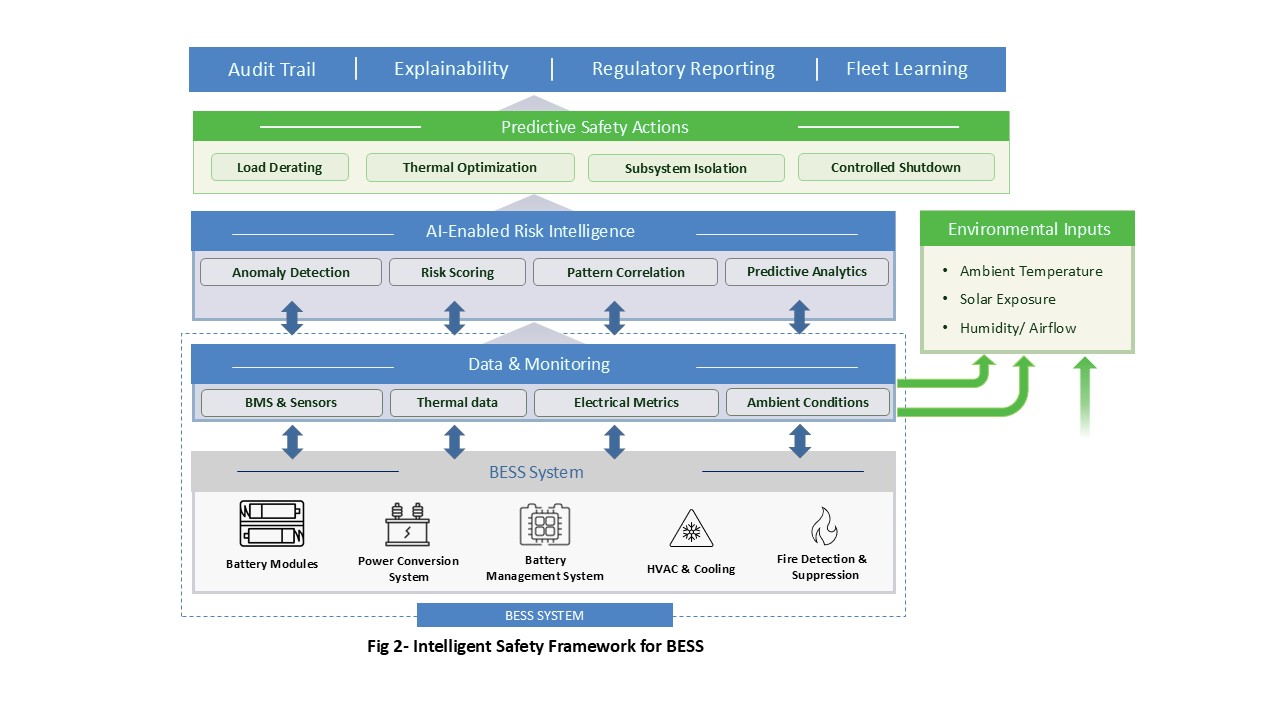
Intelligent Safety Framework for BESS
Intelligent Safety Framework for BESS
Key AI capabilities include:
- Anomaly detection: Identifying thermal, electrical, or environmental deviations that deviate from learned norms.
- Predictive modelling: Estimating remaining useful life (RUL), performance drift, or degradation trajectory.
- Multivariate correlation: Linking diverse data streams such as temperature, voltage, current, and environmental variables.
- Explainability layers: Highlighting top contributing factors for flagged risk conditions.
Unlike scripted logic, AI continuously learns from historical and real-time data, distinguishing between benign variations and early risk signals. This enables risk scoring that informs prioritisation, helping operators focus on conditions that matter most.
AI acts as a decision-support layer, augmenting human judgment rather than replacing existing safety controls. It enhances situational awareness and enables smarter operational responses without compromising operator oversight. Figure 3 provides an overview of the AI-enabled risk intelligence framework, showing how data from BMS, thermal, electrical, and environmental sources is transformed into early risk alerts and severity assessment through advanced analytics.
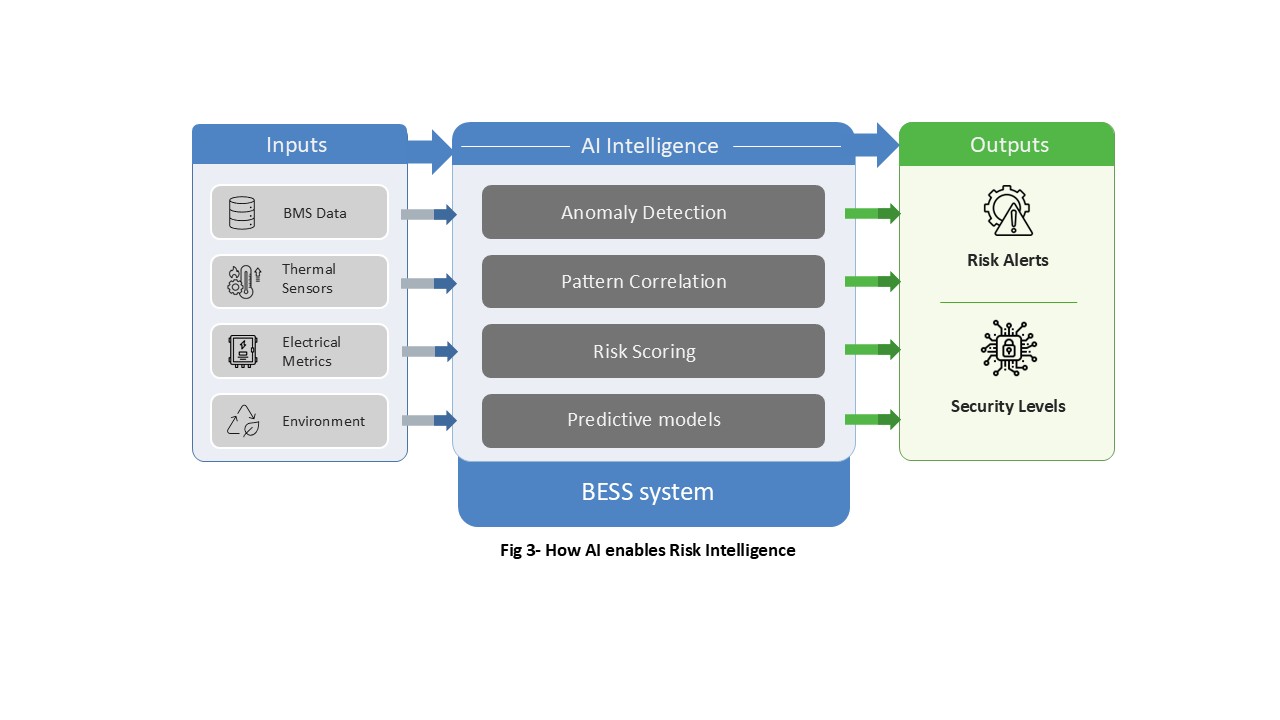
AI-Enabled Risk Intelligence for BESS Safety
AI-Enabled Risk Intelligence for BESS Safety
Predictive safety interventions
Predictive safety interventions build on AI-enabled insights to allow timely and proportionate responses before hazards escalate into incidents.
Rather than waiting for alarm thresholds, organisations can implement graduated actions based on assessed risk levels.
A graded intervention ladder might include:
- Level 1 - Monitor and alert: Early indication with context for operator review.
- Level 2 - Load derating: Adjusting power or cycle intensity to reduce stress.
- Level 3 - Thermal optimisation: Modifying HVAC or airflow strategies to address hotspots.
- Level 4 - Subsystem isolation: Temporarily isolating modules or strings showing risk trends.
- Level 5 - Controlled shutdown: Ordered system halt when predefined criteria are met.
This approach helps preserve system availability while maintaining safety margins. Predictive insights also support smarter maintenance scheduling, reducing unplanned outages and extending asset life.
By integrating predictive strategies into operational workflows, safety becomes a proactive function rather than a reactive constraint, enabling teams to balance reliability, performance, and risk reduction. Figure 4 illustrates a graded safety intervention model for BESS, showing how predictive insights enable a progressive response—from monitoring and load derating to thermal optimisation, subsystem isolation, and controlled shutdown—based on the severity of identified risk.
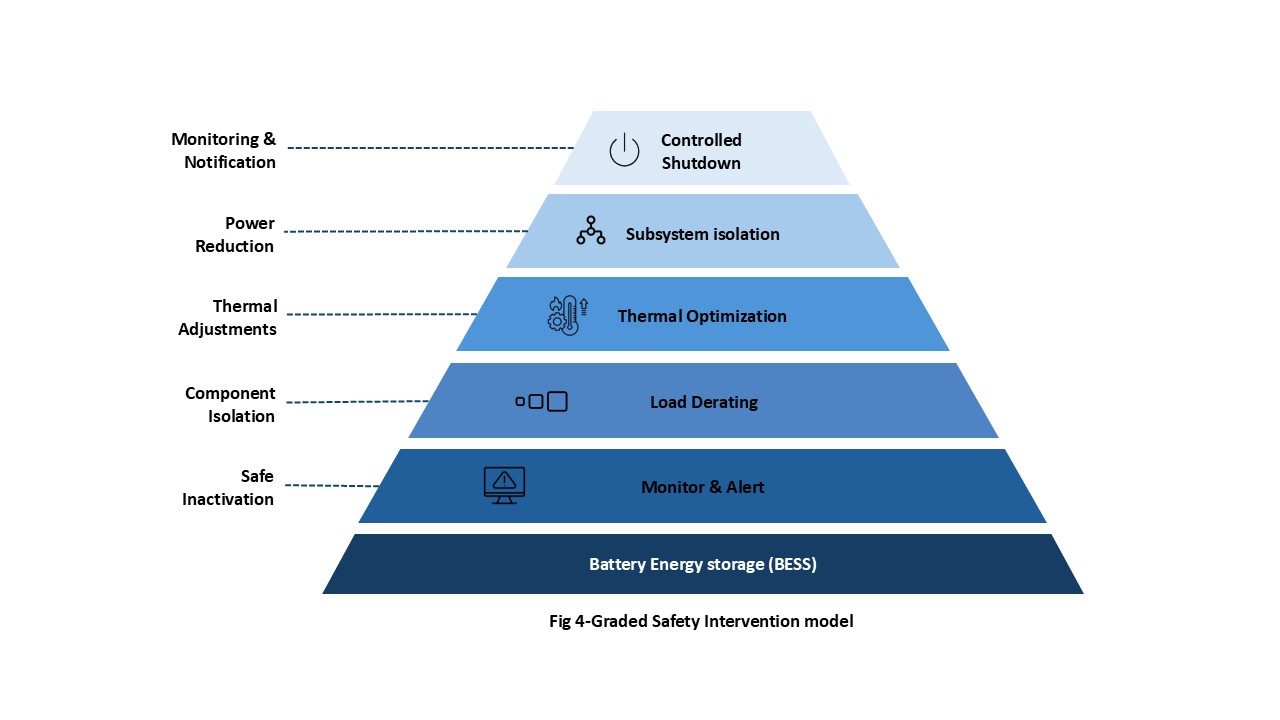
Graded Safety Intervention Model for BESS
Graded Safety Intervention Model for BESS
Scalable and compliant safety
As BESS portfolios expand, safety strategies must scale consistently while ensuring regulatory alignment and operational transparency.
Intelligence-based safety models support this through traceable, data-backed decision workflows and continuous monitoring.
Scalable safety frameworks enable:
- Portfolio-level learning: Patterns identified in one asset inform safety improvements across the fleet.
- Continuous evidence trails: Capturing decisions and risk assessments that support audits and compliance reporting.
- Benchmarking: Normalizing risk profiles across diverse operating contexts.
From a compliance standpoint, continuous monitoring and explainable decision logic help demonstrate proactive risk management rather than reactive remediation. This aligns with evolving regulatory expectations and supports clearer engagement with stakeholders including insurers, regulators, and local communities.
For example, by 2025, global battery energy storage deployments exceeded ~90 GW annually, with cumulative installed capacity surpassing ~250 GW, highlighting the rapid scale-up and the need for more mature safety frameworks.1 Scalable and compliant safety systems strengthen trust among regulators and communities and underpin the long-term sustainable adoption of BESS technologies.
Towards intelligent BESS safety
Battery Energy Storage Systems are central to a decarbonised and resilient energy future, but their success depends on the industry’s ability to manage safety in a proactive and intelligent manner.
Conventional (non-AI-enabled) battery and energy storage systems rely on static thresholds, limiting their ability to detect evolving risks. As a result, early-stage issues such as thermal drift, cell imbalance, and repeated stress cycles often go unnoticed.
This limitation has contributed to major incidents, including a series of BESS fires in South Korea (2017–2019) and the Arizona McMicken BESS explosion (2019), where early warning signals were either missed or not effectively correlated, leading to thermal runaway events and operational setbacks.
Intelligent safety strategies, enabled by artificial intelligence and contextual analytics, provide a path forward. By shifting from reactive threshold-driven models to predictive risk intelligence and structured interventions, organisations can improve safety, reliability, and resilience across growing BESS deployments.
Embedding intelligence into safety strategies is not optional, it will be essential for sustaining trust, performance, and long-term value as energy storage becomes integral to global energy systems.