Industry
Manufacturing

Future-Ready Manufacturing: Partnering in your journey to a sustainable manufacturing enterprise
Highlights
- What was once a compliance checkbox is now a decisive factor in industrial purchasing. Manufacturers that fail to showcase sustainability risk losing ESG-sensitive markets.
- Procurement teams increasingly rely on digital storefronts for sustainability cues—eco-badges, Leadership in Energy and Environmental Design (LEED) filters, and transparent data are becoming critical for winning business.
- Embedding sustainability into product metadata and digital catalogs builds trust, drives differentiation, and unlocks measurable business impact in a purpose-driven marketplace.
On this page
Overview
Imagine, a procurement team at a manufacturing firm is tasked with sourcing components for a new green-certified facility.
They are under pressure to meet ESG targets, but the supplier’s website offers no clear sustainability indicators. Frustrated, they turn to a competitor whose digital catalogue highlights eco-badges and LEED-compatible (Leadership in Energy and Environmental Design) filters. This is not hypothetical - it is the new reality of industrial manufacturing.
Sustainability, once a compliance checkbox, has become a decisive factor in B2B and B2C purchasing. Eco-conscious buyers are demanding transparent, verifiable environmental data at the point of sale. For manufacturers, this presents a strategic choice: evolve digital storefronts to reflect sustainability values, or risk falling behind in a purpose-driven marketplace.
This paper explores how manufacturers can embed sustainability into their digital product experiences—through intuitive filters, visual eco-badges, and metadata integration—creating trust, differentiation, and measurable business impact while unlocking access to ESG-sensitive markets.
Market shifts: Why now?
Sustainability is not rising in isolation—it is being propelled by a perfect storm of pressures.
The modern buyer is informed, value-driven, and increasingly intolerant of greenwashing. From regulators to investors, five forces are converging to make green labelling a business necessity, not a nice-to-have (see Figure 1):
- Regulatory pressure: Global mandates like Corporate Sustainability Reporting Directive (CSRD) and Registration, Evaluation, Authorization and Restriction of Chemicals (REACH) demand strict sustainability transparency.
- Investor influence: Environmental, Social, and Governance (ESG)-driven capital flows are reshaping procurement priorities across industries.
- Customer expectations: Business-to-Business (B2B) buyers now expect visible sustainability credentials and lifecycle clarity, like Business-to-Consumer (B2C) behavior.
- Competitive dynamics: Early adopters win trust and tenders; laggards face price-only competition.
- Digital experience demands: Sustainability metadata is now central to superior buyer journeys, including LEED filters.
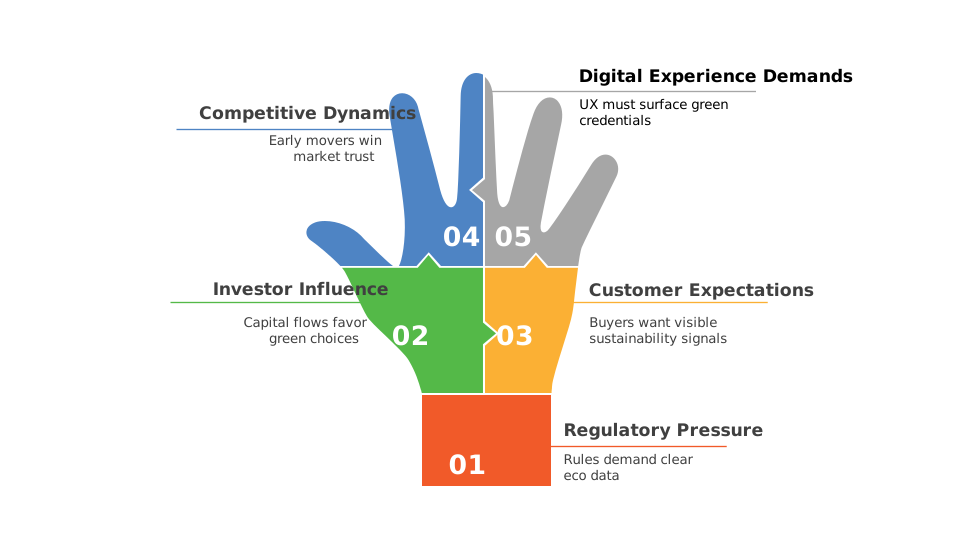
Figure 1: Forces driving sustainable procurement
Figure 1: Forces driving sustainable procurement
The visibility gap: Why is sustainable data not reaching buyers?
Manufacturers may already have the right certifications (e.g., Restriction of Hazardous Substances (RoHS), ENERGY STAR (Energy Efficiency Certification Program by the U.S. Environmental Protection Agency), Leadership in Energy and Environmental Design (LEED) – but if buyers can’t see them, they do not exist.
The disconnect between backend data and frontend experience is costing trust, bids, and brand equity. This creates friction for buyers and missed opportunities for differentiation. What if sustainability wasn’t buried in technical specs, but surfaced intuitively in every click?
By embedding eco signals into the shopping experience, manufacturers can turn trust into traction by elevating their sustainability credentials with elements such as:
a. Eco-badge overlays.
Visual badges like “Energy Efficient,” “LEED-Compatible” and “Low Volatile Organic Compounds (VOC) on product list pages (PLPs) and product display pages (PDPs) enable instant recognition and trust.
b. Metadata integration across tools.
Ensure sustainability metadata flows into Configure-Price-Quote (CPQ) tools, Building Information Modeling (BIM) models, and distributor portals—enabling specifiers and sellers to highlight green credentials in quotes and submittals.
Who gains from going green?
Let’s explore how green cues create value across the ecosystem.
| Stakeholder | Benefits |
| Design engineers | Easier access to eco-designed components (e.g., low-carbon switches, recyclable enclosures); integration into CAD/BIM systems. |
| Procurement teams | Streamlined supplier selection aligned with ESG goals; improved compliance tracking. |
| OEMs and installers | Preference in tenders due to verified green credentials; streamlined RFPs with visible sustainability data. |
| Sales and CPQ teams | Sustainability metadata flows into Configure-Price-Quote tools, enabling reps to position energy-efficient variants. |
| Distributors and partners | Co-branded catalogs and digital assets that highlight green products, enabling upselling and differentiation. |
| Facility managers | Confidence in lifecycle emissions and energy savings from smart electrical systems and automation platforms. |
| Brand and marketing teams | Stronger ESG storytelling across B2B channels; differentiation in purpose-driven markets and investor relations. |
What could go wrong?
The path to green commerce isn’t without pitfalls.
From data integrity to internal alignment, manufacturers must navigate carefully to avoid turning good intentions into reputational risks
- Data integrity and greenwashing risk: Inaccurate eco-badges can erode trust and expose brands to reputational risk.
- Metadata complexity: Mapping sustainability across thousands of Stock Keeping Units (SKUs) requires cross-functional coordination.
- Change management and stakeholder alignment: ESG, product, and digital teams must collaborate to avoid delays.
- Competitive catch-up: Early adopters gain brand preference; late movers risk competing on price alone.
Conclusion: Sustainability is not a mandate; it is a market advantage.
Sustainability is no longer a back-office metric—it is the language of trust in industrial manufacturing.
As procurement teams align with ESG goals and digital buyers seek transparency, manufacturers have a unique opportunity to lead.
By embedding sustainability into the digital experience, early movers can shape buyer expectations, win more bids, and build lasting brand equity. Those who delay may find themselves competing on price alone in an increasingly value-driven market.
The path forward is clear: sustainability is not just a mandate—it is a strategic advantage waiting to be activated.