Industry
Manufacturing

Future-Ready Manufacturing: Partnering in your journey to a sustainable manufacturing enterprise
Highlights
- As the global electric vehicle market grows, accurately estimating battery health has become critical for the resale market, where battery cost strongly influences vehicle value.
- Battery health improves buyer trust and supports regulatory needs such as the Digital Battery Passport, traceability, carbon footprint reporting, and recycling.
- This paper presents a data-driven Battery Health Certificate framework for EV resale, aligned with global regulations, enabling AI-based remaining life prediction and supporting a circular economy.
On this page
On this pageinpage
Driving trust forward
The global electric vehicle (EV) market is expanding at an unprecedented rate, with more than 14 million EVs sold in 2023 alone, according to the International Energy Agency (IEA). As these vehicles begin to mature, the resale market must address the pressing question of battery health and longevity.
Battery packs, which represent 30–40% of an EV’s value, are the single most influential factor in determining resale prices. Unlike engines in traditional cars, batteries degrade invisibly over time, leaving buyers uncertain about performance and safety in second-hand EVs.
This challenge has sparked the concept of Battery Health Certificates (BHCs): standardized, third-party assessments of a battery’s condition, remaining useful life, and compliance.
As Ursula von der Leyen, President of the European Commission, put it: “Transparency in clean technologies is not optional, it is the key to trust.”
Why certification matters.
Hidden degradation
A new EV battery is typically warranted for 8–10 years or ~100,000 miles, but real-world usage significantly accelerates wear. Factors such as:
- Fast charging frequency (high C-rates).
- Climate (excess heat or cold).
- Depth of discharge.
- Driving behavior.
These factors reduce effective capacity. Industry studies reveal that in hot climates, batteries can lose 20–30% capacity within 5–7 years, far sooner than warranties expire.
Thus, a vehicle may look pristine externally but hide a battery already operating at 70% State of Health (SoH), signaling limited remaining life.
Consumer trust gap
EV buyers list battery condition as their top concern, yet most lack reliable tools to assess it. Without certification:
- Buyers risk overpaying for underperforming vehicles.
- Sellers struggle to justify fair prices.
- Counterfeit or unsafe batteries may circulate, weakening trust in the resale market.
This uncertainty suppresses adoption and delay purchases citing uncertainty about battery lifespan.
Regulatory momentum
Without transparent certification, the resale market cannot scale sustainably.
A Battery Health Certificate transforms a hidden, technical risk into an open, trusted parameter of value.
The EU Battery Regulation (2023/1542) is pioneering digital battery passports to enhance traceability and reporting of SoH, carbon footprint, and recycling compliance. Similar initiatives include:
- United States: California exploring stricter EV resale disclosures.
- India: Battery Aadhaar, a unique digital ID for batteries.
- China: Recycling traceability systems tied to extended producer responsibility.
These frameworks point toward a global convergence where certification will be a baseline expectation, not a competitive option.
Framework for assurance.
Core certificate elements.
A standardized BHC must cover five key pillars:
Identity: Brand, model, chemistry, serial number, manufacture date.
Performance:
- SoH
- Cycle count
- Internal resistance growth
Safety: Results of thermal stability tests, presence of defects, recall history.
Sustainability: Compliance with recycling standards, reporting of carbon footprint.
Traceability: Blockchain record of certifier, test date, and report ID to prevent tampering.
Data sources:
Battery life estimation is best achieved by triangulating multiple data streams:
- On-board BMS data:
- Total energy throughput (kWh).
- Charging type ratio (AC vs DC fast charging).
- Average operating temperatures.
- Historical SoH trends.
- External vehicle history:
- Mileage, service history.
- Geographic exposure (e.g., extreme cold in Norway, extreme heat in India).
- OEM and supplier databases:
- Chemistry-specific degradation curves.
- Fleet averages for benchmarking.
AI-driven prediction
Collected data can be modeled using machine learning and physics-informed AI to estimate Remaining Useful Life (RUL). Example outcomes:
- A Nickel-Manganese-Cobalt (NMC) battery rated at 1,000 cycles may retain ~80% capacity after 8 years under moderate use.
- A Lithium Iron Phosphate (LFP) battery, by contrast, can often exceed 2,000 cycles, lasting 12–15 years in temperate climates.
AI enables dynamic RUL forecasts that update continuously as usage data evolves.
Global perspectives
Fatih Birol, Executive Director of the IEA, notes: “The next frontier in electrification is not deploying batteries—it is managing their entire lifecycle.”
By embedding lifecycle intelligence into resale transactions, a BHC ensures that EV adoption does not stall due to opaque secondary markets.
Ecosystem Benefits
For consumers
- Peace of mind: no guesswork in second-hand EVs.
- Fair comparison across brands/models.
- Reduced risk of fraud or buying “lemons.”
For retailers and OEMs
- Higher resale values: Certified EVs can command 5–10% premiums compared to uncertified ones.
- Lower disputes: Warranty claims and returns decline when buyers know the true battery state.
- Brand credibility: OEMs show accountability, strengthening customer loyalty.
- EPR compliance: Easier adherence to extended producer responsibility laws.
For recyclers and second-life operators
With EV battery retirements projected to exceed 12 million tons annually by 2035, sorting quality is vital:
- High-quality packs → second-life use in stationary storage.
- Degraded packs → recycling to recover lithium, cobalt, nickel.
Certification supports efficient routing, maximizing material recovery and safety.
Circular economy impact
The World Economic Forum highlights: “Circularity in batteries is not just a sustainability choice, it is a $35 billion annual opportunity by 2030.”
BHCs strengthen this by:
- Ensuring multiple lifecycles for each battery.
- Reducing waste and unsafe disposal.
- Driving resource security for critical minerals.
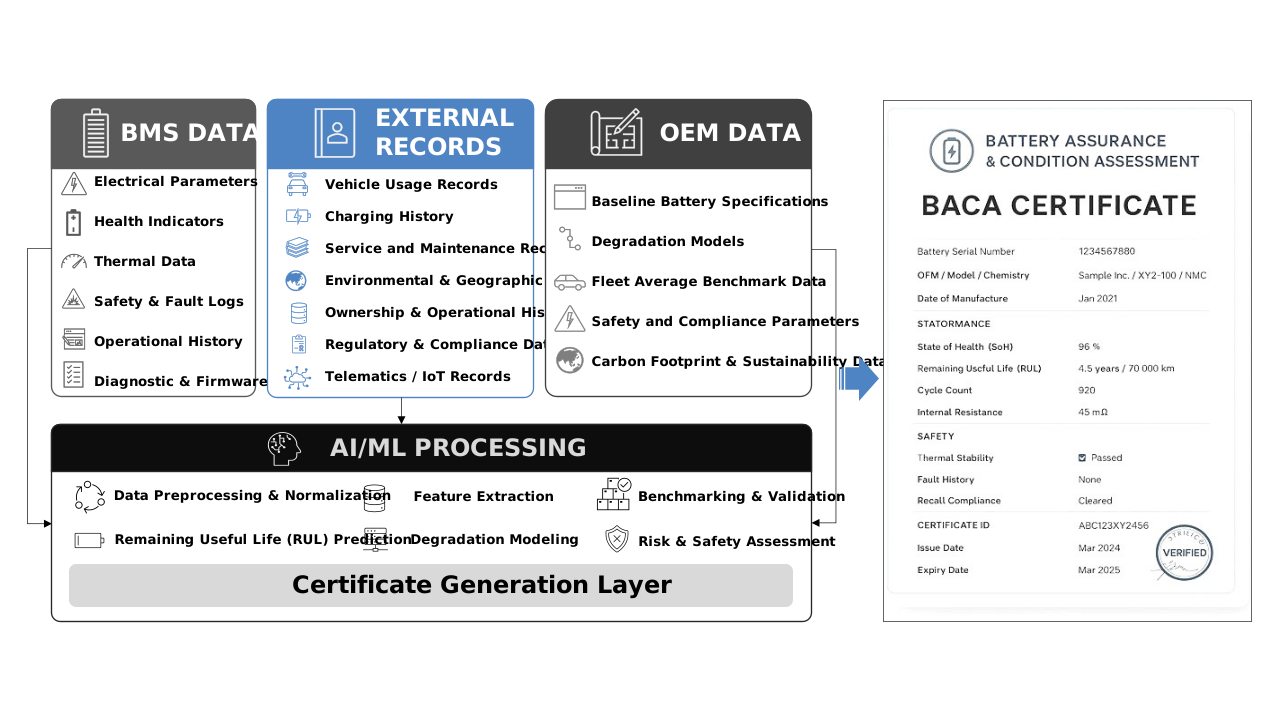
Certificate creation: process & attributes
Certificate creation: process & attributes
Creating confidence
Accurately assessing battery health is no longer optional, it is fundamental to building a transparent, credible EV resale market. A Battery Health Certificate offers the industry a standardized tool to unlock trust, protect consumers, and ensure compliance. By integrating data-driven models, AI-powered prediction, and third-party verification, stakeholders can accelerate EV adoption while supporting a sustainable, circular economy. The road ahead has challenges, cost, standardization, privacy, but the rewards are transformative: consumer trust, fair value, and a resilient ecosystem for one of the most critical assets of the clean-energy transition.