Services
Highlights
- Software-defined everything (SDx) is driving rapid innovation, enabling remote enhancements, and delivering dynamic customer experiences across industries.
- The convergence of AI and ML, GenAI, IoT, and advanced connectivity is transforming traditional hardware into intelligent, reconfigurable, and connected digital platforms, enabling industries to undergo a shift from hardware-centric models to software-defined paradigms.
- By adopting four guiding principles, including product portfolio analysis, AI-defined software architecture, SDLC, talent transformation, and a robust partner ecosystem, organisations can unlock agility, resilience, and sustainable growth through SDP and SDx transformation.
On this page
On this pageinpage
The SDx era
The rapid convergence of artificial intelligence, IoT, and advanced connectivity is ushering in a new era of software-defined products (SDP) and SDx, where differentiation comes less from what a product is at launch and more from what it can become over time. As industries face mounting pressure to innovate, adapt, and deliver personalised experiences, traditional hardware-centric models are giving way to agile, intelligent and reconfigurable digital platforms.
AI-driven capabilities are at the heart of this transformation, enabling real-time insights, predictive maintenance, and continuous product evolution. Organisations that embrace AI-enabled SDP and SDx architectures are unlocking unprecedented agility, accelerating time-to-market, reducing operational costs, and responding swiftly to shifting customer demands. The most profound impact of software-defined everything is not just technological; it is the reimagination of value chains.
When an industrial automation company sought to attain flexibility and scalability of its products by migrating custom high-cost hardware to a cluster of low cost, commercial off-the-shelf devices, it took the software-defined approach. Following a defined architecture and a series of proof of concepts (POCs), the company could develop software-centric products that helped it achieve increased uptime and distributed application processing while overcoming stringent control loop timing constraints. This enabled the company to scale its products, protect its investments in software and algorithms, and lower product life cycle costs for end users.
AI and software-defined strategies are becoming the primary levers for future-proofing products, driving business model innovation, and creating sustainable competitive advantages. This shift demands new operating models, agile platforms, and ecosystem partnerships, as capabilities increasingly come from collaborative networks rather than in-house silos.
Decisioning dilemma
In today’s smart factories, heavy engineering environments, healthcare systems, and transportation networks, complexity is no longer centralised; it is federated. Decision-making is distributed across multiple domain SMEs who interpret context, adjudicate trade-offs, and act within their local boundaries. The challenge is that outcomes are shaped by many decision points across the system, making consistency, speed, and accountability harder to sustain at scale.
At the same time, the next-generation SDP and SDx architecture is inherently heterogeneous with intelligent agents embedded across products, machines, platforms, and operations to assist and augment human experts in the loop (Human + AI). This creates a new reality: responsibility for “good choices” becomes shared between humans and machines, and the bar shifts from isolated decisions to robust, explainable, goal-aligned choices that hold up across safety, performance, cost, energy, and resilience constraints.
TCS, in collaboration with MIT Sloan Management Review, conducted a research program to examine how leading organisations are integrating predictive and generative AI with human expertise to transform decision-making. The research highlights the emergence of intelligent choice architectures (ICAs), a human centric paradigm in which AI systems proactively help structure decisions by generating novel options, predicting outcomes, and guiding choices, so leaders are not just making faster decisions but operating with better choice sets and clearer trade-offs.
In the context of SDX, ICAs can be applied as adaptive, AI-driven decision frameworks across connected products, machines, assets, and industrial ecosystems, continuously creating, refining, prioritising, and orchestrating choices in real time across goals such as performance, safety, energy, cost, and resilience. As ICAs mature, they shift decisioning from isolated, one off calls to continuous outcome stewardship: learning from changing scenarios, decisions, and results as it progresses toward target outcomes.
Human + AI autonomy
Though traditional AI methods were used in the past for product development and testing, the next inflexion point comes from edge AI, Gen AI, agentic AI, and physical AI, as they begin to influence product features, functionalities, behaviour, and developmental methodologies. In other words, helping products progress from hardware-defined behaviour to software defined adaptability and, ultimately, autonomous in operation.
As suggested by TCS’s Human + AI autonomy model, there are five practical stages of this evolution from AI as a tool, to assistants, to supervised agents, to autonomous agents, and finally to an agentic workforce, where humans increasingly move from “doing” to supervising, orchestrating, and governing outcomes. The examples that follow map representative products and engineering scenarios to each level of the Human + AI autonomy model, showing how SDx journeys are already unfolding across heavy engineering, manufacturing, and mining and construction environments.
Heavy engineering and industrial assets
Equipment such as computer numerical control (CNC) machines, automated guided vehicles (AGVs), food and material processing equipment, packaging equipment, labelling equipment, quality inspection equipment, and oil and gas machinery are now being transformed through embedded software, advanced connectivity, and intelligent control systems. This shift enables continuous upgrades and optimisation, moving beyond the limitations of fixed mechanical and hydraulic systems.
By adopting AI agents and physical AI, these machines will be able to self-learn and make the right decisions to achieve the end goal.
The journey towards autonomy in heavy engineering and industrial assets depicts the art of the possible for this industry, showing how leveraging SDx, along with human + AI autonomy, can transform the operations.
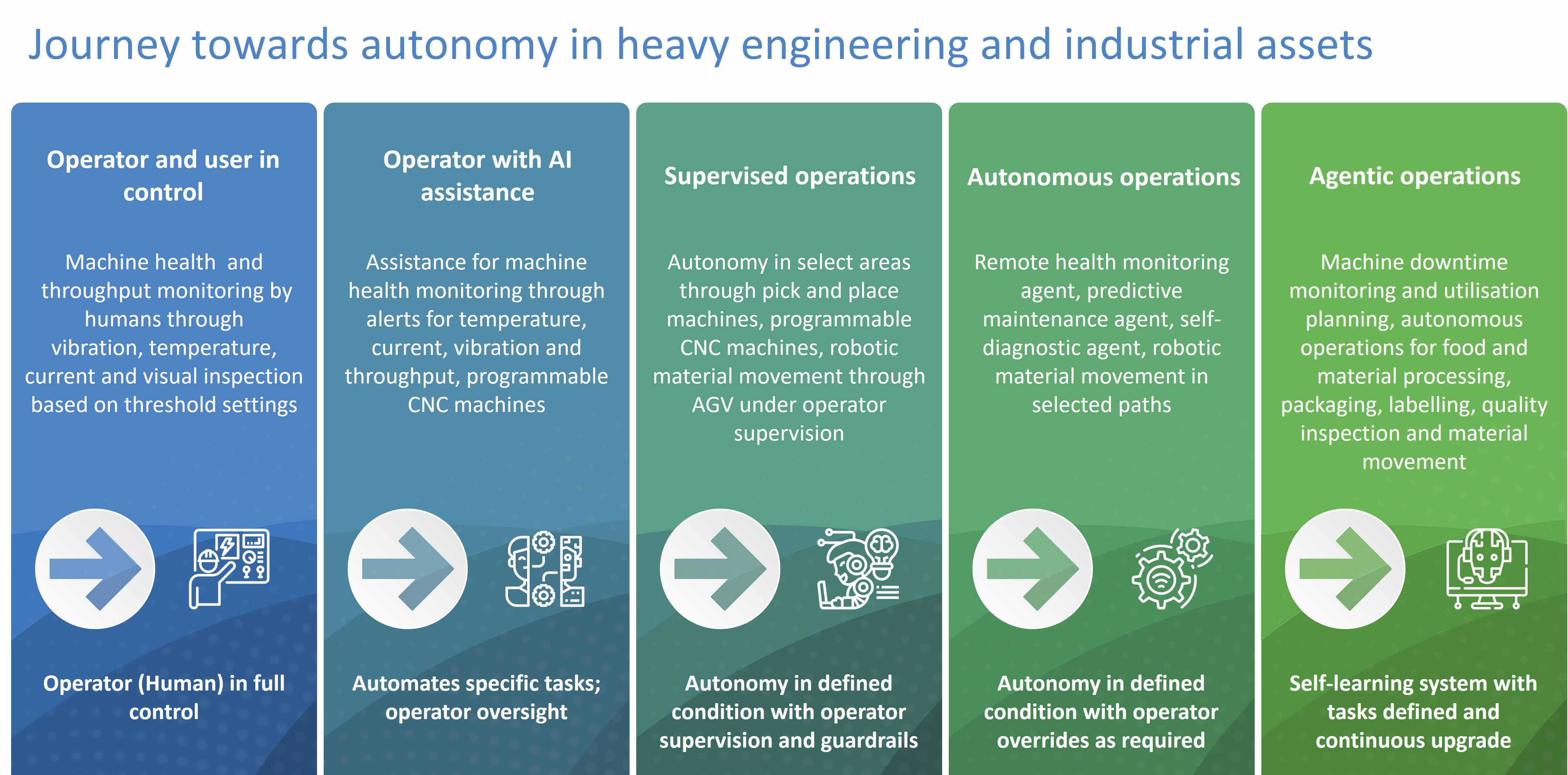
Autonomy in heavy engineering & industrial assets
Autonomy in heavy engineering & industrial assets
Manufacturing systems
Manufacturing systems such as assembly lines, process plants and smart factories are increasingly evolving into software-driven ecosystems. Traditional production environments, once dependent on fixed automation and PLC-based controls, are now being transformed through embedded software, advanced connectivity, AI-enabled sensing and control systems. By adopting an AI-first architecture, manufacturers can optimise production through predictive quality control and intelligent process management.
The journey towards autonomy in manufacturing systems depicts the art of the possible for this industry, how leveraging SDx, along with human + AI autonomy, can transform the manufacturing operations.
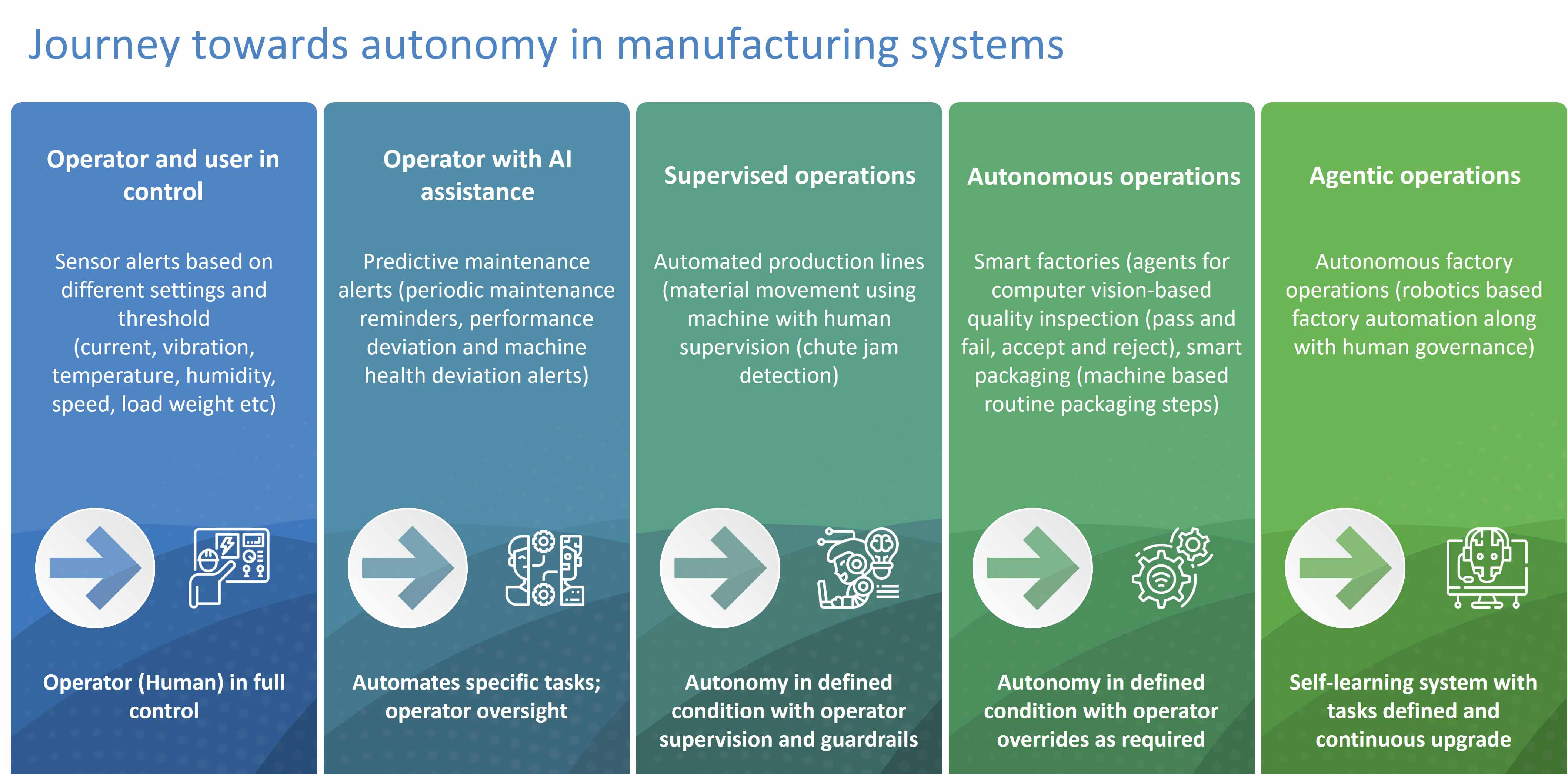
Autonomy for manufacturing systems
Autonomy for manufacturing systems
Mining and construction equipments
Inspired by the automotive sector’s success with technologies such as software-defined vehicles, autonomous driving, and over-the-air updates, mobile equipment—such as excavators, tractors, and cranes—now features adaptive performance, remote OTA upgrades, advanced diagnostics, and seamless integration with digital ecosystems. As a result, manufacturers can deliver smarter, more agile machines that boost productivity, reduce downtime, improve machine utilisation and provide real-time operational insights. A built-in agentic AI framework will enable these machines to be self-adaptable and autonomous.
The journey towards autonomy in mining and construction equipment depicts the art of the possible for this industry, showing how leveraging SDx, along with human + AI autonomy, can transform mining and construction operations.
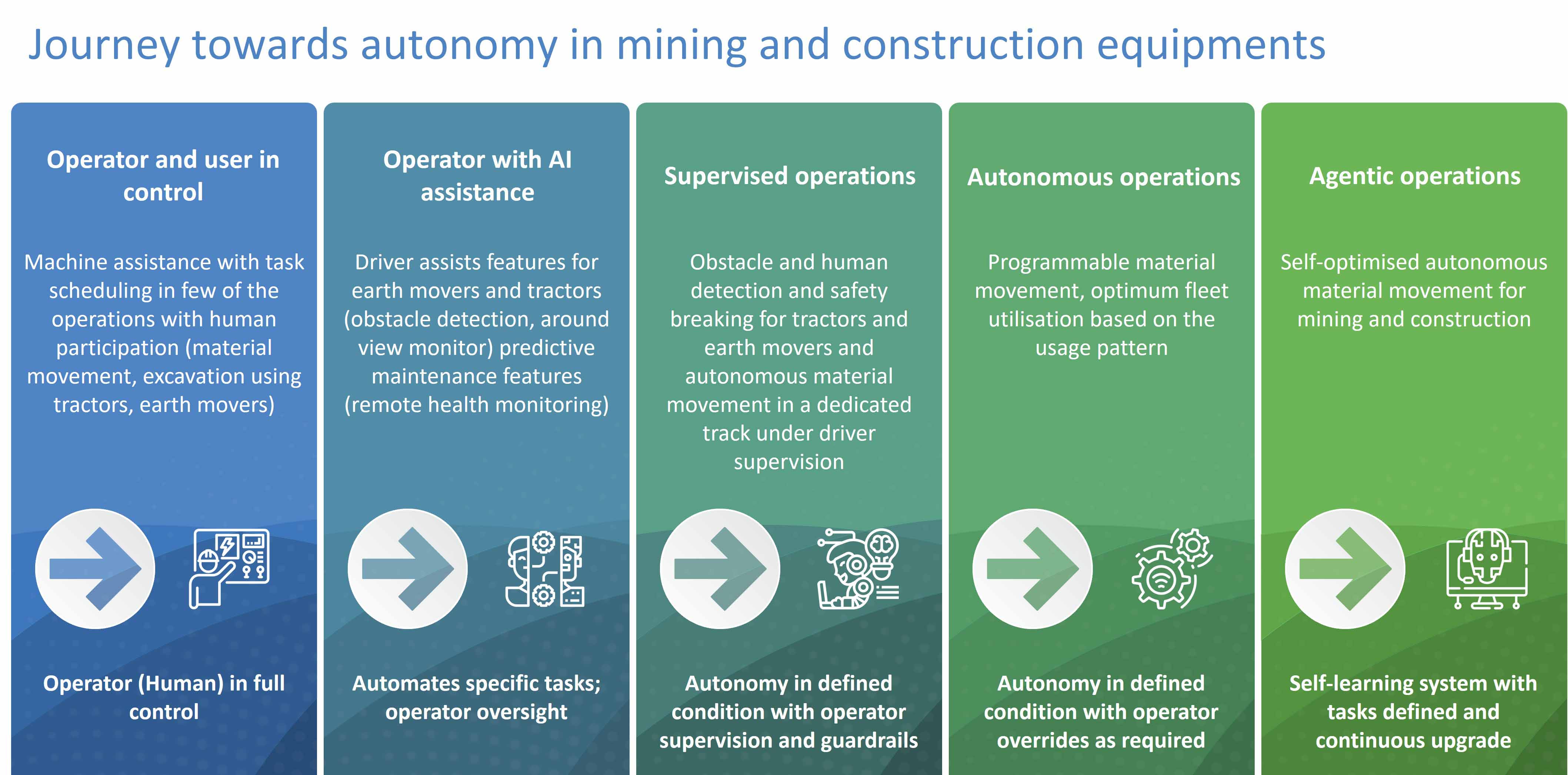
Path to autonomy in mining and construction
Path to autonomy in mining and construction
Infra to intel
The SDx architecture outlines an end-to-end framework for evolving traditional engineering products into software-defined, AI-driven adaptive systems which continuously learn from historical and real-time data. It enables the product to become self-aware, self-healing, self-adaptive and self-secure at every stage of the product value chain. The diagram below depicts a generic AI-led full-stack, with five key layers from hardware to intelligence. The components used within each layer will depend on industry-specific use cases and solutions.
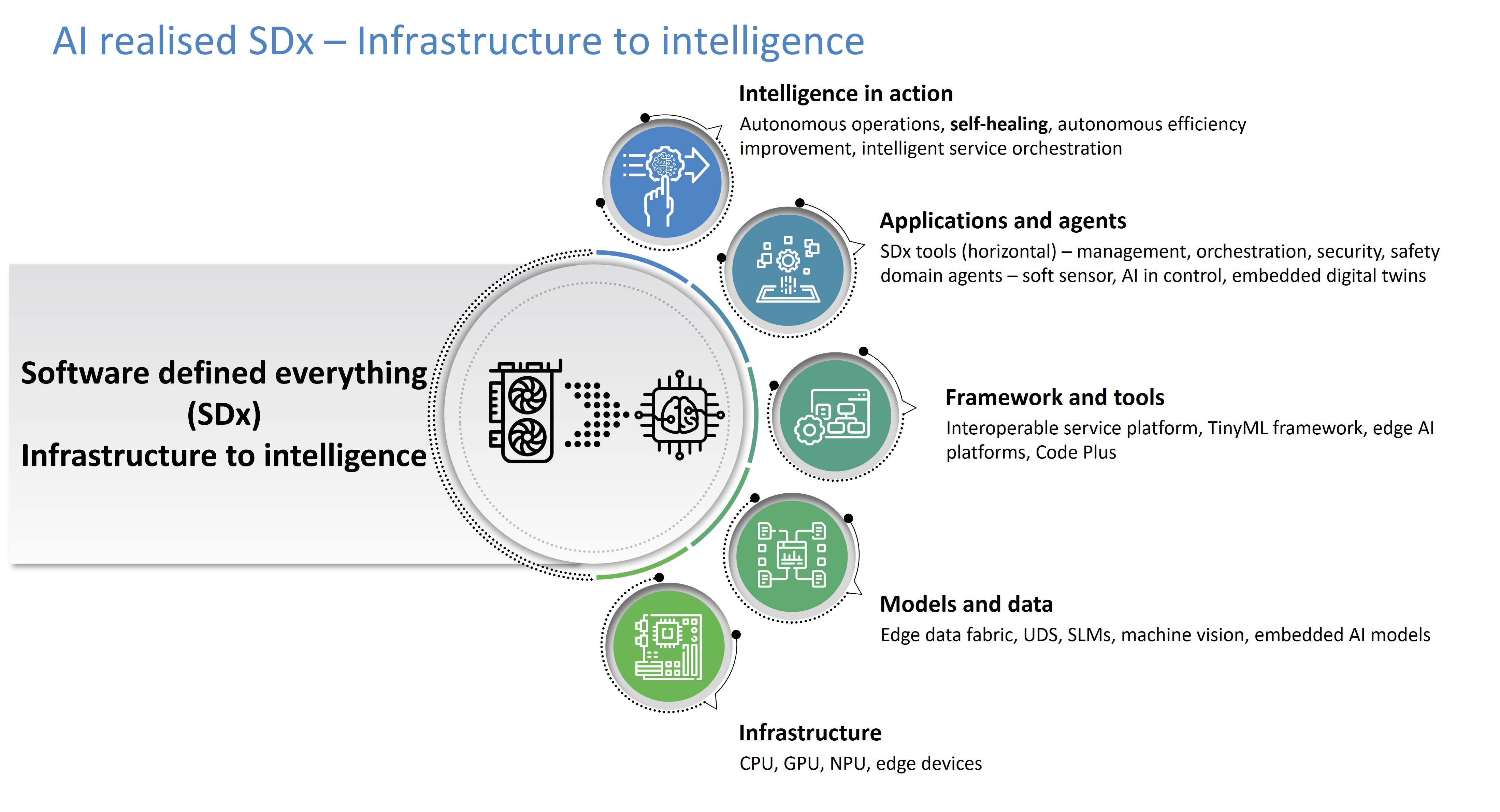
AI realised SDx – Infrastructure to intelligence
AI realised SDx – Infrastructure to intelligence
An example of software-defined automation:
A global industrial major with a portfolio spanning industrial automation products, power devices and systems, and data centre solutions was looking to modernise its safety control systems and sustain its distributed control landscape. Its controls and automation stack, comprising distributed control systems (DCS), supervisory control and data acquisition (SCADA), remote terminal units (RTUs), programmable logic controllers (PLCs), and field devices, was built on conventional architectures and deployed across ISA-95-aligned process industries. However, the current stack lacked native capability to integrate edge applications and analytics, limiting modernisation and future-ready extensibility.
With a vision to consolidate the portfolio, align with software-defined automation, and implement a software-defined control architecture, the organisation established a foundational building block, the industrial edge hub (IEH).
IEH is a virtual edge device designed to host control applications, ML models, AI applications, and diagnostics. It can be deployed across multiple infrastructure options, including industrial grade COTS hardware, hypervisors, and containerised environments. A cluster of low cost IEHs can then be used to deploy functions across L1, L2, and L3, enabling plant wide standardisation and dynamic orchestration. At scale, this IEH cluster can replace traditional OT system stacks in the processing plant by providing a flexible, software defined runtime layer for control and execution.
An intelligent edge platform built around the IEH to operationalise software-defined control at scale provided core services such as control logic runtimes, TinyML inference, an edge data fabric, IEH fleet management agents, a device security stack, IO, and plant network connectivity. This platform enables AI integrated control functions, diagnostics, and security, bringing intelligence closer to operations and creating the foundation for neural manufacturing.
The result is a flatter industrial hierarchy with greater automation and personalisation, keeping humans in the loop as AI scales execution, laying the foundation for neural manufacturing and dark factory models.
Four core principles
1. Product portfolio analysis
Transitioning from hardware-defined to software-defined architecture demands rigorous strategic planning and disciplined execution. The success of models like software-defined data centre (SDDC), software-defined radio (SDR), and software-defined network (SDN) demonstrates that product volume and a clear roadmap are critical to realising value at scale. Many industries have a mix of low- and mid-volume products, making it essential to conduct a thorough product portfolio analysis. By identifying and consolidating products that can be unified under a common software architecture and platform, organisations can maximise investment, streamline development, and accelerate the benefits of software-defined transformation across product lines. AI-defined software architecture and SDLC.
Upgrading the existing software architecture is essential for a successful transition to SDP and SDx. Embracing the architectural enhancements, organisations can ensure their products remain agile, secure, and future-ready in a rapidly evolving digital landscape. The transformed architecture will also include in-built intelligence through purpose-built edge AI, agentic AI, and physical AI components, using the Intelligent Choice Architecture (ICA) framework. This approach enables the products to seamlessly transition to different levels of autonomy by enabling agents to continuously learn and adapt.
2. AI-assisted SDx solution development life cycle
AI is accelerating how products are conceptualised, designed, developed, validated and maintained. Agentic AI tools help to accelerate the product development lifecycle, improve product quality, and enhance performance. Some examples of SDx-specific transformation activities influenced by GenAI include code refactoring, design assistance, automatic test case generation, script assistance, and compliance documentation.
3. Talent transformation
Developing products with AI-enabled software-defined architecture demands a blend of core engineering and advanced digital expertise. This calls for strategic workforce planning and targeted skills augmentation to ensure the organisation is equipped with the niche capabilities needed to drive innovation and deliver robust, future-ready products.
4. Robust partner ecosystem
SDP and SDx transformations are not solo journeys. Its success depends on how well a company leverages a broader ecosystem of partners and platforms. Developing AI-led SDP and SDx transformation requires integrating multiple software layers, each with distinct functionalities. Building a strong partner ecosystem enables organisations to access proven software components from a variety of sources, including technology partners, open-source communities and platform providers. A well-orchestrated partner ecosystem accelerates innovation and ensures a more resilient, scalable transformation journey.
Considering evolving technological trends, growing industry pressures and rising customer expectations, it is increasingly clear that AI-led SDP and SDx transformation is a strategic imperative. Early adopters are already realising clear advantages in innovation, agility and value creation, and others stand to benefit by embracing this shift. By anchoring AI capabilities through the SDx architecture, OEMs can move beyond incremental feature upgrades to transform the product engineering value chain end to end from design and validation to deployment and lifecycle evolution, unlocking compounding benefits at scale. A clear set of guiding principles, reinforced by AI’s impact across the product lifecycle, provides the discipline required to execute this transformation effectively and realise its full potential.