Services
Network Solutions and Services

Reimagining 5G and network solutions for future businesses
Highlights
- Semantic communication conveys meaning instead of raw data, reducing bandwidth and enabling intelligent, low-latency services.
- It is a key enabler for 6G, supporting immersive applications and AI-native network optimization.
- Edge monetization challenges stem from high costs and unclear ROI, requiring new value propositions.
- Embedding semantics into 6G networks unlocks efficiency, new pricing models, and revenue opportunities.
On this page
On this pageinpage
The what and why
What is semantic communication and how is it related to edge computing services?
Semantic communication is a paradigm shift from transmitting raw data to conveying meaning.
Instead of sending entire video frames or audio streams, the system extracts key inferences—such as objects, intents, or gestures—and transmits them as semantic payloads. This does not mean it overhauls the existing communication, rather it acts as an overlay on the existing communication network by optimizing the communication based on intent of users and meaning of information.
An analogy
Think of how a newspaper conveys an event. A reporter witnesses an incident but does not transmit the raw visuals. Instead, the reporter interprets the scene, extracts the essential actors and interactions, and converts these into a structured narrative. This narrative is printed and distributed, allowing readers to reconstruct the event in their minds. While each reader’s mental image may differ, the clarity and consistency of the report ensure that the core meaning remains intact, enabling a shared understanding. Semantic communication works similarly: it transmits the distilled meaning of information rather than the entire data stream, reducing complexity while preserving intent.
Semantic communication and edge computing
One basic question here is, who does such inferencing and semantic extraction at the sender-side, as well as reconstruction at the receiver-end. This is where artificial intelligence (AI) plays a big role. An AI pipeline near the user distils entities, events, intents, poses and relationships and sends a compact semantic payload. The receiver reconstructs or acts on that meaning using local models and assets (pre-loaded avatars, maps, representative images, etc.), achieving the same outcome with a fraction of the bandwidth. Edge computing plays a critical role here. AI models that derive semantics are computationally intensive and cannot run on lightweight user devices. Edge computing nodes, integrated into the network, provide the necessary processing power close to the user, ensuring low latency and real-time semantic extraction and reconstruction. Thus, semantic communication and edge computing together form the backbone of intelligent, resource-efficient services.
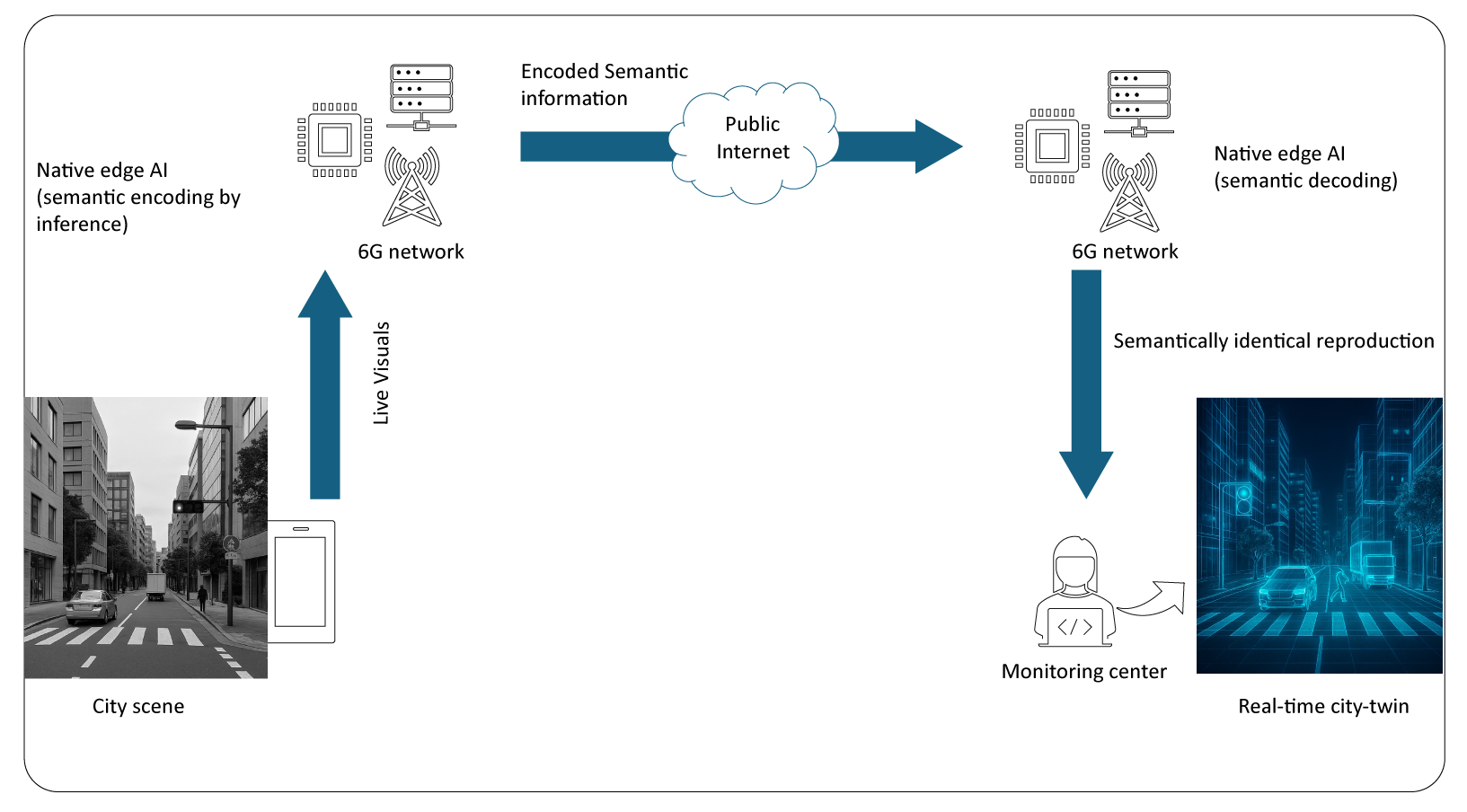
Figure 1:
A conceptual futuristic example of semantic communication system in real-time smart city application.
Figure 1:
Semantic communication for a 6G future.
Semantic communication is emerging as a cornerstone for 6G networks
6G promises ultra-low latency, massive device density, and AI-native networks to enable immersive experiences like holographic telepresence, digital twins, and predictive analytics. However, scaling such data-heavy applications will exceed even 6G’s theoretical capacity, as real-time holographic transmission demands terabits per second. Relying solely on traditional bit-based communication would escalate cost and complexity. Semantic communication, transmitting distilled meaning instead of raw data and leveraging edge computing for real-time inference, is key. It enables task-aware resource allocation and intelligent prioritization, transforming networks into adaptive, goal-driven platforms that deliver richer experiences, sustainable performance. In this respect, semantic communication is not just an optimization, but rather it is a manifestation of the AI-native network vision within the communication pipeline and ushers in new monetization opportunities for the 6G era.
Semantic communication: The bridge between AI for network and network for AI.
AI-native networks have two dimensions: AI for network, where intelligence is embedded to optimize performance and resilience, and network for AI, where distributed computing resources enable AI-driven services. Semantic communication embodies both. Through semantic-aware networking, AI interprets data flow objectives, prioritizes resources, and ensures semantic fidelity—so the network acts on goals, not just bits. It understands objectives like “prioritize collision-avoidance signals” in V2X communications, “prioritize machine control commands over regular telemetry” in industrial IoT, etc.
On the network for AI side, semantic communication enables distributed AI workloads by leveraging edge computing for real-time inference as described earlier. Edge nodes host semantic encoders and knowledge bases, allowing AI models to extract meaning from raw data streams and share context across the network through semantic brokers and caches.
The perceived edge monetization challenges in 6G era.
Monetization of AI-native edge computing services and infrastructure in 6G is challenging and needs transformative approach.
The challenges are primarily due to a fundamental gap between cost and value-proposition. Deploying edge infrastructure demands high CAPEX for hardware, orchestration, and security, yet the direct revenue from AI services remains unclear. Most edge AI functions act as enablers for other applications rather than standalone profit centers, making ROI difficult to justify. Additionally, market demand is still nascent coupled with limited notion, for both enterprises and consumers, on the benefits that edge AI may bring. A key factor fueling this is the lack of general idea on the killer applications. Without clear value propositions and scalable use cases, communication service providers struggle to convert heavy investments into sustainable revenue streams.
Catalyst for 6G edge-monetization?
Semantic communication in 6G can be a game-changer for AI-native edge monetization.
By embedding semantics into communication, 6G transforms edge from a cost center into a strategic enabler of intelligent ecosystems. This not only reduces operational overhead but also creates compelling use-cases that drive adoption and revenue.
The catalytic can be envisioned in multiple dimensions as below:
- Efficiency gains: Lower data transfer costs make edge AI economically viable.
- Context-aware services: Enables personalized, intelligent applications (e.g., AR/VR, industrial automation).
- New monetization models: Pay-per-insight or semantic subscription tiers rather than raw bandwidth.
- Demand creation: Semantic-driven apps deliver tangible benefits through energy savings and faster decisions which attract enterprises and consumers.
- Integration with existing AI functions: Semantic layers complement AI inference at the edge, creating a unified value proposition.
Research and standardization gaps.
Despite rapid progress, AI-native edge computing and semantic communication in 6G face critical research and standardization gaps that must be addressed for commercial viability.
The major gaps can be identified as below:
- Semantic metrics and benchmarks: There are still no standardized KPIs for semantic accuracy, efficiency, or reliability.
- Interoperability frameworks: There is a lack of common protocols for AI-driven edge orchestration across multi-vendor environments.
- Security and privacy standards: Need for robust guidelines on semantic data integrity and compliance with global regulations.
- Knowledge orchestration framework: Lack of standardized methods to manage distributed knowledge graphs and AI models across edge nodes for consistency and scalability.
- Scalable deployment models: Missing reference architectures for large-scale semantic-enabled edge networks.
The road ahead
Semantic communication is a strategic enabler for edge monetization in private 6G networks.
This can unlock new revenue streams, improve operational efficiency, and deliver high-value enterprise services aligned with business intent. Early investment and ecosystem collaboration will be critical to capture this opportunity. We present the necessary perspectives on these aspects.
The following threads of strategic developments may help synergize semantic communication-based approaches with 6G evolution:
- Develop semantic-aware edge platforms.
- Create differentiated service tiers for semantic-enabled applications (e.g., industrial IoT, AR/VR, Digital Twins, etc.).
- Leverage AI for dynamic resource allocation and pricing based on semantic insights.
- Strategize standards engagement (TSDSI, ITU-T, 3GPP) to accelerate adoption of proposed solutions and what NSS has already achieved.
- Build up ecosystem partnerships.
The critical role of system integrators (SIs)
Communication system integrators (SIs) can play a crucial role in monetizing edge services through semantic communication in the 6G era.
By acting as ecosystem orchestrators, SIs bridge operators, cloud providers, and application developers to deliver end-to-end solutions. Their responsibilities include designing integrated architectures that combine semantic layers with AI-driven edge computing, ensuring interoperability across multi-vendor environments, and managing distributed knowledge frameworks for consistent performance. Integrators can also create marketplaces for semantic-driven applications, implement semantic-aware SLAs tied to latency and reliability, and package vertical solutions for industries like manufacturing and autonomous mobility. This positions them as key enablers of scalable, revenue-generating semantic services.