Products and Platforms
TCS TAP™

TAP™: A Cloud-based AI-powered Source-to-Pay Platform
Highlights
- Agentic AI is transforming Accounts Payable (AP), automating not just repetitive tasks but also decision-making in invoice processing.
- Humans remain essential - shifting from routine tasks to oversight, governance, and strategic work.
- The future of AP lies in collaboration between intelligent automation and human judgment.
On this page
On this pageinpage
Agentic shift
Accounts Payable (AP) has long been a critical but often undervalued part of finance. Teams spend countless hours processing invoices, chasing approvals, and ensuring compliance. Despite decades of automation, AP still depends heavily on people to handle exceptions, resolve disputes, and safeguard accuracy.
Now, Artificial Intelligence (AI) and Generative AI (GenAI) are accelerating a change. Unlike earlier automation, these technologies don’t just process faster; they interpret context, flag anomalies, and deliver insights. The latest leap, Agentic AI, goes even further: Acting independently, anticipating tasks, and recommending resolutions before humans even step in.
This naturally raises the question: If Agentic AI can act independently, will humans still be needed in AP?
Rise of agentic AI
Earlier automation tools, such as OCR and rule-based systems, could extract data, validate invoices against purchase orders, and identify duplicates. They boosted efficiency but still leaned on humans for exceptions.
Modern AI, however, can read multiple formats, prevent fraud, detect duplicates, and even suggest cost codes. GenAI makes systems conversational: An AP team member can ask, “Which invoices above $50,000 are pending approval?” and get an instant answer.
Agentic AI advances this further. Acting as an autonomous “agent”, it doesn’t just detect problems; it can propose or even execute solutions. For instance, if it identifies a discrepancy between an invoice and a purchase order, it can reference the contract, suggest a resolution, and route it for approval - all without human intervention.
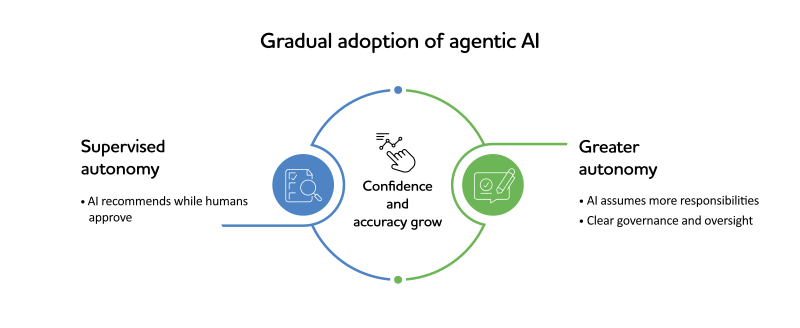
Gradual adoption of agentic AI
Gradual adoption of agentic AI
This creates the possibility of a “touchless AP” system, where invoices flow seamlessly from submission to payment. Yet, as promising as this sounds, the human role is far from obsolete.
The human edge
Finance is rarely routine. Exceptions, disputes, complex contracts, regulatory shifts, and sensitive vendor issues demand human judgment. While Agentic AI can process, analyse, and recommend, accountability and oversight remain human responsibilities.
Trust also plays a vital role. Vendors, auditors, and employees must have confidence in the accuracy and fairness of financial processes. AI alone cannot establish that trust. Humans bring discretion, ethics, and relationship management - the intangible elements that keep financial operations grounded.
As Albert Einstein once said: “The human spirit must prevail over technology.” This balance is especially true in finance, where governance carries as much weight as speed and accuracy.
The evolving role of AP teams
With Agentic AI covering routine tasks, AP professionals are stepping into more strategic roles:
- Governance and compliance – ensuring AI-driven processes meet policy and regulatory standards.
- Exception handling – resolving disputes and addressing complex cases that AI cannot manage autonomously.
- Vendor management and strategy – strengthening supplier relationships and making informed decisions to optimise operations.
This evolution repositions AP from a transactional unit into a strategic contributor. Instead of keying invoices, professionals are enabling financial resilience, agility, and smarter decision-making.
Keeping oversight human
The real opportunity lies not in replacing people but in designing collaborative workflows where humans and AI complement each other. Agentic AI can accelerate tasks, reduce manual work, and provide predictive insights; however, humans must still oversee, interpret, and ensure compliance.
In fact, overreliance on automation without strong governance can create new risks, ranging from payment errors to compliance breaches. By building systems where AI handles repetitive tasks and humans supervise exceptional ones, organisations strike the right balance between efficiency and accountability.
This hybrid model transforms AP into a future-ready function. AI becomes the engine that drives speed and scale, while humans remain the compass that ensures direction, fairness, and trust.
Conclusion
Agentic AI is not here to eliminate humans from Accounts Payable, but to elevate their role. It processes faster, reduces errors, and anticipates issues - but people remain essential for oversight, compliance, strategy, and trust.
The future of AP is not AI versus humans but “AI with humans”. Organisations that embrace this partnership will unlock faster, smarter, and more reliable finance operations—ready to adapt to an ever-changing business environment.