Industry
Life Sciences

Patient-centered Care Models Taking Center Stage in Life Sciences
Highlights
- Pharmaceutical manufacturers face an execution gap where critical decisions still require manual coordination across manufacturing, quality, engineering, supply chain, and regulatory functions despite significant digital investments.
- Agentic AI enables intelligent orchestration by monitoring signals, identifying risks, coordinating workflows, recommending actions, and supporting decision-making across functions while maintaining human oversight.
- Business value is realised through faster product launches, improved quality and compliance, stronger supply resilience, increased operational productivity, and better utilisation of scarce expert resources.
- Success depends on robust governance, trusted data, and a phased adoption approach that progresses from advisory agents to supervised recommendations and ultimately to controlled execution within validated GxP boundaries.
On this page
On this pageinpage
How has pharma manufacturing evolved from digitisation to intelligent orchestration?
Pharmaceutical manufacturing is moving from digitisation to intelligent orchestration. Over the last decade, companies have invested heavily in automation, manufacturing execution systems, laboratory platforms, industrial IoT, and advanced analytics. These investments have improved visibility and control, but many enterprise-critical decisions still rely on manual coordination across several technical operations.
Agentic AI represents a significant shift in how pharmaceutical operations are managed.
Unlike traditional AI models that primarily predict, classify, or recommend, agentic AI systems can pursue defined goals, interpret operating context, plan multi-step actions, use enterprise tools, coordinate workflows, and learn from outcomes under appropriate human oversight.
How does agentic AI enable pharma manufacturing?
Current scenarios have brought the importance of agentic AI to the fore. Pharmaceutical manufacturers face more complex product portfolios, shorter launch windows, globalised supply networks, rising regulatory expectations, and persistent capacity and skills constraints. At the same time, plants generate more data than ever before, but much of that data remains fragmented across batch records, equipment historians, deviations, change controls, laboratory results, maintenance systems, supply plans, and regulatory commitments.
Agentic AI can help close this execution gap by enabling intelligent agents to monitor signals, identify risks, recommend actions, trigger workflows, draft documentation, escalate exceptions, and coordinate human decisions across functions. In regulated environments, the value is not uncontrolled autonomy; it is disciplined autonomy — AI-enabled action within validated boundaries, documented rationale, data integrity controls, and clear accountability.
From automation to orchestration
Traditional automation improves repeatability within defined process boundaries. Agentic AI extends this by connecting intent, context, and action across the manufacturing value chain. Production issues, for example, may affect batch disposition, laboratory prioritisation, maintenance planning, material availability, deviation management, customer commitments, and regulatory reporting. Agentic AI helps shift the enterprise from sequential handoffs to coordinated decision cycles.
What are the six value levers of agentic AI?
The executive value of agentic AI lies in improving enterprise performance across outcomes that matter to leadership teams, investors, regulators, and patients. The primary value levers include:
Speed to market: Compress launch, transfer, release, and issue-resolution cycles by coordinating decisions across functions.
Quality and compliance confidence: Strengthen traceability, rationale capture, exception management, and inspection readiness through governed AI assistance.
Supply resilience: Anticipate constraints, simulate mitigation options, and coordinate actions before supply disruptions affect patients or markets.
Operational productivity: Reduce manual coordination, repetitive analysis, documentation preparation, and follow-up effort across high-friction workflows.
Expert leverage: Free scarce quality, regulatory, engineering, and technical experts to focus on judgment-intensive decisions and strategic risk management.
Enterprise knowledge continuity: Reuse institutional knowledge by connecting prior deviations, corrective actions and preventive actions (CAPAs[AP4.1]), process history, technical reports, and regulatory commitments.
To move from experimentation to enterprise value, the near-term action agenda rests on five decisions, such as prioritising workflows, quantifying value, enforcing governance, unifying technology and scaling progressively.
The infographic below summarises the operating model as a leadership-ready visual for communicating how agentic AI can connect outcomes, workflows, governance, and technology foundations.
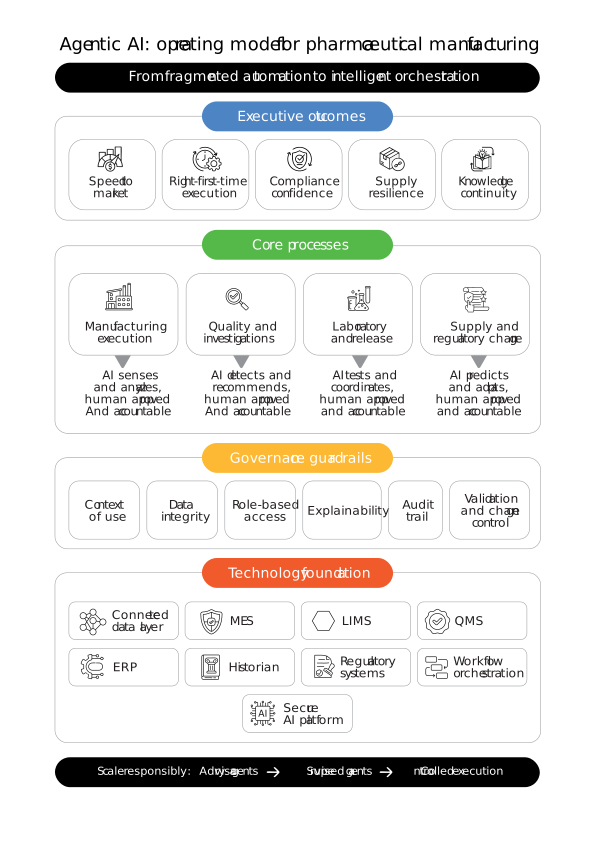
Agentic AI operating model: A leadership visual
Agentic AI operating model: A leadership visual
Some of the benefits are illustrated below:
- Illustrative agentic AI use case: Monitor batch execution, equipment signals, deviations, and maintenance history to flag emerging process risks and recommend containment actions.
- Strategic benefit: Earlier intervention, fewer repeat deviations, and improved right-first-time performance.
- Human oversight point: Quality and operations approve risk classification and action plan.
- Illustrative agentic AI use case: Prioritise laboratory testing and batch release activities based on supply urgency, sample status, historical delays, and quality risk.
- Strategic benefit: Shorter release cycles, better capacity utilisation, and improved supply reliability.
- Human oversight point: QC and QA confirm prioritisation logic and release decisions.
- Illustrative agentic AI use case: Coordinate site transfer readiness by comparing process requirements, analytical methods, facility capabilities, prior deviations, and regulatory commitments.
- Strategic benefit: Faster launch readiness, reduced transfer risk, stronger knowledge reuse.
- Human oversight point: Technical and regulatory SMEs approve readiness conclusions.
- Illustrative agentic AI use case: Track material changes, supplier risks, market commitments, and regulatory variation requirements to recommend mitigation pathways.
- Strategic benefit: Reduced compliance exposure, improved continuity of supply, better change impact visibility.
- Human oversight point: Quality and regulatory teams approve market-specific actions.
- Illustrative agentic AI use case: Detect abnormal operating patterns and recommend preventive maintenance, safety checks, or temporary operating controls.
- Strategic benefit: Lower downtime, improved asset reliability, stronger operational safety.
- Human oversight point: Engineering and site leadership approve maintenance or operating changes.
- Illustrative agentic AI use case: Draft deviation summaries, CAPA narratives, investigation timelines, and evidence packs by linking batch records, logs, test results, and prior investigations.
- Strategic benefit: Faster investigation closure, more consistent documentation, improved audit readiness.
- Human oversight point: QA owns final investigation conclusions and approvals.
How can organisations scale agentic AI for pharma manufacturing?
Agentic AI scaling for pharma manufacturing requires the following steps:
End-to-end orchestration: Unification of manufacturing, quality, supply chain, and regulatory functions to improve speed and resilience.
Regulated AI governance: Responsible, audit-ready AI deployment that strictly aligns with regulatory standards.
Industry accelerators: Leveraging proprietary digital twins, autonomous lab agents, and scientific workflow engineering to accelerate value realisation.
Enterprise scale: Organisation-wide transformation globally through strategic partnerships and internal change management.
Way forward
Agentic AI has the potential to reshape pharmaceutical manufacturing by moving organisations from fragmented automation to intelligent orchestration. Its greatest value will come from connecting people, data, systems, and decisions across manufacturing, quality, engineering, supply chain, laboratories, regulatory, and technical operations. For leaders, the opportunity is to build a more resilient, compliant, and responsive manufacturing enterprise.
The organisations that capture the advantage will be those that combine ambition with discipline: outcome-led prioritisation, trusted data, strong governance, human-centered design, and scalable technology foundations.