Products and Platforms
TCS Intelligent Urban Exchange™

TCS Intelligent Urban Exchange™
Highlights
- Circular economy adoption is now a regulatory and business imperative, driven by the circular economy action plan (CEAP), the eco-design for sustainable products regulation (ESPR), and the digital product passport (DPP) mandates—but enterprises struggle with fragmented data, limited multi-tier visibility, and manual, unsustainable compliance processes.
- Agentic AI acts as an intelligent orchestrator across the circular value chain, autonomously discovering multi-tier supply networks, generating contextual supplier intelligence, automating assessments and scoring, and proactively managing risks and action plans.
- By embedding Agentic AI into CEAP and DPP programs, organisations can move from reactive compliance to a perpetually adaptive, scalable circular operating model, enabling continuous regulatory alignment, resilient value chains, and sustained circular economy outcomes.
On this page
On this pageinpage
Why the shift to a circular economy is no longer optional
Let’s face it, the linear “take–make–dispose” model has run its course. Rampant exploitation of finite natural resources, coupled with rising economic and regulatory pressure, makes it increasingly clear that business as usual is unsustainable. A shift to the circular economy, where materials and products are designed for reuse, recovery, and regeneration, is no longer aspirational; it is imperative.
Yet, while the need is clear, the how remains complex. Circularity requires unprecedented coordination across stakeholders, geographies, jurisdictions, and timeframes. This is where regulatory momentum and digital innovation, especially agentic AI, come together to make circularity achievable at scale.
Facets of circularity programs and enabling technology trends
A successful circular economy journey requires the ability to capture, process, and securely disseminate information across the value chain. This begins with identifying stakeholders and their roles, defining the information they require, and determining where, how, and by whom that information should be captured. The information must then be shared reliably with the right stakeholders, aligned to purpose and context.
Data sensitivity adds further complexity. Information on risk, compliance, and carbon footprints must be assessed locally, considering jurisdictional requirements and national regulations governing cross-border data movement.
Recent regulatory developments under the CEAP, particularly the digital product passport (DPP), promise to accelerate circular adoption. When combined with advances in agentic AI, generative AI, AI and ML, blockchain, IoT, geographic information system (GIS), graph databases, and mobility technologies, CEAP becomes a feasible and scalable reality.
Challenges in the adoption of CEAP
Organisations typically struggle with CEAP implementation due to the following:
- Limited supply chain visibility: Most enterprises can see only their immediate (Tier‑1) suppliers. Visibility into Tier‑2, Tier‑3, and beyond remains elusive.
- Inability to assess cascading risk: Without a connected view of the value chain, it is difficult to understand how disruptions at one node ripple through the ecosystem.
- Fragmented downstream visibility: As products move into usage, repair, reuse, and end-of-life stages, data becomes increasingly incomplete and disconnected.
- Overwhelming data and manual effort: CEAP requires extensive data capture, validation, assessments, ratings, and KPI tracking across multiple parameters and entities.
- Human‑intensive qualitative assessments: Eco-design evaluations, supplier assessments, conformity checks, and ratings still rely heavily on manual judgment and expert intervention.
Together, these challenges make CEAP programs resource-heavy, slow to scale, and difficult to sustain.
How agentic AI changes the game
Agentic AI acts as an intelligent orchestrator across the circular value chain, addressing CEAP challenges as follows:
- Poor multi-tier supply chain visibility: Agentic AI autonomously discovers and builds multitier value chain networks, including indirect suppliers, based on enterprise data and external knowledge sources.
- Lack of contextual supplier intelligence: AI agents generate supplier profiles covering geography, facilities, risk exposure, carbon footprint, compliance posture, and performance indicators.
- Difficulty in visualising circular flows: Agentic AI constructs dynamic, network-based representations of value chains, enabling the clear visualisation of circular pathways and dependencies.
- Manual and fragmented assessments: Specialised assessment agents automate eco-design checks, supplier evaluations, conformity verification, and scoring.
- Reactive issue management: AI agents proactively identify gaps, flag risks, generate action plans, break them into tasks, trigger workflows, and track execution to closure.
- Complex DPP compliance requirements: Agentic AI continuously supports data collection, validation, assessment, rating, and reporting, aligning seamlessly with digital product passport mandates.
In effect, agentic AI transforms circularity from a compliance burden into an intelligent, scalable system.
Agentic AI capabilities to accelerate CEAP adoption
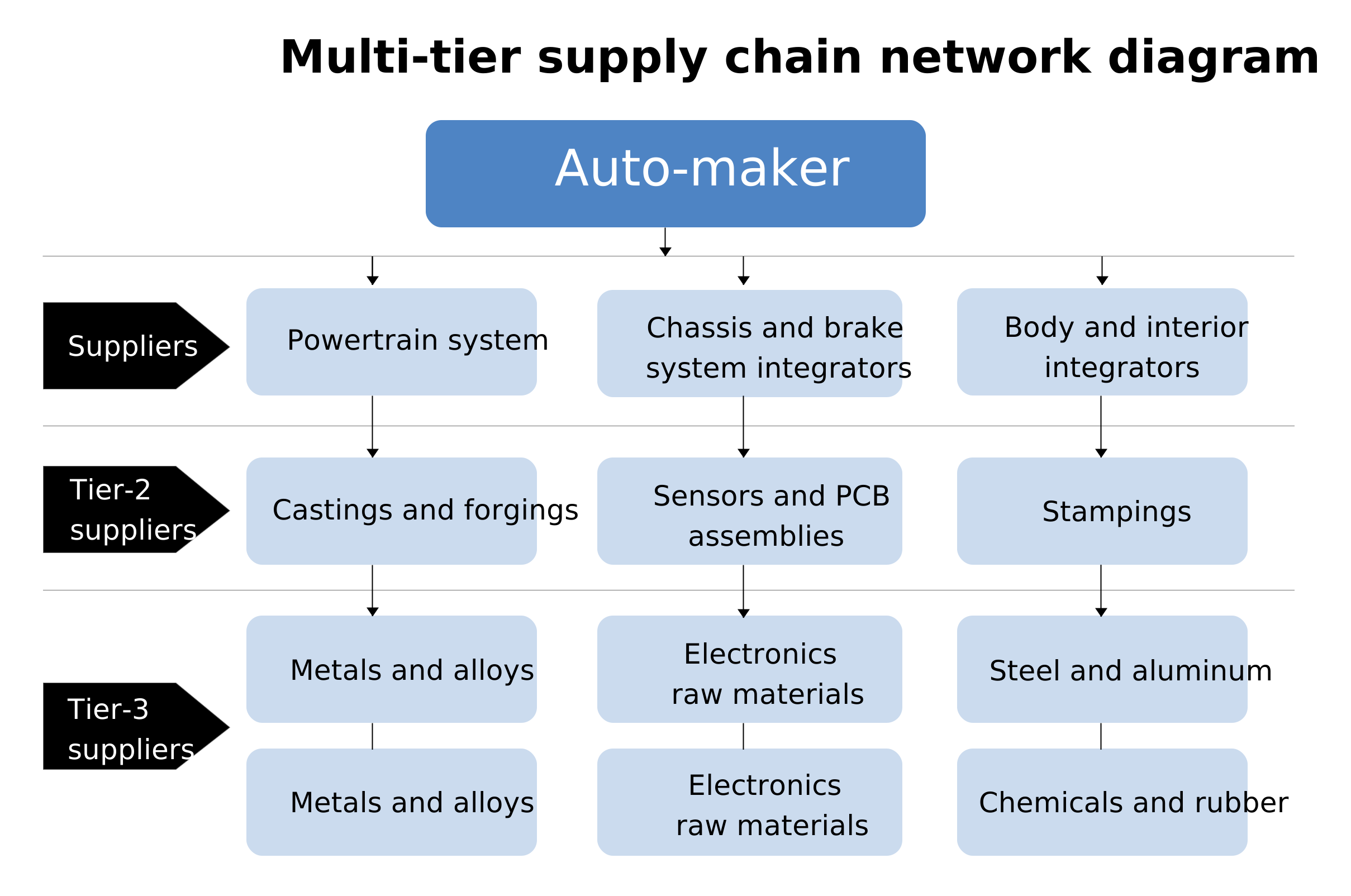
Multi-tier supply chain network diagram
Multi-tier supply chain network diagram
Embedding Agentic AI into CEAP capabilities enables automated discovery of multi-tier supply chain networks beyond known suppliers. AI‑driven profiles provide insights into supplier location, facilities, risk, carbon footprint, compliance, and performance using both enterprise data and publicly available information.
In one instance involving a TCS automotive customer, agentic AI generated an interactive multi‑tier supply chain network with geographic overlays, revealing Tier‑1 to Tier‑3 suppliers and subsystem dependencies. While not exhaustive, this provided valuable insights compared to having no visibility at all. Generative AI can also infer supply chain structures, supporting alternate sourcing strategies and improved resilience.
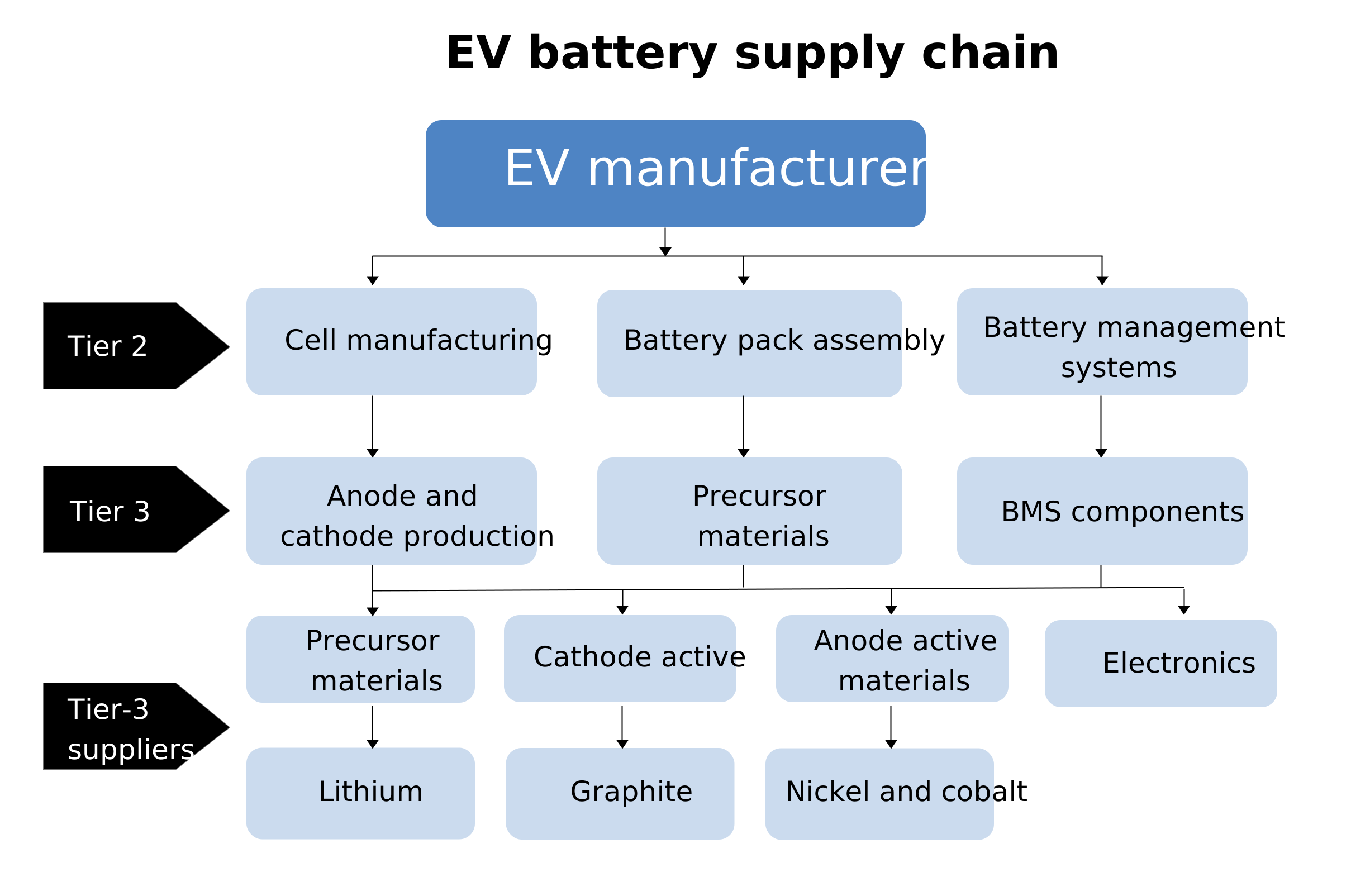
EV battery supply chain
EV battery supply chain
Even limited‑feature supply chain network views, such as those generated for an EV automaker without supplier names, can provide actionable insights into supply structures, components, materials, and source countries.
Beyond visibility, CEAP programs can deploy agents to assess, rate, and track KPIs. These agents identify issues, generate and manage action plans, trigger workflows, provide execution guidance, and track progress to completion. These capabilities align closely with the digital product passport requirements under the Ecodesign for Sustainable Products Regulation (ESPR), 2024.
Delivering the circular economy
Agentic AI makes CEAP adoption practical and scalable by enabling resilient supply chain and value chain management. By automating data capture, assessment, scoring, indicator tracking, and action plan management, AI agents support digital product passport compliance and broader circular economy objectives.
For instance, in the electric vehicle (EV) battery lifecycle, agentic AI tracks batteries across usage, repair, and second-life applications using digital product passports—monitoring performance and degradation to inform decisions on reuse in energy storage or recycling. While routing and scoring decisions are automated, final approvals for reuse models or recycling compliance remain under human oversight.
Through these mechanisms, agentic AI emerges as a powerful enabler across the circular journey, capturing information, transforming it into intelligence, and disseminating it effectively across the value chain. Over time, AI agents are poised to replace many manual processes, beginning as embedded enablers of digital product passports and expanding across circular ecosystems.