Services
Artificial Intelligence

Building a Smarter, Connected Tomorrow with AI-first and Agentic AI
Highlights
- Despite the headlines about shrinking entry-level opportunities, the grads I meet are showing real optimism about what comes next.
- AI curiosity is no longer limited to technical majors—students across disciplines are actively seeking ways to add tech fluency to their core skills.
- Many grads are already moving past theory into practice, building, and applying AI in concrete projects that solve real problems.
- To earn their trust (and meet their expectations), organizations need to shift from AI pilots to embedding AI into everyday work, responsibly and at scale.
On this page
From fear to momentum: The next workforce is forming
We hear a lot these days that grads fear the future. We see the data showing that entry-level job opportunities are shrinking. We know the world of work is transforming quickly.
But I see a different reality.
When I attend job fairs and speak with grads and job seekers, I hear hope. I see enthusiasm to learn about technology—and real energy around finding their #MyFirstAIJob.
From majors to mindsets: AI curiosity is everywhere
And it’s not just IT or programming majors. Graduates from all backgrounds are interested in learning about TCS, how we use technology, and how we help businesses transform with AI.
That makes sense to me. Because the truth is, in 2026, every job is an AI job. Grads may actually understand this better than many current workers. Regardless of their major, they see the future of business as being guided by technology. Financial majors want to learn about cybersecurity. Law students want to understand data and database analysis. Students are increasingly looking to layer technical skills on top of their core disciplines.
And much like we saw in previous technology cycles, students aren’t waiting to get hands-on experience. In the 2000s, it was building their own websites. In the 2010s, it was creating apps. Today, many grads have already designed, utilized, and implemented AI in impressive and practical ways.
I recently spoke with a young man who built a fantasy football platform using AI to search multiple databases for statistics and analyze defensive schemes against offensive players. Others described projects analyzing voice patterns—how people communicate and how those signals can inform sales and customer engagement strategies.
From pilots to practice: Making AI a daily teammate
To meet these graduates’ high expectations when it comes to working with AI, organizations must move beyond experimentation. At TCS, that means ensuring AI is enabled throughout the company—not as a standalone tool, but as a daily teammate.
TCS is undergoing a deep internal transformation to become an AI-led organization from the inside out. We are embedding AI across how work gets done, driving an AI-first culture, building practical solutions for real work, and scaling those capabilities responsibly across the enterprise.
From democratized access to AI tools and learning environments, to immersive programs like AI Dojos and global hackathons, we are giving every associate the opportunity to build fluency, experiment safely, and apply AI in meaningful ways. The goal is simple but ambitious: to ensure that everyone at TCS, regardless of role, background, or tenure, has a great AI experience that makes their work more human, more creative, and more impactful.
At the heart of our Cincinnati Delivery Center is our “Transformation Wall of Fame,” which showcases innovation stories that originated with local, Ohio-based associates. This wall demonstrates TCS’ belief that innovation happens across the business, from senior executives to entry-level associates. It is a way for us to recognize inspirational work, give project leaders ideas they can build on, and show customers that innovation is an active, ongoing priority for us. Increasingly, those stories focus on AI and how it is being used to improve internal processes—for TCS and for our clients.
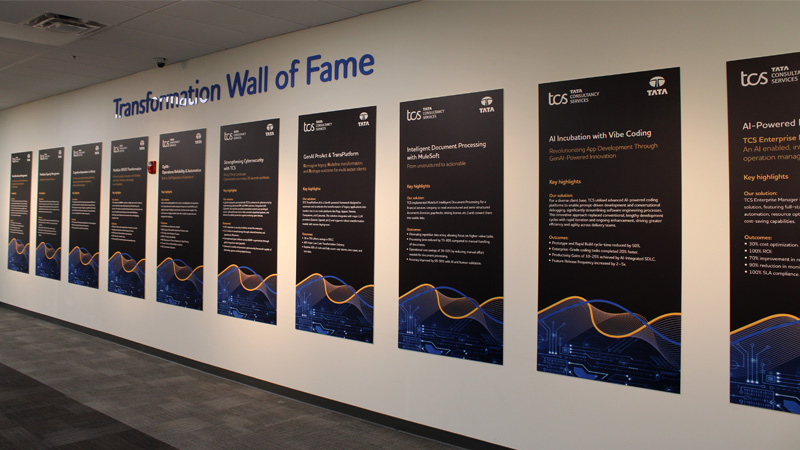
Wall of Fame
Wall of Fame
From misconception to mindset: Why Gen Z is redefining work
I hope it is clear that the widespread myth about this generation, that Gen Z “doesn’t want to work,” is a misconception.
In my experience, that simply isn’t true. I’ve had the privilege of employing Gen Z professionals and working with them as interns for several years. They are creative, curious, and motivated. It’s not that they don’t want to work—it’s that they want to work smarter. They want their work to matter. And really, shouldn’t we all?
As leaders, our job is not just to teach, but also to learn. The reality of work is at an inflection point, and we need to be willing to listen to the people who will help shape its future—not simply push outdated ways of working onto them.
Just because someone is young doesn’t mean their ideas lack value or feasibility. They may not yet have years of experience, but they are often trying to move the workforce toward what it needs to become.
We can’t be the generation that says, “This is how we’ve always done it.” We have to be willing to change, even when it pushes us outside our comfort zones. Making small changes over time to improve quality of life, effectiveness, and morale is not a bad thing,it’s essential.