Industry
Retail

Omnichannel CX and Intelligent Innovation – The Future of Retail
HIGHLIGHTS
- Closing the in-store attribution gap is critical to unlocking advertiser spend that is still skewed towards digital.
- Proving true incrementality shifts in-store media from a cost centre to a measurable revenue driver.
- A unified Capture–Connect–Convert framework is key to standardising measurement and enabling scalable ROI.
- By enabling real-time optimisation of media performance, AI-driven attribution transforms incrementality measurement into a competitive advantage.
On this page
On this pageinpage
The attribution challenge in in-store media
A digital ad plays inches away from a product on a store shelf; a shopper picks the product and scans it at checkout. It’s natural to draw inferences, but the harder question remains: did the ad influence the decision or was it a coincidence that the purchase happened? This uncertainty is one of the main reasons why retail media investment remains disproportionately digital‑first despite offline stores accounting for the majority of retail sales.
Why in-store incrementality measurement matters
As in-store media evolves through digital screens, sensors, point of sale (POS) integration, loyalty data, and computer vision, advertisers expect more than proof that an ad was shown. They want to know whether it captured attention, changed shopper behaviour, and generated incremental sales. Measurement is the missing link between in-store media exposure and trusted commercial impact.
Unlike digital channels, where impressions, clicks, and conversions can often be connected through identifiers such as cookies, identity graphs, and pixels, the physical store is a far noisier environment. Retailers must determine not only who was exposed to an ad, but also whether that exposure earned genuine attention and influenced a purchase. This challenge is compounded by privacy regulations, which limit persistent identity tracking. That is why robust incrementality measurement is essential. It helps retailers and advertisers separate real media impact from demand that would have happened anyway.
The 3C framework for in-store media measurement
Without a unified measurement framework, retailers risk investing in disconnected tools that track shopper activity but do little to prove return on ad spend (ROAS). The 3C framework (Figure 1)—Capture, Connect, and Convert—provides a structured way to measure in-store media effectiveness, regardless of the technology or methodology used, by answering three critical questions:
- Was the ad delivered and potentially seen?
- Can that exposure be linked to a shopper journey?
- Did the exposure drive incremental commercial impact?
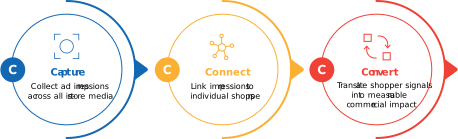
Figure 1
The 3C attribution framework
Figure 1
By linking exposure and attention to shopper behaviour and incremental sales, the framework moves beyond surface-level metrics to provide a more complete, outcome-driven view of in-store media effectiveness across the shopper journey.
The ‘Capture’ layer consolidates impressions from all in-store digital media. This includes digital screens, audio advertising, contextual POS media, mobile app placements, near field communication (NFC) tags, and traffic signals, creating a consolidated view of in-store exposure.
The ‘Connect’ layer links media exposure to individual shoppers. Retailers can map this through loyalty ID matching at checkout. This can be supplemented by beacon proximity signals, path-to-purchase tracking through sensors or cameras, and field-of-view monitoring.
The ‘Convert’ layer maps shopper signals directly to business outcomes. It measures campaign performance against defined commercial objectives such as incremental ROAS, sales uplift, new customer acquisition, larger basket size, and repeat purchase.
The in-store measurement maturity model
While the 3C framework outlines what effective in-store attribution should look like, most retailers do not have the same starting point. That’s where the in-store measurement maturity model (Figure 2) comes in. By breaking the 3C framework into practical stages, it illustrates how organisations can progressively build and strengthen their capabilities over time.

Figure 2
In-store measurement maturity model
Figure 2
To understand the maturity model of in-store measurement, consider two scenarios in a grocery retail store, occurring at times T1 and T2, respectively (Figure 3).
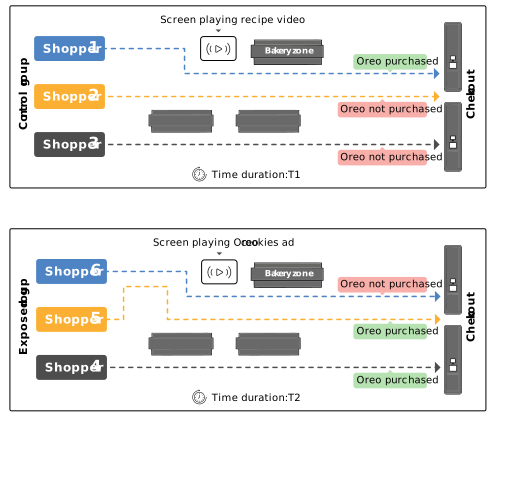
Figure 3
Scenarios for measuring in-store attribution
Figure 3
At time T1, a digital screen at the entrance of the bakery section plays a recipe video. At T2, the same screen plays an ad for Oreo cookies. The shopping journeys in both scenarios may look similar, but they tell very different attribution stories. That difference highlights why in-store measurement maturity matters: retailers need to move beyond proving that media played to understanding whether it influenced shopper behaviour and generated incremental impact.
This progression doesn’t happen all at once. Instead, it develops step by step through a structured journey, with each stage helping retailers to measure, understand, and act with more clarity and confidence.
This phase establishes the baseline for in-store ad measurement; i.e., proving that an ad ran in a specific store, on a specific screen, at a specific time. Retailers typically estimate exposure using store- or aisle-level traffic data by tracking footfall and dwell time.
A centralised content management system (CMS) records each ad play with details such as ad ID, screen ID, store location, and timestamp, along with play counts, and delivery compliance. This creates a transparent, auditable record of execution. Sales impact is then assessed through broad comparisons, for example, comparing unit sales in exposed stores with those in unexposed control stores. In the in-store attribution example, purchases by shoppers four and five would be attributed to the Oreo ad shown at T2.
While this phase helps establish correlation, it cannot conclusively prove that ad exposure caused the sales uplift—highlighting the need for more advanced measurement.
This phase shifts measurement from correlation to causation, enabling quantifiable assessment of in-store media. Closed-loop loyalty matching enables retailers to connect individual shopper impressions captured during an ad play with their exact purchase transactions by using loyalty identifiers.
Geo-lift tests serve as an effective methodology for evaluating incrementality. This involves assigning store clusters to different groups such as exposed and controlled. By linking media delivery data with aggregated point-of-sale results, retailers can estimate incremental lift without relying on personal identification. True ROAS is then calculated from the statistically verified difference in sales between both the groups.
In the in-store attribution example:
Baseline sales (from control group) = 1 out of 3
Total sales = 1 (from control group) + 2 (from exposed group) = 3
Incremental sales = Total sales – Baseline sales = 2
This is the most sophisticated measurement phase, delivering true proof of view and a verified path to purchase. Powered by sensors and computer vision, it moves beyond assumed exposure to confirm actual shopper attention. Attribution is made only when attention is verified, ensuring that sales are linked to real influence rather than proximity.
Privacy-preserving cameras anonymously track shopper movement, body orientation, gaze, and time spent in front of screens ensuring only genuine views are counted. An anonymous path token assigned at store entry captures the full in-store journey. It can be securely linked to loyalty data at checkout to create a verified exposure-to-purchase path.
With proof of view connected to loyalty IDs, retailers can apply weighted multi-touch attribution to measure the impact of each exposure across the shopper journey. This delivers the highest level of confidence in in-store media effectiveness by linking attention, influence, and conversion with precision.
In the in-store attribution example:
Purchase done by Shopper 4 is not attributed to Oreo ad played at duration T2 because of lack of proximity to the digital screen.
Hence, updated exposed group = {Shopper 5, Shopper 6}
Incremental sales (from exposed group) = 1 out of 2, i.e. 50%
Baseline sales (from control group) = 1 out of 3, i.e. 33%
This phase represents the next frontier of in-store media measurement. Insights from Phases 1 to 3 help machine-learning models evolve from retrospective analysis to real-time, adaptive decisioning. Attribution shifts from predicting impact to adjusting media mix and spending in real time.
Live POS signals verified field-of-view impressions, shopper journey graphs, and external inputs such as weather, inventory, or local demand patterns continuously feed training pipelines. Static audience segments are replaced by dynamic, behaviour-based cohorts as AI links anonymous in-store journeys with loyalty signals while being privacy-compliant. Attribution becomes automated and self‑optimising, continuously reallocating budgets toward high‑incrementality formats. It enables retailers to move away from focusing on single-visit return on ad spend (ROAS) to leveraging predicted annual customer lifetime value based on historical data. It also allows them to identify and engage high-value customers with more tailored offers. Here’s a ready‑reckoner (Table1) that clearly maps the 3C framework to each in‑store measurement maturity phase.
| Maturity Phase | Capture (Was the ad delivered/seen?) | Connect (Can it be linked to shoppers?) | Convert (Did it drive incremental impact?) |
| Phase 1: Foundation/proving ad delivery | Confirms the ad was delivered, using CMS logs and basic in-store traffic signals | No direct shopper linkage yet; exposure is estimated at the store or zone level | Shows directional sales impact by comparing exposed and unexposed stores |
| Phase 2 (Incrementality/ measuring incremental impact) | Validates impressions and confirms the ad ran as intended | Links exposure to known shoppers through loyalty matching and test-control methods | Measures true incremental sales lift and causal ROAS |
| Phase 3 (Path Intelligence/mapping the path to purchase) | Verifies actual ad views using sensors and computer vision | Connects shopper movement and purchase behaviour across the in-store journey | Attributes sales across multiple in-store touchpoints |
| Phase 4 (AI Attribution/optimising media performance with AI) | Tracks real-time exposure with advanced field-of-view signals | Uses AI to identify likely shopper groups and behaviours | Predicts performance and optimises spend based on ROI and lifetime value |
Table 1: Mapping the 3C framework to the in‑store measurement maturity model
Turning measurement into strategic advantage
Implementing a robust in-store measurement and attribution capability starts with choosing the right approach that balances accuracy with privacy. As retailers progress through the maturity stages, this approach becomes more refined and comprehensive.
Over time, attribution itself becomes more sophisticated. As retailers develop privacy-safe ways to understand how shoppers move through the store, they can begin to link ad exposure at different touchpoints to what shoppers eventually buy at the checkout. This leads to a clearer, more detailed view of what truly influences purchase decisions.
The next frontier in media attribution is cross-channel measurement. This involves unifying exposure and conversion data across onsite, offsite, and in-store channels, while removing duplication and creating a clear, end-to-end view of the shopper journey from awareness to purchase and loyalty. By leveraging advanced data collaboration platforms, retailers can match data from multiple sources securely without relying on personal identifiers. Parallelly, retailers must build capabilities for multi-touch attribution and adopt experimental approaches to assign the right weightage to different touchpoints throughout the journey.
Together, these advancements shift measurement from a static reporting function to a dynamic capability that continuously learns, adapts, and drives better outcomes.