Industry
Retail

Omnichannel CX and Intelligent Innovation – The Future of Retail
HIGHLIGHTS
- Spring-summer is traditionally the critical peak season for DIY home improvement retailers given the surge in weather-led demand. This period, spanning a few weeks, also accounts for a significant share of annual revenue, making operational resilience, up-time, and customer experience, decisive for commercial success.
- The period offers a unique opportunity for DIY retailers to unlock growth by improving end-to-end visibility, aligning technology with business priorities, and enabling faster, more confident decision-making through integrated, real operational insights.
- Our proposed three-phase Peak Season 360 Framework - pre-peak readiness, peak-execution, and post-peak optimisation, provides a disciplined, AI‑enabled approach to governance, monitoring, and execution that helps DIY retailers sustain performance throughout the highest trading periods.
On this page
On this pageinpage
Executive summary
Peak seasons are decisive windows for Do It Yourself (DIY) home improvement retailers. The demand is known to be seasonal, varies regionally, and is largely concentrated in the spring and summer months. This is the time when garden, outdoor living, and renovation projects pick up steam. That also means peak-season management for home improvement DIY retailers is not a typical one-size-fits-all. Additionally, customers expect continuous availability and frictionless shopping experiences, especially during peak seasons. So, any payment, performance, or supply chain disruption can risk revenue and reputation, making IT readiness essential. The TCS Retail Outlook also identifies the need for improving operational efficiency - via supply chain upgrades or automation – as key to controlling expenses in striving to deliver value to customers.
This whitepaper outlines the importance of peak-season readiness for DIY home improvement retailers and why summer is the perfect time to achieve this. Our Peak Season 360 framework is an operating model that can help retailers shift from reactive firefighting to proactive, AI‑assisted governance to ensure an exceptional customer experience through the proposed three phases: pre-peak readiness, peak execution, and post‑peak optimisation.
Summer is for DIY
Spring and summer seasons have historically driven demand and sales performance for DIY retailers, as warmer weather propels outdoor activities such as gardening, outdoor living, and assorted home improvements/renovations and repairs. It is no surprise that the demand for gardens, landscaping, décor, outdoor living, and building materials peaks, as e-commerce and stores experience a simultaneous omnichannel surge.
Retailers looking to capitalise on the trend must ensure successful peak operations. This, in turn, relies on:
- Accurate inventory and product availability
- Strong forecasting and seasonal planning
- Seamless customer experience and store readiness
- Stable omnichannel and e‑commerce performance
- Resilient, zero‑downtime systems
- Disciplined pricing and promotions
- Cross‑functional alignment
- Effective peak governance
- Data‑driven decision‑making
However, increasing weather volatility has resulted in concentrating demand traditionally spread over weeks to a few days, exposing operational bottlenecks. High sensitivity in seasonal categories can amplify disruption risk, while fragile conversion journeys can mean that even minor latency, stock inaccuracies, or payment failures can cause disproportionate losses. Fragmented visibility across point of sale (POS), warehouse management system (WMS), e‑commerce platforms, store devices, and critical batch processes can further weaken control. Supply chains can face additional strain from summer timings, weather variability, and tighter carrier capacity during warm spells and bank holidays. Without strict governance, promotions introduce risk, stores become overloaded with click and collect and returns, third‑party Service Level Agreement (SLA) misalignment adds hidden fragility, and unmanaged changes can break customer journeys during peak periods.
Peak Season 360
Our Peak Season 360 framework helps mitigate weather-driven volatility through forecasting and scenario models that anticipate warm weekend demand spikes. Early identification of priority seasonal Stock Keeping Units (SKUs) enables pre peak stocking, bay planning, and supplier alignment. real- time AI assisted monitoring covers search, checkout, payments, and click and collect promises. Unified dashboards centralise POS, e-commerce, WMS, store systems, and marketplace feeds. A strict peak season code freeze and controlled change advisory board (CAB) governance protect customer journeys from disruption during critical trading periods.
Peak Season 360 Framework
The peak season 360 framework is designed as a comprehensive 360-degree strategy to ensure businesses are fully prepared for the challenges of peak season. This framework enables organisations to move from reactive firefighting to proactive governance, ensuring resilience and operational excellence during high-demand periods.
Peak season 360 unifies governance, capacity engineering, AI‑assisted observability, and cross‑functional playbooks across:
- Pre‑peak
- Peak execution
- Post‑peak optimisation
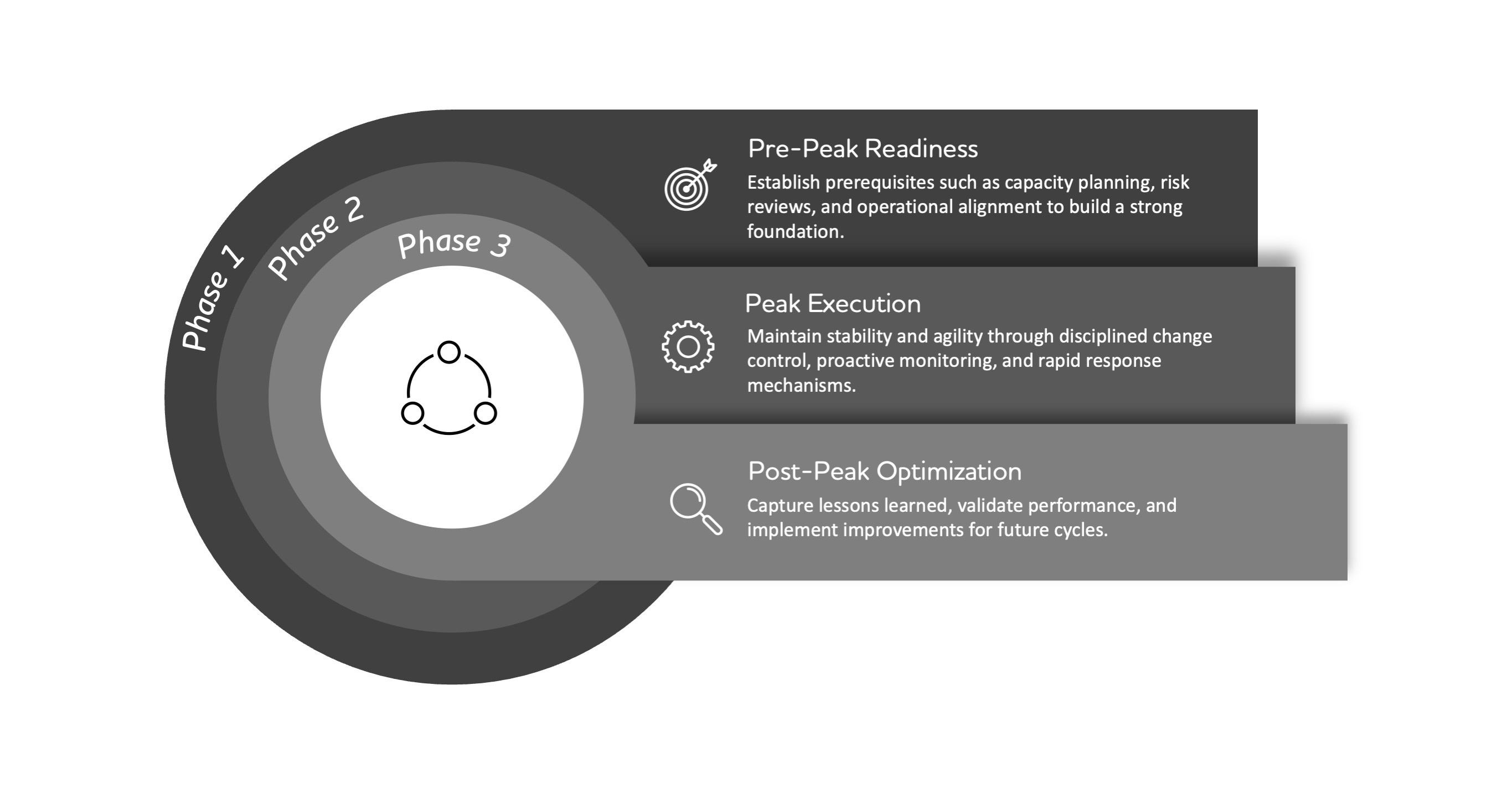
Figure 1
Peak Season 360 framework -Three‑Phase Operating Model for Peak Season Readiness
Figure 1
Peak season readiness begins by aligning and publishing a peak calendar that covers freeze dates, promotion waves, and code cut-offs, and sharing it across technology, operations, trading, and third parties to map dependencies. This is also when monitoring and alerting are tightened with stronger service level objectives (SLO) and anomaly detection across checkout, payments, inventory, and order management. Capacity is modelled for weather and business scenarios, validating headroom through load and chaos testing. Certificate and license expiries are audited with automated renewals and failover drills. Prior peak incidents are analysed to pre-deploy guardrails and runbooks. Risks are consolidated with owners defined and, a risk mitigation plan is devised.
Additionally, housekeeping clears queues, carts, logs, indexes, and patches before freeze. Third-party readiness, change control, continuity testing, communications, and refreshed Stand Operating Procedures (SOPs) complete peak governance. These activities ensure stable trading and protect customer journeys across critical peak periods. They also support stores and supply chains, enable rapid escalation, maintain executive visibility, and reduce operational risk during compressed demand windows through disciplined ownership, accountability, and proactive decision‑making throughout the peak season.
| Areas | Actions |
| Real-time peak monitoring | Continuous visibility into system health and performance ensures early detection of anomalies and prevents cascading failures during high-demand periods. |
| Priority incident management | A laser focus on major and high priority incidents with rapid triage and escalation minimising downtime and enhancing customer experience during peak trading windows. |
| Daily operational health reports | Structured automated daily reporting provides leadership with actionable insights and confidence that operations remain stable and compliant through the peak period. |
| Certificate and license management | Renewing certificates before they expire to avoid outages. Proactive hygiene is simpler and cheaper than mid-peak firefights. |
| Collaborative customer channels | Dedicated communication channels foster transparent and quick alignment with customers, reducing friction and accelerating resolution. |
| Business readiness validation | Frequent checks confirm that critical applications and processes are ready for business, ensuring seamless business flows during peak periods. |
| Centralised peak war room | A single command centre with technical Subject Matter Experts (SMEs) for decision- making and coordination enables faster response, better prioritisation, and unified control under pressure. |
| Areas | Actions |
| Consolidate lessons learned | Capture insights from peak operations to identify strengths and gaps. This ensures continuous improvement and prevents repeated issues in future peak cycles. |
| Compile performance insights | Document Key Performance Indicators (KPIs) and system behaviour to validate success and uncover optimisation opportunities for upcoming peak periods. |
| Implement permanent fixes and root cause analysis | Replace temporary fixes with robust long-term solutions to strengthen resilience and reduce future risks. |
| Revise operational guidelines | Refresh the Do’s and Don’ts based on real-world experience to create a sharper operational playbook for the next peak season. |
| Celebrate and share success stories | Socialise achievements across teams and stakeholders to reinforce best practices and boost team morale for future peak readiness. |
AI‑powered monitoring
Peak‑season success for DIY retailers hinges on seeing issues before customers feel them. Traditional KPIs and lagging reports are not enough. DIY retailers need real‑time, AI‑enhanced monitoring that unifies operational telemetry with customer metrics, interpreted in the context of peak‑season behavior. Monitoring that blends both the critical business and operational metrics.
A peak‑season dashboard for DIY home improvement retailers must provide real‑time, end‑to‑end visibility across sales, supply chain, fulfilment and technology performance. Built on a modern analytics stack—Power BI, streaming pipelines, observability platforms, and AI—these dashboards allow teams to identify risks early and respond at peak speed.
Technology stack for building Peak Season 360 dashboards
A Peak Season 360 analytics and visualisation layer is built using Power BI, connecting multiple data sources including e-commerce platforms, store systems, and batch processing data to deliver real-time peak season insights. The same architecture can be implemented using alternative platforms such as Tableau, Qlik Sense, Amazon QuickSight, or SAP Analytics Cloud, combined with streaming, data, observability, and AI forecasting components to create scalable, AI powered dashboards supporting resilient, data-driven enterprise-wide peak operations. These AI-powered dashboards are role based (Exec, SRE, Trading, Stores), device agnostic and have granular drill downs options across metrics.
Alternate supporting tech components include:
- Streaming and Real ‑ Time Data: Azure Event Hub, Kafka, Kinesis
- Data storage and Modeling - Azure Synapse, Snowflake, Databricks, Delta Lake
- Observability and APM- Datadog, New Relic, AppDynamics
- AI/ML forecasting - Azure ML, Google Vertex AI, Databricks ML
- Integration connectors - PSP APIs, carrier APIs etc.
Key components for dashboards include:
| Business Metrics | Operational Metrics |
| Demand and conversion | Incident volume and severity trends |
| Stock information | Service Level Agreements/Operational Level Agreements (SLA/OLA) compliance |
| Fulfilment and delivery experience | System availability / uptime (%) |
| Store operations | Resource utilisation (Central Processing Unit (CPU), memory, network throughput) |
| Sales trend analysis | Monitoring alerts volume |
Fast decision-making
Real-time visibility during peak periods can enable faster, evidence-based decision-making via a single source of truth across domains. In addition, early issue and anomaly detection can help reduce manual reporting through automation, support customisable role-based KPIs, enable cross device access, and enhance collaboration across global, regional, and store teams. This, in turn, will help deliver scalable insights for enterprise-wide decision-making.
Peak season 360 is not intended to replace or compete with the existing enterprise frameworks or operating models; instead, it acts as a complementary layer that can strengthen overall peak season readiness when used alongside current processes, tools, and governance structures. With proactive peak season 360 controls in place, operational tills can remain functional, promotions and pricing can be seamlessly integrated across channels, and preventive housekeeping can ensure stable performance and consistent customer experience during peak trading.
In a nutshell, retailers can expect business benefits including enhanced observability and better customer sales during peak trading.
Future evolution
A peak season 360 framework for DIY home improvement retailers can evolve into a multi-market, multi-banner operating model. It has the potential to scale across countries and banners, strengthen forecasting and capacity planning, enable smarter store and fulfilment operations, increase platform resilience, and unify data and partner ecosystems. In addition, it can help support scalable data governance and integration, embed AI-enabled decisioning, and establish a continuous learning loop.
High-demand periods bring both opportunity and risk, and without a structured approach, organisations can quickly shift from growth to chaos, making peak-season readiness a strategic imperative for DIY home improvement businesses. A peak season 360 framework offers a holistic, proactive strategy to seamlessly manage readiness parameters, ensuring resilience and agility when it matters most. In an era where every second counts, such a framework is not just a competitive advantage; it is the foundation for sustainable success during peak trading periods.
© Copyright [2025], Tata Consultancy Services Limited. All Rights Reserved.
Document ID : CGTP014396