Industry
Retail

Omnichannel CX and Intelligent Innovation – The Future of Retail
HIGHLIGHTS
- Traditional pricing approaches create hidden margin leakage because decisions are fragmented across teams, categories, and channels, causing retailers to react slowly and sacrifice profitability.
- Margin-intelligent pricing combines customer, competitive, KVI, and cost intelligence to determine when to match prices, when to hold, and where margins can be protected or recovered.
- An orchestration layer turns insights into coordinated action, enabling retailers to stay competitive while protecting price perception and improving enterprise-wide profitability.
On this page
On this pageinpage
Why traditional pricing creates margin blind spots?
Inflation, rising operating costs, supply chain disruption, and aggressive competition have intensified margin pressure across retail. Yet in many organisations, the bigger issue sits closer to home: pricing decisions are still made through fragmented processes that were not designed for today’s speed of competition. Category managers may optimise margins within individual categories, but those choices often create unintended trade-offs elsewhere in the business. Finance teams usually see the impact later, through profit-and-loss statements that reflect decisions made weeks earlier, when the opportunity to intervene has already narrowed. The result is a fragmented approach to margin management that improves local outcomes while eroding enterprise-level profitability. In practice, these inefficiencies can cost retailers 150-300 basis points of recoverable gross margin each year.
This pressure is often reinforced by the dashboard illusion. Retailers may have competitor feeds, alerts, price indices, elasticity outputs, and margin reports, but insight does not automatically become action. Valuable signals remain trapped in dashboards, while pricing teams still rely on handoffs, approvals, and manual interpretation to decide what should change. In many organisations, the gap between identifying a competitive pricing threat and updating prices across stores can stretch to three to five working days. In a market where competitors reprice millions of items daily and execute weekly promotional cycles with precision, such delays are no longer minor operational inefficiencies; they are structural margin drains.
Closing this gap requires more than better dashboards or another layer of reporting. Retailers need an intelligent pricing operating model that can sense market changes continuously, evaluate their enterprise-wide impact, and coordinate decisions across categories, stores, channels, and customer segments before margins have already leaked away.
Margin-intelligent pricing is about knowing which prices shape customer trust, which moves protect competitive position, and where margin can be preserved or recovered without weakening demand
How can retailers compete without sacrificing margin?
Margin-intelligent pricing gives retailers a more disciplined way to create, protect, and recover margin across the business. It connects the commercial signals pricing teams already use—customer behaviour, competitor relevance, key value items, costs, and channel performance—and turns them into clearer, coordinated decisions. Instead of interpreting multiple dashboards and resolving trade-offs manually, this approach helps teams make intelligent pricing decisions—where to match, where to retain, where to invest, and where to recover margin.
The model works by bringing together four areas of pricing intelligence. Each area informs a specific commercial question, while the combined view helps retailers protect price perception without giving away margin unnecessarily:
- Customer intelligence: Understands who shops at each store, what they value, how price-sensitive they are, and which behaviours should shape pricing decisions.
- Competitive intelligence: Identifies which competitors truly influence shopper behaviour at each store and when shoppers are likely to switch.
- KVI intelligence: Keeps key value item lists up to date by identifying the products that genuinely shape price perception by store and shopper segment.
- Cost intelligence: Tracks landed cost, tariffs, logistics, and supply conditions to determine where costs can be passed through and where they should be absorbed.
The coordination layer connects these signals and offers actionable insights at the store, category, and channel levels. It shows where a competitor’s move is likely to influence shoppers, where a concession is justified, and where margin can be recovered without weakening price perception.
Old way: price matching |
New way: margin-intelligent pricing |
Responds to competitor prices as isolated events |
Assesses customer behaviour, competitor relevance, KVIs, costs, and margin together |
Often applies the same response across many stores or items |
Recommends different actions by store, category, channel, and shopper sensitivity |
Focuses mainly on matching visible prices |
Decides when to match, when to hold, and where to recover margin |
Can protect price perception but may give away margin unnecessarily |
Protects price perception while identifying practical margin recovery opportunities |
Table 1: How margin-intelligent pricing changes the pricing decision
Customer intelligence: Understanding who shops at each store
Customer intelligence helps retailers answer the first and most important pricing question: who shops at each store, and what shapes their response to price? In real retail operations, this answer is rarely uniform across a market. Two stores with the same format can serve very different missions, even within the same city or region. It draws on baskets, loyalty behaviour, trip missions, demographics, and cross-shopping patterns to show whether a store is serving value-seeking households, convenience-led shoppers, premium buyers, cherry pickers, or a changing mix of missions by category and daypart.
This distinction matters because similar-looking stores can require very different pricing responses. One may have shoppers who switch quickly when staple prices move; another may have customers who are less sensitive to price but highly responsive to quality, freshness, or convenience. By combining point-of-sale data, loyalty signals, third-party card transaction data, and geodemographic insights, customer intelligence gives pricing teams a store-level view of flexibility, sensitivity, and margin opportunities. This insight helps pricing teams determine where competitive pricing matters most and where margins can be protected without affecting customer demand.
Customer signals assessed |
What the signals reveal |
Pricing decisions enabled |
Shopper mission |
Whether shoppers are stocking up, filling in, buying fresh, or shopping for convenience |
Helps decide which categories need price protection, and which can hold price |
Price sensitivity |
How strongly customers are likely to react to price changes by store and segment |
Prevents unnecessary price cuts in stores where customers are less price-sensitive |
Basket behaviour |
Which items are bought together and which products anchor customer value perception |
Focuses price investment on items that shape perception instead of the full assortment |
Loyalty and switching risk |
Which shoppers are loyal, occasional, cherry-picking, or at risk of switching |
Helps decide when a competitor move is likely to change customer behaviour |
Table 2: How customer intelligence informs pricing decisions
Competitive intelligence: Identifying which competitors truly matter
Competitive intelligence helps retailers move beyond simple price benchmarking. The objective is not to understand competitor pricing, but to determine whether a competitor actually influences shopper behaviour at a specific store. It shows which competitors’ customers cross-shop, where category overlap is meaningful, and when a price gap is large enough to trigger switching. This prevents retailers from matching every nearby competitor and focuses action on the rivals that genuinely shape price perception and customer movement.
Using competitor price feeds, third-party card transaction data, loyalty signals, and category-level overlap, competitive intelligence builds a store-level view of competitive relevance. It identifies which competitors’ customers visit, how frequently they cross-shop, how much they spend, and which categories they buy elsewhere. These insights help estimate the switching threshold—the price gap at which shoppers are likely to shift spend, giving pricing teams a clearer understanding of where competitive action is warranted and where prices can be maintained with confidence.
Store context |
Competitive signal observed |
Pricing risk identified |
Recommended pricing action |
Premium North Dallas store |
Customers cross-shop more with premium fresh and health-oriented retailers than value retailers |
Low risk from value-retailer price moves; higher risk on premium fresh perception |
Hold prices on broad value moves; protect selected premium fresh and dairy KVIs |
Mid-income East Dallas store |
Customers cross-shop heavily with both the regional grocer and value retailer on fresh, dairy, and staples |
High switching risk if visible staples or fresh KVIs fall out of line |
Match selectively on high-visibility KVIs; recover margin on specialty and long-tail items |
Table 3: How competitive intelligence guides selective pricing action
This intelligence also helps retailers distinguish between fundamentally different market events that require different pricing responses. For example, a temporary promotional discount may require only a temporary response while a permanent strategic price reduction may require a long-term response. A competitor stockout may create an opportunity to capture diverted demand and enhance margins without lowering prices. Applying a one-size-fits-all pricing strategy without factoring in the nuances of each scenario can be one of the costliest pricing mistakes.
KVI intelligence: Protecting price perception where it matters most
KVI intelligence helps retailers protect price perception where it matters most. In most categories, a relatively small group of key value items has a disproportionate influence on whether shoppers believe a retailer is competitively priced, even when most of the assortment is sold at market rates. If those items are mispriced, price perception can weaken quickly; if they are protected well, retailers can defend customer trust without discounting broadly.
KVI intelligence keeps KVI lists dynamic by reading live basket behaviour, co-purchase patterns, loyalty signals, promotion response, and competitor pricing movements. It identifies which items act as perception anchors by store, shopper segment, and mission, rather than relying on static, centrally managed lists. This ensures that price investments are directed towards products that influence customer choice, while protecting margin on items that have little impact on value perception.
Cost intelligence: Validating sustainable pricing decisions
Cost intelligence validates whether a recommended price move is commercially sustainable. A price action may look right from a competitive standpoint and still be wrong from a margin standpoint. Before execution, it checks landed costs, tariff shifts, transportation costs, supplier changes, and regional supply conditions at the SKU and zone level. When costs rise, it helps determine whether the increase should be passed through, partially absorbed, or offset elsewhere in the portfolio.
Orchestration layer: Turning specialised intelligence into pricing action
The orchestration layer is where pricing intelligence is executed. It brings together customer, competitive, KVI, and cost intelligence, then evaluates commercial guardrails, margin impact, customer relevance, competitor influence, and cost movement before recommending action across stores, categories, and channels. Its role is to ensure that a price move is not only competitive but commercially sound.
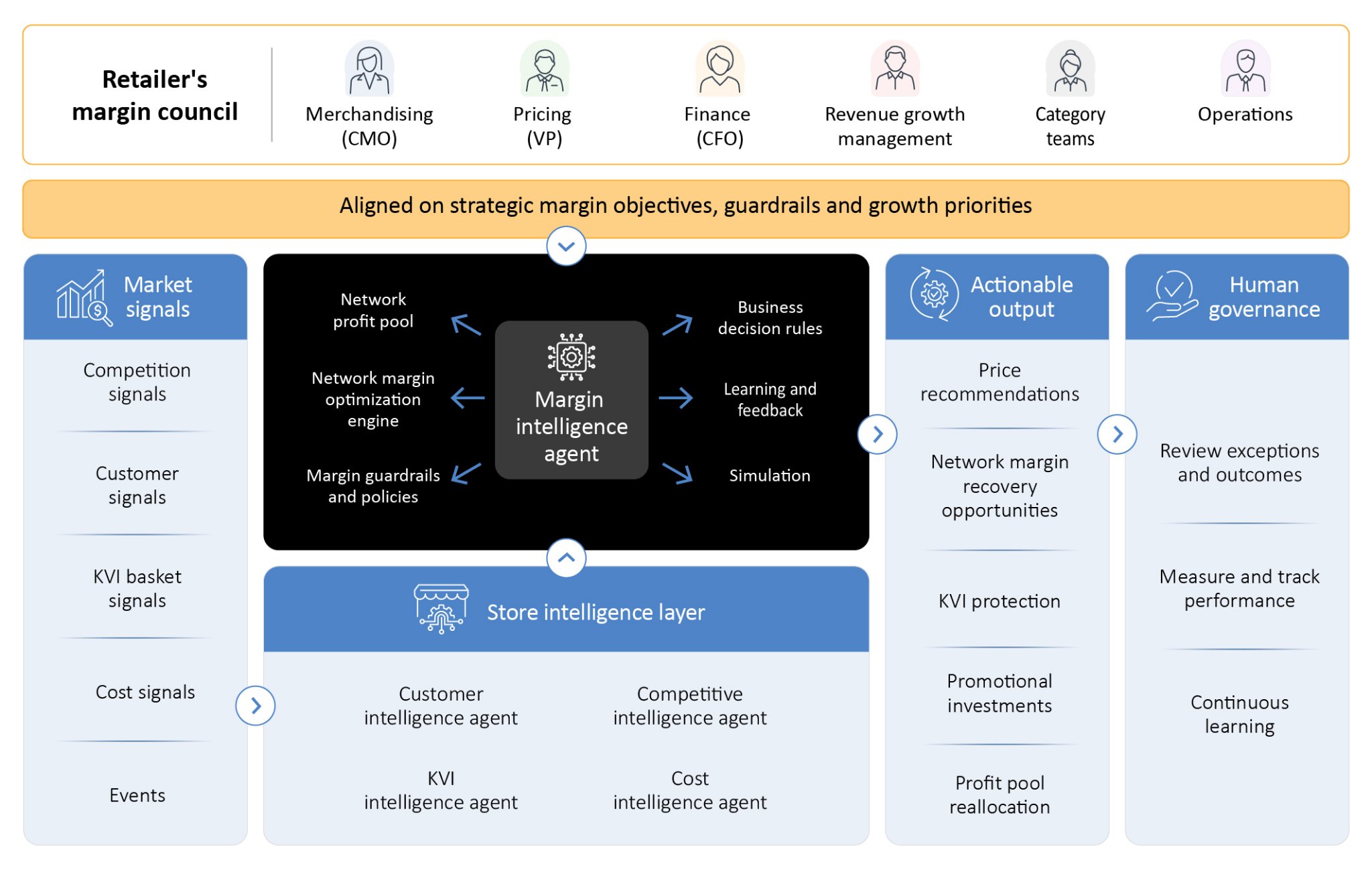
Figure 1
Margin-intelligent pricing decision flow
Figure 1
This is where margin-intelligent pricing goes beyond faster price detection. Traditional pricing systems often treat competitor moves as isolated events: a rival drops a price, the retailer responds, and the margin loss is accepted as the cost of staying competitive. The coordination layer introduces a more selective discipline by determining where to match, where to hold, and where to recover margin without weakening customer trust.
If margin must be sacrificed in one store to defend shopper perception, the model identifies offsetting opportunities in other products, stores, or channels where customers are less price sensitive. This shifts the decision from a narrow price match to a broader margin decision, while keeping pricing teams in control of the final action.
Consider a Dallas grocery network where a major regional competitor temporarily reduces the price of conventional chicken breast from $4.99 to $3.99 per pound. A blanket response would match the price across every store. A more margin-intelligent response looks different. At the premium North Dallas store, where the competitor has limited influence, the recommendation is to hold the price. At the mid-income East Dallas store, where cross-shopping is high, the recommendation is a full match. At the value-oriented neighbourhood store, the recommendation is a modest reduction based on the actual competitive benchmark. The combined response protects customer perception where the competitor matters most, limits unnecessary margin sacrifice where it does not, and identifies recovery opportunities in low-sensitivity long-tail items and organic variants on digital channels.
The result is a pricing response tailored to local market conditions, helping retailers stay competitive while protecting profitability.
What does the future of pricing look like?
Margin-aware pricing begins with a simple shift: the goal is not to respond faster to every competitor move, but to respond with greater precision. Each price change must be evaluated in context: whether it is likely to influence customer behaviour, whether the exposed stores require action, whether the affected products shape price perception, and whether the margin impact can be protected or recovered elsewhere.
This approach makes margin-aware pricing practical by connecting the signals pricing teams already use, including customer behaviour, competitor relevance, KVI sensitivity, cost movement, and channel performance, and turning them into clearer recommendations. It helps teams identify trade-offs earlier, test responses faster, and act with greater consistency across stores and channels.
Most retailers already have many of the required inputs. The opportunity lies in bringing them together to help pricing teams distinguish between a price move that threatens customer trust and one that does not. That clarity enables more selective competition, fewer unnecessary markdowns, and stronger margin recovery where customers are less sensitive.
The result is a more disciplined pricing capability: one that protects price perception where it matters, preserves margin where it can, and enables more consistent and informed decision-making. That balance will separate retailers that simply react to the market from those that compete with precision.
Every price move has a margin consequence. The advantage lies in understanding that consequence before the decision is made.’