Industry
Retail

Omnichannel CX and Intelligent Innovation – The Future of Retail
HIGHLIGHTS
- Consumer behaviour is being reshaped by four interconnected shifts: AI-mediated decisions, demand for contextual relevance, shorter consideration cycles, and elevated post-purchase expectations.
- The 5S behaviour attribution approach maps AI interventions to behavioural change throughout the customer journey.
- Behavioural outcomes demand new metrics: AI-influenced journey completion rate, contextual relevance score, cross-category exploration index, and advocacy amplification factor.
- Retailers that build behavioural intelligence, organisational capabilities, and AI foundations to serve new consumers across their life stages will be best positioned to lead the next era of retail.
On this page
On this pageinpage
The behavioural paradox
Retailers are facing a growing paradox. Despite access to smarter technologies than ever before, building lasting customer relationships is becoming increasingly harder. The disconnect lies not in the capability of AI itself, but in how it is being deployed. According to the TCS Global Retail Outlook 2026, based on responses from more than 800 senior retail executives across 18 countries, only 24% of retailers currently use AI for autonomous decision-making. While improving customer experience and loyalty remains a top retail priority, many AI investments are still focused on operational efficiency and recommendations rather than understanding why customers make or do not make purchase decisions, widening the gap between AI deployment maturity and CX ambition.
This paper presents a five-stage behavioural attribution approach where each stage of the modern customer lifecycle is shaped by AI interventions and appropriate nudges.
The 5 behavioural shifts redefining retail
Before designing AI-first journeys, it is essential for retailers to recognise a simple reality: that customer behaviour is changing faster than traditional CX models can keep up with. Today, five behavioural shifts are redefining how customers discover, evaluate, buy, and engage with brands.
Discovery is no longer driven solely by customer search. Predictive and ambient AI can identify needs before customers explicitly express them, surfacing relevant products, services, and experiences based on context and behavioural signals. As a result, customers are increasingly relying on AI to help them discover products and services, making trust and relevance more important than ever.
Customers no longer evaluate products through lengthy comparison journeys. GenAI assistants can synthesise reviews, recommendations, social signals, and product attributes simultaneously, compressing consideration cycles from days to minutes. Rather than processing information themselves, customers increasingly rely on AI to simplify complexity and accelerate decision-making.
Personalisation has become an expectation rather than a differentiator. Customers increasingly expect experiences that reflect not only who they are, but also their immediate context, intent, timing, and circumstances. AI systems that can interpret these signals are better positioned to deliver recommendations that feel relevant and timely.
Purchasing is becoming less of a discrete event and more of a seamless outcome. Agentic AI can reduce transactional effort through intelligent checkout orchestration, proactive interventions, and autonomous purchasing assistance. As friction disappears, the decisive moment shifts away from checkout and towards resolving customer uncertainty earlier in the journey.
The customer relationship no longer ends at purchase. Consumers increasingly expect post-purchase experiences to be as proactive, intelligent, and personalised as the shopping journey itself. Because customers tend to remember experiences by how they conclude, post-purchase interactions now play a disproportionate role in shaping loyalty, retention, and advocacy.
These shifts collectively point to a larger transformation: the customer journey is evolving into an AI-mediated journey. Understanding these behavioural changes is important but understanding how to influence them is becoming essential. This is where customer journey intelligence and the five-stage behavioural attribution approach become relevant.
The 5S behavioural attribution approach
While traditional journey maps help retailers understand what customers do, they provide limited insight into why customers behave the way they do. This is where behavioural attribution becomes critical. It seeks to identify the psychological drivers behind customer decisions at each stage of the lifecycle and understand how AI can influence those drivers. To address these changing behaviours, we introduce the 5S behavioural attribution approach (Figure 1),sense, shape, serve, sustain, and scale or the five AI intervention models. This approach focuses on why they behave as they do, and how AI can be designed to work with those mechanisms rather than around them.
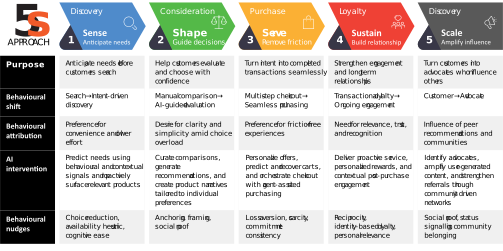
Figure 1
The 5S behavioural attribution approach to maximise AI-led engagement
Figure 1
five-stage behavioural attribution approach
This is the first stage of the AI-mediated customer journey, where discovery shifts from reactive to proactive. Instead of waiting for customers to search, AI anticipates needs and surfaces relevant products based on context, preferences, and behavioural signals. As customers increasingly trust AI to filter choices and reduce discovery effort, relevance becomes critical. AI analyses signals such as browsing activity, location, time of day, seasonality, and past interactions to identify latent needs before they are explicitly expressed. Behavioural nudges such as choice simplification, familiarity, and contextual relevance help reduce cognitive effort and make discovery faster and more intuitive.
The second stage focuses on helping customers make decisions with greater confidence and less effort. Rather than manually comparing products and evaluating endless options, customers increasingly rely on AI to narrow their choices and simplify the evaluation process. AI supports this through GenAI-powered product storytelling, dynamic comparisons, social proof synthesis, and real-time review summarisation tailored to individual preferences. Behavioural nudges such as anchoring, framing, and social proof help establish clear reference points, highlight relevant benefits, and enable faster, more confident decisions.
The third stage focuses on converting customer intent into commercial value. As shopping becomes more seamless, checkout evolves from a multi-step process into an ambient experience where agentic AI handles much of the transactional execution in the background. Customers increasingly expect purchases to happen with minimal effort and friction. AI supports this through personalised offers, cart abandonment prediction and recovery, intelligent checkout orchestration, and agentic shopping assistance that helps resolve hesitation and accelerate conversion.
The fourth stage recognises that post-purchase experiences play a critical role in shaping long-term loyalty. Customers are increasingly drawn to brands that continue delivering value after the sale through relevant engagement and proactive support. AI enables this through sentiment-driven service, issue resolution, personalised rewards, and contextually relevant promotions. Behavioural mechanisms such as reciprocity, trust, and personal relevance help strengthen customer relationships and encourage continued engagement.
The final stage extends the retailer's influence beyond individual customers into their social networks. Rather than remaining passive recipients of value, customers increasingly become advocates who influence the decisions of others. AI helps identify micro-influencers, amplify user-generated content, and strengthen referral and community-driven recommendation programmes. Behavioural mechanisms such as social proof, status signalling, community belonging, and network effects reinforce advocacy and drive organic growth.
How to build trust in AI-led journeys?
As AI autonomy grows, trust becomes increasingly important. Customers must understand when AI is acting on their behalf and have confidence that recommendations are fair, transparent, and aligned with their interests. Guardrails should be embedded across all five stages to prevent bias, manipulative nudges, misleading social proof, and privacy misuse. Explainability, transparency, consent, and human oversight are essential foundations for maintaining trust as AI-led journeys become more autonomous.
Which new KPIs matter in AI-mediated commerce?
The 5-stage behavioural attribution approach calls for a complementary measurement vocabulary that enables deeper customer journey intelligence helping retailers measure outcomes across the new AI-mediated customer journeys. This way, the focus is not just on what customers say about their experience, but on how their behaviour is changing due to AI intervention.
Behavioural KPI |
Definition and measurement approach |
AI-influenced journey completion rate |
The proportion of customer journeys progressing from the Sense through Serve stage without abandonment with AI interventions, vis-à-vis journey progression in a control group, to quantify the incremental conversion impact with AI. |
Contextual relevance score (CRS) |
An engagement signal that measures how well AI recommendations align with a customer's context—such as timing, location, browsing behaviour, and life stage, using engagement, click-through, and conversion signals across interactions. |
Cross-category exploration index |
The rate at which customers engage with product categories not previously purchased that can be attributed to AI-curated, contextually relevant product recommendations in the sense stage, indicating potential for basket growth and long-term loyalty. |
Autonomous conversion rate |
The proportion of completed transactions facilitated by AI-mediated processes, such as automated replenishment or agentic checkout, versus those requiring human-initiated decision points; an indicator of AI maturity in the Serve stage. |
Post-purchase behavioural retention score |
The effectiveness of AI-driven post-purchase engagement by tracking repeat visits after 30 days of purchase, return rates, and service escalations, providing an indication of how well the Sustain stage is strengthening loyalty and reducing customer friction. |
Advocacy amplification factor |
The multiplier effect of customer advocates on purchase behaviour of their social networks; a primary KPI in the scale stage, directly connected to organic growth vs investments in long-term customer acquisition. |
These behavioural KPIs are designed to complement, not replace, traditional metrics such as Net Promoter Score (NPS) and Customer Satisfaction Score (CSAT). While NPS and CSAT measure how customers feel about their experience, behavioural KPIs reveal how customers behave within AI-enabled journeys and the extent to which AI is influencing those outcomes. For example, a retailer may have a strong NPS score, indicating satisfied customers, but a low cross-category exploration index, suggesting customers are not discovering new products or expanding their engagement with the brand.
Viewed together, these metrics provide a more complete foundation for customer journey intelligence, helping retailers understand behavioural outcomes as well as business performance. Retailers can use them alongside existing KPIs and apply control-group methodologies to quantify the incremental impact of AI before scaling interventions.
How to turn every touchpoint into a turning point?
The five-stage behavioural attribution approach provides an understanding of not just what customers do, but why they do it. Across the various stages, AI evolves from supporting transactions to influencing decisions, strengthening relationships, and amplifying advocacy.
The next evolution, companion commerce, will make AI increasingly life-stage-aware, adapting to customers as their needs, priorities, and circumstances change. Retailers that combine behavioural intelligence, trusted AI, and strong governance will be best positioned to lead this shift. For them, every touchpoint becomes a potential turning point.