Products and Platforms
TCS Intelligent Urban Exchange™

TCS Intelligent Urban Exchange™
Highlights
- The digital product passport (DPP) is introduced as a transformative mechanism that enhances transparency, traceability, and sustainability across product lifecycles by consolidating essential information on materials, manufacturing, usage, and end‑of‑life processes.
- DPPs enable visibility into lifecycle stages, supply‑chain transparency, carbon footprint assessment, regulatory compliance (Ecodesign for Sustainable Products Regulation, Carbon Border Adjustment Mechanism), ESG metrics, and chain‑of‑custody tracking through cloud and blockchain technologies.
- It highlights solution pathways, including the adoption of international standards, blockchain, IoT integration, collaborative platforms, and training initiatives, to support successful and scalable DPP deployments.
On this page
On this pageinpage
Introduction to DPP
The digital product passport (DPP) is an innovative concept designed to enhance transparency, traceability, and sustainability in product lifecycles. A DPP serves as a digital record containing essential information about a product, including its origin, materials, manufacturing processes, usage instructions, and end-of-life options. This digital documentation is accessible to stakeholders, including manufacturers, retailers, consumers, and recyclers, enabling informed decision-making. It serves as an information backbone for the circular economy. The implementation of DPPs is gaining momentum, particularly in the European Union, where regulatory frameworks are evolving to require such documentation for various product categories.
Key challenges
- Data standardisation: Integrating diverse information from multiple sources requires standardised formats to ensure interoperability and consistency across industries.
- Privacy and security: Protecting sensitive product and stakeholder data from unauthorised access or breaches is crucial.
- Technical infrastructure: Setting up robust digital platforms and networks capable of handling large volumes of data and providing real-time access is a significant hurdle.
- Stakeholder collaboration: Coordinating among manufacturers, suppliers, retailers, and regulators requires clear communication and shared goals.
- Cost and complexity: The investment in technology, training, and process adaptation can be significant, especially for small and medium-sized enterprises.
DPP requirements
- Comprehensive data collection: DPPs must capture all relevant product information, including material composition, production methods, certifications, and lifecycle data.
- Interoperability: The system should be compatible with existing enterprise resource planning (ERP) systems, supply chain management tools, and regulatory databases.
- User accessibility: Stakeholders should be able to easily access and interpret DPP information using user-friendly interfaces and standardised identifiers (e.g., QR codes).
- Regulatory compliance: The DPP must meet legal requirements related to product labeling, sustainability reporting, and consumer protection.
- Security and privacy controls: The passport must safeguard proprietary and personal data using encryption and access controls.
Core features
DPP serves as a central hub for transparency and sustainability, connecting suppliers, manufacturers, consumers, and recyclers while meeting regulatory and ESG requirements. It provides visibility in:
- Lifecycle stages: Design → Production → Use → End-of-life
- Suppliers: Integrated for upstream traceability
- Lifecycle impact: Includes performance information
- Regulatory checkpoint: EU ESPR and CBAM compliance
- Data layers: Material origin, carbon footprint, compliance
- QR code integration: Consumer access to product details
- Feedback loop: Visualised for reuse and recycling
- Blockchain and cloud interoperability: Ensures secure, immutable traceability and real-time updates across supply chain
- ESG metrics highlighted: Environmental (carbon footprint), social (labour compliance), governance (audit trails).
DPP part information map
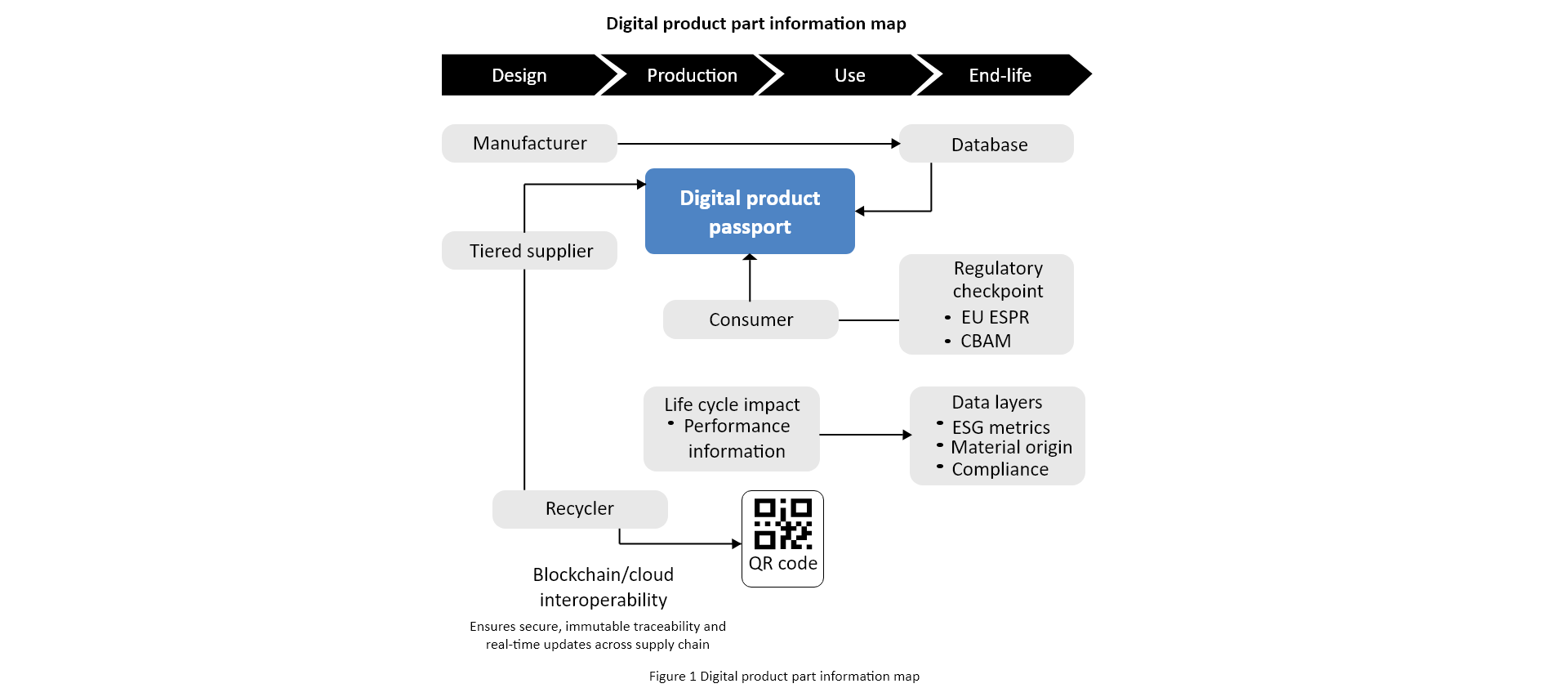
Digital product part information map
Digital product part information map
- Chain of custody tracking: Helps trace custody ownership, nature of custody, handling details, place of custody of product, its constituent and its derivatives through the entire life cycle.
- Access controlled data exchanges: Enables capturing relevant data throughout lifecycle stages and making appropriate information available to each custodian and stakeholders.
- Establishes a comprehensive information bank on the product: Includes inputs, throughputs, outputs, by-products, waste information, design details, energy information, specifications, manufacturing data, operational data, compliance tracking, certifications, lifecycle impact reports, time series data on performance indicators, and end-of-life information.
DPP overview
Typical dataset needed in a DPP can be broadly classified in the groups and subgroups detailed in the diagram below:
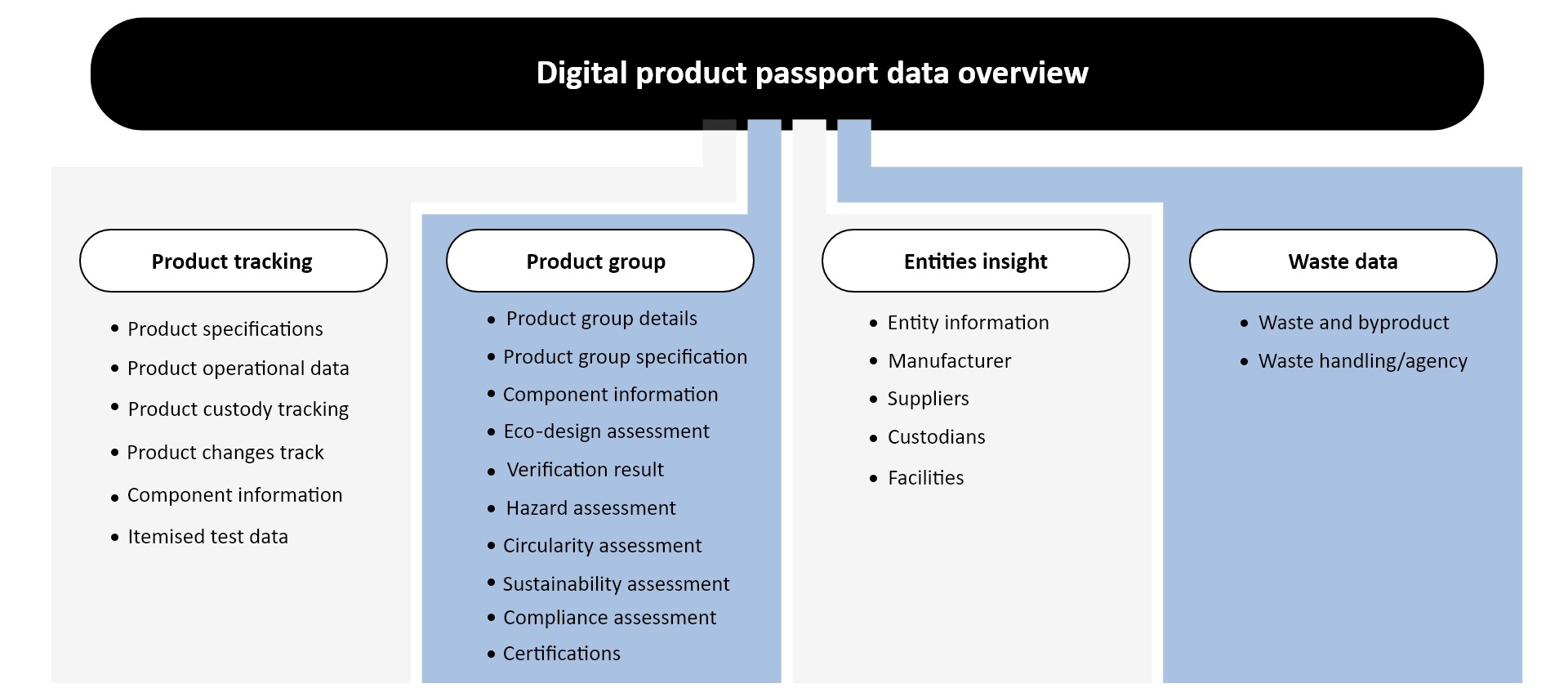
Digital product passport data overview
Digital product passport data overview
DPP solution plan
- Adoption of international standards: Leveraging globally recognised standards (such as ISO and GS1) for data formatting and exchange also eases interoperability and scalability.
- Blockchain technology: Utilising blockchain can enhance data integrity, traceability, and security, ensuring that information in the DPP is tamper-proof and transparent.
- Collaborative platforms: Developing cloud-based platforms that support collaboration among stakeholders, streamline data sharing, and provide real-time updates.
- Integration with IoT devices: Connecting products to the Internet of Things (IoT) enables automated data capture and real-time monitoring throughout the product lifecycle.
- Education and training: Providing stakeholders with training and resources ensures successful adoption and ongoing management of DPP systems.
- Regulatory support and incentives: Governments and industry bodies can accelerate implementation by offering guidance, financial incentives, and clear regulatory frameworks.
Real-world case studies
The following case studies show the practical application of DPPs across diverse industries. By highlighting successful pilots and implementations in textiles, electronics, batteries, and construction, these examples highlight how DPPs enhance transparency, traceability, and sustainability. They also illustrate the benefits for stakeholders and the growing momentum toward regulatory compliance and circular economy practices.
Textile industry – Circular fashion partnership (EU)
- A leading textile brand piloted DPPs to track garment origins and recycling options.
- Consumers accessed product details via QR codes, improving transparency and supporting circular fashion.
Electronics – Circular lighting
- A leading lighting company assigned DPPs to lighting products, sharing material and lifecycle data through cloud platforms and QR codes.
- This streamlined maintenance, recycling, and regulatory compliance.
Batteries – European battery passport pilot
- The Global Battery Alliance piloted battery passports for electric vehicles, using blockchain to track sourcing, usage, and recycling.
- Enhanced traceability and prepared for future EU regulations.
Construction – Material passport (Netherlands)
- A construction material provider provides material passports for buildings, documenting origin and recyclability.
Stakeholders use DPPs to plan renovations and maximise reuse, supporting circular construction.
Conclusion
The DPP is a transformative tool for promoting transparency, sustainability, and circularity in product management. While challenges exist, thoughtful solutions and collaborative efforts can pave the way for widespread adoption and lasting impact on industry practices and consumer behaviour.