Products and Platforms
TCS Intelligent Urban Exchange™

TCS Intelligent Urban Exchange™
Highlights
- Enterprises face increasing challenges in regulatory compliance due to constantly evolving laws and fragmented requirements across jurisdictions, making traditional, manual compliance management unsustainable and risky.
- Agentic AI automates the end-to-end compliance workflow, from regulatory scanning to executing action plans. At the same time, generative AI produces precise regulatory reports and filing datasets, with human oversight for accountability and transparency.
- AI and ML technologies are leveraged to identify relevant regulations, assess their applicability, generate actionable intelligence, and assign compliance tasks, ensuring comprehensive and up-to-date compliance management.
On this page
On this pageinpage
Simplifying compliance
Regulatory compliance has become one of the most complex and high-stakes challenges for enterprises today. Laws, policies, and guidelines shift constantly across geographies, jurisdictions, and political landscapes, sometimes without warning. For organisations operating globally, this means navigating thousands of evolving requirements while ensuring zero lapses in compliance. Any oversight, even at a local level, can trigger severe consequences for the entire enterprise, including legal penalties and board-level accountability. The sheer pace and fragmentation of these changes make traditional compliance management increasingly unsustainable, creating an urgent need for smarter, technology-driven solutions.
Compliance programs today face structural limitations that amplify risk. Regulations are not only numerous but highly fragmented, requiring contextualisation for each geography, jurisdiction, and business unit. This forces enterprises into a distributed execution model where filings and reports must be handled locally, while maintaining centralised oversight to protect the organisation from systemic failures.
The stakes are high: Non-compliance can lead to severe financial penalties, reputational damage, and even personal liability for senior leadership and boards. Traditional enterprise governance, risk, and compliance (EGRC) platforms have attempted to address these needs by assigning accountability to individuals; however, human-driven processes remain vulnerable to oversight and omissions, making compliance management an onerous and error-prone task.
Reinventing compliance
Despite advances in IoT, edge computing, big data, and AI and ML that have improved compliance monitoring and filing accuracy, the most critical gaps remain unresolved: Identifying new regulations, interpreting their implications, and translating them into actionable steps. These tasks are time-intensive and demand specialised expertise, making manual approaches unsustainable. For example, meeting the corporate sustainability reporting directive (CSRD) or the upcoming International Financial Reporting Standards Standard 2 (IFRS S2) climate disclosure standards requires enterprises to track evolving requirements, assess their impact across operations and supply chains, and generate accurate disclosures within tight timelines. This complexity is addressed through the integration of Agentic AI and Generative AI within compliance workflows. The solution automates regulatory scanning, impact analysis, and action planning, while Generative AI generates structured reports and XBRL-ready datasets for filings. By leveraging these capabilities, enterprises can transform compliance from a reactive burden into a proactive, intelligent process—saving thousands of manual hours and reducing risk across jurisdictions.
Agentic AI introduces end-to-end automation across compliance workflows, from scanning for new regulations to analysing their impact, creating action plans, and managing execution. Generative AI complements this by producing regulatory reports, disclosure narratives, and filing datasets with precision, including eXtensible Business Reporting Language (XBRL) tagging where required. Human oversight remains integral for review and accountability, but the heavy lifting, tracking, scheduling, filing, and responding to post-filing clarifications is handled by AI agents. Together, these technologies promise a compliance ecosystem that is proactive, adaptive, and resilient.
Visual AI compliance
A schematic diagram, shown here, describes the high-level working of agentic AI and generative AI in the context of compliance. Agentic AI encompasses end-to-end processes, including identifying regulations, analysing them, assessing impacts, creating action plans, and managing the execution of these plans. Generative AI assists with preparing regulatory reports and filing datasets, along with the applicable XBRL tags. Humans are involved in the review and accountability process. Agentic AI further takes care of scheduling, filing, and completing the filing according to the requirements outlined in the regulations. If any clarification is necessary after filing, Agentic AI addresses the issue appropriately, with humans in the loop for final approval.
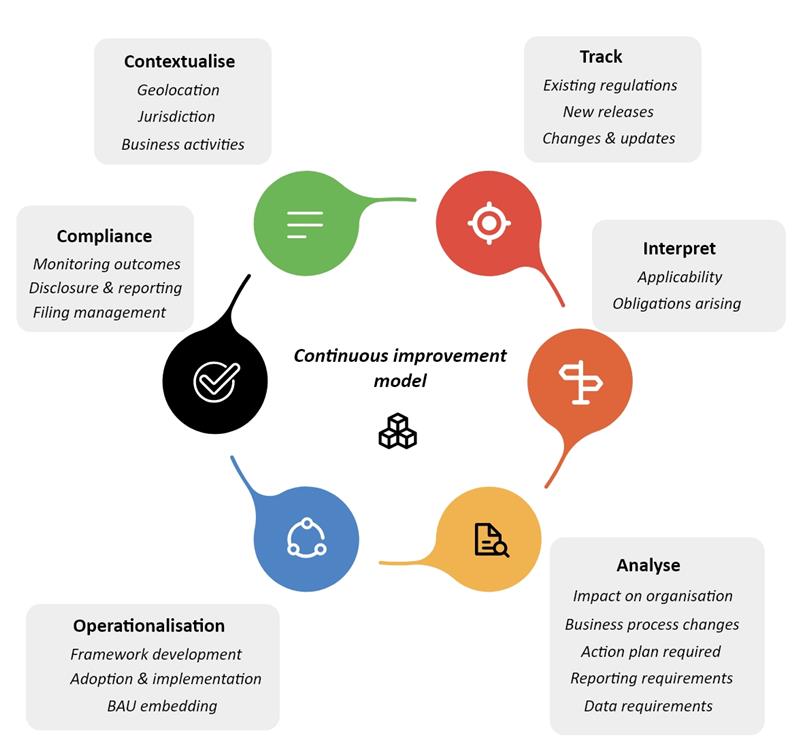
Continuous Compliance & Improvement Model
Continuous Compliance & Improvement Model
AI compliance in action
A sample use case for compliance with sustainability and climate action requirements has been implemented as per the schematic diagram above. The models are being trained to identify regulatory agencies and standard-setting organisations, ranging from global multilateral organisations to local government agencies. The next step in this exercise has been to access and extract the guidelines, regulations, standards, acts, rules, bylaws, notifications, filing forms, regulatory reporting templates, and public disclosure-related information requirements from the respective agencies.
These are being further evaluated for their applicability to the enterprise, either wholly or in part, in relation to the combination of processes, products/services offerings, geographical footprints, jurisdictions, and timelines. For this exercise, a comprehensive analysis of the operational and business activities of select multi-jurisdictional, multi-offering enterprises is being undertaken. To cross-check the efficacy of the models, the results of the above analysis are compared against the actual compliance programs already put in place for those enterprises. The applicable laws and guidelines, along with updates made to them from time to time, are then serialised by the date of issuance, “coming in force” notifications. They are also being tagged to other applicable dimensions, such as geographies, jurisdictions, operational activities, business activities, products, services, processes, and issuing agencies, among others.
Human in the AI loop
The next step in this use case process is to generate actionable intelligence. For an update, a comparison with the existing version having the latest update is necessary. This comparison is performed clause by clause to compile a list of changes. These changes could take the form of additions, deletions, or modifications. They are then used to assess the impact on current processes and actions associated with the existing compliance management program, and to enumerate any required changes, as appropriate. Likewise, for the new regulations and guidelines which become applicable to the enterprise, Agentic AI are to be used to outline actionable items, including a required set of activities and reporting obligations.
Thereafter, agentic AI helps determine the persons to be assigned specific tasks based on their organisational roles, responsibilities, specifications, and job descriptions. In determining the specific person responsible for a particular set of tasks, a combination of information, including designations, geographical hierarchies, business line hierarchies, and functional line hierarchies, is also utilised.
During compliance management programs, generative AI plays a very important role in various phases. It is used to create narratives for assessments and reports, as well as charts, graphs, and explanatory commentaries. It is also used to generate disclosure reports according to the prescribed layout /structures, as well as XBRL datasets (if applicable), for online filing.
These filing result sets are being built with human-in-the-loop approval, given the sensitivity associated with them. With all the necessary safeguards in place, report publication and filing are scheduled and tracked using Agentic AI. Any aberration triggers appropriate notifications and alerts, which are then processed by Agentic AI according to the escalation matrix it determines using applicable reporting and workflow hierarchies.
Next-level compliance
The integration of Agentic AI and Generative AI within compliance workflows is not limited to sustainability or climate-related regulations. The underlying architecture is inherently extensible and can be adapted to any regulatory reporting framework, whether it involves financial disclosures, data privacy mandates, industry-specific standards, or cross-border trade compliance.
By leveraging modular AI components for regulatory scanning, impact analysis, action planning, and automated reporting, enterprises can create a unified compliance backbone that scales across jurisdictions and domains. This adaptability ensures that organisations remain agile in the face of evolving global regulations, transforming compliance from a reactive obligation into a proactive, strategic advantage.