Services
Cognitive Business Operations

Unlock Business Agility and Future-ready Operations with TCS
Highlights
- Traditional global business services (GBS) approaches are reaching their limits because they focus on process efficiency rather than business outcomes, constrained by silos, fragmented data, and legacy systems.
- Artificial intelligence (AI)-led autonomous GBS redefines operations by combining AI agents with human oversight, shifting accountability from managing processes to delivering measurable outcomes.
- The new approach is powered by six core enablers that unify data, orchestrate workflows, and strengthen decision-making across the enterprise.
- Together, they create connected, transparent, and outcome-driven operations that enable organisations to deliver not just efficiency but measurable business impact.
In this article
The limits of traditional GBS
In today’s fast‑changing business and technology landscape, global business services (GBS) are at an inflection point. Enterprise leaders increasingly expect GBS to act as an engine to meet strategic goals like revenue growth, profitability, adaptability, experience, and resilience. However, traditional GBS approaches are not equipped to meet the realities of the modern world. While they deliver process efficiencies, they struggle with outcomes that drive sustained growth, agility, experience, and competitive advantage.
There are a multitude of reasons, intrinsic to legacy and traditional GBS. Siloed processes, lack of a unified view of organisational data, coupled with a disparate and fragmented technology landscape, and the constraints of legacy systems make operations disconnected from superior business outcomes. As a result, operations only optimise activities, not outcomes.
The rise of outcome-based GBS
To overcome these, a new operational method is required—one that reimagines how work gets done by harmonising human expertise with artificial intelligence (AI). Artificial intelligence, along with an innovative operating framework, provides an opportunity to transform GBS into a future-ready, outcome-focused engine. At the heart of this transformation is the new paradigm of AI-led autonomous GBS. This is built on the evolutionary human+AI partnership, where AI agents autonomously execute routine tasks and activities while humans provide oversight, judgement, and governance. This fundamentally shifts the basis of operations from people running processes to people governing outcomes, enabling enterprises to realise superior business outcomes in speed, quality, experience, resilience, and cost. This is the north star for future‑ready business operations.
The shift to outcome-based GBS also redefines how value is measured across service lines. In finance, the focus moves from transactional efficiency to stronger cash flow, improved risk mitigation, and real-time financial visibility. In human resource, it enables a seamless, responsive, and personalised employee experience. In customer experience, it helps enterprises deliver personalised, proactive, and omni-channel engagement at scale. In supply chain, it powers agile, resilient, and sustainable operations, helping organisations respond faster to disruption.
Beyond embedding AI into individual processes, autonomous GBS requires a deeper operating transformation—breaking down functional silos, adopting an end‑to‑end process view, and building high straight‑through processing so work can flow seamlessly across the enterprise. This method uses autonomous AI agents to sense, reason, make decisions, and execute multi-step workflows, shifting AI usage from passive bots to active partners. These agents are goal-driven, adaptable, and integrated, handling routine operations to allow human employees to focus on high-value, strategic work.
Accountability moves from activity volumes to business outcomes. The value is not better analysis alone; it is the ability to execute across systems and functions with clear ownership of outcomes.
This is where we make the shift from function-based organisations to value streams such as market to order, order to cash, record to report, source to pay, hire to retire, and problem to delight. These are not just process maps. They are operating flows that connect decisions, actions, data, systems, and accountability across functions.
The tenets of autonomous GBS
For AI agents to operate effectively, the reasoning capabilities of foundation models need to be grounded in enterprise context and seamlessly harmonised with enterprise processes, people, systems and policies (see Figure 1).
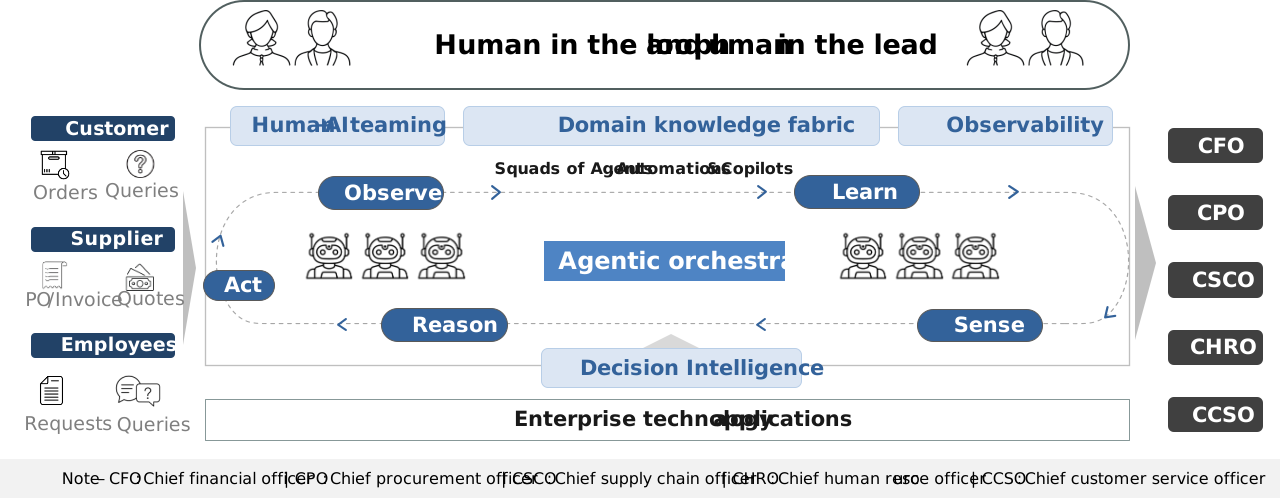
Figure 1: Human + AI model for autonomous GBS
Figure 1: Human + AI model for autonomous GBS
The following tenets effectively enable the functioning of autonomous GBS:
- Unit of one: It creates a measurable and attributable unit of business outcome within a value stream. It brings the focus on a single workflow, a single set of outcomes, a single measurement logic, and clear attribution. It tests whether the redesigned operating approach can move a business outcome under real enterprise conditions—with real data, real exceptions, real controls, and real business ownership. It connects AI-enabled orchestration, organisational context, decision support, governance, and human accountability around a specific business result. It makes business impact easier to measure because the unit of work and the unit of outcome are clearly linked, creating a credible basis for scaling across adjacent workflows and value streams once the outcome logic is proven.
- Real-time integration: It enables access to enterprise data sources and systems spread across the disparate technology landscape, for agents to understand enterprise context and take actions.
- Enterprise knowledge fabric: It acts as the organisation’s digital brain. It establishes a common semantic layer to ensure uniform data definitions across departments, maps where data sources are located, and captures the complex logic of business processes and decision-making. It codifies critical, often unwritten, tribal knowledge of a business through use of process discovery tools. Knowledge fabric connects policies, rules, data relationships, roles, and historical patterns. They anchor AI in enterprise context, reducing drift and enabling consistent, outcome-aligned execution. AI learns how the organisation works rather than starting from scratch each time. This directly addresses the challenge of a fragmented data view by creating a unified map of the enterprise’s knowledge.
- Agentic orchestration – Human+AI teaming: This requires coordinated orchestration of AI agents, existing automations, and human experts working in tandem across different systems to achieve specific business goals. The orchestration layer ensures that even with underlying legacy systems the end-to-end process remains seamless and efficient.
- Decision intelligence: For work that requires judgment, trade-offs, or business accountability, AI-enabled decision support systems bring assisted AI into enterprise work by presenting decision pathways, choices, and likely outcomes, enabling humans or AI agents to make better decisions. This improves decision velocity and decision quality.
- Observability: It provides business and operational observability of agentic processes. It offers a unified view of how workflows operate across the enterprise. Leaders can track an order, invoice, dispute, or request end-to-end details. This improves transparency and strengthens the ability to measure and attribute outcomes accurately.
These six tenets leverage a powerful set of capabilities. Evolutionary human+AI teaming clearly defines the roles of both AI and human workers, allowing tasks to shift to AI as it matures, freeing up humans for higher-value work.
This is guided by decision intelligence, which provides both AI and human agents with optimal choices for action, based on the rich context captured in the knowledge graph. Crucially, the entire system is built on a foundation of observability, ensuring complete traceability and auditability of every AI-driven decision and action. This builds the trust necessary for widespread adoption.
By integrating these enablers and capabilities, organisations can dissolve their data silos, bridge their disparate systems, and build an intelligent, connected, and truly AI-powered enterprise. It is about making work visible, contextual, governable, and directly tied to business outcomes. That is the shift from cost efficiency to outcome leadership.
Autonomous GBS in action
Enterprises are re-imagining operations around autonomous GBS by connecting data, intelligence, workflows, and accountability to measurable outcomes across finance, supplier operations, and customer experience.
A US-based home improvement retailer deployed an autonomous supplier service desk to transform supplier experience at scale. Using orchestrated goal and task-based AI agents, the solution autonomously managed query intake, classification, resolution, and response generation, with human oversight for governance. Average query response time reduced from 48 hours to under 15 minutes, improving speed, consistency, and supplier satisfaction. The engagement shows how autonomous GBS can help finance and supplier operations move beyond transactional efficiency to stronger responsiveness, better experience, and improved operational control.
A leading Middle East conglomerate reimagined its finance operations through AI-led autonomous GBS. By leveraging agentic AI, GenAI, and advanced analytics to enable real-time dashboards, value added tax (VAT) validation and reconciliation, touchless invoice processing, and automated record-to-report processes. An integrated business-as-a-service solution with end-to-end observability further improved agility, service quality, and operational efficiency. The transformation delivered 20% reduction in cycle times across key business metrics, and stronger control over exceptions, helping build a finance function that is more insightful, agile, and decision-oriented.
A leading pay television and streaming company reimagined customer experience with GenAI-powered agent assist, augmented reality (AR)-based remote assistance, and connected intelligence across sales, support, marketing, and product teams. These interventions accelerated sales, improved collections, increased self-service containment, and significantly improved the Net Promoter Score.