Service
Cognitive Business Operations

Unlock Business Agility and Future-ready Operations with TCS
Highlights
- Most finance ‘noise’ is the downstream symptom of upstream breakdowns in procurement, supply chain, or human resources (HR), not a failure of finance operations.
- When each function improves in isolation, no one owns the seams between processes—allowing the same exceptions to resurface month after month.
- Process mining, agentic artificial intelligence (AI), and unified data architectures finally make cross-functional friction visible and fixable by addressing root causes, not just resolving exceptions.
On this page
Expanding responsibilities
The ambit of chief financial officers (CFOs) is expanding at a brisk pace.
A majority of CFOs no longer want to consider themselves as mere gatekeepers or fiduciaries limiting their potential to financial book-closing and external reporting. Rather, they are keen on spearheading strategic endeavours for their companies by distending responsibilities in corporate strategy, customer acquisition and retention, and mergers and acquisitions (M&A).
Given that all business activities eventually converge into financial figures, CFOs are already in pole position to leverage this data for meaningful information regarding companies’ strengths and weaknesses. The advantage so gleaned is now parlayed into a strategic beachhead, allowing CFOs to explore opportunities for business growth, market expansion, and to create advantages to beat the competition. This has become possible due to the evolving world of analytics supercharged by frontier technologies like artificial intelligence (AI) and generative AI (GenAI)!
With the emergence of machine learning (ML), a subset of AI, analytics strengthens the decision-making of CFOs with predictive and prescriptive insights underpinned by structured data from within the organisation ((historical organisational data like sales, expense, price) and without (macroeconomic, geopolitical and political indices).
The GenAI inflection point
Recent advancements in AI, especially GenAI, have opened up unprecedented opportunities for financial managers.
It has been estimated by researchers and analysts that 80 % to 90 % of any organisation’s data is unstructured in the form of e-mails, documents, images, contracts, presentations, transcripts. GenAI, predicated on large language models (LLMs), helps marry the vast quarries of untapped unstructured data, both internal and external (economic releases, 10K reports of competitors, analyst reports) with structured data.
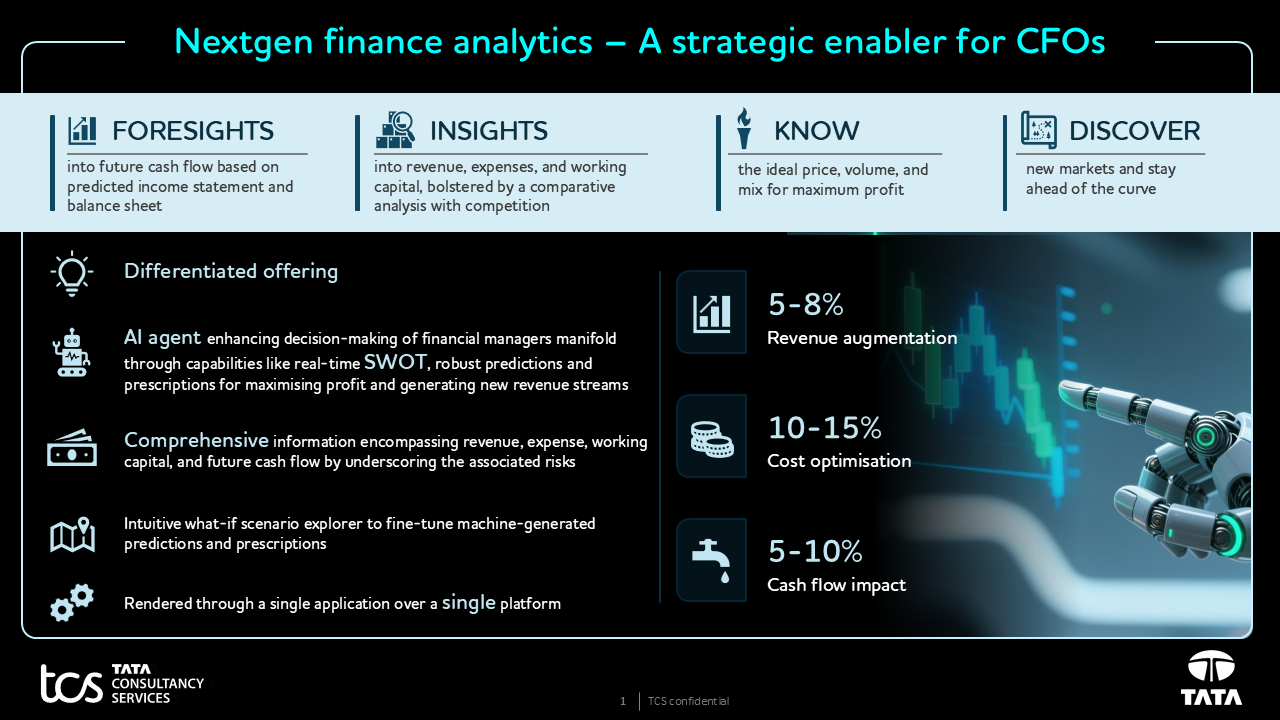
With analytics, CFOs can dip into this vast, expanded information repository to create the best strategy aided by actionable insights and foresights on multiple dimensions such as revenue, expense, working capital, thus putting their companies ahead of the curve.
Solutions
Figure 1: Analytics improves strategy
Solutions
Focus areas
Modern CFOs are frequently pummeled with requests for details on performance and strategic growth drivers.
They have to field questions on the customer segments bringing the greatest margins (hindsight and insight), the regions likely to drive revenues (foresight), and the product mix that can maximise profitability (prescription).
To answer these, analytics solutions should be strong in some key high-level focus areas:
Financial planning kicks off with ‘goal setting’. This typically entails determining the growth rate, profit margin, dividend payout ratio. Besides providing information on revenue, expense, and financial ratios, analytics can do a comparative analysis of the industry and the nearest competitors.
In the next phase, ’defining assumptions and planning’, next-gen analytics can generate interpretable predictions within 5% accuracy utilising sophisticated ML models.
In the ‘consolidation’ phase, proforma financial statements are generated at the company level, which acts as the lodestar for tracking and measuring overall performance.
CFOs must constantly be aware of the shifts in market.
Failing to anticipate them can wreak havoc on the company’s performance. Future-ready analytics solutions are highly capable of bringing together competitor, buyer, and seller information, and combining them with macro factors and economic releases to create a holistic view of the market and the risks associated. They can also offer a tailored plan to mitigate the risks.
Not just the variance analysis between the budgeted and actual, analytics solutions are also geared to delineate information on customer churn, product performance, and profitability prescriptions.
They even prescribe ideal prices and product mixes to help retain existing customers through cross-selling and up-selling, maximising both revenue and profit.
M&A provides incredible opportunities to increase market share, access new markets, accelerate growth, and save cost. However, zeroing in on the right investment is not easy. One of the key drivers of a successful M&A is accurate valuation. Avant-garde analytics applications allay the agony of the CFOs to a large extent by comparing various investment options based on net present value (NPV), internal rate of return (IRR), and prescribing the most pragmatic choice to maximise the return on investment (ROI).
Analytics solutions for the CFOs can be configured as an AI agent.
The handler or goal-based agent that acts as the orchestrator reasons and identifies the pertinent AI agent—CFO agent in this case (see Figure 2)— out of all other agents to deflect the question or prompt. The CFO agent responds with a semi-structured output (eg JSON) back to the handler-agent, which converts the response in natural language for the CFO or another AI agent.
Turning uncertainty into strategic clarity
The world today is in flux.
Unending geo-political strife, threats of war, belligerent policies, and hawkish rhetoric are reshaping the relationships between nations. This state of tumult will impact businesses globally. These are challenging times for CFOs. But amid the gloom and unpredictability, CFOs have something to cheer for. Analytics, with the ability to capture these changes vividly and offer a nuanced montage of the business landscape, will allow the CFOs to navigate the uncertainty with confidence.