Services
Consulting

TCS Consulting Services to Achieve Success in the Digital Era
Highlights
- Inbound logistics is now a board-level performance lever, directly shaping the cost to serve, inventory readiness, service reliability and resilience.
- The value shift is from visibility to intelligent action: real-time operational signals must translate into prioritised, governed interventions that reduce leakage, disputes, claims and circular-system waste.
- Vision artificial intelligence (AI), agentic AI, and execution orchestration can enable a more autonomous gate-to-shelf flow across yard, dock, receiving, and exception management, while pallet intelligence unlocks a hidden margin opportunity.
On this page
On this pageinpage
Introduction
Inbound logistics is one of the least visible control points in the supply chain, but it has a significant bearing on cost, service, carbon, and stock availability every day.
In fact, business decisions start the moment the first truck reaches the gate: which dock to use, which labour to deploy, which pallets need further checking, and which inventory can move into stock.
New technology makes it easier to manage inbound, right from gate arrival to stock availability, and also helps reduce costs as it helps deal with issues at the earliest before grow and cascade into other functions. For instance, vision artificial intelligence (AI) and vision language models (VLMs) can accurately capture and interpret gate paperwork, delivery notes, pallet labels, seal numbers, load images, and visible damage at arrival.
Depending on the quality of the image and the document, operating conditions, and exception complexity, the captured information can be compared against advanced shipping note (ASN), appointment, carrier record, pallet account, and receiving rules. Agentic AI can help teams identify exceptions earlier and recommend whether loads should be released, held, reworked, or escalated before receiving is blocked.
Inbound blockages
The four main challenges that inbound logistics faces are: i) weak pre-arrival visibility that affects smooth entry on arrival; ii) manual checks and validation that causes delays and requires human effort; iii) poor pallet accountability that makes tracking and managing pallets difficult; iv) and fragmented ownership of transport, yard, warehouse, suppliers, and finance, which means there is no end-to-end visibility.
- Limited visibility results in trucks arriving with missing or insufficient documents, mismatched appointments, or information that has not reached the right team. A driver could arrive early without any confirmed slot, or a temperature-controlled load may lack the temperature evidence the quality team needs. All this causes long queues, increased dwell time, detention risk, and pressure before unloading even starts.
- Manual validation is still a major constraint and increases the probability of errors creeping in as bills of lading, ASNs, pallet notes, and delivery confirmations are checked under time pressure. Besides, traditional optical character recognition (OCR) helps only when documents are clean and structured. However, real inbound work is rarely clean: torn CMRs (consignment notes), mixed supplier formats, unreadable labels, missing seal numbers, and visible damage still need judgement.
- Poor pallet accountability increases the chances of asset leakage. This, in turn, means higher cost, disputes, replacement demand, and weaker circular reuse—all preventable with better management. Also, treating returnable pallets as consumables causes problems because this common practice affects cash, supplier accountability, and sustainability performance.
- Fragmented ownership worsens the problem. Transport management system (TMS), yard management system (YMS), warehouse management system (WMS), enterprise resource planning (ERP), pallet systems, and supplier portals often have different owners and measurement metrics. Without common exception rules, one team can improve its own performance while pushing waiting time or rework elsewhere.
Economics of inbound logistics
Inbound logistics costs rarely sit in one place. They are spread across transport, warehouse operations, inventory, pallet management, and supplier administration. This makes it difficult to see the full financial effect of delays, manual checks, pallet disputes, and receiving errors.
Much of the cost of inbound logistics is determined before unloading begins. An exception identified too late may add waiting time, trigger rework or detention charges, delay inventory availability, or result in asset loss. Detecting the same issue earlier gives teams more time to protect throughput, plan labour, release stock, control pallets, and manage carrier performance.
Agentic AI adds value when it helps the operation act on these issues sooner. Its role is not simply to automate an existing task, but to bring the relevant evidence, rules, and operational context together so that teams can make a timely decision before cost and disruption spread across transport, warehouse, and inventory operations.
Four improvements
1. Better decisions at arrival and receiving
The first checks should catch any gaps to make the next decision and action better and clearer: 18 pallets booked but 20 counted, a damaged carton, a cracked returnable pallet, or a seal number that does not match the order The earlier teams spot the exception, the easier it is to decide what should happen next. Details from documents, labels, pallet references, seal numbers, and visible load conditions can be captured and compared with appointment, ASNs, order and pallet records before the truck reaches the dock, thus ensuring smooth operations.
Those checks, however, will make a difference only if they are followed up with action. A gate agent, for instance, can advise whether the truck should proceed, wait, change lane, or if the issue is to be escalated. Similarly, a receiving agent can route shortages, overages, paperwork gaps, or damage to the right owner. Spotting a shortage at the gate provides sufficient time for course correction or damage control, rather than finding it hours later and scrambling for solution.
2. Better coordination across gate, yard, dock, and receiving
The flow of inbound logistics improves when all the teams—those at the gate, yard, dock, receiving, and put-away--use the same arrival record. By preparing docks earlier, planning labour better, setting receiving priorities, avoiding repeated checks, and escalating problems faster, teams can ensure efficient operations.
Earlier visibility enables teams to adjust the dock plan for swift action. For example, a floor-loaded container can go to a door with the right labour; a promotional order can move before one that is meant for routine replenishment; a truck suspected to have a damage can be sent for inspection, ensuring it doesn’t block a standard bay. This means less improvisation, fewer repeated checks, and faster availability.
3. Where the business case starts
The business case should start with a look at familiar costs such as manual checking, detention and demurrage, discrepancy handling, slow goods-receipt posting, poor dock utilisation, inventory errors, and pallet loss. This exercise is especially effective when these costs are measured against a clear baseline.
A pilot study on a real friction point such as a supplier cluster with ASN errors, a gate lane with queues, a carrier group with detention claims, or a pallet flow with repeated disputes will help ascertain the problem areas. This will help figure out the best solution. Once the value of the new model is proven, scaling can move to more docks, sites, suppliers, carriers, stock keeping units (SKUs), and pallet flows.
4. Less waiting, rework, and avoidable carbon
Many operational aspects contribute to carbon costs—a truck idling outside the gate, a trailer moving twice because the dock was not ready, a load having to be rehandled because a damage was detected late, or replacement pallets that had to be ordered because of poor reconciliation. To minimise emissions, the waiting, unnecessary movement and rehandling have to be prevented. This waste can be reduced with better yard control and by detecting exceptions early.
This links sustainability to daily inbound decisions, not only to reporting. Timestamped events, dwell-time analytics, carrier performance, exception codes, and pallet movement records can support Scope 3 logistics transparency and supplier or carrier scorecards.
Value framework
Improved working between truck arrival and pick-ready inventory ensures minimal wait at the gate, fewer hours spent on manual validation, fewer pallet or quantity disputes, faster goods-receipt posting, and quicker closure of exception points. These make the business case tangible at the site level.
Table 1 shows how improvement areas can be measured from financial, operational, and sustainability perspectives.
Value lever |
Primary KPI |
Financial logic |
Operational logic |
Sustainability link |
Throughput |
Gate-to-receipt cycle time |
More volume handled with existing capacity |
Reduced queues and faster dock readiness |
Less idle time and congestion |
Productivity |
Manual validation hours |
Lower admin and exception effort |
Fewer routine checks; more focus on exceptions |
Reduced rework and repeated handling |
Asset control |
Pallet discrepancy, recovery rate |
Lower replacement cost and claims exposure |
Improved pallet accountability |
More circular and reusable asset flow |
Inventory availability and visibility |
Time to goods receipt posting |
Earlier stock availability |
Faster system confirmation |
Reduced need for emergency replenishment |
Risk and governance |
Audit trail completeness |
Lower dispute and compliance risk |
Traceable decisions and ownership |
Better data for Scope 3 reporting |
These key performance indicators (KPIs) help determine the areas that contribute to delays, manual efforts, pallet disputes, goods-receipt gaps, and carbon impacts, and the sites, suppliers, lanes, or product flows that should be prioritised. These are valuable insights for the leadership looking to scale up after the pilot.
Road map
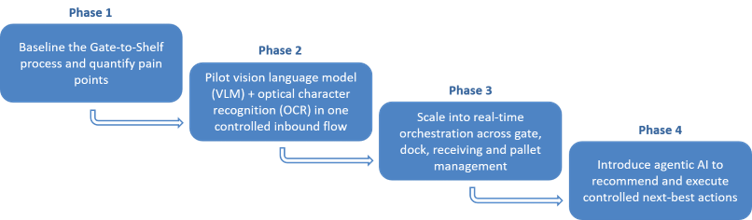
Once the improvement measures are implemented, the inbound flow should be measured on the KPI parameters. The management should think of scaling only those aspects that show a clear improvement (see Figure 1). Measure the main delays, test one controlled flow, connect decisions across gate, dock, receiving, and pallets, and introduce agents only when data, rules, and controls are ready.
Scaled inbound intelligence
Scaled inbound intelligence
Phase 1: Build the baseline, locate the sources of delay and cost
This phase shows how inbound work--from arrival and document checking to unloading, receiving, pallet reconciliation, exceptions, and goods-receipt posting—works. The baseline will give an idea of where time is lost and what increases cost: incomplete ASNs, queue-prone lanes, recurring detention claims, and missing pallet balances.
A trusted data foundations will need to be part of the baseline assessment before AI-enabled decision support is introduced.
Phase 2: Test AI in one controlled inbound flow
Use AI to focus on a narrow but critical area of inbound logistics. The pilot with AI can cover aspects such as one-gate lane, a supplier cluster, a carrier group, a distribution centre, or a high-friction category. OCR can help with structured documents, while image capture and VLM technologies can be used to decode handwritten notes, damaged paperwork, labels, seal numbers, load images, and visible exceptions.
Phase 3: Connect gate, dock, receiving, and pallet decisions
Turn validated arrival information into coordinated action. Late trucks, document mismatches, complex loads, or pallet discrepancies will affect dock allocation, labour readiness, receiving priority, pallet reconciliation, and supplier or carrier communication. A late truck with a fast-moving SKU should not be treated like a routine replenishment. A mixed pallet with missing labels needs a different path from a clean full-pallet receipt.
This phase needs clear exception ownership, reliable master data, agreed operating rules, integration with TMS, YMS, WMS, ERP and pallet systems, and governance over which decisions can be automated, recommended, or escalated.
Phase 4: Introduce AI agents with clear operating rules
AI agents should be added only when data, process rules, and controls prove their effectiveness in solving real-world problems. Agents can track inbound events against the plan, check carrier, supplier, pallet, quality, and receiving rules. It can then estimate impact and recommend approved responses. Guardrails, decision ownership, auditability, and human in the loop must define what can be released automatically, approved, escalated, or blocked.
Keep the operating model simple: capture arrival evidence, match it with the appointment, ASN, order, carrier, and pallet records, check exceptions to agreed rules, and send approved actions to TMS, YMS, WMS, ERP, control-tower, or exception workflows. Agents should connect those systems; they should not replace them.
The same gate-to-shelf logic becomes even more important in regulated industries such as MedTech, where inbound errors can affect not only cost and service but also compliance and patient access.
Industry spotlight: MedTech
Inbound logistics matters in every supply chain, but the consequences of receiving errors are more serious in MedTech. A discrepancy can delay product release, weaken traceability, interrupt supply, or prevent a critical device from reaching the point of care.
For medical device manufacturers and distributors, inbound control is not only about efficiency. A damaged shipment, missing documentation, temperature excursion, or mismatch between physical inventory and Unique Device Identification (UDI) records may require the receipt to be held while operations and quality teams investigate the exception. The additional checks can increase manual effort and delay product availability.
Better arrival evidence gives receiving and quality teams an earlier opportunity to act. Vision AI and VLMs can read shipment documents, labels, serialisation data, and visible load conditions. Agentic AI can then compare the findings with quality requirements and expected shipment information before the inventory moves further into the supply chain.
Inbound intelligence is particularly useful in three areas:
Regulated Receiving and Release Readiness
Before goods receipt is confirmed, teams can check shipment documents, UDI records, lot and serial information, expiry dates, supplier status, and quality-release requirements. Finding a mismatch at this stage can prevent avoidable quarantine, rework, or a delayed product release while preserving a clear audit trail.
Serialised Traceability and Recall Preparedness
Accurate serial numbers, chain-of-custody records, and device genealogy established at receipt give teams a stronger starting point when a recall occurs. They can identify affected inventory more quickly, trace where it has moved, and distinguish impacted devices from stock that can remain available.
Supply Continuity for Critical Devices and Components
An inbound exception involving a critical device or component requires a different response from a routine discrepancy. Earlier visibility of supplier, inventory, logistics, and quality risks gives teams time to assess available stock, prioritise inspection or release activities, and address a potential interruption before it affects patient access.
For MedTech operations, the practical value of inbound intelligence is earlier control. It gives receiving and quality teams more time to resolve discrepancies, protect traceability, and release compliant products without unnecessary delay.
Optimising gate-to-shelf with agentic AI
Inbound logistics is becoming a key part of operational control because gate decisions now shape dock readiness, labour planning, receiving accuracy, pallet balances, carrier waiting time, and inventory availability.
At the gate, vision AI checks for details in documents, labels, seal numbers, pallet identifiers, load condition, and visible exceptions that often slow down receiving. Then, agentic AI helps decide whether the truck moves to a dock, waits in the yard, or needs a supplier or carrier follow-up. The decision then carries through to dock allocation, receiving confirmation, goods-receipt posting and pallet reconciliation.
The next step is to test this in an inbound flow where delays, exceptions, or manual checks are already visible, determine the operational and financial impact, and then scale from there. Supply chain leaders who get gate-to-shelf control right will be able to reduce avoidable waiting, rework, pallet leakage, cost, and emissions while improving the speed from truck arrival to pick-ready inventory.