Industry
Life Sciences

Patient-centered Care Models Taking Center Stage in Life Sciences
Highlights
- Standard Operating Procedure (SOP) management is a living system as day-to-day practices evolve continuously with internal changes or regulatory triggers.
- Yet many enterprises rely on manual SOP management, ultimately resulting in audit failures.
- Agentic AI can help organisations detect triggers, orchestrate updates, and keep SOPs audit-ready from draft to rollout.
On this page
What does agentic AI mean for SOPs?
SOP management is a dynamic, continuously evolving process in which policies, controls, tools, and operational practices must adapt to changing business and regulatory requirements. However, many organisations still depend on manual methods such as tracking regulatory updates, managing change requests through emails, and conducting periodic document reviews. This reactive approach often leads to outdated procedures, inconsistent local practices, and increased pressure during audit readiness activities.
Agentic AI takes goal-directed actions across tools and workflows, with defined guardrails and human approvals. In SOP management, an AI agent can monitor change triggers, gather evidence, propose edits, route reviews, and verify adoption while maintaining traceability for compliance.
What are some common triggers that necessitate continuous SOP management?
New regulatory guidance and internal change requests are a couple of common triggers that keep organisations on their toes in SOP management.
- New regulatory guidance: A regulator publishes an updated guideline, FAQ, or enforcement priority. In many organisations regulatory changes are tracked through manual monitoring. Compliance teams interpret the change, but operational procedures often lag—especially when multiple SOPs across functions such as risk, onboarding, data handling, and vendor management are impacted.
- Internal change request: Organisational changes such as the introduction of a new tool, a shift in roles and responsibilities, the implementation of additional controls, or lessons learned from an incident often require updates to existing procedures. While these changes are typically time-sensitive and business-critical, the path to updating documentation is frequently fragmented and unclear. Organisations often struggle to determine which SOPs are impacted, who should review and approve the revisions, and what training, communication, or change management activities are needed to ensure effective adoption.
These are some common scenarios that demand real-time SOP management.
How should organisations approach agentic AI workflows for smarter SOP management?
A modern approach to SOP management should begin with a shift in focus. The goal is not simply to auto-generate an SOP from regulatory guidance or a change request. The primary objective is to translate regulatory or internal change intent into policy statements first. These should then be compared with current enterprise policy statements, and the enterprise policy must be updated when required. Policy interpretation then defines the process and procedural control requirements that form the foundation of the SOP. Establishing this knowledge base before executing regulatory or change-related updates creates a stronger, more consistent starting point for downstream documentation.
This approach also makes SOPs easier to convert into digital playbooks, enabling more effective implementation and compliant operations. Digital playbooks can translate SOP requirements into role-based actions, checklists, decision points, and controls that teams can follow consistently. With that foundation in place, the SOP ecosystem of tomorrow can become more connected, actionable, and audit-ready.
What steps does an agentic AI workflow follow when a regulation or internal request triggers an SOP update?
Detect and log the trigger: The agent monitors designated sources such as regulatory bulletins, internal ticketing systems, risk findings and opens a structured change case with a timestamp, source, and initial summary.
Map impact to SOPs and controls: Using the SOP library and a simple taxonomy of process, role, system, control, the agent identifies candidate documents and related artefacts such as work instructions, checklists, training items, etc. It then proposes an impact scope for human confirmation.
Generate a change brief: For a regulatory trigger, the agent drafts what changed and why it matters, highlighting affected obligations and translating them into operational terms. For internal requests, it captures the intent, dependencies, and rollout date.
Draft redlines with supporting evidence: The agent proposes specific edits such as steps, RACI (responsible, accountable, consulted, informed), inputs/outputs, exceptions, and links each change to a rationale in the change case. Reviewers get a clear picture instead of a blank page.
Route approvals intelligently: Based on document ownership and risk level, the agent routes requests to the process owner, compliance, legal, and quality assurance (QA)—sequencing reviews and enforcing service level agreement (SLA) reminders. Nothing is published without the required approvals.
Validate downstream adoption: After approval, the agent can generate a short what’s new note, update training prompts, and create a rollout checklist for managers. It can also schedule attestation reminders where required.
Maintain audit-ready traceability: Every step—source, decisions, reviewers, version history, and effective date—stays attached to the SOP record, making audits faster and less disruptive.
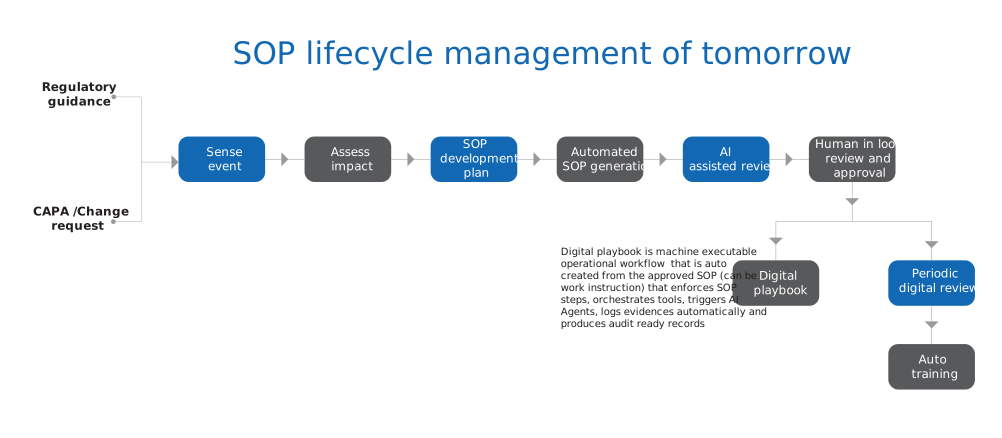
Figure 1: Agentic AI workflow of SOP management
Figure 1: Agentic AI workflow of SOP management
How to make SOPs trustworthy?
While an agent's value lies in speed, SOPs are valued for their trustworthiness. That’s why agentic SOP management should be designed with guardrails: clear, role-based permissions; mandatory human approvals for policy intent; locked templates for required sections; and a defined source of truth for regulatory interpretation. In practice, the AI should recommend and orchestrate but never silently publish.
How can organisations benefit from agentic SOP management?
When change is triggered by a new guidance note or an internal request, the hard part isn’t writing—it’s coordination. Agentic AI reduces these coordination efforts by keeping the work moving and the evidence attached. Organisations typically see:
- Shorter cycle times from trigger to published SOP, because impact analysis and routing are automated.
- Higher consistency across sites and teams, as updates propagate through linked documents and checklists.
- Reduced audit disruption thanks to end-to-end traceability and a clean version history.
- Lower operational risk by validating adoption (training, attestations, and rollout tasks), and not just publishing a PDF.
In a world where regulations evolve quickly and internal processes change even faster; SOPs can’t be maintained as a periodic documentation project. They should be treated as an operational product. With agentic AI, every new regulatory guidance or internal change request becomes a controlled, trackable workflow—one that delivers faster updated procedures, verified adoption, and audit-ready evidence without slowing the business down.