Industry
Life Sciences

Patient-centered Care Models Taking Center Stage in Life Sciences
Highlights
- Pharmaceutical labelling is a critical patient safety, regulatory compliance and brand trust function. Labels serve as strategic information tools for patients, healthcare professionals and regulators. Therefore labels must be accurate, consistent, compliant and implementation-ready across markets, formats and product lifecycles.
- Traditional label quality control (QC) relies heavily on manual review, proofreading and iterative checks. As product portfolios expand and regulatory requirements evolve, this model is increasingly difficult to scale.
- AI-enabled quality control offers an opportunity to shift from reactive, document-by-document review to a more predictive, risk-based and digitally connected operating model.
On this page
Why is it important to have stringent quality control in pharma labelling?
Pharma labels are the most visible and highly regulated components of a pharmaceutical product. They inform regulators and consumers about product identity, safety, efficacy, dosing, administration, warnings, contraindications, and storage. Any error or inconsistency can affect patient safety, trigger regulatory action, delay approvals, create product complaints, or lead to recalls and reputational damage.
Companies, therefore, invest significant time, cost, and expert effort to maintain the quality and compliance of labels. The pressure on quality control is increasing due to multi-market requirements, frequent health authority updates, evolving digital standards such as electronic Product Information (ePI) and Identification of Medicinal Product (IDMP), and technical submission formats such as Structured Product Languages (SPL).
Drivers and impact on QC labeling
Complexity drivers |
Impact on QC in labelling |
Multi-country submissions |
Country-specific label variations, cross-market consistency management |
Frequent health authority updates |
Continuous artwork revisions, cross-market consistency management |
Serialisation requirements |
Data integrity controls, integration with packaging data |
Digital health integration |
Dynamic electronic labelling, continuous compliance monitoring |
Combination products |
Multi-component instructions |
Personalised medicine |
Small batch and variable label content |
ESG and sustainability expectations |
Packaging and material changes |
Rapid launch timelines |
Accelerated approval cycles, shortened QC review timelines |
New regulations (such as ePI, IDMP) |
Structured content validation, data standardisation and harmonisation |
What are the operational challenges in label quality control?
Despite strong quality systems, many organisations continue to face operational challenges in label quality control. These challenges create cycle-time pressure, increase dependence on experienced reviewers and limit visibility into risks across the labelling lifecycle.
- Highly time-consuming quality reviews
- Heavy burden of proofreading and suboptimal, low-quality labels
- Content accuracy and consistency across different types of labels, regions
- Changing regulatory requirements and compliance maintenance
- Language and miscommunication
- Limited transparency
Reducing label quality issues is important because labelling errors can lead to patient harm, product complaints and recalls, regulatory findings, and loss of confidence among healthcare professionals, patients, and regulators.
There is a clear need to reimagine label QC so that organisations can produce high-quality, consistent and compliant labels across formats and markets with significantly less manual intervention.
What are the key considerations for an AI-first labelling QC?
AI-enabled label QC requires a connected digital foundation with standardised data and content, a single source of truth, and intelligent capabilities that can understand label types, determine checklist applicability, compare label texts, validate country-specific requirements, verify symbols and barcodes, assess formatting, detect inconsistencies, and classify findings by risk severity.
While AI has a significant role to play, human oversight remains essential. Qualified regulatory labelling experts are still required for the interpretation of regulatory changes, assessment of labelling deviations, determination of submission strategy and final decision-making in complex scenarios.
The target maturity model should shift from a predominantly manual operating model to a machine-assisted and risk-based model. In this future state, AI performs high-volume, repeatable checks, while expert reviewers focus on exception handling, judgement-based decisions and regulatory strategy.
The future operating model for labelling QC services can be transformed by using AI to validate mandatory labelling data elements, compare source documents such as Company Core Data Sheets (CCDS) and Summary of Product Characteristics (SmPC) against target labels such as Patient Insert Leaflet (PIL) and artwork, detect inconsistencies and generate structured review reports.
How does AI intervention enhance the quality control process in pharma labelling?
Artificial Intelligence is integrated into the core processes of labelling to enable faster implementation of compliant, accurate, right-first-time labels to protect patients and ensure the right information is disseminated.
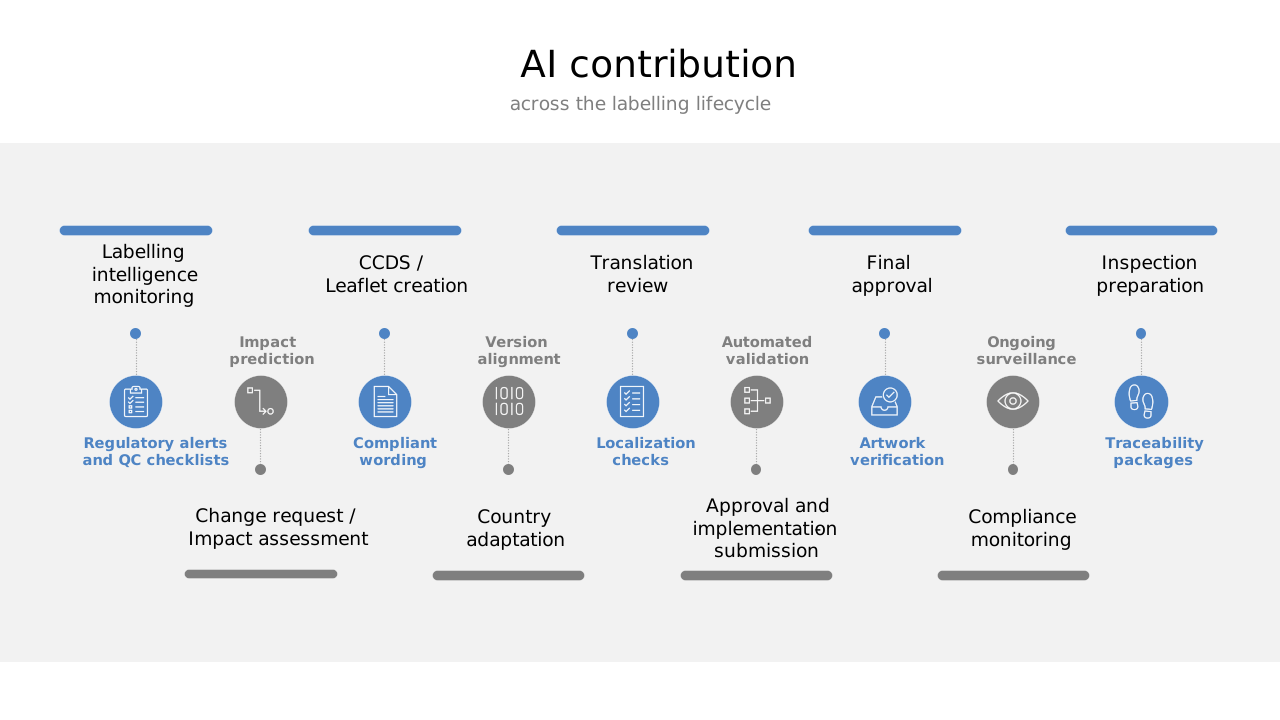
Select AI interventions across labelling lifecycle
Select AI interventions across labelling lifecycle
What are the business outcomes that AI enables when it drives labelling QC?
AI-enabled label QC can
- reduce manual review effort by an illustrative 40–70%, shortening QC cycle times increasing throughput and improving resource utilisation.
- enhance quality through higher first-time-right rates, fewer defects, deviations and review iterations.
- strengthen compliance through improved inspection readiness, reduced Health Authority Queries (HAQs), stronger compliance scores and timely label implementation.
Looking ahead
The future of pharma label QC lies in intelligent, risk-based, and continuously monitored quality systems. Such systems blend connected data, standardised content and AI-enabled review. With AI, real-time checks can be improved, automated comparisons are possible, error detection can become more proactive and human intervention is only for exceptional reviews. Expert oversight ensures regulatory judgement, accountability and governance. This future-ready model can improve patient safety, compliance, inspection readiness and operational resilience while delivering faster, more consistent labelling outcomes.