Industry
Healthcare

Patient-centered Care: Health and Wellness Redefined
Life Sciences

Patient-centered Care Models Taking Center Stage in Life Sciences
Research & Innovation
TCS Research

TCS Research: Inventing to build sustainable futures
Highlights
- Elite and competitive sports organisations should move beyond siloed athlete monitoring toward a more robust, intelligent and efficient converged digital twin approach that unifies musculoskeletal and cardiac intelligence into a single continuously learning performance decision system.
- By the ability to combine biomechanics, physiological response, AI, simulation, and sensor-driven insights, this convergent twin will enable more precise and data-backed decisions across training, recovery, injury prevention, endurance optimisation, and return-to-play.
- The strategic value lies not only in improved athlete outcomes—such as fewer injuries, safer load management, and more consistent peak performance—but also in creating a scalable model for data-driven governance, cross-functional collaboration, and long-term competitive advantage.
On this page
On this pageinpage
Introduction
With the widespread use and adoption of AI and ML-driven insights, performance optimisation and injury prevention of the elite and competitive athletics have entered a phase where marginal gains are limited not by training effort but by biological uncertainty—how far an athlete can safely push performance without triggering injury, overtraining, or cardiovascular risk.
Digital twin technology offers a novel paradigm shift in this journey. While musculoskeletal (MSK) digital twins are already globally demonstrating value in injury prevention, movement optimisation, and return‑to‑play decisions, their full potential in sport is unlocked when they are converged with a cardiac digital twin. Together, these twins form a closed‑loop, multi‑organ performance-intelligence system that allows coaches, sports physicians, and athletes to optimise performance within individualised physiological safety boundaries, rather than relying on population averages or reactive metrics.
The future of elite performance is not “train harder” or “train smarter” in isolation—it is train precisely, guided by a continuously learning digital replica of the athlete’s body.
How to go about whole-athlete performance optimisation?
Emerging research shows that athlete-specific digital twins can model energy use and performance more accurately than generalised approaches. Broader work also highlights their value in injury prevention, load management, and personalised decision support. The next critical step is convergence - linking musculoskeletal mechanics and cardiovascular respons, so that performance decisions can be optimised across the whole athlete rather than within separate systems. A more physiological converged digital twin allows a shift from retrospective monitoring to real-time predictive decision-making by demonstrating how changes in training load, movement patterns, rehabilitation course, or intensive competition demands are likely to affect both performance and risk before action is taken.
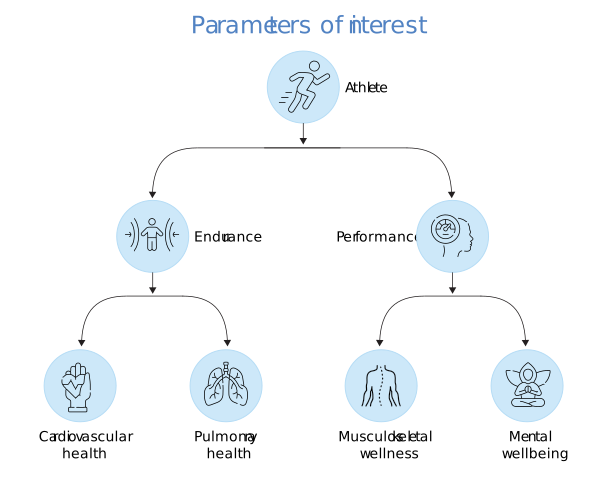
Figure 1
Factors that influence athlete endurance and performance
Figure 1
Digital twin technology changes how performance can be engineered.
It creates an adaptive, personalised virtual model of the athlete that continuously updates with real-world data.
This helps sports organisations:
- simulate likely outcomes;
- test interventions before they are applied;
- make better decisions before stress, fatigue, or injury becomes visible on the field.
This convergence of musculoskeletal (MSK) and cardiac digital twins is the very foundation for an intelligent, holistic performance and endurance intelligence platform—one capable of empowering coaches, clinicians, and performance leaders to make better decisions across training, recovery, and competition.
How does a convergent digital twin function?
Most athlete monitoring environments still operate in silos, with no solution that offers complete insights. Biomechanics and musculoskeletal analytics primarily focus on movement efficiency, tissue loading, and injury prevention. Cardiac and physiological analytics focus on cardiac endurance, cardiac fatigue, and recovery readiness. Each provides useful insight on its own, but neither fully explains how the whole athlete will respond to a specific training load, technical change, or competition demand.
- Biomechanics and musculoskeletal analytics focus on movement efficiency and injury prevention.
- Cardiac and physiological metrics focus on endurance, fatigue, and recovery.
The next frontier in high-performance sport is not another dashboard or a broader set of disconnected metrics. It is a continuously learning model that connects mechanical efficiency, tissue stress, haemodynamics, and cardiovascular adaptation. This provides teams with a stronger foundation for anticipating likely outcomes and taking proactive action before declines in performance, excessive workload, or injury become apparent.
- Individualised: Customised to the unique profile of each athlete rather than relying on population-based averages.
- Predictive: Designed to detect performance trends and risk indicators before they are visible.
- System-aware: Capable of managing adaptation across both biomechanical and physiological systems.
What are the advantages of a converged digital twin?
The MSK twin will define and identify movement strategies to maximise speed, power, and efficiency.The cardiac twin insights will define and help optimise the athlete’s real‑time cardiovascular capacity. Together, they will ensure performance gains remain within individualised physiological safety boundaries.
By virtue of its enormous potential, the twin will be able to simulate thousands of “what‑if” scenarios and can detect early signatures of tissue overload leading to injury risk and cardiovascular maladaptation—enabling early intervention weeks before an issue becomes clinically visible.
Personalisation allows training prescriptions to be tailored regularly based on predicted mechanical stress, fatigue accumulation, and recovery readiness—maximising adaptation while minimising recovery time.
In highly competitive and demanding sports environments, the twin can support the return‑to‑play decisions and competition pacing strategies. All of these will be supported by objective simulation of match demands, recovery windows, and reinjury risk, thereby reducing subjective judgment and uncertainty.
How can sports organisations take advantage of the convergent twin model?
For elite sports organisations, this translates directly into:
- Fewer injuries and shorter recovery times
- More consistent peak performance across seasons
- Longer athlete careers
- Higher return on investment in talent
Beyond performance, the convergent twin model strengthens sports medicine governance, improves collaboration between coaches and clinicians, and positions the organisation as a leader in data‑driven athlete care.
What are the strategic implications of a converged digital twin?
The impact should not be regarded as a point solution. The strategic opportunity for sports organisations is to build a scalable digital twin system that connects sensors, simulation, AI, biomechanics, and clinical workflows. It can be deployed incrementally—starting with injury prevention, rehabilitation, or high-value athlete cohorts—and expanded over time into a broader performance decision capability.
Conclusion
Elite sports performance and competitive edge are increasingly constrained not by talent or training intensity, but by biological risk, injury prevention, and uncertainty around individual limits. Marginal gains today depend on the ability to precisely balance performance optimisation and athlete safety—something traditional monitoring tools and population‑based models are not designed to achieve.
Converged cardiac and musculoskeletal digital twin technology is a critical enabler of this shift, empowering organisations to replace fragmented monitoring with individualised, physiology-based approach. Digital twins can model athlete performance more precisely than generic approaches, which will optimise training, recovery, and return-to-play outcomes. The future of elite performance is not “train harder” or “train smarter” in isolation—it is train precisely, guided by a continuously learning digital replica of the athlete’s body.