Industry
Life Sciences

Patient-centered Care Models Taking Center Stage in Life Sciences
Highlights
- Surgical robotics adoption is rapidly increasing worldwide.
- Widely adopted preventive maintenance is mostly time-scheduled, leading to unnecessary costs, part replacements, and costly downtime for hospitals. AI-driven predictive maintenance uses sensors and analytics to monitor the health of robotic systems and optimise maintenance timing, reducing downtime and costs.
- Incorporating predictive maintenance during the design phase can significantly improve the serviceability of future surgical robotic systems.
On this page
On this pageinpage
What are the root causes for surgical robot failures?
Surgical robots use complex electromechanical systems. Failures in surgical robotic systems can arise from multiple factors and are broadly categorised into three groups: software issues, hardware malfunctions, and system-level faults. Among these, hardware malfunctions account for most failures.
Unexpected hardware failure can result in erratic robot motion or a complete system shutdown during surgical procedures. Such incidents can create procedural delays and, in some cases, cause patient injury.
The occurrences of sudden hardware faults can be minimised by detecting degradation and potential failures in advance using AI-driven predictive maintenance. This can help prevent unexpected disruptions during surgical procedures, improve system reliability and ensure safer clinical outcomes.
How does AI help in failure forecasting?
Advanced surgical robotic systems commonly leverage embedded sensors such as accelerometers for critical functions, including motion planning and collision detection. Signals collected from acoustic sensors, temperature sensors, and electrical current monitoring—alongside accelerometer-derived vibration data—offer valuable insights into the condition and operational performance of internal electromechanical components. These multimodal sensor inputs capture early indicators of wear, misalignment, and degradation in moving parts of the robotic system.
Surgical robots’ internal sensor data, along with usage patterns and other contextual information such as environmental conditions can be used to recognise abnormalities and spot potential failures in advance with the help of AI-based predictive models. These AI models can be embedded in the robotic system and use built-in or virtual sensing infrastructure to predict failures, send real-time alerts to the operator through the robot console, and help make timely decisions for proactive maintenance. In legacy systems or situations where internal sensor data is not accessible or running an AI model is not possible with existing computational power, an alternate approach is to attach a compact external module equipped with all sensing capabilities, edge computing to run AI models and communication modes to send alerts to connected applications or cloud platforms. In this way, the older-generation surgical robots can also be enabled for predictive maintenance.
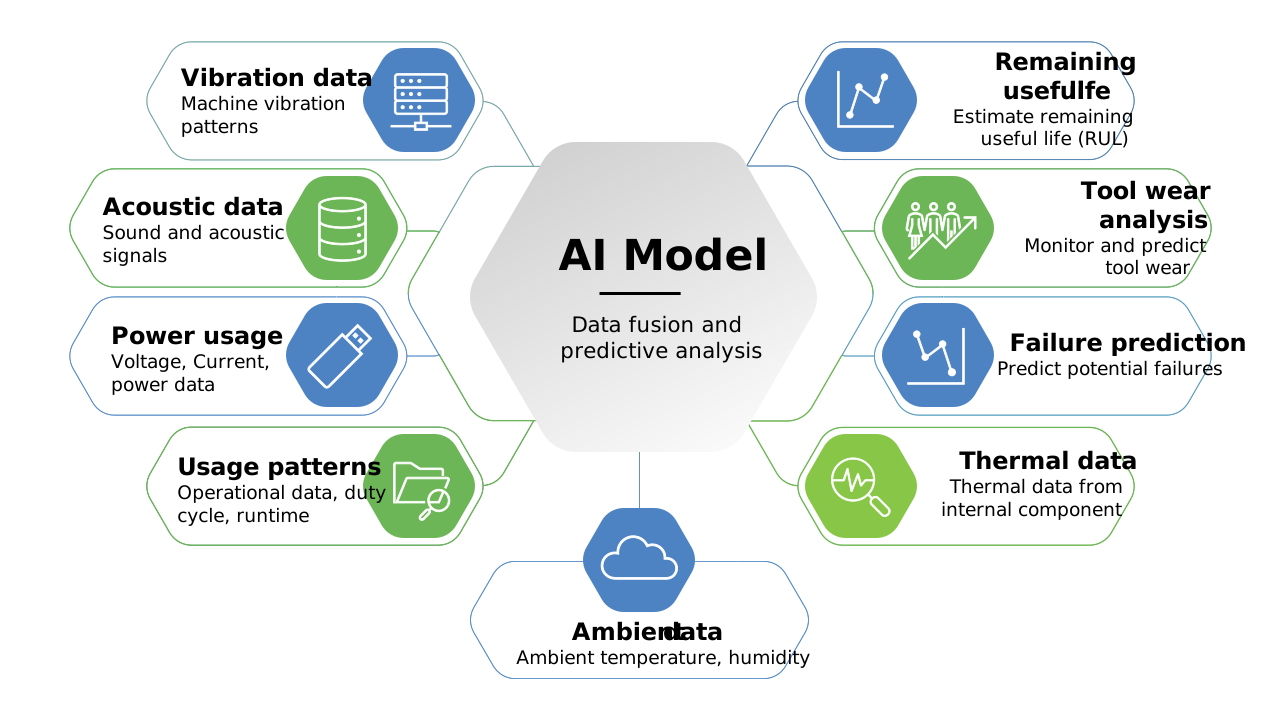
How AI model can enable predictive maintenance
How AI model can enable predictive maintenance
How does predictive maintenance enhance surgical robot serviceability?
Predictive maintenance fundamentally transforms the approach to design for serviceability by shifting it from reactive repair-oriented design to a proactive, data-driven architecture. Instead of simply enabling easier replacement of components after failure, designers are required to embed sensing, data acquisition, and diagnostic capabilities directly into the system at the design stage.
AI-driven predictive maintenance algorithms enable early detection of anomalies using sensor inputs such as vibration, acoustic, temperature and electrical parameters, allowing maintenance actions to be planned before failure occurs. This necessitates accessible layouts, modular designs, inclusion and placement of sensors and standardised interfaces. These enable support for quick interventions, based on alerts generated from predictive maintenance algorithm. Also, predictive maintenance requires the inclusion of intelligent diagnostics and communication pathways to the operator console or remote system access to ensure timely decision-making.
As a result, serviceability is no longer limited to ease of repair. It evolves into a system-level capability that encompasses continuous monitoring, rapid fault isolation, and minimal operational disruption, ultimately improving reliability, reducing downtime, and optimising maintenance costs.
How does predictive maintenance become a competitive advantage for surgical robot manufacturers and hospital chains?
By reducing unexpected system downtime, predictive maintenance enables hospitals to achieve significant cost and time savings while enhancing asset utilisation and avoiding unnecessary maintenance activities.
Surgical robot manufacturers can integrate sensing and predictive maintenance functionality into the design stage, enabling prediction of failure modes and enhancing overall serviceability. They can also benefit from an increased profit margin by reducing avoidable maintenance during the warranty period.
By proactively preventing failures, predictive maintenance increases MTBF (Mean Time Between Failure), improves system reliability, and strengthens customer trust in surgical robotic systems.
Conclusion
Surgical robotic systems are very complex and demand a high degree of criticality. This necessitates shifting from conventional preventive maintenance towards data driven more intelligent predictive maintenance. Predictive maintenance, enabled by continuous monitoring of sensor data and AI-driven analytics, can detect anomalies early and anticipate failure before it happens. Thus, predictive maintenance reduces downtime and unnecessary servicing.
If included in the design stage, predictive maintenance can greatly enhance the design for serviceability of a surgical robotic system by integrating intelligent diagnostics, targeted interventions, and faster recovery. By adopting integrated sensing capabilities, modular design principles and standardised interfaces during design stages, organisations can implement efficient maintenance strategies informed by predictive insights.
This convergence improves system reliability, operational efficiency, and optimises lifecycle costs and asset utilisation. Combining predictive maintenance with more serviceable designs create a foundation for next-generation surgical robots enabling a sustainable product lifecycle, improved performance and safer procedures in a healthcare environment.