TCS Manufacturing AI Vantage Framework
Navigating AI evolution. Realising enterprise autonomy.
Highlights
Manufacturing organisations need a new way to assess readiness for enterprise autonomy
Manufacturing organisations are rapidly moving beyond isolated AI initiatives toward enterprise-wide transformation. The challenge is no longer identifying where AI can create value, but determining:
As AI becomes increasingly embedded across manufacturing operations, readiness - not adoption - has become the defining factor for sustainable transformation.
Traditional AI maturity assessments provide valuable insight into current AI capabilities, but they offer limited guidance on organisational readiness, progression priorities, and the actions required to advance.
Manufacturers need more than a maturity score - they need a way to diagnose capability gaps, prioritise transformation opportunities, and establish a structured path toward progressively autonomous operations.
A unified blueprint for realising AI evolution across manufacturing
Purpose-built for the next generation of AI-enabled manufacturing, the framework provides a structured blueprint for assessing, governing, and progressively advancing AI across manufacturing enterprises. Rather than measuring AI maturity as a static point in time, it enables manufacturers to evolve AI capabilities while ensuring organisational preparedness keeps pace with increasing autonomy.
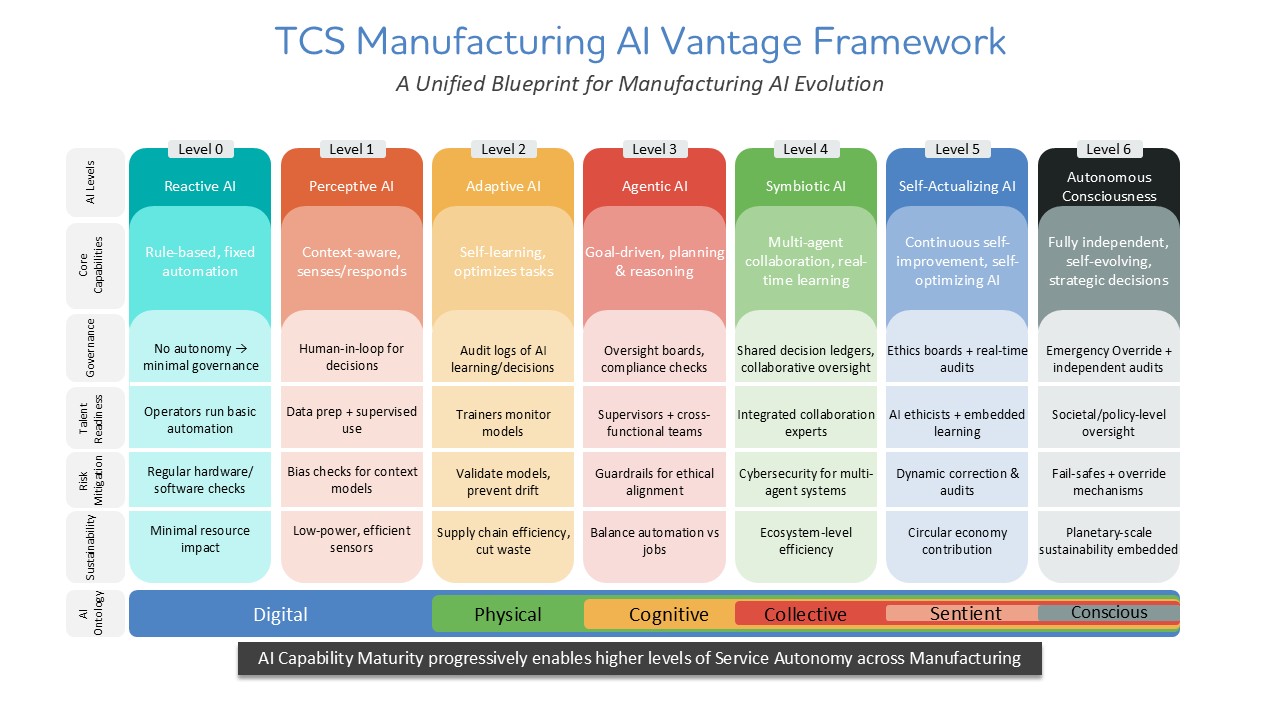
At its core is a seven-level AI capability progression model that maps the evolution of AI from Reactive AI to Autonomous Consciousness. The framework combines AI capability evolution with AI ontology and evidence-based progression across governance, risk, talent, and sustainability, creating a trusted progression framework for increasingly autonomous manufacturing operations (see Figure 1).
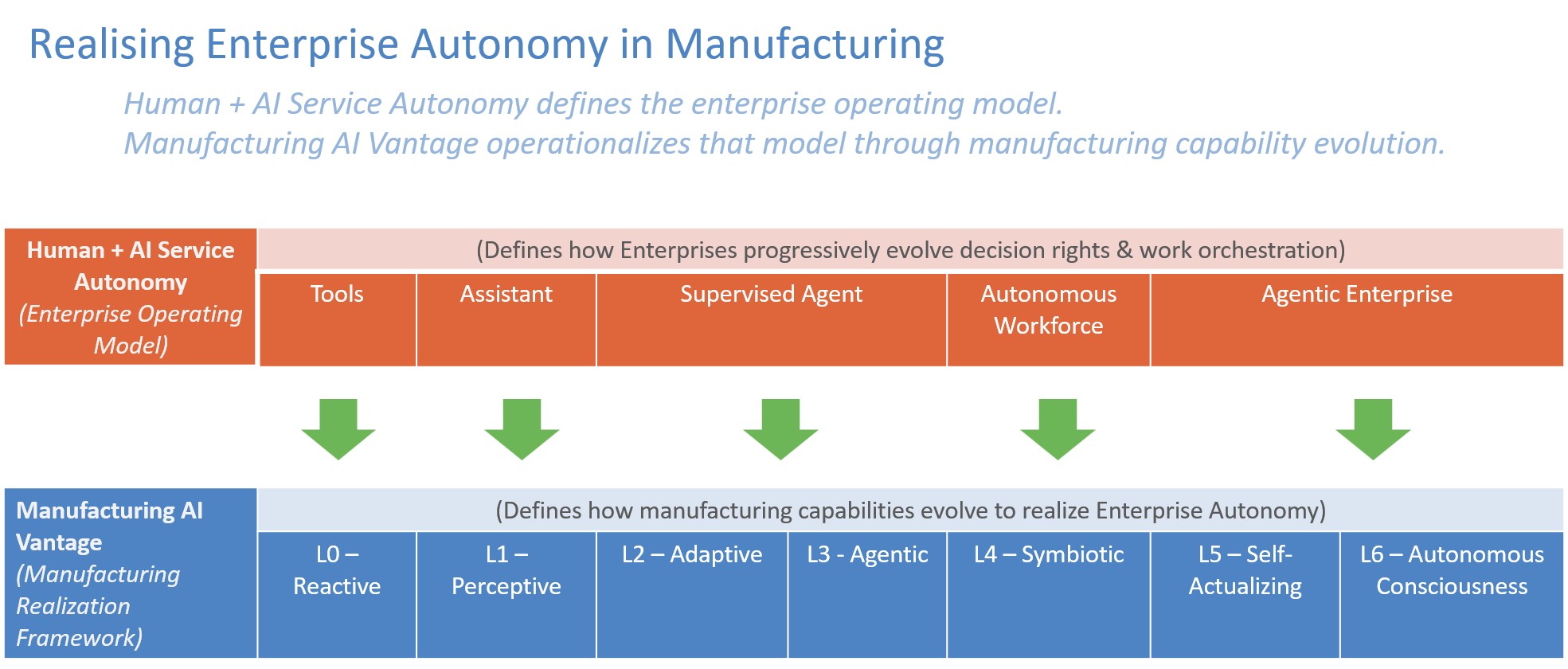
The framework complements TCS’ Human + AI Service Autonomy by defining how enterprise autonomy is realised in manufacturing. While Human + AI Service Autonomy defines how enterprises progressively evolve through increasing levels of human–AI collaboration and autonomy, Manufacturing AI Vantage enables manufacturers to assess, govern, and systematically advance that evolution across manufacturing operations (see Figure 2).
A structured approach to assessing readiness, prioritising transformation, and realising measurable business value
The framework transforms AI maturity from a descriptive assessment into an execution blueprint for enterprise-wide AI transformation. Rather than relying on static maturity scores or isolated benchmarks, it enables manufacturers to understand their current readiness, identify where AI should be prioritizsed, and establish a structured pathway for scaling AI with confidence.
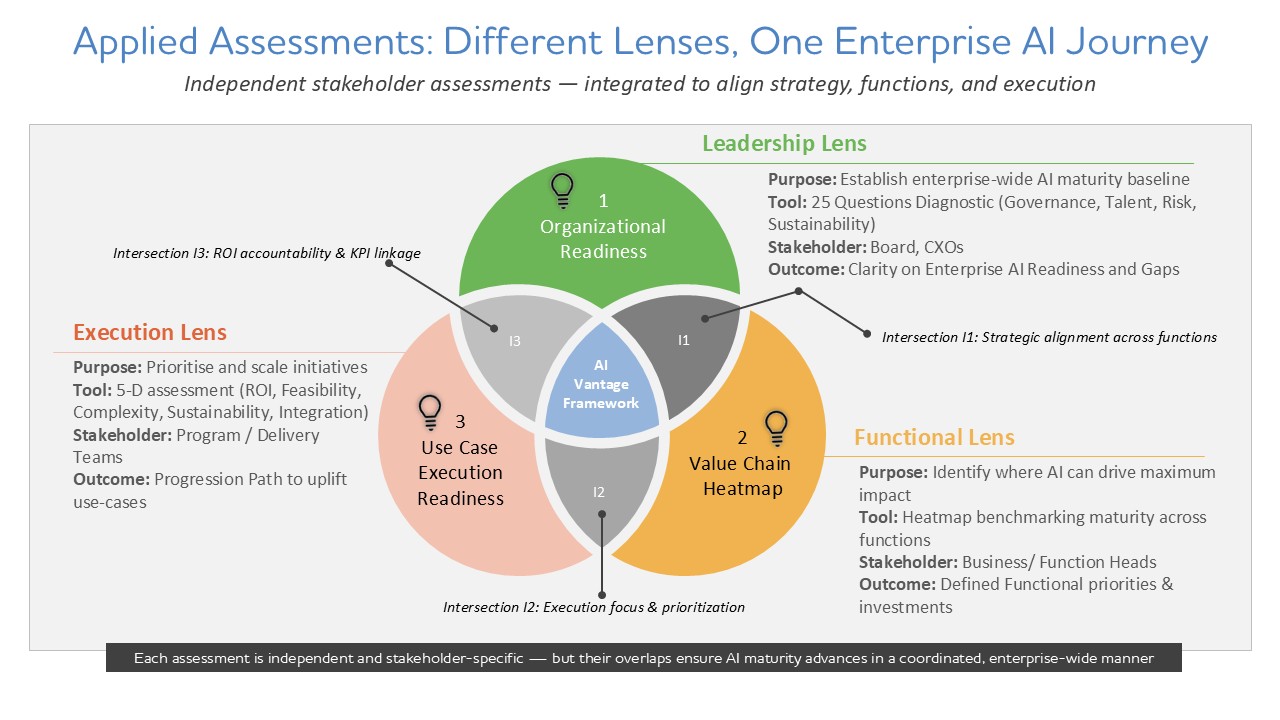
This is achieved through three integrated assessments: Organisational readiness, value chain heatmapping, and use case execution readiness. Together, they provide a connected view of enterprise preparedness, investment prioritisation, and execution confidence, enabling organisations to translate AI ambition into focused transformation initiatives (see Figure 3).
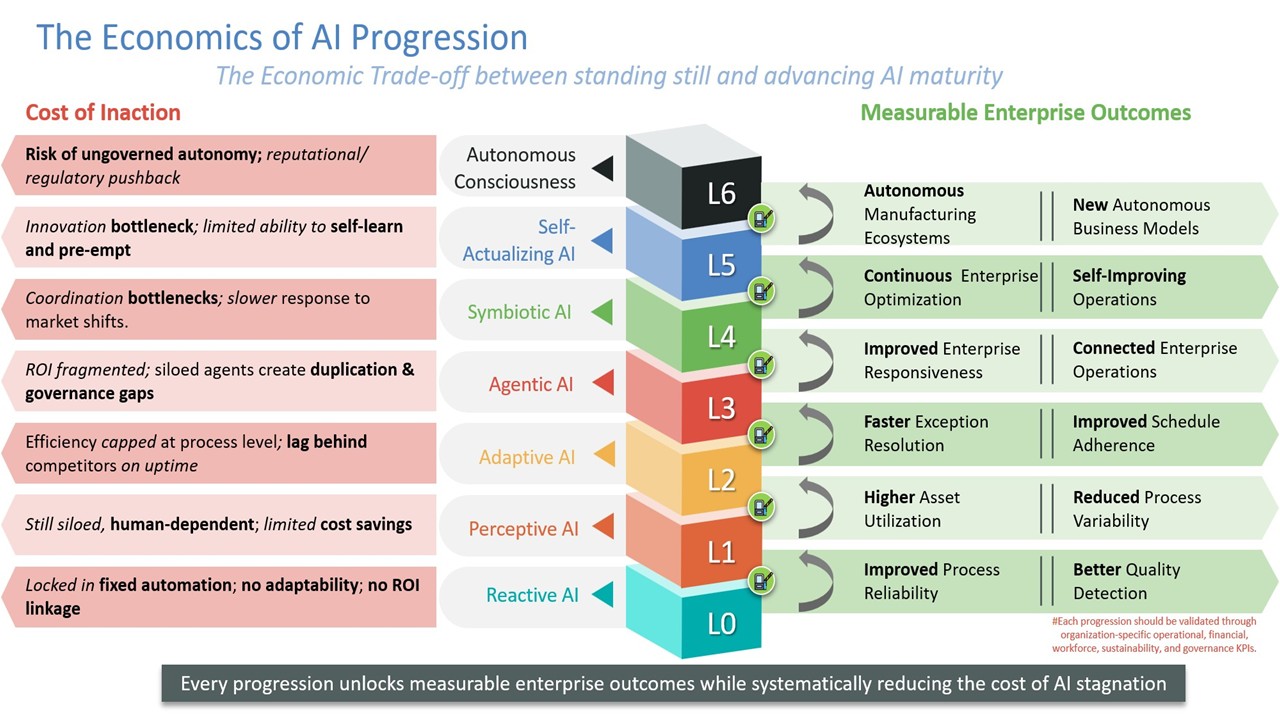
The outcome is a structured pathway toward measurable enterprise value – helping manufacturers make informed investment decisions, reduce transformation risk, strengthen organisational readiness, and scale AI responsibly while maintaining governance, talent readiness, sustainability and operational control. (see Figure 4).
Purpose-built to govern, realise, and scale the next generation of manufacturing AI
The TCS Manufacturing AI Vantage Framework goes beyond conventional AI maturity models by combining AI capability evolution with evidence-based progression into a unified manufacturing realisation framework. It enables manufacturers not only to assess AI maturity, but also to govern AI responsibly, prioritise transformation, and systematically realise enterprise autonomy.
What sets the TCS Manufacturing AI Vantage Framework apart?
The result is a future-ready manufacturing framework that enables manufacturers to assess with confidence, prioritise with clarity, govern with responsibility, and progressively realise enterprise autonomy with measurable business value.