Industry
Manufacturing

Future-Ready Manufacturing: Partnering in your journey to a sustainable manufacturing enterprise
Services
Consulting

TCS Consulting Services to Achieve Success in the Digital Era
Highlights
- There is a fundamental shift in automotive customer expectations – from vehicle ownership, to experience, value, and outcomes – mostly enabled by technology, including a rising demand for seamless omni-channel experiences, personalisation, and value across the customer lifecycle.
- The emergence of connected, value-centric, and end-to-end journeys across marketing, sales, delivery, ownership, service, connected experiences, and loyalty requires organisational transformation.
- AI is rapidly transforming the way we engage with customers and enabling predictive, personalised, orchestrated journeys at scale.
- AI investment should now expand to enable strategic transformation across the entire customer lifecycle – the total sum opportunity of AI-enhanced customer experience is more than the sum of its individual use case parts.
On this page
Introduction
Customer AI is the key to unlocking the next era of automotive competitiveness.
The automotive industry stands at a pivotal moment, with software-defined vehicles, connected ecosystems, new mobility models, and emerging technologies – especially AI – reshaping customer experience.
While digital and AI transformation has gradually been taking place upstream in factories and supply chains, the real opportunity now lies downstream, where customer AI enables hyper-personalised, anticipatory experiences at speed. As customer expectations evolve toward seamless, digital-first, personalised, and value-driven experiences, customer obsession is emerging as a strategic lever.
OEMs that invest in transforming the “in-car” experience and integrating it into everyday lifestyles will future-proof their business, while those who fail to adopt customer AI risk losing ground to more agile competitors.
Evolving customer experience expectations.
AI is reshaping the omni-experience era, empowering customers and redefining how OEMs deliver value across the entire vehicle lifecycle.
AI has become a catalyst in enabling seamless, connected omni-experiences that customers now expect, and it is the driver for advancing organisational customer-centricity at scale.
Customers can now choose, configure, and purchase a vehicle instantly anytime, anywhere, with unprecedented levels of personalisation. Post purchase, AI-enabled interactions allow OEMs to nurture ownership journeys, ensuring drivers unlock full value from their vehicle while realising their lifestyle ambitions and day-to-day goals.
OEMs have already achieved varying levels of success, moving beyond proof-of-concept to proof-of-value through AI and IoT investments. ADAS and SOS alert systems have become standard, while capabilities such as anticipating service requirements through live vehicle diagnostics, and leveraging shared OEM-retailer data models are now gaining momentum.
Key enablers |
Definition |
Customer expectation |
Value-centric journeys |
Shifting from transactions to enabling experiences and value. |
Enabling end-to-end journey design with focus on value delivered to customer and business outcomes. |
Connected omni-experience |
Moving from multi-channel to omni-channel to omni-experience. |
Customers now expect to interact seamlessly through any kind of touchpoint, across OEMs and retailers. |
Personalised experiences |
Human-digital-AI interactions, correctly balanced, to deliver integrated lifestyle-based experiences. |
Customers expect highly personalised vehicle experiences and services that are connected to and go beyond the core ‘transportation’ purpose of a vehicle. |
Memorable experiences |
Creating special experiences that exceed expectations, build brand equity and drive advocacy. |
Customers who remember remarkable experiences in, or connected to, their vehicle will recommend the brand to others. |
Anticipated experiences |
Enabling predictable future experiences, proactive offers and service actions. |
Anticipate customer needs, intent, unexpected events and next best actions to optimise experiences in real-time and augment the continuous learning model. |
Augmented product experiences |
Placing an emphasis on digitally enabled product-related customer experiences. |
Customers expect more from their vehicle in terms of infotainment and comfort, where seamless digital integration with mobile and other devices is a minimum expectation. |
As bandwidth grows and platforms mature, the market is rapidly shifting toward scalable, more immersive connected experiences, driven by an increasing number of connected vehicles on the road.
Strategies to transform customer experiences.
AI has shifted from a promising option to an essential engine of end-to-end transformation for the automotive industry.
Automotive manufacturers have already demonstrated tangible business value from AI through multiple high-impact use cases. As a result, many are now developing strategies that evaluate end-to-end opportunities and prioritise where AI can deliver the greatest enterprise-wide outcomes.
AI adoption is no longer optional; the present-day challenge lies in scaling it beyond pilot phases into more strategic transformation across the customer lifecycle, while maintaining a balance between market and organisational constraints.
With the right AI strategies and necessary investments in people, processes and technology, automotive manufacturers and retailers can deliver superior customer experiences, especially in the in-vehicle product experience, which helps them remain resilient against existing and future headwinds.
Case for change |
Current State |
Future opportunity |
Customer AI offers a new way to accelerate the business towards a competitive end-to-end seamless customer experience. |
Customers touchpoints span OEMs, dealers, Tier 1 mobility partners, and platforms, creating inconsistent experiences. Customers expect seamless, real-time experiences similar to digital native industries. |
Automotive manufacturers and retailers should consider moving beyond use cases to deliver an end-to-end AI-driven experience strategy: Identify all customer experience AI use cases along the journey, with the required processes, capabilities and technologies, to deliver an end-to-end experience that is context-aware. |
Repurchase rates and loyalty overall are not as high as they could be.
|
Sales and marketing investment is typically more heavily focused on the buying experience rather than on the product experience and services underpinning it. |
Refocus on mid-life product experience excellence. Enabling value realisation in the product experience will increase the likelihood of repurchase. |
Customer-focused value creation across the journey isn’t fully realised. |
Current focus is on vehicle performance, features, and price. Customer journeys are often siloed and have limited visibility/connection with the end-to-end customer lifecycle and lifetime value. |
Design journeys focussed on value delivery that generate the greatest impact end-to-end, leveraging AI to drive personalisation at scale; consider customer obsession as a growth differentiator. |
AI investment fund models are rarely prioritised on customer journeys with greatest long-term customer growth impact. |
Funding models are often limited to specific projects – misalignment of scope boundaries can result in unintended gaps in realising the total customer value management opportunity. Projects tend to identify with specific experience outcomes within a journey and may only have incremental impact. |
Put customer lifetime value (CLV) and repurchase at the heart of the funding-decision model. CLV/repurchase rate weighted prioritisation can be applied to portfolio roadmaps so that funding can be used to promote initiatives that enable improved customer experiences. |
Build on AI use case successes using Agile to capture the greater value opportunity of the total customer experience. |
Typically, deployments of AI solutions have been project-led rather than taking Agile approaches that allow for continuous innovation and adaptation. |
Build a new Agile AI transformation model and AI expertise: Redraw, invest in and reprioritise new AI skills, capabilities, processes, system and data requirements that AI solutions demand. |
Likewise, here are some scenarios where once the decision on which AI value-centric opportunities to invest in has been made, organisations are challenged in how to implement AI transformation and develop a more data-led culture.
Case for change |
Current state |
Future opportunity |
Business leaders who effectively articulate the organisational value of AI can enable employees to adopt AI as a positive augmentation to existing ways of working.
|
Employees who don’t trust the reliability or appreciate the potential opportunities that AI offers, may fear the consequences of change personally or collectively. Fear-based reluctance to change can manifest itself as a lack of commitment to new practices or an inability to let go of the expertise and assets that they have previously built their success upon. |
Make employees part of the journey of AI transformation. Trust can be built with employees, by keeping them well informed while enabling opportunities to learn about wider community, organisational and personal benefits of the change. Effective leadership communications can help employees feel in control of their work in a world where they know how to partner with AI agents to accomplish their tasks and influence others.
|
AI model outputs are only as good as their inputs and therefore, managing data to standards that make it available, usable and understandable are becoming increasingly important.
|
Vehicle manufacturers and their retailer network partners are limited in what structured and unstructured data they share. Data needs to be more readily available, understandable and usable to build in context of the customer situation as an enabler for AI models to ‘predict’ with accuracy. |
Focus on developing data foundations and expertise in leveraging data, especially unstructured data. An increasing number of customer AI use cases are leveraging unstructured data and dialogue in the form of agentic AI in order to customise experience and drive outcomes e.g. highly personalised marketing offers where the offer is in part being designed by the customer through conversations.
|
There needs to be a digital experience design that threads across customer journeys to drive connected and personalised experiences. |
Datasets are often siloed – if combined they could deliver richer insights and enable end-to-end customer experience improvement. |
Design digital and platform ecosystems which are API-led, composable and are enablers of seamless integration across OEMs, dealers, suppliers, and service partners (that coordinates with human-led experiences). |
Real-time actionable insights and decision-making. |
Insight teams have been reliant on backward-looking customer experience measurement methodologies, tools and systems e.g. the use of sample-based surveys are rapidly becoming outdated and not adding the value that can be gleaned from AI-powered insights. |
Implement customer AI analytics to provide predictive actionable insights for every customer. Retire high-cost, low value reactive surveys and start to leverage the combination of in-house data with LLMs. |
Once these challenges are addressed through structured strategies, they become an integral part of the broader AI transformation model and roadmap, as discussed in the following section.
Transformation: Product experience excellence with AI.
Automotive manufacturers need to incorporate today’s customer expectations and those of future generations into the transformation cycle, enabled by new AI expertise and technologies.
A product experience-led Agile approach increases transformation success, where teams collaborate and incrementally deliver on transformation outcomes; A fast and responsive planning approach embedded into the way teams collaborate and deliver, with continuous ability to learn and adapt, is critical for teams to continuously add value to product-led experiences and keep pace with today’s competitive environment.
The assumption is that Agile Teams start with, build and train the internal model (MVP) before adding new and latest capabilities to leverage external data and scale to incorporate broader context.
Overall, the model (see figure 1) needs to encompass a product experience transformation led approach with a Customer Experience (the left-hand loop)
Product experience excellence led organisations maximise value from incremental product development with a focus on customer experience demands, evolving lifestyles, and looking at the end-to-end customer relationship. This drives the AI Transformation part of the model (right-hand loop).
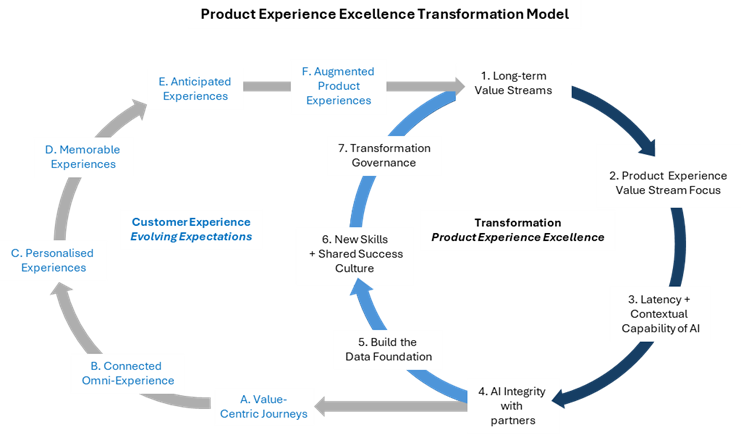
From product excellence to customer obsession
From product excellence to customer obsession
The future automotive customer experience.
Generation Alpha is growing up co-creating in real time with AI, and this will push the automotive industry to deliver hyper personalised, interactive, AI-driven vehicle experiences as the new norm.
The next generation of vehicle owners expect an unprecedented level of personalisation, both in how their vehicles look and in how they enhance their lifestyles. For them, a vehicle will be far more than transportation from A to B; it will be a platform that supports broader life goals and/or day-to-day needs.
Customers increasingly expect their devices to interact seamlessly with their vehicle’s computer, just as they do with in-home devices or public networks. AI agents will assist with real-time queries and automate tasks across a customer’s wider lifestyle ecosystem, such as reserving parking for a shopping trip or re-booking a holiday effortlessly.
To meet these expectations, automotive manufacturers must invest in technologies that enable deeply integrated life experiences.
This includes:
- Real-time agent response and proactive servicing.
- Multi-device connectivity in a mobile-first world.
- Advanced in-car computer architecture capable of supporting a robust software and social platforms.
- Higher levels of bandwidth to generate richer, more personalised content and recommendations.
- Enabling connected and value-centric customer journeys through integration of AI, data, digital platforms and ecosystems to orchestrate consistent, connected and continuous experiences, while enabling the shift from traditional ownership.
As we move further into the 21st century, subtle but impactful shifts in customer values demand that OEMs continually align technology investments with evolving customer expectations.