Industry
Retail

Omnichannel CX and Intelligent Innovation – The Future of Retail
HIGHLIGHTS
- The rapid evolution of supply chain complexity, rising customer expectations, and persistent labour shortages are placing unprecedented pressure on warehouse and data centre operations for retailers.
- Agentic AI transforms warehouses from static, rule-driven execution environments into autonomous, self-optimising ecosystems.
- Retailers who adopt agentic AI early in their supply chain are likely to gain a competitive advantage through faster fulfillment, optimised productivity, and lower operational costs.
On this page
On this pageinpage
Why is agentic AI important for retail warehouse operations?
Traditional automation and rule-based systems, while effective in structured environments, often fall short in dynamic, real-world scenarios.
Given the growing demand for fulfilment, retailers need to ensure that modern warehouses/distribution centres are capable of operating with better speed, efficiency, and intelligence. According to some industry estimates, by 2030about 50% of cross-functional supply chain management solutions will use intelligent agents to autonomously execute decisions within the ecosystem. This makes agentic intervention a critical investment to ensure resilient and scalable warehouse operations for retailers. However, most organisations are still operating in siloed processes with fragmented systems, reactive decision-making, and static workflows. Given fulfilment is directly associated with customer satisfaction, an autonomous warehouse execution system offers strategic advantages for modern retail. The organisations can drive speed, productivity, and growth by combining planning and physical execution in distribution centres that require specialised equipment for product handling.
A modern automated warehouse synchronises warehouse operations between three critical systems - warehouse management system (WMS), warehouse execution system (WES), and warehouse control system (WCS). With increasing warehouse automation and the use of robots, introducing agentic AI will enhance the warehouse execution system into a real-time decision-making layer. It can help orchestrate workflows, dynamically optimise labour, increase efficiency, and ensure seamless automation that adapts execution to changing demands.
How does an agentic warehouse execution system work?
Agentic WES represents a paradigm shift from static, rule-based execution toward autonomous, multi-agent orchestration of warehouse or data centre operations.
Traditional warehouse operations rely heavily on manual interventions and predefined workflows, leading to inefficiencies such as scheduling conflicts, congestion, and delayed exception handling. Agentic WES transforms this model from static execution to an autonomous decision-making model. It leverages a learning loop of continuous Perception (Sense) →Reflection (Decide) → Action (Act) ecosystem, where specialised agents operate autonomously using real-time enterprise data, IoT signals, and system integrations. This shift introduces a multi-agent decisioning layer that continuously optimises operational flows and removes friction points across warehouse processes. The agents in this layer are capable of perceiving their environment, reasoning about objectives, and taking autonomous actions to achieve defined goals.
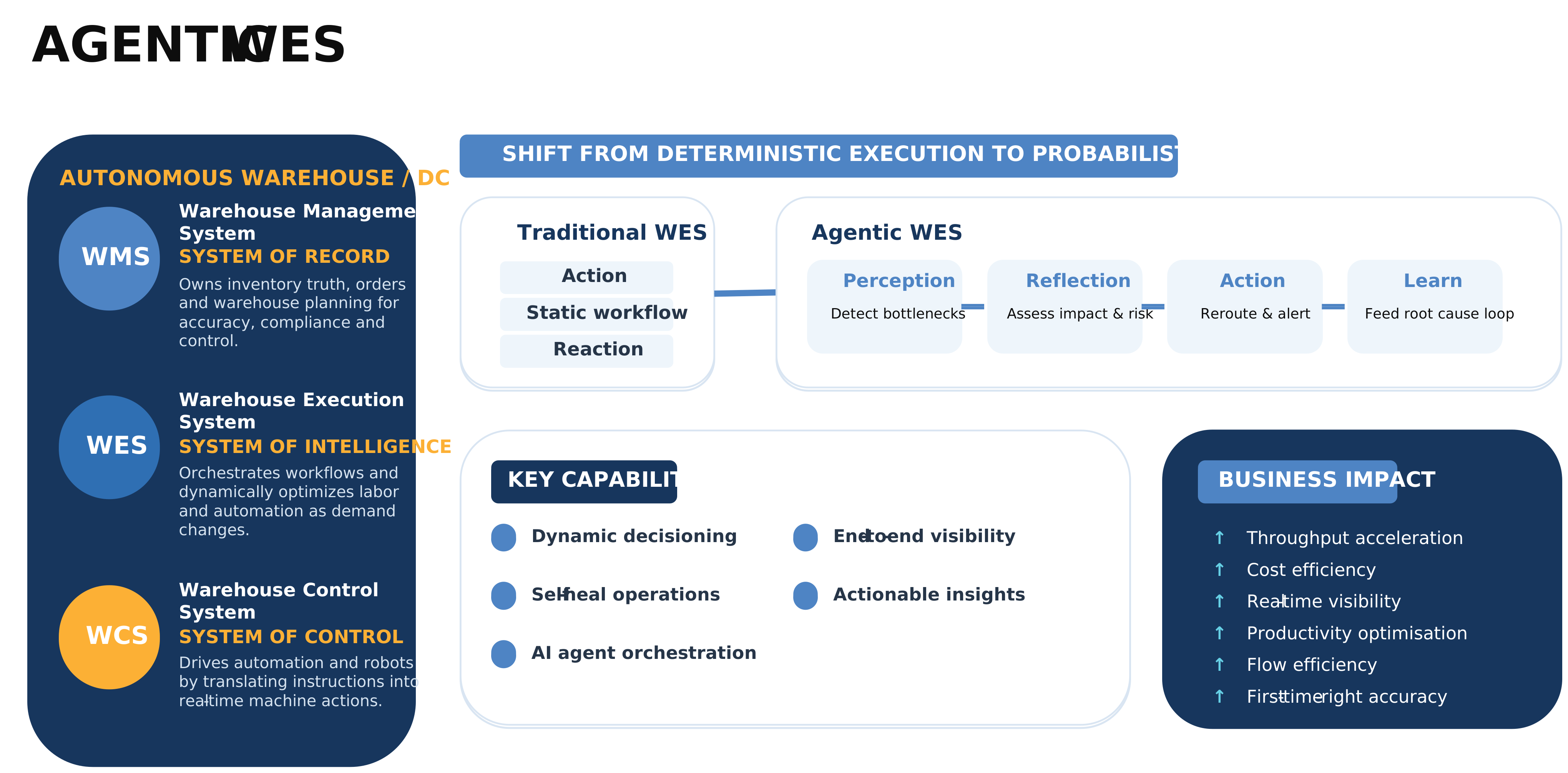
Figure 1
Agentic WES
Figure 1
By embedding intelligence across warehouse processes, agentic WES enables organisations with real-time decisioning, optimising resource utilisation, and significantly enhancing operational performance. As industries continue to evolve toward omnichannel and high-velocity fulfilment models, Agentic WES will be a critical enabler for organisations seeking a competitive advantage through autonomous, AI-driven supply chain and warehouse operations.
What are the four types of AI agents in warehouse operations?
The right type of Agentic AI intervention determines whether a warehouse becomes a true autonomous operating model or simply a collection of disconnected bots.
Warehouse decisions are not made by roles or isolated tasks, but are driven by constantly changing business goals, resource constraints, order priorities, congestion levels, labour availability, equipment status, and service commitments. Therefore, agentic interventions should be based on multiple parameters that reflect operational decision flow, not just human roles or individual tasks. The recommended model to identify agents can be based on a four-tier classification separating capabilities such as decision-making, execution, resources, and intelligence services:
Agents that focus on business outcomes rather than activities. They are responsible for throughput optimisation, service-level protection, order prioritisation, cross-node flow balancing and exception coordination.
Agents that own specific execution domains. They are responsible for executing domain-specific decisions, coordinating activities within a process area, and continuously adapting execution plans.
Agents that reflect the digital representation of operational assets. They are responsible for monitoring capacity, reporting availability, negotiating work allocation and representing local constraints.
These are reusable cognitive services consumed by all other agents. They are responsible for providing advanced reasoning, enabling forecasting and optimisation, and delivering recommendations to other agents.
The four-tier model produces several strategic benefits. New agents can be added without redesigning the entire architecture, the warehouse can start with advisory agents and progressively automate, multi-agent collaboration enables self-healing operations, and shared skills are leveraged across warehouse functions.
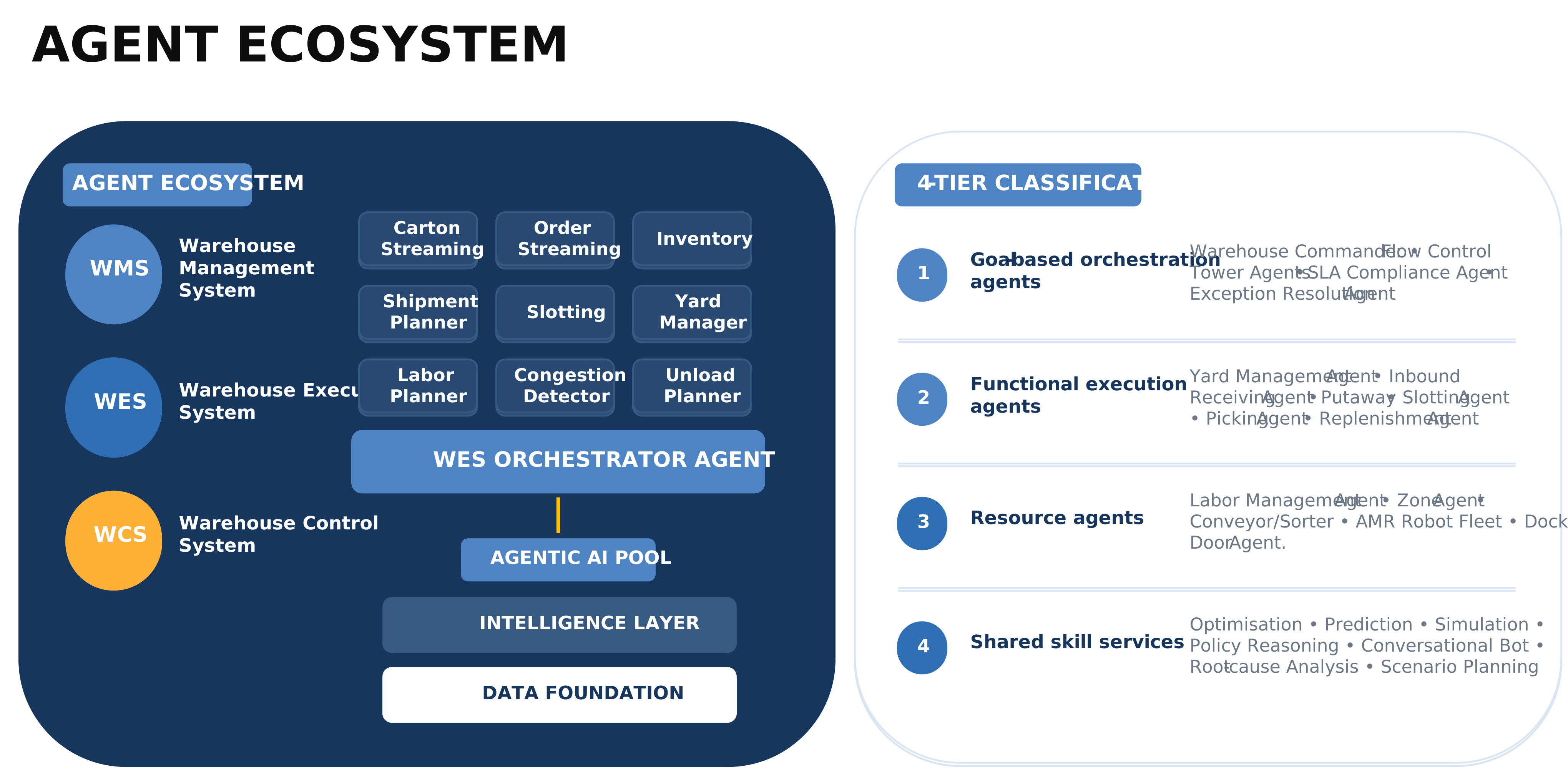
Figure 2
4-tier classification in Ecosystem
Figure 2
What are the core layers of an agentic AI ecosystem?
The success of agentic AI in warehouses will be determined by how effectively the agent ecosystem is structured.
Depending on the requirement, one or multiple agents can be identified to be deployed to a suitable warehouse and data centre processes. In case of multiple agents, the focus shifts to establishing a relevant ecosystem consisting of a data foundation, an intelligence layer and agents.
- Data foundation: Instead of data being fragmented, it is collated through data ingestion and synthesis, where it is cleaned, contextualised, and structured into a format that agents can leverage.
- Intelligence Layer: The layer built on this combines predictive, generative, and cognitive AI, enabling reasoning, reporting, while providing insights and actively supporting decision-making. The decisions are no longer made within individual systems. Instead, they are contextualised using signals from across the enterprise.
- Agentic AI Pool: The intelligence is then consumed by a set of specialised, goal-driven agents within the agentic WES layer. In addition, each of these agents focuses on a specific operational domain.
The agents are not static rule engines; they are continuously sensing what is happening in real time, retrieving the right context, and making localised decisions to optimise outcomes. All of this is coordinated by the Agentic WES orchestrator, which acts as the control tower. It ensures that all these agents work in harmony, aligning their decisions to broader business goals like throughput, efficiency, and flow optimisation, while dynamically adjusting priorities as conditions change. Finally, those decisions are executed back into the operational systems, and importantly, the outcomes are fed back into the system. This creates a continuous learning loop, where the system gets smarter over time and becomes more adaptive to variability and disruptions.
How can retailers evaluate agentic AI use cases for warehouses?
A well-defined approach can help retailers initiate the journey from understanding the business to building an executable transformation roadmap.
Our approach has been designed to prevent organisations from moving directly to AI implementation without the necessary checks. It requires validating business value, operational readiness, and feasibility before getting to implementation. This ensures the discovery of value in data availability, process maturity, existing digital capabilities, system integration maturity, and governance structures in three key phases.
- Capture: At this stage, the objective is not to discuss technology but to understand how the supply chain or warehouse operates today. Through stakeholder interviews, warehouse visits, process observations, operational data reviews, and maturity assessments, the organisation establishes a clear understanding of current challenges and strategic priorities. The goal is to understand where operational friction exists and assess the organisation's readiness for AI adoption.
- Analyse: Potential use cases are systematically identified to create a comprehensive backlog of business problems that could potentially be addressed using AI and agentic capabilities. Each use case is evaluated across multiple dimensions based on an evaluation matrix, which explicitly balances the value and complexity of the use cases. The final activity in this phase is prioritising and mapping the opportunities that can deliver meaningful business outcomes within existing organisational constraints. Define: Insights are converted into a transformation blueprint with expected benefits, risks, dependencies, and implementation considerations. Simultaneously, an AI roadmap highlights initiatives into short-term pilots, medium-term scale-up opportunities, and long-term autonomous transformation objectives. The resulting roadmap provides a structured path from experimentation to enterprise-scale agentic operations.
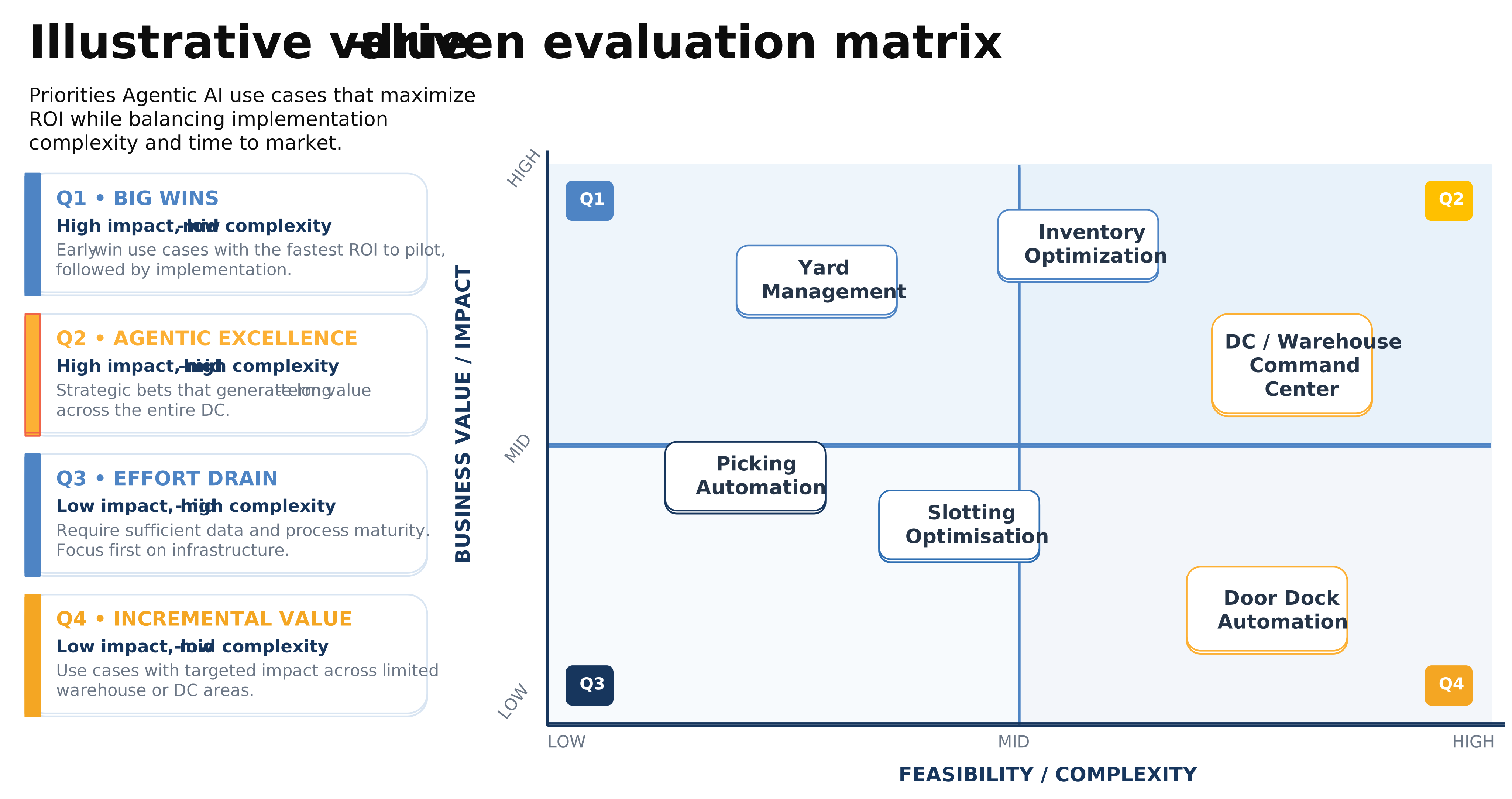
Figure 3
Evaluation Matrix
Figure 3
The value-driven evaluation matrix is a mapping of use cases based on a profiling framework that categorises opportunities into four implementation horizons. This framework recognises that not every AI or agentic use case should be pursued at the same pace; instead prioritise based on the maximum benefit obtained, considering complexity and time to market.
How will agentic AI shape the future of retail warehouses?
A future warehouse is not simply a supply chain entity with more robots or more AI models. It is an autonomous, self-orchestrating operational ecosystem.
The warehouse, in an autonomous distribution centre for retailers, behaves more like a coordinated ecosystem than a collection of systems. In this set-up, multiple specialised agents continuously sense, reason, collaborate, and act in real time. This consolidated effort translates into meeting business objectives such as throughput, service levels, cost efficiency, inventory accuracy, and flow optimisation.
Going forward, agentic AI is slated to become the backbone for the next-generation warehouse operations. As these systems evolve, we expect a deeper integration with supply chain networks, enabling end-to-end autonomous logistics. The advances in multimodal AI, edge computing, and digital twins will further enhance agentic capabilities. At the same time, human roles will evolve toward oversight, strategy, and exception management, with agentic AI handling execution and optimisation.
That means investing in agentic AI is a strategic imperative for retailers seeking to remain competitive in an increasingly complex, and fast-paced market. The transformation of warehouse operations through agentic AI will redefine efficiency, resilience, and scalability, setting a new standard for the future of supply chain excellence.