Industry
Travel and Logistics

Data and AI in Travel Industry for a Memorable Passenger Experience
Highlights
- Aircraft turnaround management is a major focus area for transformation with artificial intelligence (AI).
- AI will become effective and be part of the decision system when it gets validation from business domain experts.
- Without business domain experts at the core, AI systems risks being detached from realities and the nuances of day-to-day operational requirements.
- By leveraging business domain knowledge, AI can separate true operational issues from noise, ensuring faster and more reliable aircraft turnarounds.
On this page
On this pageinpage
Introduction
The artificial intelligence (AI) revolution is gathering steam at an unprecedented pace.
AI systems are quite powerful. However, for maximum benefits, travel and logistics organisations must embed domain intelligence into impactful AI systems.
AI is efficient in processing data, but without domain expertise at the core, it risks being detached from the realities and nuances of business requirements, operations, and even human needs such as operational safety while, for instance, working near an aircraft.
One of the focus areas for transformation with AI is aircraft turnaround management. Aircraft turnaround is a precision, time-bound operation where multiple stakeholders must work in perfect synchrony to ensure the flights are on-time. Limited real-time visibility on turnaround progress across teams poses a challenge to both airlines and airports to achieve on-time departures. A 15-minute delay on the first leg of a tail’s rotation can snowball into a 60-minute delay by the final flight of the day. Inefficient turn not only causes delays but also impacts on-time performance (OTP), reducing customer satisfaction and resulting in significant financial losses.
Airlines and airports are increasingly piloting AI-embedded computer vision-based turnaround monitoring. While these AI systems are efficient, for maximum benefits, business domain intelligence must be embedded to move from being a monitoring tool to a robust AI-powered decision system. Without business domain expertise at the core, these AI systems risks being detached from the realities and the nuances of day-to-day operational requirements.
Aircraft turnaround management
Aircraft turnaround is one of the most complex and highly orchestrated processes of preparing an aircraft for its next flight after landing.
It is a time-critical operation where every minute impacts airline efficiency, costs, and passenger experience (see Figure 1).
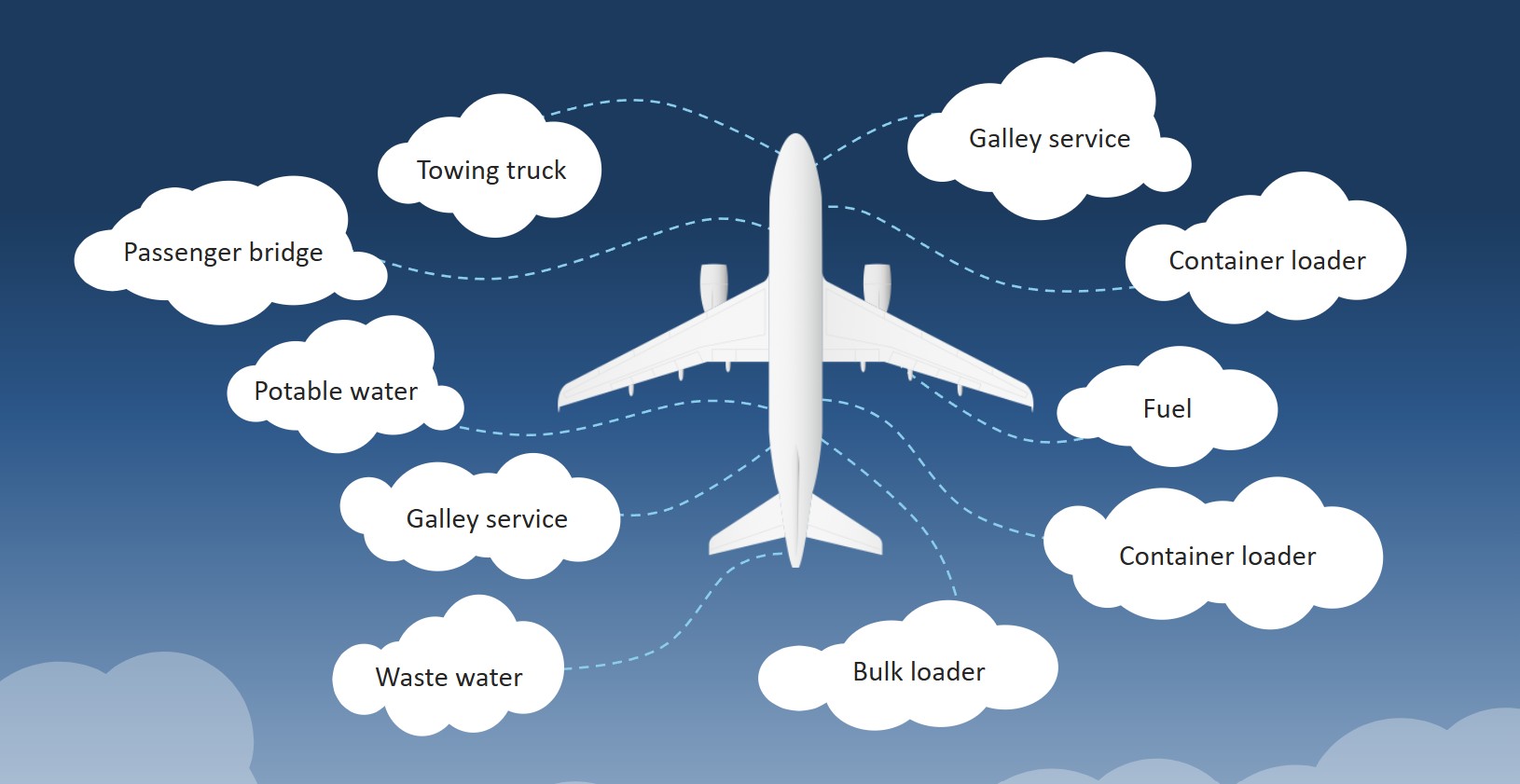
Figure 1
Aircraft turnaround management
Figure 1
At most airports, this process remains a black box where the stakeholders involved do not get a connected view of operations. With AI-image-based processing, coupled with machine learning, these turnaround processes are now being captured in real-time, stitched together for integrated operational visibility and, finally, optimised to improve operational efficiency, passenger experience, and on-time performance. Many airlines and airports have been adopting this approach for improved aircraft turnaround process and to minimise delays.
To design the best-in-class AI turnaround management system, gathering turnaround data alone will not be sufficient. An AI model, for instance, trained on thousands of historical images of aircraft surface dents or cracks labelled as ‘damaged’ or ‘not damaged’, may recommend an aircraft change due to a ‘damage’ on the aircraft body. But, ground engineers, on inspection, may find that to be nothing but sun’s reflection from the metallic surface. This highlights that for AI to be efficient, it needs validation from business domain experts, otherwise it risks giving false positives.
Organisations must utilise the real multiplier—business domain expertise—at every step of the AI journey because it bridges the gap between technical capability and real-world applicability, ensuring that the turnaround AI system delivers outcomes that are not only accurate but also relevant.
Solutions and benefits
In aircraft turnaround management, domain intelligence cannot be treated as a last-mile validator that only confirms AI outputs.
If used that way, it reduces AI to a technical system with limited operational value. The right approach is to embed domain expertise across the entire AI lifecycle–from framing value-oriented turnaround use cases, identifying and preparing operational data, guiding model design, and monitoring for drift, to continuous improvement. Only then can AI move beyond abstract analytics to deliver actionable insights that bring in operational visibility, improve on-time performance (OTP), safety, and passenger experience. In short, domain expertise is what transforms AI from a dashboard into a dependable decision partner.
Identifying value-driven AI use case
In aircraft turnaround, the choice of AI use cases determines whether the technology delivers real value or is simply deployed to catch up with the industry out of fear of missing out. Domain experts become key players here because they live the workflows everyday–they know the pain points, the frequent exceptions. By mapping these nuances into AI design, they ensure that use case selection is grounded in operational reality and not just industry trends.
Data ingestion and preparation
Once the use case is identified, it is time to identify the data and its sources, and prepare it for the model.
For aircraft turnaround, for example, a real-time integrated dashboard can be created to provide a 360-degree view of the turnaround operations. The dashboard will provide predictions on the key performance indicators (KPIs) like estimated time of departure, and aircraft door closure time. Now this requires an understanding of precision time schedule (PTS) for an aircraft by its type, the flight schedules, weather, irregular operations, and other applicability factors.
This grounded data will be required for model training.
Even the most advanced AI is only as good as the data it learns from. This is where business domain knowledge plays a key role as the expert can guide on the data that needs to be collected, cleaned, and structured to ensure the AI system being designed reflects real-world operations and delivers actionable insights, rather than being misled by noisy data.
Training and implementation
AI models can analyse vast amounts of turnaround data but tend to struggle with real-world nuances without the perspective of those who know the workflow intimately.
For instance, imagine a delay caused by a damaged baggage container. AI might predict door closure timings based on historical loading times and the current baggage loading delay, but it cannot immediately assess if the container can be replaced or repaired. However, by having domain experts label such incidents–identifying which containers were damaged, how long the repairs took, and the steps taken to mitigate the problem, AI begins to recognise the patterns and becomes adept at offering the right solution. It can flag potential risk situations and suggest proactive actions in real-time. Continuous feedback from experts refines the model, allowing AI to anticipate exceptions more accurately for faster, safer operations.
Before an AI model is deployed for turnaround operations, it needs to be validated against ‘golden test scenario’ that reflects actual aircraft turnaround complexity. Turnaround business context is essential in crafting this scenario as it is ingrained with an awareness of the typical conditions, the edge cases. By defining realistic golden test scenarios and continuously monitoring for data drift, domain experts help AI models optimise turnaround efficiency without compromising operational practicality. Without their insights, output evaluation and decision reliability might be at risk.
North star for the team
The role of a domain expert goes beyond guiding AI systems. They also become catalysts for scaling organisational knowledge. By sharing their insights and best practices with other team members, they uplift overall capability and create a culture of learning. This empowers the team in the long run, ensuring AI adoption is not limited to a few specialists but is embedded across the organisation (see Figure 2).
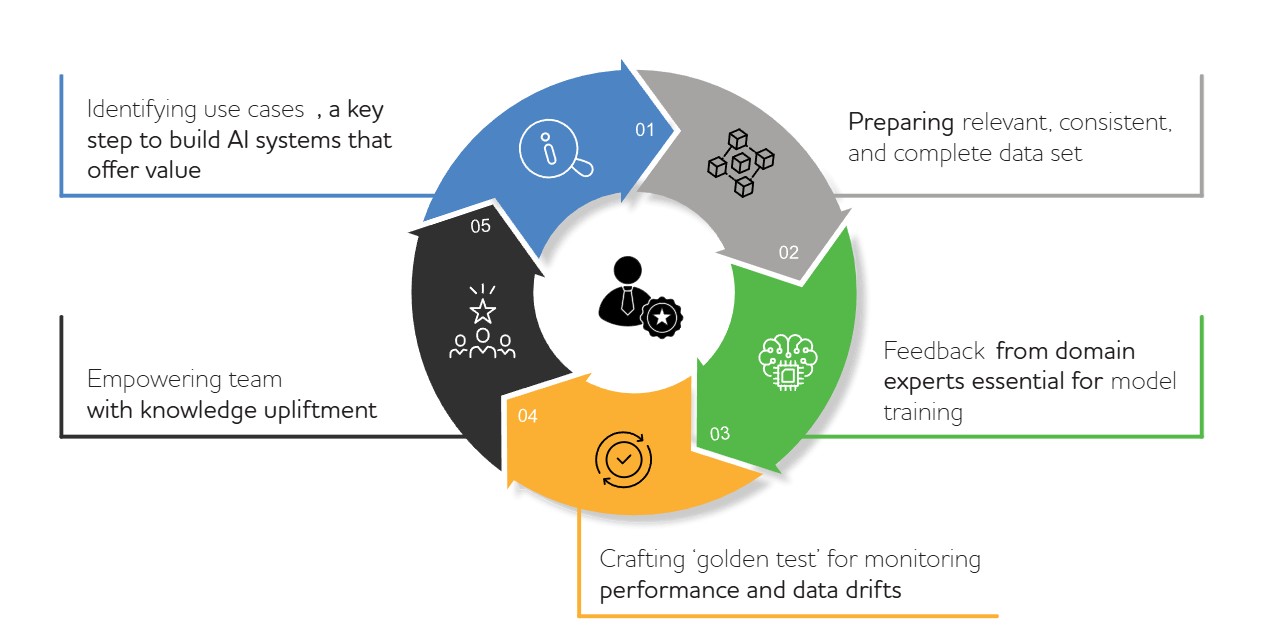
Figure 2
Domain expert in AI lifecycle
Figure 2
Actionable insights
Leveraging business domain knowledge throughout the AI journey, ie, right from use case identification to AI system implementation, ensures that technology delivers expected real-world insights rather than abstract results. By embedding expert judgement into AI systems designed for aircraft turnarounds, airlines and airports can translate operational nuance into optimised process flow, thus improving safety, OTP, and ultimately enhancing passenger experience. It reminds us that blending AI with domain intelligence isn’t just an upgrade; it’s the runway to the future of aviation.