Industry
Travel and Logistics

Data and AI in Travel Industry for a Memorable Passenger Experience
Highlights
- Airline performance is increasingly shaped by decision quality, as artificial intelligence (AI), data abundance, and operational volatility compress timeframes and raise the cost of suboptimal choices.
- The industry must move from using AI only to inform decisions towards designing AI‑enabled decision environments that structure options, expose trade-offs, and preserve accountable human judgement.
- The most material outcomes—network resilience, revenue protection, customer trust, safety, and compliance—are determined where enterprise trade-offs are made in real time.
- Intelligent decision environments provide airlines with a practical path to scale consistent, explainable, and governed decision‑making across operations, traveller experience, retailing, cybersecurity, and the airline ecosystem.
On this page
On this pageinpage
Decision quality: The airline industry's new strategic advantage
Airline leaders operate in an environment defined by an overabundance of data, advanced analytics, and accelerating adoption of artificial intelligence (AI) technologies. These capabilities have expanded the scope, speed, and reach of decision-making across the enterprise. As operational and commercial complexity increases, the defining constraint has shifted from manual access to disparate sources of information to the ability of humans, supported by machines, to make unbiased, prescriptive, defensible choices—and superior decisions—under pressure.
To meet this challenge, airlines must move beyond deploying analytics to deliberately designing embedded AI‑driven decision environments across the industry and its ecosystem. An intelligent decision environment is a deliberately designed system that supports leaders at the exact moments decisions must be made. These environments anticipate decision points, present a relevant, consumable set of viable options, and make the consequences of each option explicit. Data, AI models, governance, and decision interfaces work together so that choices are framed clearly, trade‑offs are visible, and judgement—human or automated—can be exercised confidently under pressure.
Unlike traditional decision support or risk analysis that focuses on isolated optimisation or retrospective review, intelligent decision environments are designed to operate under speed, uncertainty, and interdependence. As AI accelerates decision velocity and irreversibility, the ability to design human-in-the-loop decisions at scale becomes a primary source of advantage for airlines. Figure 1 provides a comparison between a traditional airline operating model and AI-driven decision-led operating model in the airline industry.
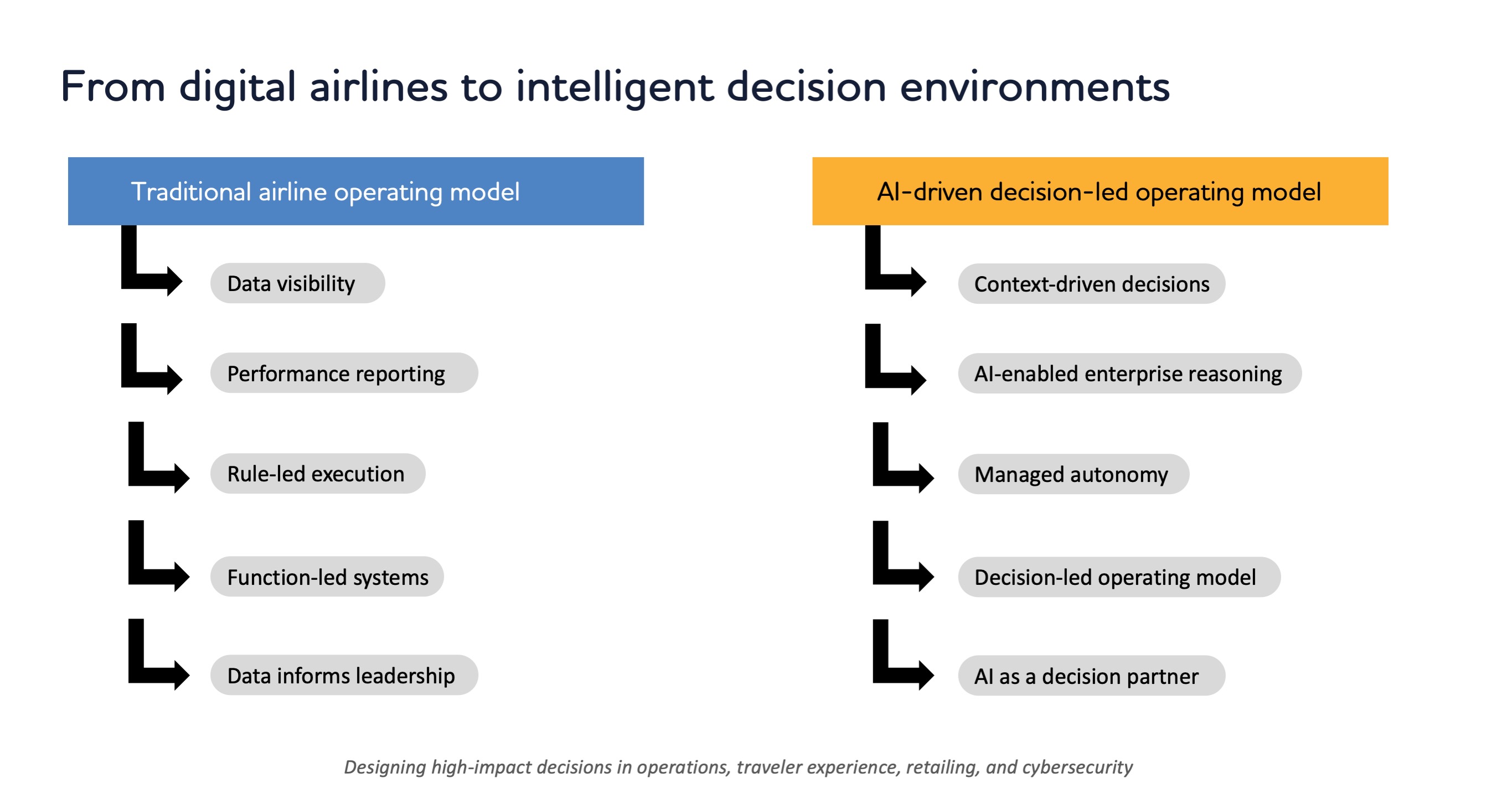
Figure 1
Intelligent decision environment in the airline industry
Figure 1
Leadership decisions now span multiple dimensions simultaneously—passenger experience, operations, revenue, safety, and security. A single intervention during disruption recovery can impact network resilience, traveller trust, regulatory exposure, and long-term profitability at the same time. Effective leadership and organisational resilience increasingly depend on assessing these factors together rather than optimising them independently. Industry research shows that passenger expectations are shifting rapidly toward seamless, personalised, and predictable journeys, requiring airlines to integrate operational, commercial, and customer decisions rather than manage them in isolation. Airline operations have become time-compressed, highly interconnected, and increasingly irreversible. Once actions such as flight cancellations, crew reassignments, or customer reaccommodation are set in motion, reversing them can amplify disruption, cost, and customer impact.
Decisions are frequently made with incomplete information and understanding of how consequences will unfold across operations, the partner ecosystem, customers, and revenue. At the same time, AI systems are generating options, forecasts, and recommendations at unprecedented speed. Leaders must evaluate implications rapidly, often faster than conventional decision processes are designed to support.
As a result, competitive advantage in aviation is increasingly defined by how ecosystem-wide decision-making is designed and governed. With the global AI in aviation market projected to grow at nearly 20% CAGR over the next decade according to industry research, success will depend less on adopting analytics and more on how effectively airlines embed and oversee AI‑supported decisions.
When speed and complexity exceed what any individual or team can reasonably manage, airlines outperform only when they do something different. They must invest in dynamic decision environments that clarify the available options to eliminate human bias, make trade‑offs explicit, and ensure that accountability stays with human leaders—even as AI accelerates the process.
Industry developments are reinforcing this trajectory. Industry-wide transformation initiatives across modern airline retailing, intelligent airline operations, cybersecurity, and traveller experience increasingly focus on shared decision interfaces rather than on optimising isolated systems. In this scenario, performance will be shaped by embedded, scalable decision frameworks that operate cohesively across platforms, partners, and enterprise boundaries.
Traditional operating models no longer support modern decisioning
The challenges airlines face today are structural rather than technological. Traditional operating models were designed for lower volumes of choice, slower feedback cycles, and clearer functional boundaries than today’s environment demands.
Despite broad leadership commitment—83% of airlines prioritise data‑driven decision‑making—airline operating models remain misaligned with the speed, scale, and interconnectedness of modern decisions. Decision‑making remains fragmented across functions in airline organisations and within the airline partner ecosystem, with each optimising competing objectives.
During disruption, the perspectives of each function converge without being integrated. Operations may propose cancellations to stabilise the network. Commercial leaders may prioritise protecting high-value customers or minimising revenue loss on key routes. Customer teams may recommend costly reaccommodation strategies. In practice, many of these decisions are taken or executed by frontline staff under time pressure, with limited visibility into broader enterprise trade-offs, further amplifying fragmentation. Across the partner ecosystem, decisions remain fragmented, with airports, handlers, and partners optimising local priorities rather than coordinated outcomes. These inputs surface as parallel positions rather than coherent enterprise‑level or ecosystem-wide alternatives. Even as AI adoption grows across operational functions and the airline ecosystem, fragmented decision ownership continues to force senior leaders into manual reconciliation under extreme time pressure. A United Kingdom (UK)-based carrier addressed the challenge of fragmented decision ownership with a unified data ecosystem that enables faster, data-driven decision-making (see Figure 2).
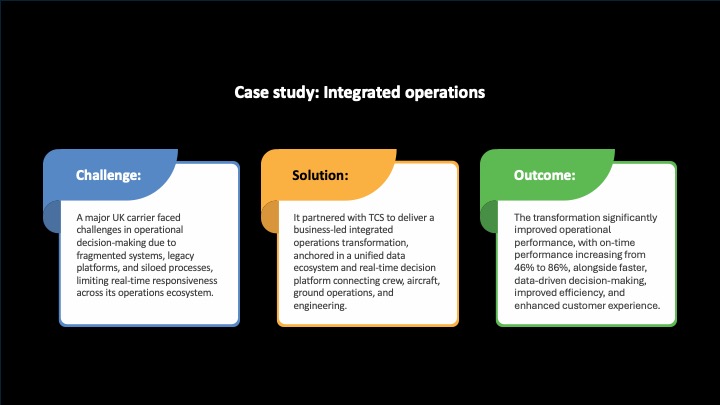
Figure 2
A unified data ecosystem for faster decision-making
Figure 2
Recurring disruption has turned airline operations into a continuously adaptive system, with weather volatility, crew availability, infrastructure constraints, airspace restrictions, and fuel price shocks often escalating at once. While analytics improve visibility, decision tools still only describe conditions instead of translating them into clear, comparable trade‑offs across cost, recovery time, customer impact, crew legality, and network effects.
Modern airline operations also extend across a complex ecosystem that includes airports, alliance partners, ground handlers, distribution platforms, payment providers, and technology vendors. Industry research shows, as order-based retailing and interconnected systems expand, the risk of value leakage increases when operational and commercial decisions are not aligned—making coordinated decision-making, rather than technology limitations alone, the critical factor.
As disruption becomes constant and AI shifts from being an adviser to an architect, shared decision design across operations, retailing, cybersecurity, and traveller experience is becoming a core source of airline resilience and advantage.
How airlines can design intelligent decision environments
Unlike traditional tools that seek a single answer, intelligent decision environments enhance human judgement by framing and comparing clear, accountable choices. Leaders can gain visibility into what each option delivers, the risk involved, and what it sacrifices. Over time, these environments create AI and human learning loops that connect decisions to outcomes. AI becomes a mechanism for structuring and scaling judgement rather than replacing it. However, adaptive decision‑making is only effective when it is grounded in robust operational foundations—reliable data, stable core systems, explicit decision rights, and well‑tested contingency logic.
The following four areas in the airline industry have decision environments with the greatest impact.
Airlines that use AI to anticipate customer needs and dynamically manage journeys consistently outperform those that rely on static recovery rules and manual intervention. What makes the difference is not automation alone, but clear, explainable decision frameworks. These frameworks help leaders deliver more consistent service recovery, fairer reaccommodation decisions, and better timed communications—strengthening trust at moments when travellers are most vulnerable.
Leading airlines now use AI to recommend default operational actions during disruptions, allowing leaders to intervene strategically instead of taking decisions under extreme time pressure. Operations leaders can benefit from continuous, explainable choices that connect constraints with downstream consequences. Decision environments have the potential to enable dynamic shaping of outcomes, allowing leaders to design operational responses rather than select from static plans. For example, the UK-based airline mentioned earlier is bringing agility and insights to its revenue management processes with a unified, API-led decision ecosystem (see Figure 3).
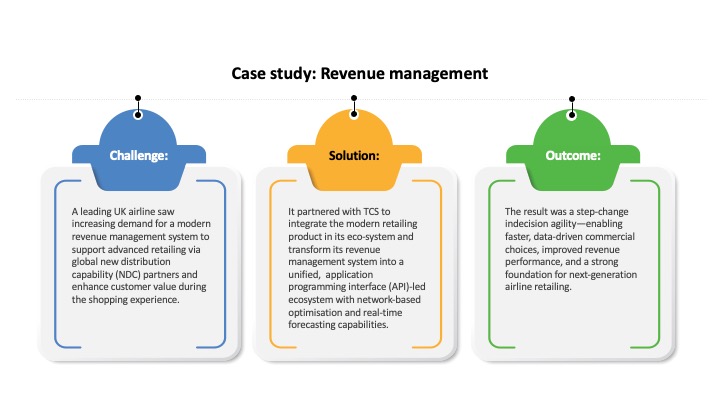
Figure 3
AI-enabled agility in revenue management
Figure 3
Airline retail transformation is ultimately about better decisions. Success depends on an airline’s ability to generate and coordinate alternative offer strategies across pricing, fulfilment, servicing, and settlement—while balancing personalisation with operational viability at scale. Industry estimates suggest modern airline retailing can unlock tens of billions of dollars in annual value through personalised offers and simplified purchase decisions, making decision design a primary commercial performance lever.
As connectivity expands, trust becomes a strategic variable. In cybersecurity, intelligent decision environments make trade offs visible. They clarify who has the authority to decide and help leaders balance protection, performance, and access as deliberate, accountable choices rather than implicit compromises. As airline operations become more digitally interconnected, cyber resilience is no longer determined by an airline’s internal controls alone, but by decisions made across a broad network of technology providers, partners, and customers.
Building durable decision advantage: An adoption road map
Airlines must design decision environments that scale with operational complexity and remain resilient over time. Well‑designed decision environments deliver not only faster disruption response, but clearer accountability, stronger governance, and more consistent outcomes for customers, regulators, and partners. Figure 4 illustrates the three phases of the intelligent decision adoption road map for airlines.
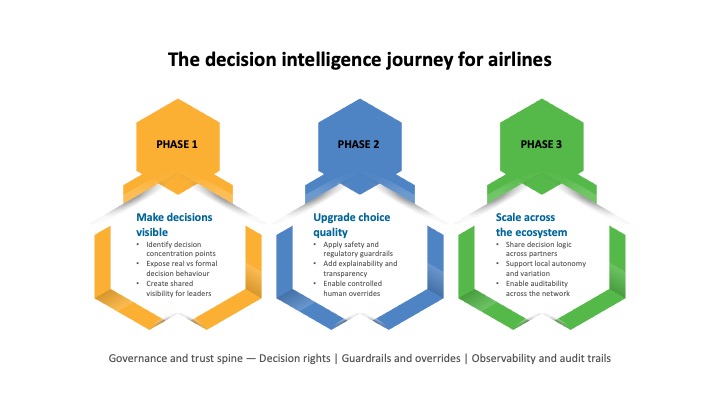
Figure 4
Intelligent decision adoption road map for airlines
Figure 4
The starting point is visibility into where high‑impact decisions actually occur, many of which are informal, distributed, or embedded across systems. This shared visibility allows leaders to understand how decisions are made and where they have the greatest enterprise impact.
In airlines, this exposes how schedule recovery, fleet assignment, pricing, disruption handling, and security responses are decided. This visibility clarifies decision ownership, reduces escalation and rework, and strengthens auditability. Risk, safety, and compliance functions gain earlier line‑of‑sight into consequential decisions, improving regulatory defensibility while avoiding retrospective intervention.
With decision points established, AI enhances the quality of choices presented. Flexibility at this stage must not come at the expense of operational discipline or safety. Effective decision environments embed safety rules, certification constraints, and regulatory obligations directly into option generation, ensuring that all recommended choices remain operationally sound and compliant. Predictive models and simulations generate alternative scenarios under varying constraints. Explainable AI clarifies underlying assumptions. Generative AI (GenAI) synthesises perspectives across operations, revenue, customer experience, and risk into enterprise‑level options. Leaders can select from among clearly articulated alternatives rather than reconciling fragmented inputs. For airlines, this enables clearer trade-offs among on‑time performance, yield, customer recovery, crew legality, and cost under volatile demand and operational disruptions. Higher‑quality choices improve passenger outcomes during disruption while making risk and compliance explicit, reducing sub‑optimal decisions under pressure.
In the final stage, decision logic scales across systems and partners through embedded, auditable frameworks that govern offers, servicing, and settlement. Shared decision logic enables coordination across airports, partners, and regulators—unlocking ecosystem‑wide value while preserving accountability and local autonomy. Flexibility only works when frontline staff and partners trust and adopt it. Transparent decision logic, clear override mechanisms, and shared participation in decision design are critical to embedding these environments into day‑to‑day operations.
At scale, decision environments enable a cultural shift for airlines—from individual heroics to repeatable, explainable judgement. Success depends on standardising decision principles, building decision literacy across functions, and aligning incentives to enterprise outcomes, improving resilience for partners, regulators, and customers.
Turning intelligent decisions into sustained airline performance
Future airline performance will be defined by decision environments. By deliberately designing how decisions are structured, compared, and governed across operations, traveller experience, retailing, and cybersecurity, airline leaders can convert complexity and uncertainty into sustained strategic advantage. Competitive differentiation increasingly depends on how choices are made, not simply on data availability. In practice, progress starts with focus—understanding where the most consequential decisions sit today, improving how those choices are framed and evaluated, and gradually extending consistent decision logic across functions and partners. Many airlines can begin by addressing a small number of disruption‑, risk‑, or customer‑critical decisions before scaling more broadly.
As operating conditions continue to intensify, airlines that invest in decision design alongside technology adoption are more likely to build resilience, maintain trust, and translate intelligence into sustained performance over time.