Industry
Travel and Logistics

Data and AI in Travel Industry for a Memorable Passenger Experience
Highlights
- In the travel, transportation, and hospitality (TTH) sector, data remains scattered and in silos across traveling and tourism platforms and hotels, posing integration challenges and obstructing hassle-free travel experiences.
- Seasonal volatility, sudden weather disruptions, operational failures, and geopolitical events further complicate dynamic market behaviour, making demand estimation and service optimisation even more complex.
- Additionally, data privacy concerns are at a peak, presenting significant regulatory hurdles and ethical dilemmas for market players. Eco-friendly initiatives are also lagging, making sustainable innovation in business operations a key requirement.
- Incorporating artificial intelligence in business operations is becoming crucial to staying competitive and meeting dynamic customer needs. AI helps streamline operations, enhance customer engagement, and drive sustainable growth.
- A responsible AI-driven framework that integrates privacy-by-design governance with sustainable, intelligent automation, and enables regulatory compliance, ethical data usage, carbon-aware optimisation, and operational efficiency, therefore, becomes critical for success.
On this page
Current AI trends
Businesses are integrating artificial intelligence (AI) into their operations.
They are doing this to provide superior experiences in the travel, transportation, and hospitality (TTH) sector through bespoke guidance, smart itinerary management with on-demand travel aid, boosted productivity, greater availability, and by pioneering breakthrough.
Intelligent itinerary creation, dynamic offers, and real-time re-planning–AI enables hyper-personalised travel experiences. Conversational agents act as 24/7 concierges, simplifying booking and support. Predictive analytics optimise next-best offers, while personalisation extends to on-property experiences in hotels and resorts. Data-driven insights enhance customer engagement, loyalty, and satisfaction.
Airlines today use AI to optimise flight routes and enhance operational efficiency by analysing real-time data such as weather, wind speed, and air traffic. For instance, for a flight from say Delhi to London, AI systems determine the most fuel-efficient route and ideal cruising altitude, helping reduce travel time and fuel consumption. Advanced capabilities like granular demand forecasting and reinforcement learning enable dynamic route adjustments for fuel efficiency and reduced travel time. On the ground, real-time personalisation improves gate assignments and passenger flow, and integrated operational dashboards provide holistic visibility into fleet performance, maintenance needs, and scheduling. This intelligent, data-driven approach is transforming air travel into a faster, safer, and more sustainable experience.
AI systems analyse real-time data such as demand, season, competitor prices, and local events to automatically adjust rates and maximise revenue. For example, when a traveller searches for a hotel during a popular festival, the system detects high demand and slightly increases room rates. Conversely, it lowers prices on less busy days to attract more guests. Competitive intelligence automation ensures real-time responsiveness to market shifts, enabling dynamic strategies that benefit both consumers through timely offers and providers through optimised pricing.
AI trends causing disruptions
Emerging AI trends are actively disrupting conventional frameworks, even as they maturing and scaling towards global adoption.
The following trends are experiencing significant growth, with pioneers poised to adopt them within the next 3-5 years:
AI enables carbon-aware route optimisation and energy-efficient smart infrastructure, reducing emissions and resource consumption. It powers eco-personalised travel recommendations and dynamic eco-pricing to promote sustainable choices. With real-time waste management and green sentiment analysis, AI helps providers align operations with environmental goals and traveller values (see Figure 1).
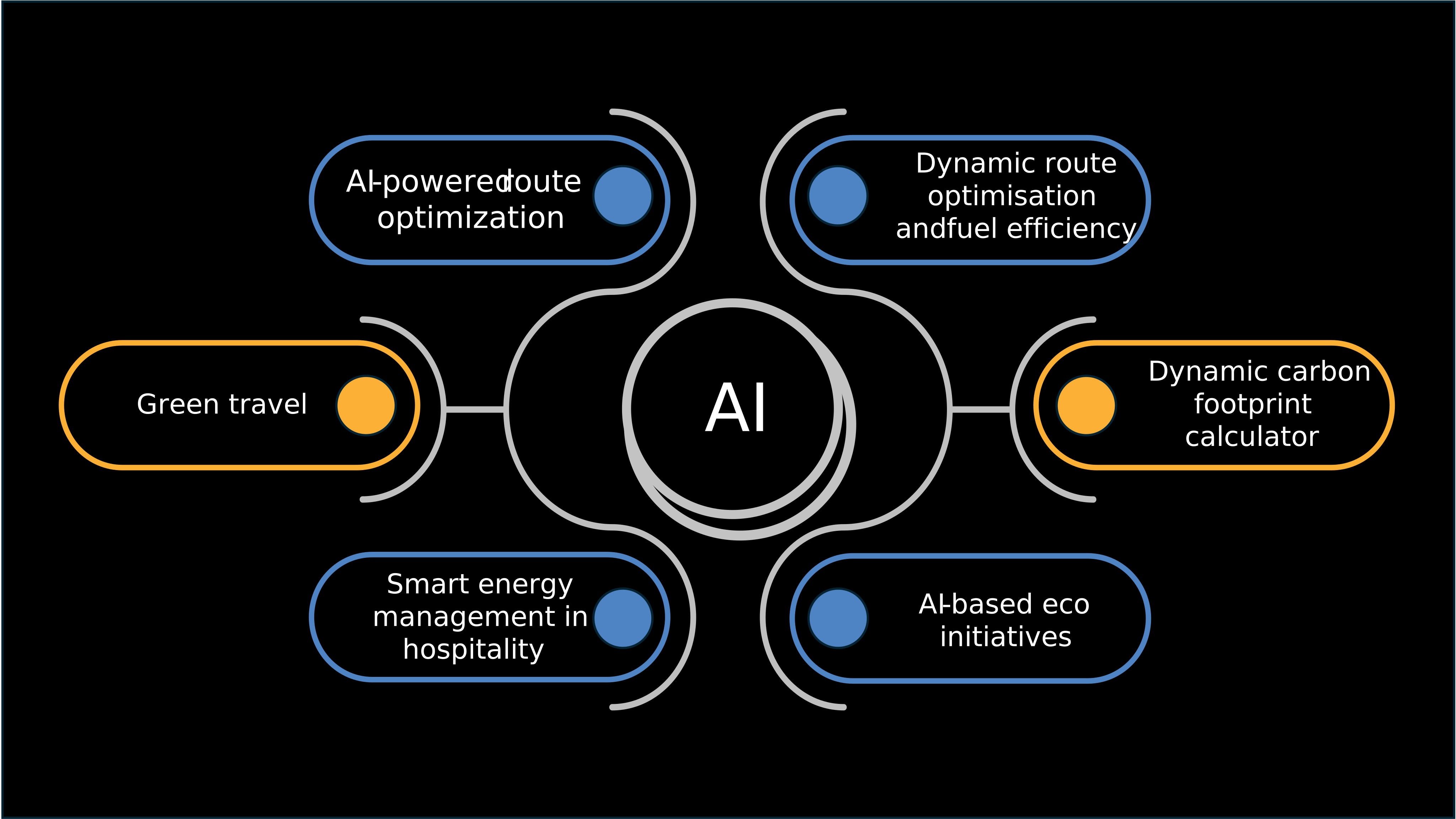
Figure 1
AI-powered sustainability and green travel
Figure 1
AI-powered systems are transforming travel by analysing visuals and spotting critical details much faster than manual controllers. They are streamlining airport security, making processes quicker and effective. From automated threat detection in airport security using computer vision to predictive maintenance and smart gate allocation, AI-IoT systems enhance safety, efficiency, and passenger experience. These intelligent ecosystems also support energy optimisation, crowd flow management, and contactless services, driving sustainability and operational excellence across travel and hospitality.
AI personalises virtual travel previews by adapting immersive content to user preferences and behaviours in real time. It also uses emotion recognition and scene generation to create engaging, responsive simulations that elevate pre-travel decision-making.
Intelligent journeys
AI is poised to revolutionise the TTH sector over the next decade through enhanced booking efficiency, proactive maintenance, and adaptive route adjustments.
Quantum AI that offers hyper-personalised experiences, edge AI and digital twins that optimise logistics, and autonomous systems that drive down operational costs will set new industry benchmarks.
Quantum AI agents analyse complex emotional, behavioural, and contextual data to instantly generate hyper-personalised travel plans across millions of scenarios. Enhanced by advanced natural language processing (NLP) and gesture-based conversational AI, they enable intuitive, real-time planning aligned with travellers’ moods, preferences, and situational factors.
AI-powered digital twins simulate real-time traveller profiles, enabling hyper-personalised services like smart room settings, biometric check-ins, and predictive transport coordination. By integrating IoT and behavioural data, they optimise guest experiences and support sustainable, efficient travel ecosystems.
Edge AI enables real-time decision-making in autonomous vehicles by processing sensor data locally for efficient route planning, object detection, and adaptive navigation. It supports self-sufficient, low-latency electric mobility networks, reducing carbon emissions and enhancing sustainability without relying on cloud infrastructure.
AI-powered hyperloop pods enable ultra-fast, autonomous travel with real-time route optimisation and minimal wait times for enhanced efficiency. Integrated AI systems personalise onboard environments and support eco-friendly operations, redefining long-distance mobility in a sustainable way.
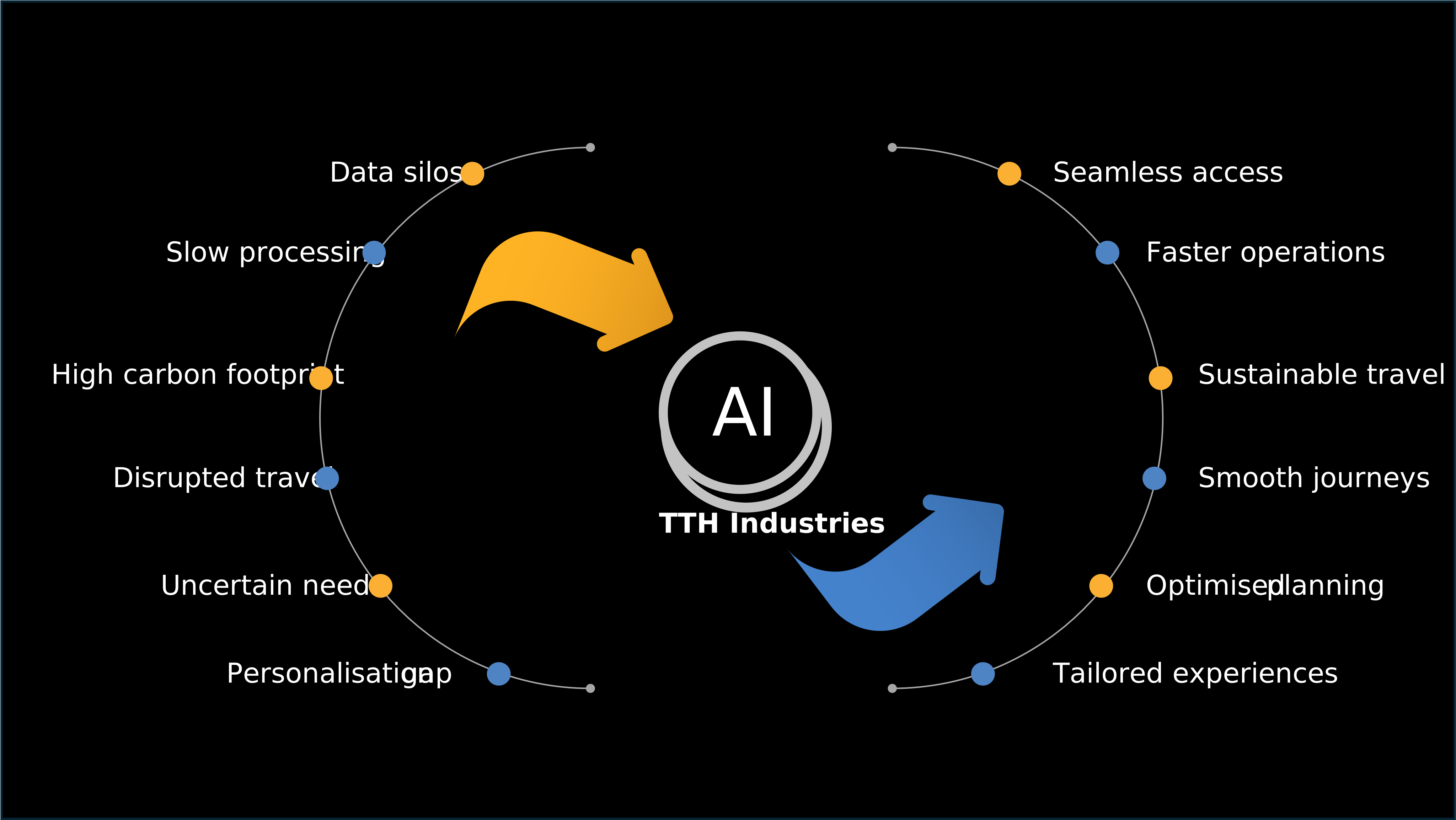
Figure 2
Turning gaps into gains
Figure 2
Agentic AI is more than a smarter system—it’s a self-directed digital worker that enhances existing technologies by bringing autonomy, adaptability, and strategic reasoning to TTH operations. Unlike systems that merely simulate or process, agentic AI acts independently, making decisions across multi-step tasks (eg, rebooking travel during disruptions) without human input. These agents leverage long-term memory, external tools, and application programming interfaces (APIs) to learn and evolve, collaborate with humans or other agents, and dynamically reason through complex scenarios—transforming how TTH services are delivered.
The synergy of these advancements will transform TTH, steering it toward an AI-powered future that prioritises efficiency, customisation, and sustainability. By 2030, these innovations will establish TTH as a self-sustaining, intelligent ecosystem.
The road ahead
The path to AI-driven expansion necessitates revolutionary adjustment– integrating hyper-intelligent automation, foresightful cognition, and self-governing decision processes.
Businesses must embrace AI-centric ecosystems obliterating existing data silos and leveraging quantum speed analytics.
This strategy must be augmented with robust ethical AI governance, strict data privacy measures and unbiased decision-making. This synthesis will set off a revolution, redefining industries, transforming sectors and promoting a sustainable, self-advancing future.
Adopting AI-driven solutions is crucial to stay competitive and meeting dynamic customer needs. By incorporating AI into the business, one can streamline operations, enhance customer engagement, and drive sustainable growth. Now is the perfect time to act–harness AI to reshape your business and maintain a leading edge in the rapidly evolving TTH landscape.