Services
Industrial Autonomy & Engineering

Industrial Autonomy & Engineering: Building autonomous enterprises where intelligence is embedded directly into the value chain and operating models
Highlights
- The shift from software-defined vehicles (SDV) to AI-defined vehicles (AIDV) demands intelligence that learns and evolves continuously, overcoming today’s fragmented, pilot-level implementations that fail at scale.
- Three forces, rising consumer expectations, escalating regulatory demands, and a technology inflexion point, are making SDVs unavoidable. Yet only a unified architecture and operating model can deliver safe speed, sustainable compliance, and scalable AI-driven innovation across the vehicle lifecycle.
- Automotive players must embed intelligence at every stage and actively orchestrate the ecosystem so all pillars work in sync. A 360-degree engineering view across the full lifecycle drives agility, efficiency, and continuous innovation.
On this page
Why is the industry moving from software-defined vehicles to AI-defined vehicles?
The mobility industry is building on SDV foundations to enter the era of AIDV, in which intelligence becomes the core of mobility. Vehicles are no longer limited to sensing, perceiving, deciding and acting. They are expected to continuously learn, adapt, and evolve through closed learning loops that enhance safety, performance, and user experience over time.
AIDV does not replace SDV; it builds on SDV by adding AI-driven learning, reasoning, and adaptation across the vehicle lifecycle. This makes vehicles faster to develop, more personalised for users and capable of continuous learning across real-world conditions and lifecycle stages.
SDVs have been instrumental in driving the software-led transformation of mobility. The next phase of innovation builds on this foundation by enabling intelligence to operate seamlessly across vehicles, infrastructure, and the broader mobility ecosystem. This shift represents a fundamental re-architecture of how vehicles are designed, engineered, operated, and evolved.
While the enabling technologies are now mature, realising their value at scale requires a fundamental rethink of vehicle architecture and engineering models. Three forces are converging, making AIDV unavoidable.
Consumer expectations have reset: Vehicles are now judged as digital products. Customers expect intelligence that improves over time through continuous updates, personalisation, enhanced performance, predictive maintenance and seamless digital experiences. Vehicle-generated data further enhances performance by guiding drivers toward better efficiency and helping R&D teams design smarter vehicles.
Regulatory complexity has crossed a threshold. Cybersecurity, over-the-air (OTA) updates, functional safety, and multi-region compliance demand system-level visibility and control across the full vehicle lifecycle.
Technology has reached a clear inflexion point. Centralised compute, high-speed networks, virtualisation and AI are now production-ready, but only when engineered into the vehicle architecture.
Massive investments in SDV programs now demand tangible returns. However, vehicle re-architecture, while non-negotiable, remains largely invisible to customers and often uncompensated. Yet it is the foundation that enables fast, stable updates, lifecycle compliance, scalable AI, and continuous feature evolution. The right architecture shifts development from multi-year release cycles to continuous delivery, enabling automakers to balance speed, safety, rich user experiences, and affordability.
At the heart of AIDV are physical AI and agentic AI. Together, they enable vehicles to understand their environment, make intelligent decisions, and continuously learn and adapt from real-world experiences.
Across the industry, SDV initiatives are delivering impressive demonstrations. But when these capabilities move from pilots to production fleets, complexity multiplies, costs rise, and progress slows. The challenge is aligning architecture, integration, and execution into a coherent system. Without this shift, intelligence remains fragmented, working in isolation but failing at scale in the real world.
How are AI-defined vehicles transforming mobility across segments?
As software-defined architectures mature, every mobility segment, from passenger vehicles to commercial vehicles, two-wheelers and agricultural and off-road machinery, is leveraging intelligence in ways that address its unique operational challenges and business outcomes.
In passenger vehicles, the focus is on creating a more connected, comfortable, and personalised driving experience. SDV enables seamless updates and digital features, while AI continuously learns from data to improve safety, performance, comfort, and personalisation.
In commercial vehicles, the priority is to keep fleets moving efficiently with higher uptime. SDV enables real-time visibility, predictive maintenance, and smarter diagnostics, while AI helps fleets learn from operational data to improve reliability, optimise maintenance, and enhance performance over time.
For two-wheelers, SDV is making every day rides smarter, safer, and more connected. Features such as OTA updates, rider assistance, theft protection, and mobile-integrated services are becoming increasingly common. At the same time, AI personalises rider experiences, enhances safety, and optimises energy usage based on real-world riding patterns.
In tractors and off-road vehicles, SDV is unlocking new levels of productivity and efficiency. Powerful computing platforms enable autonomous operations, precision farming, and advanced geospatial insights, while AI helps machines learn from field conditions, historical data, and operating environments to improve performance and decision-making continuously.
The next leap in mobility will not be defined by how much software a vehicle runs, but by how intelligently it learns, reasons, and evolves, marking the evolution of SDV into AIDV through AI-driven intelligence.
What does it take to transition from software-defined vehicles to AI-defined vehicles?
The shift from SDV to AIDV needs more than advanced software capability. It requires innovative software minds to work closely with legacy-domain small and medium-sized enterprises (SMEs) that understand vehicle systems, engineering constraints, safety, and lifecycle complexity. By combining this deep automotive expertise with agile software and AI capabilities, original equipment manufacturers (OEMs) can build scalable, intelligent, and continuously evolving vehicle ecosystems.
AIDV is not simply the next evolution of SDV; it is the effective utilisation of SDV through AI across both vehicle development and vehicle operation. Leading global OEMs are increasingly applying AI across three key dimensions: accelerating engineering and business processes, transforming software development and validation, and delivering more personalised customer experiences. Agentic AI is helping automate engineering workflows, improve software quality, and accelerate development across the software lifecycle. Mobility-specific small language models (SLMs) and fine-tuned large language models (LLMs) provide deeper vehicle-domain intelligence, enabling AI systems to understand engineering context better and accelerate decision-making. At the same time, Physical AI enables software within the vehicle to continuously learn from real-world conditions, helping systems become more adaptive, intelligent, and capable over time. Together, these capabilities are enabling vehicles to become faster to develop, more personalised, self-learning, and continuously evolving throughout their lifecycle.
New-age OEMs are accelerating SDV adoption by vertically integrating critical parts of the stack - from batteries and chips to vehicle operating systems and centralised electrical and electronic architectures - while embedding AI across the full lifecycle of design, manufacturing, and intelligent driving systems. AI-driven virtual prototyping, crash simulations, and virtual wind tunnels are helping to reduce physical iterations and accelerate development. At the same time, software-hardware decoupling, OTA-ready architectures, and modular vehicle platforms are enabling faster feature rollouts, future upgrades, and scalable innovation across vehicle lines. This platform-centric, AI-first approach is becoming a defining enabler of speed, scalability, and product differentiation, while strengthening OEM control over the end-to-end technology stack.
Many legacy OEMs remain caught between models: moving too fast destabilises ecosystems, while moving too slowly compounds complexity. This is not a short-term problem. It reflects a far-reaching industry transition that requires new ways of designing, building, and orchestrating complexity, not just adding more software. As the industry moves toward AI-defined vehicles, success will depend on turning intelligence into clear customer value, faster development, and quicker product innovation.
What are the building blocks of AIDV?
At TCS, intelligence emerges when multiple engineering disciplines operate as one. AIDV is a system-level transformation that combines human expertise with AI to accelerate the industry’s evolution, stitching infrastructure to intelligence by connecting foundational engineering, platforms, and processes to enable smarter, more adaptive vehicles.
We see AIDV as a six-pillar structure like a vehicle chassis. Remove one pillar, and the system may appear functional, but it will not hold at scale.
- It begins with domain engineering, such as autonomous driving and advanced driver assistance systems (ADAS), EVs, chassis, powertrain, and cloud-connected vehicle behaviour, grounding intelligence in physical and regulatory reality.
- Platform engineering is the control layer, encompassing vehicle OS, middleware, cybersecurity and diagnostics, where reuse, governance and long-term economics are established.
- Platform decisions shape hardware engineering. High-performance computing (HPC), sensors, and networks must be designed with future software needs in mind, ensuring the hardware remains upgradeable and ready to support evolving vehicle intelligence.
- As complexity rises, design and simulation engineering enable virtual validation, styling integration, and cost optimisation, resolving issues early.
- Across all this sits compliance and process engineering, leveraging various standards and methodologies such as automotive software process improvement and capability determination (ASPICE), functional safety, model-based system engineering (MBSE), virtualisation, which are embedded to enable trust without freezing evolution.
- Finally, AI engineering acts as an amplifier, infused across both the development lifecycle and into the vehicle product itself. Without context and governance, AI magnifies inconsistency rather than intelligence. Engineering AI into every stage of product development enables scalable, resilient, and future-ready systems.
These pillars reinforce one another. Together, they form the structural backbone of AIDV.
Delivering this system requires orchestration across an ecosystem, i.e., academia for talent, semiconductor partners for compute alignment, hyperscalers for data and AI infrastructure, and product owners for lifecycle value. For example, advisory-led integrators often help architect learning loops, platform governance, and supplier alignment without owning every component.
Success in AIDV demands that industry leaders architect the system, infuse intelligence at every stage of operations, and orchestrate the ecosystem, ensuring all pillars work together rather than attempting to build every component in isolation.
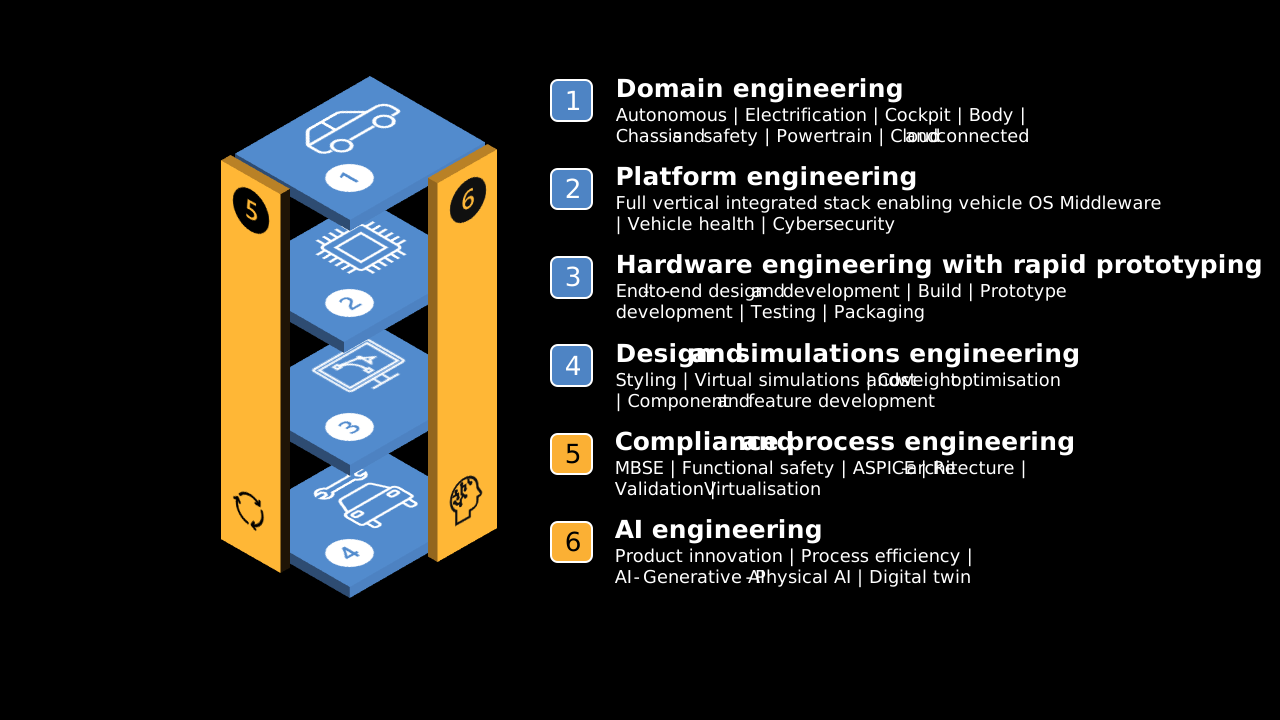
Integrated engineering approach
Integrated engineering approach
Key considerations:
AI should shorten the architecture, development, validation, and operations cycles rather than serving only as a feature enabler. It needs to be embedded from concept through production and post-sales, with feedback loops added at every stage to drive ongoing improvements in design and process efficiency.
Integration, safety, cost, and scalability must be addressed at design time, not discovered late.
Designing the system matters more than optimising components.
Leverage ready-to-use agents and own the platform customisations, integration logic, and learning loops.
Safety must enable learning, not freeze systems in time. AIDV leadership is no longer about adding software. It is about designing the system early so that intelligence can scale safely, quickly, and affordably, through multi-party collaboration and accountable governance.
What should automakers prioritise when scaling AI-defined vehicles?
AIDV is more than a technology shift; it redefines how intelligence is built across the vehicle lifecycle. It is not just a software challenge but also a design and orchestration challenge. Organisations that invest early in architecture, integration, and lifecycle thinking will scale their capabilities faster than their complexity.
AIDV leaders will stand out for how well they bring together people, technology, and ecosystems. The real differentiation will come from seamlessly integrating human intelligence with AI across engineering, platforms, data, and partner networks, enabling vehicles to learn, improve, and evolve throughout their lifecycle continuously.