Services
Industrial Autonomy & Engineering

Industrial Autonomy & Engineering: Building autonomous enterprises where intelligence is embedded directly into the value chain and operating models
Highlights
- Asset Performance Management (APM) delivers the greatest value when asset insights are connected directly to maintenance execution, operational decisions, and continuous field learning.
- Trusted asset data is the foundation for accurate analytics, predictive maintenance, and AI-enabled decision-making.
- Closed-loop APM links asset strategy, risk insights, human-approved actions, work execution, and feedback to drive continuous reliability improvement.
- AI can identify emerging asset risks and recommend actions, while engineers and operators maintain oversight of critical decisions.
- Organisations should start with a clearly defined reliability challenge, demonstrate measurable business value, and then scale successful use cases across assets and sites.
On this page
On this pageinpage
How does asset performance management improve asset reliability?
Asset Performance Management (APM) helps organisations improve reliability by turning asset data into informed maintenance and operational decisions. Yet many organisations still struggle to translate asset insights into timely action. A closed-loop APM approach addresses this challenge by connecting asset strategy, trusted data, AI-enabled insights, engineering reviews, work execution, and field feedback. This enables asset-intensive industries like utilities, oil and gas, manufacturing, transport, and others, to identify risks earlier, reduce unplanned downtime, optimise maintenance costs, and extend asset life.
Why is closed-loop APM becoming a business priority for asset-intensive organisations?
Asset-intensive organisations face growing pressure to improve reliability while controlling maintenance costs, operational risk, safety, and asset life. Ageing infrastructure, increasingly connected equipment, and fragmented data across enterprise asset management (EAM), supervisory control and data acquisition (SCADA), historians, inspection records, and engineering systems make consistent asset decisions difficult.
Many APM initiatives successfully identify asset risks but fail to connect those insights with maintenance planning and field execution. Incomplete asset data, inconsistent failure history, limited user trust, and weak field feedback further reduce their value. As a result, risks may be identified without timely action, contributing to avoidable downtime, inefficient maintenance, production losses, and reduced asset performance.
The need is becoming more urgent as organisations pursue AI adoption, digital transformation, sustainability goals, and operational resilience while managing workforce and skills constraints. Enterprises, therefore, need a data-first, closed-loop APM approach that converts trusted insights into approved actions, captures evidence of execution, and continuously improves reliability decisions.
How can organisations implement closed-loop APM effectively?
A data-first, AI-enabled, closed-loop APM approach can help organisations connect asset insights with maintenance execution and continuous learning.
- Define the value: Prioritise business outcomes such as reduced downtime, optimised maintenance cost, lower asset risk, or extended asset life.
- Focus the scope: Select a critical asset class and a well-defined reliability problem rather than starting with a large technology rollout.
- Strengthen asset data: Connect asset hierarchy, condition, operational, maintenance, inspection, and failure data to create a trusted foundation.
- Generate trusted insights: Apply reliability engineering, analytics, AI, and digital twins to assess health, identify risks, and recommend actions.
- Connect insight to action: Integrate recommendations with enterprise asset management (EAM) and asset performance management (APM) platforms, work orders, inspections, and operational workflows. Human approval should be required before initiating actions involving safety, critical assets, significant cost, operational disruption, or high business risk. The approver should review the supporting evidence, asset criticality, recommended action, urgency, expected impact, alternatives, and remaining risk.
- Close the loop: Capture field findings and completed work to refine data, models, thresholds, and maintenance strategies.
- Scale proven value: Expand successful use cases across assets and sites using common standards, governance, and value tracking.
What Business Outcomes Can Closed-Loop APM Deliver?
A data-first, AI-enabled, closed-loop APM approach delivers value by connecting asset insights directly with maintenance and operational action.
- Improved asset reliability: Earlier identification and treatment of asset risks help reduce unplanned downtime and improve operational continuity.
- Optimised maintenance cost: Risk- and condition-based decisions reduce unnecessary maintenance while ensuring critical assets receive timely attention.
- Extended asset life: Better health visibility and targeted interventions support informed repair, replacement, and lifecycle decisions.
- Reduced operational risk: Trusted data, traceable recommendations, and human approval improve decision confidence for critical assets.
- Higher workforce effectiveness: Prioritised insights help reliability, maintenance, operations, and field teams focus on the most important actions.
- Continuous improvement: Field findings and completed work evidence refine asset data, thresholds, models, and maintenance strategies over time.
- Scalable business value: Proven use cases can be extended across asset classes and sites using common standards, governance, and value tracking.
Together, these outcomes enable organisations to shift from reactive maintenance to a more proactive, risk-informed, and evidence-based approach to asset management.
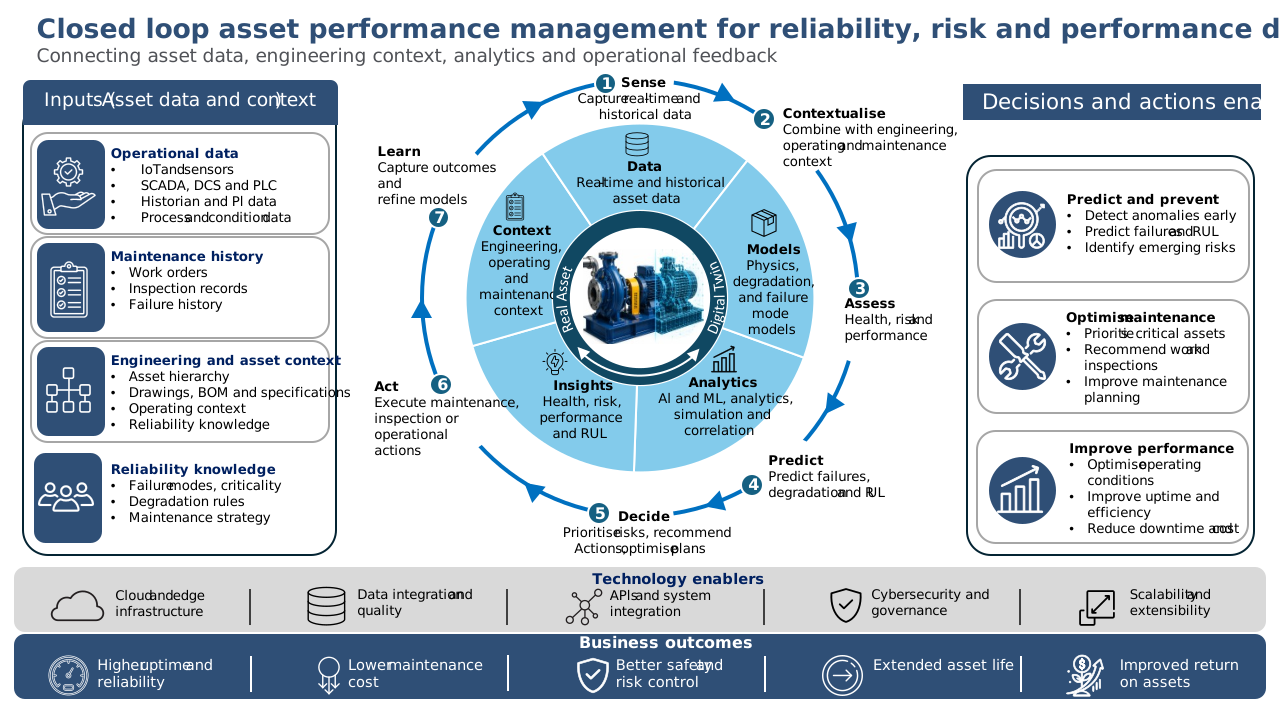
Figure 1
Closed-loop asset performance management model
Figure 1
What separates successful APM programs from technology-led initiatives?
Successful APM programs are distinguished not by the sophistication of their technology alone, but by their ability to connect insights with action. Organisations that achieve sustained reliability improvements typically combine trusted asset data, reliability engineering, operational context, AI-enabled analytics, governance, and field execution within a single operating model. Rather than pursuing disconnected technology deployments, they focus on solving clearly defined reliability challenges, demonstrating measurable value, and continuously improving decisions through operational feedback and learning. This integrated, outcome-led approach helps transform APM from a monitoring capability into a driver of long-term business performance.
What is the future of asset performance management?
The future of APM will be defined by an organisation's ability to move from prediction to coordinated action. As AI and agentic capabilities mature, organisations will increasingly automate the identification, prioritisation, and orchestration of maintenance activities. However, trusted data, robust governance, and engineering judgement will remain critical. Organisations that establish a closed-loop approach today will be better positioned to improve reliability, manage risk, and sustain asset performance at scale.