Industry
High Tech

High Tech Solutions to Drive Business Transformation through Technology
Highlights
- TCS frames the shift to AI-native business process services (BPS) as a governed climb up the Human+AI service autonomy curve— reframing swarms of agents from a leap into a credible destination reached one rung at a time.
- The target level of autonomy is set process by process, based on process nature, systems, regulation, and risk appetite — and outcomes are delivered through a mix of levers (bespoke agents, copilots, native AI, best-in-class solutions, RPA, and Systems of Record), not agents alone.
- AI-native BPS is built on reusable business capabilities — so swarms of agents become a composition of governed, reusable capabilities rather than isolated automation projects.
On this page
On this pageinpage
Why reinvent BPS
For decades, Business Process Services competed on scale. The next decade will be won on intelligence, adaptability, and trust.
For decades, BPS created value by combining process discipline, skilled talent, delivery scale, and technology enablement. That model still matters but the expectations around it have changed fundamentally. Enterprises no longer buy capacity; they buy outcomes. They want operations that respond in real time, adapt to exceptions, reduce variance, and make every decision and handoff transparent.
The strain shows in the everyday reality of operations: approval-heavy workflows, manual exception handling, knowledge locked to specific people, and cost structures that rise with volume. Adding more people no longer moves the needle the way it once did, because the constraint is no longer effort; it is intelligence, speed, and trust.
The next operating model cannot be built around human capacity alone. It must be built around intelligent orchestration, where people and machines share the work across the full process lifecycle. The journey ahead is a shift from labour-scaled operations to intelligence-scaled operations. This paper lays out how enterprises can make that shift with confidence rather than guesswork.
Human + AI journey
The path to AI-native operations is not a leap. It is a climb, and every rung pays for itself.
Before we talk about autonomous agents or swarms, we need a shared map — otherwise the future sounds like hype. TCS frames this journey through the Human + AI Service Autonomy Model, a progression that describes how the balance of decision-making shifts from people to intelligent systems, stage by stage:
- Level 1 — Tool: Humans do the work; technology assists with discrete tasks. Decision-making is around 90% human.
- Level 2 — Assistant (Copilot): AI supports the associate in real timem summarising, guiding, drafting, checking; but the human stays in control of every decision.
- Level 3 — Supervised Agent: AI executes defined workflows end-to-end within guardrails, surfacing decisions for human approval at authority boundaries.
- Level 4 — Autonomous AI Workforce: Coordinated agents run whole processes, escalating only exceptions and high-risk decisions. Humans govern rather than execute.
- Level 5 — Agentic Enterprise: Swarms of agents operate across value chains with embedded governance; decision-making is around 90% machine and 10% human — focused on judgement, trust, and accountability.
Most BPS operations today sit at Levels 1 and 2. The Swarms of Agents vision lives at Levels 4 and 5. Seeing the whole ladder matters, because it reframes the future from a bet into a destination reached one rung at a time — with value created at every rung, not only at the top.
Swarms are not where you start. They are where the climb leads.
Process autonomy
The right level of autonomy is a business decision, not a technology default.
A common mistake is to assume every process should race to full autonomy. In reality, the target autonomy level should be chosen deliberately, process by process, based on four factors:
- Nature of the process: How structured, repeatable, and rule-bound it is.
- Systems involved: The maturity, stability, and openness of the underlying platforms and Systems of Record.
- Regulatory requirements: The compliance, audit, and explainability obligations that apply.
- Risk appetite of the process owner: How much autonomy the business is comfortable delegating.
A high-volume, low-risk back-office task may run comfortably at Level 4. A regulated, high-consequence decision may deliberately be held at Level 3, with humans firmly in the approval loop — and that is a sign of good governance, not a limitation. The goal is not maximum autonomy everywhere; it is the appropriate autonomy for each process, calibrated to value and risk.
Maximum autonomy is not the goal. Appropriate autonomy is.
Copilots to swarms
The future of BPS will not be shaped by one intelligent assistant, but by many specialised agents working together, orchestrating the right blend of levers.
Copilots have already changed how associates work — guiding them through procedures, summarising information, supporting quality checks, and removing repetitive effort. But copilots improve the productivity of individuals. The next step changes how the entire process runs.
A Swarm of Agents is a coordinated network of specialised AI agents, each performing a defined role across the lifecycle — an intake agent captures requests, a classification agent routes work, a decision agent applies policy, an execution agent updates systems, a compliance agent verifies controls, an escalation agent brings humans in at authority boundaries, and a learning agent improves the system over time. Instead of automating one task at a time, swarms coordinate work across stages, systems, rules, handoffs, exceptions, and outcomes. This is the mechanism that powers the higher rungs of the autonomy curve — the shift from AI-assisted BPS to AI-native BPS.
A copilot makes a person faster. A swarm makes the process itself intelligent.
But a swarm is a coordination model, not a mandate to build an agent for everything. There is a growing risk in the market of “agent-washing” — relabelling every automation as an agent and implying that agents alone solve everything. TCS takes a more honest and more effective position: AI-native BPS is delivered through a mix of interventions, orchestrated towards an outcome. Those levers include:
- Bespoke AI agents for context-specific reasoning and orchestration.
- Copilots where human-in-the-loop productivity is the goal.
- Native AI embedded in enterprise platforms such as SAP, Salesforce, and Oracle — using the intelligence that already lives inside Systems of Record.
- Best-in-class point solutions where a proven specialist tool is the right answer.
- RPA and workflow engines for stable, high-volume, deterministic tasks.
- Maximum reuse of Systems of Record as the trusted source of data and truth.
In this model, an agent may itself be bespoke, may be native to a platform, or may act as an orchestrator that coordinates several other levers to achieve the outcome. This is what separates a durable operating model from a demo: agents are used where they add reasoning and coordination, and simpler, proven levers are used where they are more reliable, cheaper, or safer.
The measure of success is the outcome, not the number of agents deployed.
Reusable capabilities
The future of AI-native BPS will be built on reusable business capabilities, not isolated automation projects.
Rather than developing separate automation, agents, or copilots for every process, TCS takes a capability-led approach. The objective is a reusable library of business capabilities that can be composed, orchestrated, and reused across service lines and customer environments — powered by AI agents, traditional automation, workflow engines, APIs, enterprise systems, or human expertise, depending on the requirement.
This works because many BPS functions share common building blocks. Customer interaction, information understanding, work management, decision intelligence, compliance governance, enterprise knowledge, enterprise integration, and continuous improvement appear repeatedly across Finance and Accounting, Human Resources, Recruitment, Security Operations, IT Service Desk, and Customer Service.
Build these once and reuse compounds. A document-understanding capability created for invoice processing can also support recruitment screening, claims validation, compliance review, or service-desk intake. A decision-intelligence capability can serve many domains while sharing the same governance framework and orchestration model. Crucially, this is also where governance lives by design — a shared Human Control Tower oversees process health, confidence levels, exceptions, SLAs, approval gates, and compliance signals across every capability, so humans govern outcomes instead of managing each step.
In this model, Swarms of Agents become a composition of reusable capabilities rather than a collection of isolated point solutions — enabling enterprises to scale AI-native BPS faster while maintaining governance, interoperability, and continuous improvement across the value chain.
Build once. Reuse everywhere.
BPS vision 2030
By 2030, leading enterprises will measure BPS not only by cost and capacity, but by intelligence, adaptability, governance, and outcome resilience.
The 2030 vision is credible precisely because the ground beneath it is shifting fast. External forces are compounding: models are becoming dramatically more efficient, needing far less GPU memory to run; GPUs of the same power are becoming smaller and cheaper, pushing capable AI closer to where work happens; native AI is being embedded directly into the enterprise platforms operations already run on; and agentic capabilities are moving from labs into mainstream business applications. Each of these lowers the cost and raises the reach of intelligent operations — turning what looked aspirational two years ago into what is practical today, and inevitable by the end of the decade.
Follow the curve forward. In the next two years, most enterprises will move confidently into Levels 2 and 3 — copilots everywhere, supervised agents in well-understood processes, governance patterns maturing. By around four years out, reusable capabilities and discovery-led portfolios will push suitable processes to Level 4, with autonomous execution and human governance at scale. By 2030, the leaders will operate at Levels 4 and 5 across their value chains — swarms handling structured, repeatable work, and human experts governing judgement, trust, relationships, and accountability.
TCS is shaping this journey with a clear point of view: business operations that are agent-led, human-governed, platform-enabled, and outcome-accountable, industrialised through OS for Business and its Agent Marketplace. This is not a technology shift dressed up as strategy. It is a new services model for enterprises seeking speed, resilience, transparency, and scalable intelligence — a governed climb from automating tasks to reimagining how work itself runs. That is the promise of BPS 2030.
2030 is not a bet on the future. It is the arithmetic of forces already in motion.
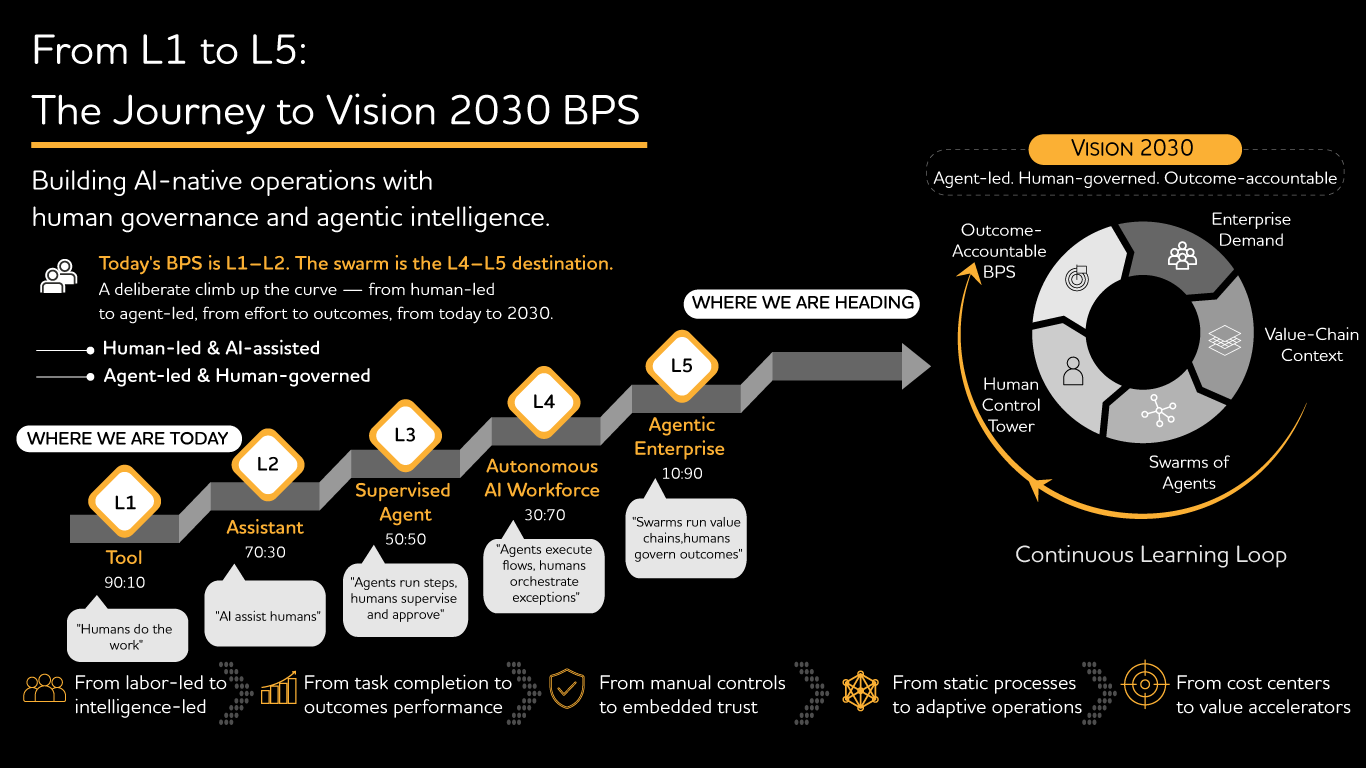
Figure 1:
BPS 2030: Building AI-native operations with swarms of agents
Figure 1: